The Magic of Using Essential Oils with Kids

You probably already know that essential oils are great for all sorts of uses to support your wellness, but there were a few surprises in store for me as I began to use essential oils with my kids.

Calming down

Look, life with young kids can be tough sometimes. Sleep deprivation, co-sleeping, nursing, hunger, teething, new developmental milestones, parental discord, sibling rivalry, and so much more can cause some seriously tense moments in any home, mine included. So sometimes we need tools to help us de-escalate.

A short sensorial meditation is a tool we use on a regular basis. We each pick an oil we like, I place one drop in the palm of one hand, we rub our hands together, and then cup our hands over our noses, close our eyes and take at least 5 deep breaths. You don’t need a fancy diffuser to enjoy essential oils, your hands can be your diffuser! Lavender, frankincense, and lemon are some of our favorite choices when we need to take a moment to breathe and calm down.

I am consistently amazed at what a difference 5 deep breaths can make to my own emotional state, and when paired with one of my favorite essential oils, this practice becomes a delightful sensorial experience, which just encourages me to drop the drama and breathe again next time.

In our house, this technique quickly helps to resolve sibling conflicts by allowing each person to take a moment to reflect on their experience. Everyone is usually calm enough after 5-10 breaths to discuss the issue further without arguing. Sometimes my kids will even offer one another empathy and listen to each other after a short meditation like this, when before hand, they were each fighting to be heard.

Diffusing for a purpose

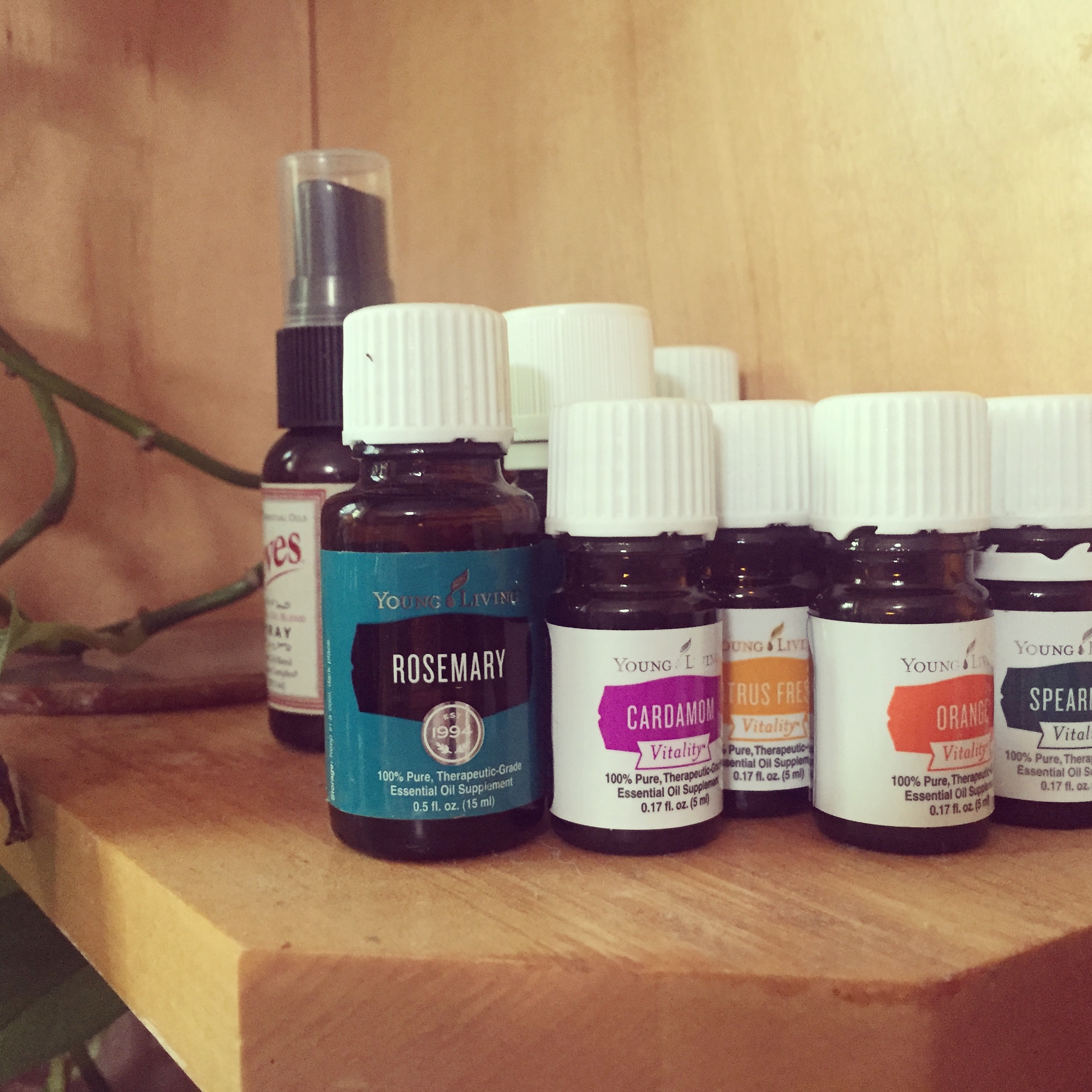
Oils can have different effects on different people, but there are some qualities of essential oils that are fairly universal so by diffusing a specific oil for a specific purpose, we may find certain oils to have an enlivening or awakening effect (Citrus), support focus and clarity (Rosemary), be calming and relaxing (Lavender, Copaiba, Frankincense), or even comforting (Christmas Spirit blend). Experiment with your own family and find the blends and single oils that work best for you. For us, this can be a preventative measure that helps everyone get their needs met and ensures that we maintain peace, even at the end of a long day. Typically, 30-60 minutes of diffusing is all we need to shift the energy of our household.

Owie magic

There are several ways that I use essential oils with my kids when they’re injured. For bumps and bruises, I apply Owie oil directly to the affected area. For cuts or abrasions I usually apply the oil nearby, but not into the open wound.

Please do be careful to introduce oils to your kids slowly and educate them about appropriate uses to ensure that your child’s experiences with oils are positive ones. Definitely make sure that children and babies don’t get peppermint or winter-mint oil into any of their mucous membranes (eyes or nose). If you’ve ever made this mistake yourself, you know what I’m talking about…ouch!

Turning bad stink into good

If you have a diaper pail in your house, you know that not every corner of your home smells wonderful all the time, but with essential oils on hand you can easily battle the bad smells with good ones. For my own diaper trash I loved the blend Purification, it contains lemongrass which really cuts through bad smells. I either put a few drops on a cottonball, used a room spray, or diffused it. All of these methods are effective ways to clear out yucky smells. And since you’re using plant-based essential oils, you don’t have to worry about the toxic and sometimes hormone disrupting ingredients in chemical perfumes.

Bath time magic

Do your kids resist bathing like mine do? I swear, I cannot say the word bath without loud protestations from my children about how it can’t possibly be bath night. The other day I knew it was time, it had been DAYS since their last bath but my daughter was resisting big time…until I offered her a drop of essential oil in the bath! I told her that she could choose which one she wanted and then I offered her a sniff from a few of my favorite oils and she knew instantly which one she wanted in her bath. I just dropped the oil directly into the bath water, but you can also mix it into some Epsom salts for a similar effect. Her resistance melted and she happily jumped into the nice smelling bath!

Scent recognition game

Another fun way to use essential oils with kids is to ask them to close their eyes and try to identify the scent. Children love these types of sensorial challenges. One my son’s children’s books says that our nose can detect over 1 TRILLION smells. I have no idea if that’s true, or even how they would determine that, but I do know that humans have evolved to be able to detect different colors, smells, tastes, and textures to help us survive. Developing these skills of discrimination can be hugely helpful later in life. Who knows, maybe he’ll become a master chef? Or perhaps she’ll be a farmer. No matter what we choose to do as adults, developing our senses as children can provide a great advantage.

What medicine cabinet?

Did you know that the FDA has recalled some children’s cough medicines because they’re no longer considered safe?! Now we just use honey instead and it works great! While I cannot recommend essential oils to treat diseases because of the FDA’s regulations on such statements, I can tell you that for supporting wellness, essential oils are awesome.

We have used them for many purposes, to keep our lungs and breathing clear (Eucalyptus, or RC), to prevent toenail fungus (Tea Tree), to ease the pain of a scrape, bruise, or burn (lavender), to support our immune system’s optimal functioning (Thieves), to help sore muscles feel better (PanAway, Copaiba), and lots more. We try to avoid over the counter medications as much as possible and since adding essential oils to our repertoire, I’ve gotten rid of just about every “medicine” in the cabinet! The only drug store item left is ibuprofen but I am using about 10x less of that too! Now my cabinet is filled with vitamins, supplements, and essential oils and I feel great about using the oils with my kids.

Monster spray

I think most children go through a time when they’re afraid of monsters under their bed, or afraid of the dark, or just feeling uneasy about being alone in their bedrooms. Monster spray has helped us a bunch. You can choose an essential oil that you like, add about 10-15 drops to about a cup of water, add about a tablespoon of witch hazel (this helps the oil distribute throughout the water) and put it all in a spray bottle. I’ve seen some parents get creative with a label, but I didn’t bother with that. Now when your child gets afraid, remind them that monsters are imaginary, and just in case, you have monster repellant!

Essential oils have enriched our lives so much. I hope that you enjoy them as much as we do! And if you’d like to sign up for wholesale prices from my favorite essential oil company, Young Living, click this link to sign up with a premium starter kit and I’ll get a small commission from everything you buy, forever! Plus, I’ll be here for you if you have any questions. Want to know more? Ask me about Young Living’s Seed to Seal promise!

And have a wonderful great smelling week!


How to Convert an Altoids Tin Into a Keepsake Box

My birthday was last week and as a gift, my mom invited me over to her house to turn an Altoids tin into a small keepsake box. I’ll tell you right now, this project was the most fun I’ve had all month. OK, it might be possible that I’ve been depriving myself of creative projects, which is really not good for me. In fact, in the realm of self-care, creative pursuits are pretty much at the top of my list. So here’s a window into my creative process and some pix of the sweet little box I created! I think it’s Pinterest worthy if I do say so myself.

Here’s what you need:

1 Altoids tin

Scotch quick dry adhesive

Elmer’s glue

Leather

Paper

Buttons

Stickers, beads, screws, bolts, ribbon, or other embellishments

Here’s a picture of some leather and the #1 key to your success…the glue! This glue is absolutely magical. It adheres practically anything to anything else. I used it to glue leather to metal and metal to buttons and metal beads onto buttons and buttons onto paper. It takes a few moments to adhere, but once it’s dry, it’s permanently stuck. Do note that this glue leaves a shiny residue, so if you want a completely invisible glue, use Elmers. It’s not as strong, but it dries completely invisible.


Sorry I didn’t take photos of the actual process but let me explain what I did. First I decided what I wanted for the top, bottom, inside top and inside bottom surfaces. I used cork wall paper samples for my top and bottom and for the inside of the lid. I used leather for the inside bottom part of my box. Do note that you don’t want to use anything very thick on the inside of your lid or it could keep it from completely closing.

I used the tin to trace the size onto the paper or leather and then used a pair of very sharp scissors to cut them out. For the inside I had to trim a bit more off to get it to fit well. I used a string of beads to embellish the inside bottom of the box and this is where I used the Elmer’s glue. I used the Scotch glue for pretty much everything else.

I sorted through my mom’s button, bead, and paper collections until I found what I was looking for. Then I designed the embellishments for the top, bottom, and inside.

I used paper on the inside and outside edges, but I’ve seen other boxes with ribbon, fabric, or even paint.

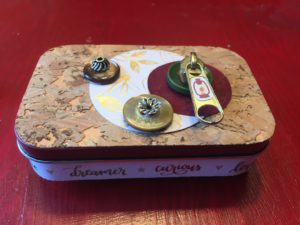
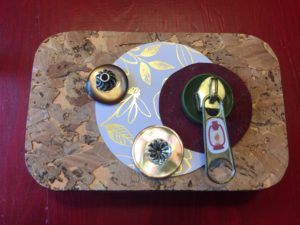
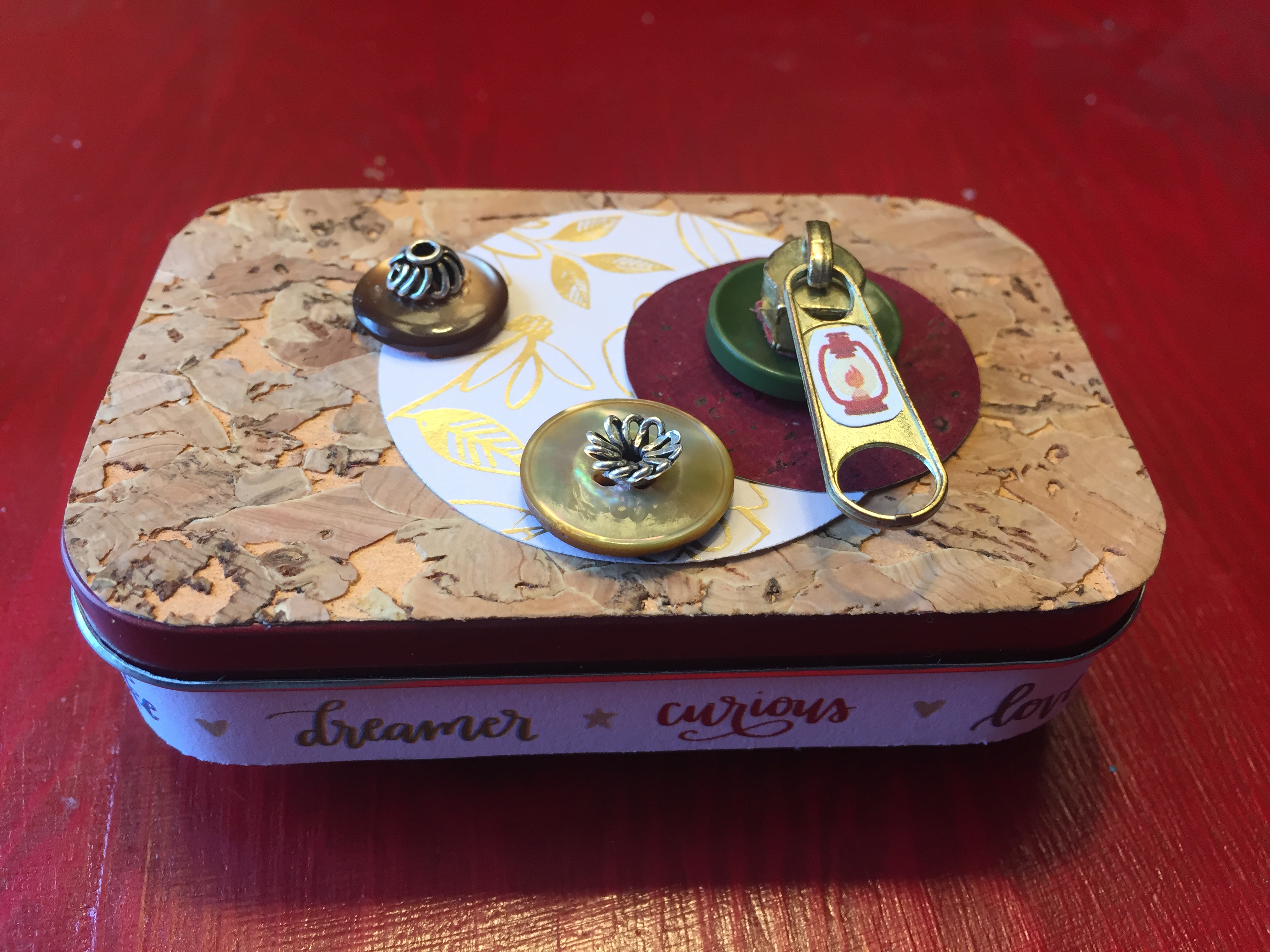
Here’s how my  box turned out:

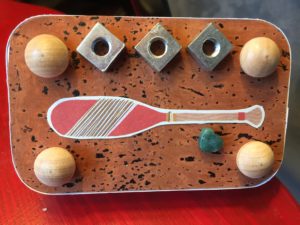
When I found the zipper pull, I knew I was on the right track. I also glued wooden feet onto the bottom. And when I opened it up, it kept falling over, so I added some nuts to the bottom front to help it keep it’s balance. Here’s a picture of the bottom:

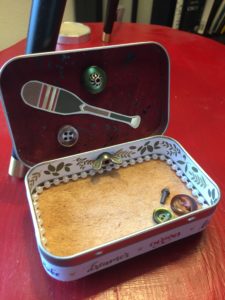
And here’s the inside:

I had so much fun with this project! May you take the time to do the things you love. Nourish yourself with creativity and fun!

10 Ways to Help Your Kids Deal with Your Separation

As a child of divorce myself, I can share my own experience to help you navigate your separation in the way that will best support your children and allow them to adjust to the new reality of having two separate homes. I may write more on the topic of healing or ending your romantic relationship, but today let’s focus on how you can help your children thrive, even in the midst of your separation.

Please note, I’m writing this article with the assumption that you were married and that both parents will continue to be involved in your children’s lives. If that’s not the case, there are still some points that will be helpful, but others may not apply or you may need to change the language to suit your needs, for instance, you can replace the word spouse with girlfriend/boyfriend/partner as needed. My hope is that all children will be encouraged to have some connection and relationship to both of their parents whenever possible.

1. Be honest, but don’t share too many details

Children, especially those under 5 years old, need clear and consistent messages that they can rely on. Being wishy washy or confused about whether you’ll divorce or get back together is fine within your adult relationship, but be careful not to draw your children into your indecision. Children need to understand the hard facts so that they can adjust to their new reality. And they are not your emotional support system. Rather, you are theirs, so if you find yourself talking to your kids about your relationship, please stop, refer to number 5 below, or call a friend.

Your kids also need a consistent message from both parents, so it’s important to get on the same page with your spouse on this point. What is our message to the children and can we both agree to share a consistent message? Perhaps you’ll say something like, “Mom and Dad have decided to live separately for the next 6 months. We both still love you and that will never change, but right now, we need space from each other.”

If your older child asks follow up questions about why or what happens after 6 months, you can let them know that adults have complicated relationships and that you haven’t decided yet, but try to keep your responses concise and consistent, without a lot of emotional content (whenever possible). And never ever share the details of your upset with your spouse with a child under 12.

2. Remind them that you’ll love them no matter what and none of this is their fault

I’m sure you’ve noticed that young children are very self-centered. Because of this developmentally appropriate inability to focus on others along with a tendency to think that the world revolves around them, children often assume that when bad things happen, it’s their fault. It’s important to make sure that your kids know that your love for them and the other parent’s love for them will not change, just because you’re no longer living together. They should also be reminded that your decision to live separately has absolutely nothing to do with them. This is one thing my parents did right during their divorce, and I’m certain that it made a positive impact on me to know for sure that both of my parents still loved me no matter what and that I didn’t cause their problems.

3. Be kind to your spouse

OK, I know this one sounds like a tall order right now, this was one of the most traumatic aspects of my own parent’s divorce. They were furious with each other and they let me see it. I heard them yelling at each other over the phone. There were slammed doors. And the tension between them was palpable for YEARS. In fact, for most of my life I believed that while they both loved me, my parents hated each other. That was a difficult burden to bear, especially since they were my whole world at 5 years old.

So, if you’re able to maintain civility with your spouse, please do so. It’s OK to argue in front of the kids, but only if you make up in front of them too. It’s also OK to have lots of feelings about your spouse that you don’t share with your kids. But in order for children to feel safe and secure, it’s important to show them that even though you’ve chosen to live separately, you still respect each other, and you support one another’s right to have a good and healthy relationship with your children.

Obviously if there is sexual or physical abuse happening, this may not be possible. But even in cases of abuse, it’s important for children to be allowed to maintain some contact with their parent if that’s what they want. Every child is different and will process their experiences differently. In the case of abuse, rely on a therapist, social worker, or other healthcare professional to help you decide how much contact and what kind to allow.

This is something my parents did right. Even though they weren’t able to maintain a civil tone with each other, they did ensure that I got to see and have relationships with each of them and that was a huge gift. I am so incredibly grateful to have such a close relationship with each of my biological parents, even though neither of them are perfect and they both made mistakes.

So please do your best not to villainize your spouse to your children. No matter how tempting it might be to punish your spouse by keeping them away from your kids, remember that these types of actions will ultimately harm your children much more than they will teach your spouse a lesson.

4. Talk about their feelings

Providing emotional support for your kids is one of your most important jobs as you navigate your separation. They may not be ready to talk about their feelings about the separation in particular, but even so, you can talk about their feelings about all sorts of other things. Kids may not even realize that their upset about a situation at school could actually be related to their upset about your separation, and that’s perfectly OK. The crucial piece is to make sure you’re talking about feelings regularly and helping your child make sense of their emotional world.

I highly recommend the book, Nonviolent Communication by Marshall Rosenberg. This book has helped me navigate many conflicts and has taught me how to respond with true empathy (it may not be what you think) as well as how to give myself empathy. These skills will help increase your child’s emotional intelligence which will make a huge positive impact for him throughout his life.

5. Get yourself some therapy

It’s super important to maintain your own health and wellbeing as much as possible during this stressful and challenging time. Therapy, coaching, or counseling is an absolute must for your emotional wellbeing as you navigate your separation and make decisions about how to proceed.

Self-care is the key to being able to be there for your kids right now. For some, that might look like extra baths with essential oils, late night phone calls with friends, or a weekend getaway. For others it’s getting to the gym regularly, eating healthier, or reading an inspiring book. Tune in to yourself and find several things you can do to support your own journey, so that you can be even more available to support your children during this transition.

6. One on one time with each child

This is a good practice, even when you’re not dealing with challenges. Kids need to know that they are important to you and one of the ways they know that they matter is when we set aside a specific time to spend with them, one on one. Turn off your phone and take your kiddo on a picnic, to a park, for some other activity, or just play together in the back yard. Give your child your full and undivided attention and do the things that make them feel cherished.

You may want to check out the book The Five Love Languages of Children by Gary Chapman and Ross Campbell. Once you know what your child’s primary and secondary love languages are, you’ll be more likely to find effective ways to fill up their love tank.

Do make sure you’re actually enjoying the time together too though. If you’re miserable, your one on one time with your child will flop. So find an activity you’ll both enjoy. For bonus points, tell your child 5 things you love about them and why you’re grateful for them.

7. Never use your kids as a bargaining chip

This is the #1 biggest pitfall you face as you navigate your separation. If you threaten to take the kids, seek full custody, or infringe on your spouse’s parental rights even a little bit, you’re doing your kids a huge disservice. Instead, be an advocate for their relationship with your spouse. Even though you no longer choose to live together, you obviously both want what’s best for your kids. And the research is clear, relationships with multiple loving adults provide better outcomes for kids.

Do your best to separate your own feelings about your spouse from those of their beloved children. Try to find opportunities to support their continued connection. Agree on a schedule and then stick to it as closely as possible. Children need consistency and clarity to feel safe and secure. So if every Friday night is pizza night at Daddy’s house, they’re more likely to relax into the routine and adjust to the new normal.

8. Spend some time in nature

Time in nature reduces your blood pressure and cortisol levels and exposes you to microbes that can actually make you happier! Studies have shown that even just 10 minutes in nature can make a significant positive impact on your mood and stress hormone levels. So, if you’re feeling blue or not sure what to do, go outside!

Teaching kids to use time in nature to help them de-stress, get a bit of exercise, and enjoy the sights and smells of the natural world is setting them up for future success. Finding effective strategies to handle their big feelings will be a huge asset for them later in life.

9. If the kids show signs of distress, get them some therapy or a support group too

My parents tried to send me to therapy when they first divorced but the therapist said I was handling things well and didn’t need the extra help. Two years later when my parents were locked in a custody battle and I was having unexplained stomach aches every day, my dad’s girlfriend, who happened to be a social worker and would later become my step mom, recommended that I get some professional support.

I was missing my mom terribly and wasn’t coping well. So she recommended that my dad sign me up for some group therapy with some other kids who were experiencing a similar situation. It was enormously helpful to know that I wasn’t alone and to get to play games and talk about my situation openly with other kids, as well as an adult. It’s not the kind of thing we talked about on the playground at school.

So if your child is having regular emotional outbursts, crying daily, having unexplained physical symptoms, or seems disconnected from their feelings entirely, get some professional help for them. In my opinion, it is always worth the cost of therapy to help a kid through a difficult transition.

10. If you’re dating, save the introductions until after the divorce is final, and even then, tread very lightly

I’m going to be blunt here. Until your divorce is final, please DO NOT introduce your kids to your new fling. It can be extremely confusing for kids to meet someone as the “babysitter” or “friend” only to later discover that they are in fact your new romantic partner. Just don’t go there. Depending on your state’s divorce laws, this could also cause you a whole bunch of trouble as you negotiate your divorce.

In fact, even after a finalized divorce, please tread lightly in this area. Meeting a string of people you’re casually dating is not helpful for your children. Only introduce your kids to a new romantic interest if you’re getting serious and the kids have had some time to process the truth that their parents will not be getting back together.

Also, don’t watch The Parent Trap, or any other movie that could give your kids false hope about you getting back together. But do read books about separation and divorce and answer their questions as honestly as possible while keeping their development in mind.

I guess I had quite a bit to say on this topic! May your relationships with your children continue to grow and thrive, even as you navigate your separation from your spouse or partner.

Warmly, Shelly


I’m Back! Here’s What I’ve Been Up To (Starting a Montessori charter school)

It’s been YEARS since I’ve actively blogged and you might have been wondering why you haven’t gotten any posts from Awake Parent for a while.

After my miscarriage I did get pregnant again and while I was pregnant, my husband’s office manager at his Chiropractic office left. He had wanted us to work together for years and I had resisted, since I loved working from home so much. But in 2013, I agreed to become the new Business Manager at Heartstone Family Chiropractic.

Now I know more than I ever wanted to know about medical insurance billing

It was a bit of learning curve, but I figured it all out and then in 2014, our son was born! Our daughter was absolutely thriving in her Montessori preschool but there were ZERO Montessori elementary programs available in Bend, OR. Even if there had been a private option for Montessori elementary, I concluded that it would cost us over $100,000 to send both of our kids through Montessori preschool and elementary. With free (yes I do pay my taxes) public school as an option, it just didn’t make sense to pay so much for elementary school when we really should be saving for college.

So, some friends and I decided to start a tuition free, publicly funded Montessori charter school! We formed the entity “Desert Sky Montessori” in the fall of 2014 and got to work on the application to our local school district. I’ll write more about this process in future posts, but needless to say, it took a lot longer and the process was far more involved that I originally anticipated. It took us three separate applications, a bunch of fundraising, three years, and many many volunteer hours to reach our goal.

I was the Desert Sky Montessori Board President for the entire process of our start up. So last year at this time I was frantically looking for space for our newly approved school. After more than three years of volunteer work, on my 40th birthday, I finally found out that my daughter would have a guaranteed spot in the school! We also received a $100,000 Planning grant from the Oregon Department of Education.

Our contract with our school district said that we had to sign a lease on a space by May 1st in order to open our doors in the fall of 2017. Also, none of the grant funds we had received could be used on facilities. Miracles ensued and I signed the lease on April 28th. I was so happy and relieved that we had finally found a space! Now we just had to remodel it, hire teachers, purchase furniture and materials, and get ready to welcome our students.

I started the first tuition free Montessori charter school in Central Oregon!!!

In September of 2017 we opened our school to over 100 students and my daughter began 2nd grade in her lower elementary (1st-3rd grade) classroom. Here’s a photo of my daughter and a few of her classmates after a recent small group lesson on polygons.

Montessori charter school lower elementary polygon lesson

So I guess my point is that I’ve been a bit busy while I’ve been away! But now I’m ready to come back, share even more information about conscious parenting, child development, Montessori, and my own parenting journey. But here’s the thing, my blog is going to be a bit different from now on and I wanted to give you a heads up.

No more Origami, this is me, deal with it

I turned 40 last March and there was something extremely powerful about turning 40 years old and opening a charter school that has changed me in some fundamental ways. In the past I cared a whole lot about pleasing others and making sure people like me. But when I turned 40 I found that I no longer cared as much about folding myself into Origami shapes just to please someone else. I felt more boldly myself. I didn’t need to modify my language or behavior to ensure that others felt comfortable.

So you can expect my future blogs to be more raw and real. There will likely be some cursing. I’ve learned a lot from parenting two kids, instead of just one, and from trying things that worked with #1 that absolutely flopped with #2. I’m definitely more bold but also less judgmental of others. I’ve found my grit too, so little challenges just don’t throw me off as much as they used to. I’m persistent and determined to do the things that really matter to me, and I don’t care as much about the rest.

There will be advertising

The other change you’ll notice is that I will begin some advertising on my site. I will only advertise products that I believe in or personally recommend. I may get some commissions (I hope!). And I will definitely be adding some information about one of my new loves, Young Living essential oils and products.

I understand that some folks will be upset by these changes, and that’s OK. If you’re irritated by my advertising or annoyed at how much I love Montessori education or my MLM essential oils, you’re welcome to unsubscribe. But I sure do hope you’ll stick around because I have so much great information, advice, and tons of personal stories to share with you! I’ve missed writing regularly and I’m very excited to get back to it!

I’m also considering recording some video blogs and doing some online classes. My coaching practice is reviving too. If these are things you’re interested in, please let me know. And as always, if there’s a particular topic you’re hoping I’ll write about, please share! I love to address specific issues that are happening right now. Thanks for being here and I’m excited about what’s next!

Pre-parenting 101 Agile Parent Podcast!

Hey there! I recently had a lovely conversation/interview with John and Jahaira about their plans to get pregnant and become parents. We talked about early childhood development, sustaining a nurturing relationship with a partner before baby arrives, parent/child dynamics, mindset, and cultivating critical thinking in very young children. Also, we had fun and discussed how we might handle it if we were to see a child being spanked in a public place. Their podcast will be ongoing, so I hope you’ll check it out!

You can listen on itunes here:

https://itunes.apple.com/us/podcast/pre-parenting-101-shelly-birger/id952485811?i=334079282&mt=2

or on Sound Cloud here:

https://soundcloud.com/agileparents/pre-parenting-101-with-shelly-birger-phillips

Or you can go directly to John and Jahaira’s website and listen here:

http://www.agileparents.com/1/

Have a great week! Warmly, Shelly