Storytelling, it’s more important than you think

Whenever the same idea comes up again and again in my life, I try my best to pay attention.  For me, the fact that I’ve heard the same thing said in different ways a bunch of times, especially over a short period of time, means that there’s something special I need to pay attention to.  This belief has served me well over the years and brought some interesting insights.

This week the concept that keeps popping up is that the ability to tell a cohesive narrative about our lives makes all the difference in attachment and parenting.  I first read the idea in “Parenting from the Inside Out” by Siegel and Hartzell and then just moments ago, I saw a video on facebook about the exact same concept.  Coincidence?  I think not.

OK, so the idea is that our own ability to tell a cohesive narrative about our childhood events and experiences positively impacts our ability to connect with our children.  I’m not exactly sure why this is the case, but apparently researchers at UC Berkeley are actually able to predict the attachment styles of children who aren’t even born yet based on their parents narratives.  Whoa!

I have always thought that personal growth and the ability to make sense of our lives through self reflection were important, but now I have hard evidence that this ability directly impacts how safe and secure my child will feel in her connection to me.

So I guess that means it’s time to take a hard look at anyplace where my personal narrative is incoherent.  Well, that sounds like a great way to spend a Saturday afternoon.  Just kidding.  A better way to find out if your narrative is complete and coherent is to start telling it.  Ask your spouse, friends, or family members if they’d be willing to listen to the story of your childhood.  And, as you share, pay attention to the times when the story flows naturally and the times when it doesn’t.  Are there long silences in which you’re frantically trying to come up with the next part?  Are their pieces that don’t make logical or chronological sense?

When you discover areas of your personal narrative that still need work, just think of yourself as a master storyteller ironing out the details of the story to make it as flowing, interesting, and clearly resolved as possible.  If telling your story is quite difficult for you, you may want to start by typing it out or journaling about it.

If you have no experience writing stories, that’s OK, just take a lesson from one of your child’s favorite storybooks.  Every coherent story has a clear beginning, middle, and end.  And there’s usually some sort of obstacle or challenge to overcome that gives the story some interest and propels the storyline forward.  My favorite stories also have a lesson or moral to be gleaned.

Luckily for all of us, we can edit our narrative at any time and we then become more available for secure attachment!  So let’s all work to create those cohesive narratives so that we’re even more available to connect with the young people in our lives.

If you want to take things a step further, then help your children to create a narrative of their own childhood.  Ask them to tell you stories from their lives.  And don’t stop asking.  Often, it isn’t until they are college aged that they can fully process some of the experiences of their childhood and go on to construct a narrative about it.  But one thing seems clear from the current research.  Helping your children to have a cohesive narrative of their childhood experiences will make them better able to connect with their own children.

But if grandkids seem a very long way off, remember that storytelling and the ability to construct a narrative will help you and your children in more ways than one.  Storytelling can help the two hemispheres of the brain work together and helps us make sense of our lives.

In “Parenting from the Inside Out” there’s a sweet story of a young girl who moves to the US from abroad and begins preschool in an English speaking preschool.  The little girl only knew a few words of English and one day when she fell and hurt her knee she quickly became very upset and didn’t seem to understand where her mother was.

Luckily, the preschool teacher was aware of the power of narratives to help children understand new concepts and so she got a doll and acted out the injury.  Then she acted out calling the doll’s mommy on the telephone, and finally she brought a “mommy” doll to pick up the injured doll from school.  The little girl relaxed and wanted to act out the story with her teacher again and again.  And when her mom arrived to pick her up, she acted out the story once again, showing her mother what had happened.

So, whether you’re introducing a new concept to your child, or just want to connect more deeply, storytelling is a magical way to help create a secure attachment.  I would love to hear all about it!  Please share your stories in the comment box below.

Have a great week, Shelly

The positive power of play

Every year here in Bend, OR we have “The week of the young child.”  It’s a week of activities centered around child development in the first five years of life.  Last night I went to a really great free event with several speakers who shared their passions about supporting child development.  We heard a lot about pre-literacy and how to prepare young children for reading.  But the speaker that moved me most talked about the importance of play in learning and development.

In humans, as in other animals, play is crucial to learning.  When children engage in imaginary play they are acting out possible real life scenarios, practicing skills they’ll need as they mature, and processing experiences they’ve had.  So, if we want to support our children’s learning and growth, it’s absolutely necessary that we play with them.  I want to repeat that, because it’s not just that we ought to allow our children to play or invite their friends over to play with them.  We actually need to get down on the floor and play with them.

Since parents, grandparents, and caregivers are a child’s greatest influence for the first three years of life, it’s critical that we help young people learn how to play.  Until they’re three years old, most children will engage in more parallel play with their peers than real, engaged cooperative play.  And since our neural pathways are forming beginning in utero, it is our ability to play with our babies and young children that informs their ability to play throughout their lives.  And like it or not, their ability to play dramatically impacts their ability to learn other skills.

If you’re gasping for breath right now and thinking about how hard it is for you to play, don’t worry.  There are lots of great ways to play that don’t require you to be an expert at comedy improv.  Singing songs, reading books, acting out stories from books, rhyming, and dressing up in costumes are a few ideas to get you started.

My husband just created a fun game to play with our daughter last week.  He noticed that she laughs when our dog makes a funny coughing sound so he imitated the sound and she laughed.  By the next day SHE was making the sound and HE was laughing.  Now we all take turns saying “Kack!” and we all giggle.  Our daughter has already learned her first joke!

Many of the parents I’ve worked with are concerned about the “violent” play that their young boys engage in.  So, I checked in with our resident expert and research psychologist, Amy Howell PhD.  She says that children’s so called violent play is often not actually about violence.  In imaginary play, killing and death can simply be a way to change the focus or begin a new scene.

She recommends asking your child direct questions about the game or imaginary play if you’re feeling concerned about the content but warns that parents are often too quick to interrupt. You may find that by waiting, it’ll soon become apparent that there’s no cause for concern.

If you’re still worried, try checking in, and you’ll likely learn that a magic potion will bring the character back to life, or that a new theme is about to emerge.  She also stresses that we adults far too often see children’s imaginary play through our own adult perspective, and that’s just far too literal and with too little imagination.

You may find that by checking in, you’ll learn that a magic potion will bring the character back to life, or that a new theme is about to emerge.  She also stresses that we adults far too often see children’s imaginary play through our own adult perspective.

I’ve found that young people often play at “killing” when they’re working through their feelings about their own power or the lack thereof.  So, this week, as you support your child’s imaginary play, try either checking in, or waiting to see, rather than assuming you know what happens next in the story.  And for extra credit, let your child be the director and play a part in his story to his exact specifications.

Have a wonderful week, Shelly

The truth about separation anxiety

OK, I’ll admit it, when I was a preschool teacher I used to shake my head at the moms who had such a hard time leaving their child.  It seemed obvious to me that by prolonging their goodbyes and furrowing their brows they were only escalating their child’s separation anxiety.  If they would just leave swiftly, their child would settle in and enjoy the day much sooner!

Now that I have my own child, I definitely have more compassion for those moms.  It’s so hard to leave sometimes!  And when your little one is clinging to you and asking you to stay, I imagine it’s almost impossible to walk away.

But as my daughter and I have our first experiences of separation anxiety, I’m realizing that right now, I’m actually more upset than she is!  And after seeing lots of young kids freak out when their moms leave them at preschool, I know that I had better get a handle on my own separation anxiety now, so that I don’t transfer my upset to my beloved child.

So, I picked up Elizabeth Pantley’s “No-Cry Separation Anxiety Solution” and I am really enjoying it.  Pantley says that separation anxiety for both parent and child is completely normal and natural and that it’s actually an indication of a strong and healthy attachment.  Whew!  What a relief!

OK, so now that I know that my upset is caused by my deep love for my child, I can relax a little bit and give myself some compassion.  I dearly, deeply love my daughter and want what’s best for her.  And intellectually I know that what’s best for her is to form and maintain ongoing relationships with several trusted adults and some peers.

But emotionally, sometimes I just want her all to myself.  There, I’ve said it.  So now it’s time to take stock.  And actually, I’m already making great progress in sharing her with other adults.  Her Grammy comes over twice a week, she has a Daddy day every week, and she spends several hours each week with our good friend who is a childcare professional.  She is starting to go on outings without me and so far it’s going well.

So in the moments when she needs me, I think it’s OK to go to her.  I’ve also been giving her more time by herself while I’m home and if she calls out  for me I simply call back, “Hey sweetie, I’m in here folding some laundry.  I’ll see you in a minute.”  If she gets upset, I go to her immediately, but often, just knowing that I’m nearby is enough to calm her.

Now that I think about it, I bet some of my separation anxiety comes from my own early childhood experience of going from my mom’s house to my dad’s house and back again every week.  No matter how happy I was to reunite with the parent I missed, I also had to say goodbye to a parent I loved dearly.  Hmmm, isn’t it amazing how our own experiences can color our experiences with our children?

I’m so curious, what have your experiences been with separation anxiety?  What helped you the most?  In Pantley’s book she shares a great idea about a magic bracelet that you fill with your love and send with your child to school or daycare.  I love that idea!  I also remember a children’s book about a mother raccoon (I think) giving her child a kiss on the palm that he got to take with him.  I think it’s so important to help children understand that our love stays with them even when they’re far from us.  And I guess I need to reassure myself that my daughter’s love stays too, even when she’s at her Grammy’s for the afternoon.

I hope you’re having a fantastic week.  Love, Shelly

A cure for clutter: using a rug to define a workspace

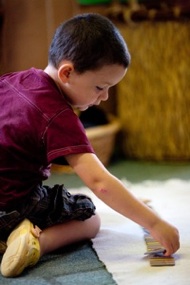
Are you tired of tripping over your child’s toys or bugging the kids to pick them up off the living room floor?  Using a rug to define your child’s workspace is a great solution that works well for everyone!

You might even already have a rug that will work well.  You want a rag rug, bathmat, or other rug that is about three feet by four feet in size and is easy to roll up.  To keep it out of the way when it’s not being  used, you can store your rug in a clean trash can, large vase, or other container when it’s rolled up.  And when your child is ready to get out her dinosaurs, remind her to get her rug first. This trick was taught to me by my friend who is also a parent and works for Oriental Rug Cleaning in Jupiter, FL, she the idea while working one day! Just make sure you don’t choose a rug that will get dirty easily.

Children often enjoy taking care of their workspace and will take great pleasure in laying out their rug and then setting out their toys or other activities.  And, by keeping the space defined you will notice several benefits.

First, your child will feel his work and play are honored and important when you make it a point to walk around his rug and encourage other family members to respect his space.  Second, you’ll cut down of sibling conflict when each child has his own space and both practice respecting one another’s space.  In the Montessori classroom children are required to ask permission to touch anything on someone else’s rug.

Also, if you need to move your child’s activity, it’s fairly easy to pick up two ends of the rug and drag it over to another spot without disturbing what’s on the rug.  That means that even though she starts a puzzle on the living room floor, you can pull it over to the hallway, or even into her room, when the family needs the floor space again. Continue reading “A cure for clutter: using a rug to define a workspace”

Hypnosis, one of my new favorite tools

Have you ever found yourself ruminating about things, going over and over the experiences of your day, beating yourself up about the way you talked to your child, and not able to relax to sleep at night?  Well, I occasionally find that relaxing to sleep is difficult for me, but I have found a wonderful solution!  Self-hypnosis helps me turn off my mind and relax my body enough to go to sleep.  It has also been helping me handle the pain I experience during nursing.

I first learned self-hypnosis during my pregnancy through my Hypnobabies birthing class.  Through the use of guided CDs we created a “switch” that I can now use to turn off the muscles of my body and completely relax.  It’s one of the best skills I’ve learned in the past year.

So now, whenever I find myself ruminating or tense when I’d rather be relaxing, I simply “turn off” and instantly relax my entire body.  Amazingly, the process of turning off my muscles seems to naturally relax my thoughts too!

I have struggled with pain during my entire nursing experience.  For the first 9 weeks of my daughter’s life the pain was so excruciating that I would bite my hand in order to take my attention away from my nipples.  And now, more than 7 months into nursing, I still have days when my daughter’s mouth feels like a vice clamp.

It took me a while, but in the past few weeks I suddenly remembered what I learned in my birthing class and have been practicing “turning off” when I begin to nurse.  Wow, what a difference!  Instead of leaving a nursing session in pain and tension, I actually feel relaxed and refreshed.  And I’m certain that my milk is flowing more easily now that I’m more relaxed too.

So, how does this apply to you?  Well, you might think that self-hypnosis is difficult, takes lots of training, or wouldn’t be possible for you, but I’ve learned that we are in a state of hypnosis often throughout our day, we just might not recognize it. Continue reading “Hypnosis, one of my new favorite tools”