
12 Ways to Encourage Failure and Why You Definitely Want to Do it

Now why in the world would I suggest that you’d want to encourage your child to fail? Well, current research is telling us interesting things about which character traits are associated with lifelong achievement and success. It’s also showing us that these “traits” are not simply inborn, but can be actively taught.

Character traits like grit, perseverance, and tenacity turn out to be much higher predictors of accomplishment than test scores, grades, or even IQ. It turns out that even smart kids who lack these skills often end up leaving college without a degree or have a difficult time holding down a job. On the flip side, even children who aren’t academically gifted can achieve great things if they have the drive and tenacity to keep reaching toward their goals.

So, how do children learn something like perseverance? They learn it through experience. About six months ago I noticed that if my daughter wasn’t able to do something on the first try, she would throw herself down and cry in frustration, refusing to try again. “I can’t do it,” she’d intone through her tears.

For a while I wasn’t sure how to respond to her upset. I didn’t want to encourage her to stuff her feelings of frustration, but I also knew it was important for her to learn to persevere. And then I read, “How Children Succeed: Grit, Curiosity, and the Hidden Power of Character” by Paul Tough. What an enlightening read!

After absorbing a bunch of new information, I decided to offer some reassurance and to encourage Julia to keep trying, even when she didn’t succeed initially. I said things like, “Just keep trying and eventually you’ll succeed,” and “Everyone makes mistakes.” After a few weeks, I knew these messages were getting through to her because one day she failed at a task and instead of the usual meltdown, she calmly announced, “Sometimes you have to try more than once before you succeed.”

So I decided to make a list of quick and easy ways to encourage failure.

Here it is:

1) Acknowledge and challenge, “Wow! You did it! Want to try something even harder?”

2) Encourage, “I know you’ll succeed eventually if you just keep trying.”

3) Offer a demonstration, and then let them try “Would you like me to show you how? OK, now you try.”

4) Suggest a new strategy, “When I get frustrated, sometimes it helps me if I walk away and try again later.”

5) Share your observations, “I see that you’re using your right hand to hold it and your left hand to push it through.”

6) Ask for a lesson, “Hey, I noticed that you’re able to do ______, will you please teach me how?”

7) Discover their strategies, “How did you decide to do it that way?”

8) Present a problem, “I need your help to figure this out, how do you think we should go about solving this?”

9) Remind them of past challenges, “Hey, remember when you were littler and you couldn’t climb up the jungle gym? And now it’s super easy for you!”

10) Help them keep track of their accomplishments, “Hey, you can do it now! Do you want to add this to your list of accomplishments?”

11) Remind them that circumstances can alter the outcome, “I know you were able to do it last week, but right now you’re hungry and tired and that makes things more difficult. I’m sure if you try it again after a snack and a rest you’ll have better luck.”

12) Celebrate the failures,Hooray, you failed! That means you’re trying something really challenging. I feel so proud when I see you trying something difficult. You’ll always learn more if you continue to challenge yourself.”

Do any of these seem foreign to you? If so, you might have some work to do on your own relationship to failure. Remember, when Thomas Edison invented the light bulb, he tried 10,000 things chemical compositions that didn’t work, before he found the one that did. Here’s what he said about his so-called failures. “I have not failed. I’ve just found 10,000 ways that won’t work.” Now that’s the epitome of grit, perseverance, and tenacity.

And no matter what your child ends up doing, these character traits will serve her well. So this week, see how many of these 12 you can implement with your kids. And then watch as they develop more resilience and tenacity before your very eyes.

Have a fantastic week, and even if you don’t, find a way to learn and grow from the challenges you face! Warm hugs, Shelly

Photo by Suzette Hibble

You Don’t Have to Work So Hard to Entertain Your Baby

Well, the secret’s out. We’re expecting! And as I contemplate the inevitable chaos of introducing an infant into all of our lives there’s one idea that brings me a huge amount of peace and calm. It’s the notion that babies can actually entertain themselves.

I was first introduced to this idea by Janet Lansbury and if you want to explore this further, I highly recommend her website janetlansbury.com It’s filled with information about how to be respectful to even the youngest infants and some of the underlying messages I’ve gotten from her work with babies are:

1)   You don’t have to be Super-Mom, you’re already a super mom.

2)   You don’t need to hold your baby for every second of the day to foster proper bonding and development.

3)   Ultimately, even newborn babies are really good at meeting their own needs for learning and entertainment, when given the opportunity for independent play.

Sometimes these ideas seem to fly in the face of all of the attachment parenting information out there, but I don’t think the ideas are really at odds at all. In fact, I think that when we provide the nurturing and responsive environment for our children that we naturally want to give them, they respond by needing less reassurance and wanting more independence.

This is certainly what I’ve seen with my first daughter. As soon as she feels safe and comfortable, she’s ready to take on a new task or skill and she almost always wants to do it herself.

Even as a tiny infant, when she was fed, rested, and we were fighting a diaper rash, we’d leave her strapped to her changing table with a pre-fold underneath her just in case, put on some music and she would stay there happily for up to half an hour!

Other times I’d simply lay her down on a soft blanket on the floor, offer her one or two toys to explore and leave the room. And again, as long as her physical needs were met, she would rarely call out for me. So I got to fold laundry, cook dinner, or do whatever else I’d been neglecting for up to half an hour before she needed another diaper change or to nurse or some help falling asleep.

So if you’re a first time mom and are worried about how you’ll keep your baby entertained, or if you have other kids and you’re pretty sure the new baby won’t get the same kind of undivided attention that your first baby got, fear not. You can relax and trust your baby to learn and grow perfectly, even without your constant attention.

There are a few keys to encouraging this kind of independent play in infants (and toddlers for that matter) Here’s a quick check list:

1) Safety first—Make sure the space is safe from anything that could harm your baby, even if they move farther than you expect (because they probably will!). Check for long cords, electrical outlets, furniture that’s unstable (it’s best to attach bookcases to the wall), fluffy bedding, choking hazards etc.

2) Less is more—Young babies really don’t need 12 toys that blink and play music. A simple ball, a cloth or wooden teether, or even a kitchen utensil may be enough stimulation for a young developing brain. Some babies don’t even need a toy, they can be content just learning to move their bodies and looking around at the things in the room or in my daughter’s case, listening to music.

3) Give them space and time—If you’re not accustomed to leaving your baby alone, this one can be challenging. It’s an exercise in trust and an opportunity for self care.  But remember, offering your baby this time is helping him develop a longer attention span, reminding him that he’s safe, even when he’s left alone, and laying a strong foundation of self-reliance.

4) Be within earshot and available—Infants need to know that we’re there and available when they need us, so be sure you’re within earshot and available to respond quickly either verbally or physically if your baby cries out. When we respond quickly to their needs, babies relax and are able to feel safe even when we’re out of the room. But if we fail to respond when they need our help, we’re breaking a fragile trust and infants will easily learn to object to our being out of sight in order to be sure we’ll be there when they need us.

Just to be clear, I’m not suggesting that you leave your newborn alone for hours at a time or even for several hours a day, but the idea that we must be interacting with our babies 24/7 is just an impossible dream that undermines our own sanity.

Yes, it’s incredibly important to make eye contact, smile, talk to, hold, and sing to your baby. And I already know you’re doing those things. This is just a reminder that there’s absolutely no reason why you can’t take a shower, read a novel, or talk on the phone with a friend, even when you have an infant in the house.

And when we give our babies time alone, we’re not just taking care of ourselves by giving ourselves a much needed break, we’re also helping them develop crucial skills and allowing them to learn and grow at their own pace.

I’m curious, do you give your baby alone time? Or does this idea seem foreign? I would love to hear about your experiences. Please share your story with the rest of us!

And have a lovely week, Shelly

4 Keys to Setting Boundaries That Get Respected WITHOUT Using Bribes, Threats, or Punishment

My daughter is about to turn three and her willfulness is definitely growing, as is her ability to reason and negotiate for what she wants. I wish I could say that this means that conflicts and tantrums are even further reduced, but on the contrary, it seems that her new negotiating skills simply fuel the fire of emotional upset when she doesn’t get her way.

I’ve noticed that gentle discipline is often misunderstood and mistaken for permissive parenting, however, the two are definitely not the same. Permissive parenting involves avoiding setting any rules or boundaries and definitely avoiding maintaining any. But setting clear rules and boundaries are a hallmark of gentle discipline. That’s because children desperately need rules and boundaries in order to feel safe and secure. In fact, they need rules and boundaries in order to BE safe.

Since children aren’t born with a clear understanding of all of the potential dangers we face in our modern lives, it’s crucial that we teach them rules about how to be safe in parking lots and crossing the road, as well as how to form solid bonds with other people and what to do if they get into a situation where they’re feeling worried or afraid.

I guess I was naïve to think that we’d escape completely unscathed by tantrums. I had forgotten that the threes and fours can be even more challenging than the twos when it comes to willfulness and pushing back against rules and boundaries.

But in my experience, the strongest push-backs come when we’re unclear about exactly where the boundary is. In fact, almost as soon as I’m completely clear, testing behavior is greatly reduced.

So, the first key to setting boundaries that get respected is, you guessed it:

1) Be completely clear about exactly what the boundary is and why.

When we set a rule like, “We always hold hands in the parking lot,” it’s clear to us why it’s so important as we have visions of a toddler running into oncoming traffic. There is no wiggle room here, it’s a dangerous situation and we’re determined to keep our kids safe.

We have a rule at home that we always sit while we’re eating. This is to prevent choking and to keep Julia at the table, focused on eating, rather than grabbing a bite to eat while she’s playing. This is an essential rule for us because we have dogs and cats who would like nothing better than to eat her food if she were to walk away. It also helps us keep the food in the kitchen so that I’m not cleaning up spills on the carpet.

Since I have a very clear understanding of why we have this rule, it’s easy to enforce and rarely causes any conflict. If Julia walks away from her food, I assume she’s finished and clear it away. And she knows that’s our policy, so there’s no need for any further testing.

But what about rules and boundaries that aren’t quite so clear?

On the other hand, we have a guideline that we take our shoes off when we come into the house. This one doesn’t have any huge consequences for me, so I’m more lax in enforcing it. And as a result, it gets tested.

Just the other day, my daughter tried to wear her shoes to bed. I said, “Absolutely no shoes on the bed,” (I’m clear on that!) and she pushed a little farther, saying, but it’s OK to wear shoes in the house.

A few days later, she looked over at me as she climbed onto the couch with her shoes on. She was looking for clarity about the boundary, and I provided it. “I don’t mind if you wear your shoes on the couch as long as they’re not too dirty. But no shoes on the bed, remember? And I REALLY like it best when we take our shoes off when we’re inside so that we can keep the dirt near the door.”

As I said, this is more of a guideline than a true rule, and she’s now clear about where the true boundary is, no shoes on the bed, ever.

The next key to setting boundaries that get respected is to:

2) Lovingly enforce the boundary, making it almost impossible for your child to break the rule.

Young children have very little impulse control, so if you make a rule like, “No touching the sharp knives,” and then put the knives within reach, guess what? They won’t be able to help themselves. And truly, it’s not developmentally appropriate to expect that they should.

Instead, set the boundary and then HELP your child to follow the rules by putting the knives out of reach.

If you want children to follow the rules without bribes or threats of punishment, then you need to give them an incentive.

3) Tell them why the rule exists and how you feel when it’s broken

When kids understand that rules exists to help keep them safe, healthy and happy and to maintain peace at home, they’re more likely to cooperate and work within the boundaries. That’s because children have an innate desire to be in connection with their parents and to live in a loving and peaceful environment.

So, if a rule isn’t getting respected, feel free to tell your kids how upset and frustrated you feel. “This rule exists to make our lives easier, and when you forget to put your dishes away and the dogs knock them down and break them, I feel upset because I have to clean up broken glass, someone could get cut, and we have less dishes to use next time.”

If you have any trouble with this, try using an NVC format when talking about your feelings with kids.

My final tip to setting boundaries that get respected is:

4) Reduce the number of rules as your child matures

In fact, reduce the number of rules, no matter what age your child is. Unless you’ve been practicing permissive parenting and failing to set any boundaries at all, you’re likely erring on the side of “more rules are better.” However, this makes it hard for kids to remember and follow all of the rules.

I find it’s much more effective to set just a few hard and fast rules and then to follow my own internal reference system about when things are OK and when things are not OK with me. It’s all right to let a child know that usually that’s fine, but right now you’re just not able to deal with the noise or the mess or having them help you cook.

When children know that there are just a few rules that are always in place, they’re able to remember them and work within those boundaries. But when the number of rules gets, ehem, “unruly,” kids have a really hard time keeping it all straight. Plus, they begin to feel micro-managed and then they lash out in frustration at not having enough freedom and autonomy.

So, your homework this week if you choose to accept it, is to sit down and write down your top 3-5 rules and boundaries. The ones you absolutely MUST have in order to maintain peace and safety. And remember, the most important rule of parenting is to maintain a healthy connection with your child, so if any of these rules seem to undermine connect, re-think them pronto.

I would love to know whether you found this article helpful and I always enjoy your contributions through comments. Please share your thoughts and stories!

And have a wonderful week, Shelly

7 Keys to Getting Kids to Listen

Isn’t it amazing how selectively our kids listen to us? If they don’t like what they’re hearing, they have an uncanny ability to tune it out and engross themselves in a book or toy instead. I’m sure you’ve experienced this universal kid skill. The thing is, it’s not just children who tune out. We do the exact same thing to them all the time. In fact, I’m guessing we’re where they learned the skill in the first place.

Not a pretty picture, but a good place to begin if we want our kids to truly listen and respond to us when we speak to them.

1)   Listen to children—

Good listening skills are not innate, they’re learned, just like any other skill. Children don’t naturally understand that it’s considered disrespectful to avoid eye contact. They’re just doing what comes naturally to them, avoiding conflict or confrontation.

By modeling good listening skills to your child, you’re showing them exactly what you’re wanting. And since kids are hard wired to imitate their parents, they’re already more likely to listen well and respond respectfully when they’re exposed to those behaviors every day.

So the next time you find yourself tuning out as your child is telling a long involved and possibly nonsensical story, breathe, relax and give him your complete attention. Make eye contact, and give the appropriate social signals that you’re engaged. You might even want to ask some follow up questions just to be sure you heard correctly.

2)   Practice Compassion—

Rather than taking “not listening” as an affront, considering it rude or disrespectful, try to see it for what it is, a genuine attempt to keep the peace.

If you think about the specific times when your child is most likely to employ the avoidance strategy of “not listening,” you may see a pattern. He avoids listening when you ask him to clean up his toys. Or she won’t make eye contact after she’s hit her sister. Most often, children are attempting to avoid conflict, embarrassment, added work, or punishment when they refuse to give us their attention.

So I recommend practicing empathy and compassion as you approach a child who isn’t listening. By showing your child that you understand what’s happening for him, you’re much more likely to get his attention and eventually to get your own message across.

3)   Get close and be very very quiet—

Our natural reaction when kids don’t listen is to speak louder and louder until we’re yelling across the house feeling more and more frustrated. “I KNOW she can hear me,” you think. Don’t be so sure.

When we yell, our kids shut down, go into fight or flight, and are actually less able to listen and process information. Instead, try going over to your child and whispering in his ear.

I first tried this as an assistant teacher in a Montessori classroom. Peace is a huge part of the Montessori curriculum and maintaining a peaceful classroom that provides the most potential for learning and focus is hugely important. Rather than raising our voices in the classroom, we were taught to walk over to the child, get down on her level, gently tap her shoulder, make eye contact and quietly speak to the child.

Amazingly, this works like a charm! Even in situations that were about to go haywire, my calm and quiet reminders helped the children remember the rules and follow them more easily. And in the times when I forgot, got upset, or raised my voice, guess what happened? The volume and energy in the whole classroom was negatively affected.

And I can tell you from experience that the exact same thing happens at home. When we’re able to maintain a calm and peaceful tone of voice, our kids can hear us and are much more likely to respond in the ways we’d like.

4)   Only say it ONCE—

This one is hugely important. Think about it this way, every time you repeat yourself, you’re actually training your kids not to listen to you the first time. When they know that you’ll say it 10 times, there’s really no need to pay attention the first 9 times. Kids can be pretty sure they’ll hear it again and again, so why even tune in?

On the other hand, when you refuse to repeat yourself, children learn quickly that they must pay attention or they might miss crucially important information.

Now I don’t mean that you can never repeat yourself if your child is genuinely curious and truly didn’t hear you the first time. It’s just the incessant repetition with no response that is troublesome. And if you’re not sure if they heard you the first time, ask!

5)   Tell them exactly how you’d like them to respond—

As I mentioned before, children don’t come already equipped with all of the information they need to respond to us or other people in socially acceptable ways. They actually have to learn the appropriate responses. So instead of getting frustrated, let’s try some patient instruction.

When my daughter doesn’t respond in the way I’d like, I simply model it for her or ask her to do it. I’ll say, “I hear you Mommy,” and wait for her to repeat, or I’ll ask, “Will you please let me know that you heard me? You can say, ‘OK Mom!”

And if your child isn’t quite as cooperative as mine is, offer them some responses that meet everyone’s needs. “I hear you Mom and I’ll take care of that after I’m finished with my puzzle.” Or give them the option of giving you a thumbs up if they’ve heard you.

6)   Ask them to repeat it—

We’ve already gone over the importance of NOT repeating yourself, so how can you be sure your child really heard and understood your request? Ask them to repeat what you’ve said. “Hey Julia, did you hear what I asked a moment ago? Can you tell me what I said?” Or be playfully forgetful, “Wait, what did I just say? I can’t even remember! (wink wink)”

The most important part of this practice is remaining completely calm and relaxed as you ask your child to repeat your words. The repetition is not a punishment, it’s simply an attempt to ascertain whether your communication has been effective.

When we have tension in our voices as we ask these types of questions we’re not likely to get a positive response. Remember, no one likes to be forced to do anything so keep an inviting rather than a demanding tone of voice and you’ll have a lot more success.

7)   Have some fun—

Never forget that being playful and easygoing is the quickest way to get a child’s attention. Getting upset only triggers kids into shut down mode, but playing a fun game is a sure-fire way to engage and invite children into your world.

Rather than getting angry, see if you can figure out a way to make listening to you more fun than the alternative. Turn it into a game of who has super keen hearing, or who can guess what you want when you act it out in pantomime. Try learning sign language together or make your request in song and dance.

By lightening up and learning to play and have more fun, you’re showing your kids that you’re willing to step into their world a little bit more and I’ve found that whenever I’m willing to do that, children are happy to reciprocate.

I’m so curious whether you’ve tried these keys yourself and how they’ve worked for you. Please share your insights and stories below!

And have a wonderful week, Shelly

The Little Known Secret to Happier Healthier Kids

We all want what’s best for our kids, but with all of the conflicting information out there, sometimes it’s difficult to tell exactly what that might be. Rest assured, what I’m about to share with you is one of the easiest ways you can help your child develop a healthy immune system and prevent depression and best of all, it’s all scientifically proven.

Scientists have discovered a microbe in dirt that can actually increases serotonin production. Serotonin increases feelings of wellbeing and is even linked with learning. But that’s not the only benefit of playing in the dirt.

Exposure to the millions of microbes and bacteria present in dirt help children develop a healthy immune system. Stranger still, exposure to dirt has been shown to improve cardiovascular health, promote healthy skin by preventing inflammation, and it can even decrease anxiety!

And that’s not to mention the many studies that have shown that simply spending time outside is good for us. In my environmental psychology class in college, we learned that simply listening to nature sounds or even watching a video of a natural scene decreased blood pressure significantly. So how much better must it be to actually get out and enjoy the outdoors?

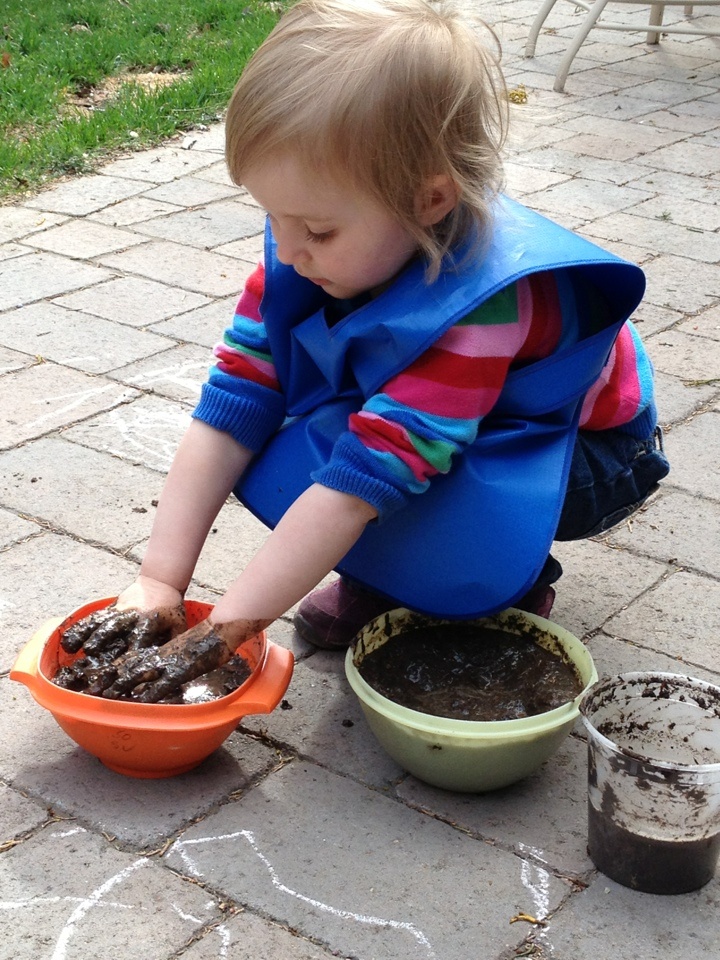
Spending time in nature and digging and playing in the dirt or mud are sensorial experiences that children delight in. Do you remember the wonderful feeling of mud squishing between your toes? Or recall the joy of discovering how a steady stream of water can erode a “mountain” of dirt into nothing at all?

I used to love to make mud pies as a child. I would mix the dirt and water in my own special concoction adding just the right amount of each, a sprinkle of grass, a few clovers, and then I’d mix it all up with a twig and serve up my creations with the pride of a master baker.

Who knew I was improving my immune system, developing a healthy heart, and decreasing my chances of depression? I just knew it was fun!

Last week my mom introduced my daughter to the joys of making her first mud pies. She was slow to warm up, unsure about getting quite that dirty, but I’m betting that by the end of the summer we’ll have some shots of her covered head to toe. And who knows, maybe I’ll join her!

I mean, I don’t have to go to some fancy resort and shell out of bunch of money to take a mud-bath, I can do that in my own back yard! So, yes, encourage your kids to put on some old clothes, and play in the mud, and if you’re feeling adventurous, join in the fun!

Have a wonderfully dirty week, Shelly

Photo by Christee Cook