
The power of your attention

Working in a Montessori Preschool classroom wasn’t easy, but I love kids and I found a way to enjoy myself in the midst of 25 3-5 year olds. One of the most useful tools I had was the power of my attention. I noticed everything–and the kids respected me for it. And, I didn’t just offer up copious praise at the drop of a hat either. When I gave appreciation for something, the kids knew I really meant it.

I required levels of cooperation, consideration, and polite manners in the classroom out of necessity. If I let things go too far in a certain direction, I could have a room full of upset kids and no way to console them all. I was there to help the kids maintain order, and have a constructive day of fun and learning.

As a teacher, a lot of my job was to be a leader, an example, and a director for the kids in my charge. Directing can seem forced or authoritarian, if you feel anxious about it, but I’ve found that when I’m calm, centered, and clear about my direction, children often seem relieved and excited to contribute in the ways I’ve suggested. Structure can actually provide freedom, knowing someone else is providing direction and containment.

When it’s time to clean up I feel open and unconcerned as I let the kids know that there are several things that I’d like to see happen in the next hour: First, I’d like all the tables to be scrubbed, then I’d like the floor to be swept, and finally I’d like every child to look around the room for three things that are out of place and replace them to their “homes.” I ask for volunteers, get them easily and the children quietly go to work. Now I observe the children, and without interrupting their fun, insert helpful comments or warnings about possible spills or dangers. But I trust them to complete the tasks easily and independently.

Now, suppose a child is resisting, and I REALLY want this specific child to help. My most successful strategy is to clearly explain what I’d like to have happen, make a clear request and then put my attention on something else–that way the child doesn’t feel pressured, but is able to go about starting the task, without being stared down (sometimes your attention can be overwhelming for kids!).

Maybe she’s not quite ready to start the work, she’s still feeling resistant. So in five minutes I might go up to her and say quietly, “Hey, I just want to remind you about the sweeping- I’d really like that to happen before story time, do you think you’ll be able to get to it? Is there any help or support you need to accomplish the task?” By offering our help, sometimes we can get to the heart of the resistance. I’ve heard, “I can’t do it!” a LOT of times, which to me sounds like, “I need some help and reassurance!” So, remember to be patient and tune in to the underlying reasons why Julie might not want to clean up her mess.

The most visceral experience I’ve had of the power of my attention was one day at circle time. I was sitting at the front of the room and waiting patiently for the children to sit down and quietly fold their hands in their laps for circle. As I looked around the room I saw a few children who weren’t sitting and were instead bothering their neighbors, talking loudly, and moving around the room. I felt flustered, frustrated, and out of control and I began to ask them each to sit down.
“Frank, please sit down, I really want to read the story!”
“George, can you please stop bothering Nate?”
“Lucy, please put down the pencil.”
But the more I focused on the kids who were contributing to chaos, the more chaos ensued. Pretty soon half the kids in the class were running around the room talking loudly.

And then I had an “Aha!” moment. I realized that I had been focusing on what I didn’t want! I looked at the children again, but this time I only paid attention to the kids who were sitting quietly and ready for circle time. I offered my heartfelt appreciation to them.

“Jose! Thank you SO much for sitting so nicely on the line! I really like the way your legs are folded and your hands are placed in your lap. Thank you for showing me that you’re ready for the story.” And, “Sophia, it looks like you’re ready for story time too, I’m especially appreciating how careful you’re being to keep your hands to yourself, thank you!” As soon as I shifted my attention to what I wanted, the energy of the room changed. And within a minute I had all 25 kids sitting quietly on the line, ready for circle time.

I’ve never forgotten the lesson those kids taught me. When I pay attention to what I’m enjoying, I get more of it! But the reverse is true too–when I pay attention to what frustrates and annoys me, I get more of that.

So, this week, I invite you to focus on the positive, pay attention to what you appreciate and let the other stuff slide by–if only for one week. But most of all ENJOY yourself!

I’d love to hear about your experiences of the power of your attention, please leave your comments in the box below.
Parenting outside the box: A happy divorce!?

Shelly and I spend a lot of time talking about how to do this and how to do that. We get feedback that this is helpful.

But lately, I’m getting curious about all the ways I and other parents do things completely off script, out of bounds and with little or no precedent. Outside the box, if you will.

I realize that when enough people do things “differently,” we create new norms and new trends—hence, the phrase “conscious parenting:” let’s choose what we want to create instead of just rehashing what our parents did just because it’s all we know. (We might still choose to do all or most things the same way, but choosing is different than repeating on auto-pilot!)

So, when my partner and I decided to separate, we did things very differently than most other folks I’ve met. In some ways, this came naturally, since we had a marriage that was pretty different, at least in some ways, from most. But that’s another story.
Continue reading “Parenting outside the box: A happy divorce!?”

Sharing Gratitude: Acknowledging each family members’ contributions

It’s amazing what a little appreciation, acknowledgment and gratitude can do.  You can go from feeling hum-drum or bummed to feeling completely ecstatic in a few short moments if you only take the time to practice gratitude.  Gratitude is like this magic potion that reminds us of all we have to appreciate in life–and there is a LOT to appreciate.

I have some friends who share gratitude with one another every time they sit down to share a meal together.  Others use gratitude as a way to connect at the beginning of their monthly family meeting.  I even know some parents and kids who say what they’re grateful for each night before bed.

I’ve found that when I feel appreciated and acknowledged, I am more willing to contribute, I feel more engaged in my relationships, and I’m just generally happier.  So, do kids feel any different?  I don’t think so.  I think we all respond well to being appreciated and acknowledged.  But it depends on how.  For instance, compliments like, “You have pretty hair.” usually don’t impact me in the same way that true acknowledgment does.

Here’s the difference:  A compliment is really just a positive judgment which might feel good at the time, but then it also leaves room for negative judgments which we can feel afraid of.  An acknowledgment is different. Continue reading “Sharing Gratitude: Acknowledging each family members’ contributions”

Cooking with kids: How preparing food for ourselves and our families contributes to everyone’s well-being.

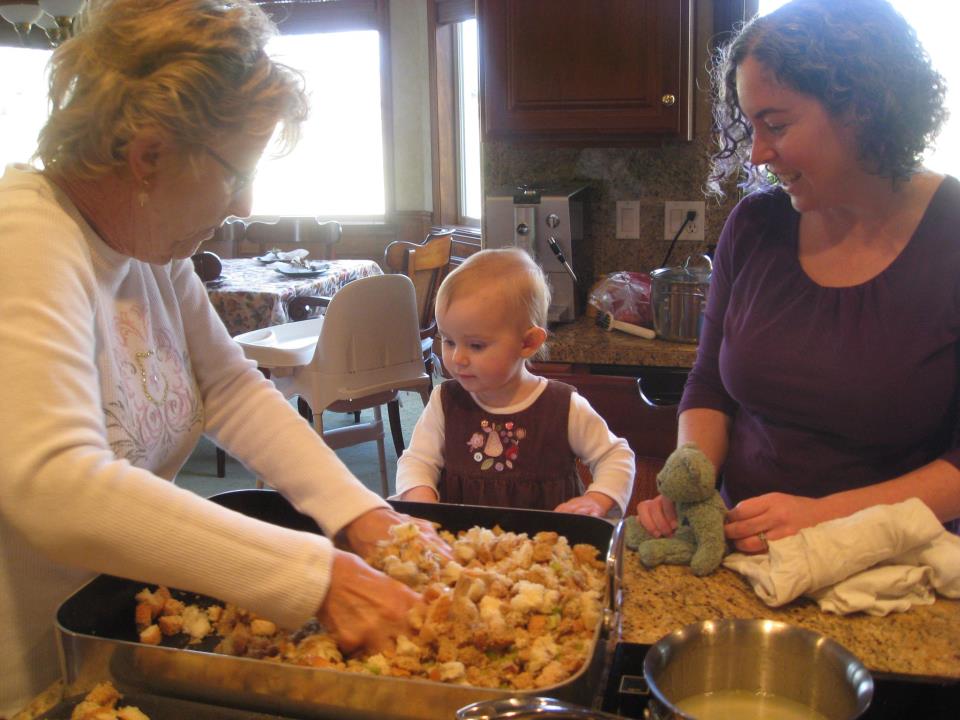
I used to despise spending time in the kitchen. I didn’t like doing dishes, I didn’t know how to cook, and I preferred microwave meals to home cooked ones. Wow! Have things changed. Now I buy lots of fresh organic produce, free-range meats and eggs, and I enjoy coming up with new interesting creations and cooking traditional foods. And for some reason I want to put cumin on everything.

Thinking back, I can identify a couple of things that produced the shift for me. First, I read “Peace is Every Step” by Thich Nhat Hanh. There’s a passage where he talks about enjoying the present moment even in the mundane activities of life like washing dishes. I immediately began to ENJOY doing dishes! I luxuriated in the warm soapy water and felt a deeper sense of accomplishment than I ever could have anticipated from the simple act of doing dishes.

And then I moved in with my husband to be (we’re getting married in 6 weeks!). As soon as I moved in with him I noticed a strong desire to learn to cook welling up in me. I wanted to feed us delicious, nutritious foods.

So, I began to learn the art of cooking. It feels a little funny to be writing about cooking since I’m still so new at it, Jill is the real chef of the two of us. But what I do bring to the table is the ability to modify cooking activities into interesting and age-appropriate activities for kids of all ages.

Think of your child as the apprentice chef in your kitchen. Continue reading “Cooking with kids: How preparing food for ourselves and our families contributes to everyone’s well-being.”

Nine ways to exercise with children

Have you been lamenting your lack of exercise? Thinking back on the days when you used to get to go to the gym, or run around your neighborhood or swim laps at the pool? Kid time is sometimes almost all our time—and the kind of “running around” we do with them doesn’t always feed our body’s need for vigorous (or gentle) and sustained exercise.

Here are some of the ways I’ve found to bring exercise back in, with activities that you and your kids both enjoy, and that give you the added benefit of that exercise you’ve been craving to round out your life, keep you physically fit, and elevate your mood. You can adapt these suggestions to your mobility level.

1. Go for a long walk outdoors. People who walk in nature report that they feel happier after a walk in the woods than they did when they started. Find a trail where you can both walk, or where you can walk and push a stroller, or where your child can run, or scoot on a scooter (a great way for them to develop coordination). A brisk walk can revitalize your and your child’s circulatory system, and a controlled dose of sunshine will do you both some good. If it’s cold, bundle up. If it’s raining, throw on ponchos.

2. Play chase. Pretend you can’t catch your child, so they can feel powerful. Then run away from them and let them “catch” you. Before you do, you might be able to run several laps around them. Depending on how long their energy lasts, you might be able to get in a good aerobic workout.

3. Go for an actual dedicated run with your child around a local track.  If you have an infant or very young child, you might be able to run pushing a stroller.  Or, if your older child runs slower, you can run circles around them, and make a game out of it. In this case, your goal will be to keep up your own pace. You can talk with them beforehand about your goals, for example, “I want to run for twenty minutes. You can run with me, let me run around you, follow on your scooter, or stay on the side where I can see you and play with your toys and books.” Did I mention it helps to bring toys and books almost anywhere? Continue reading “Nine ways to exercise with children”