
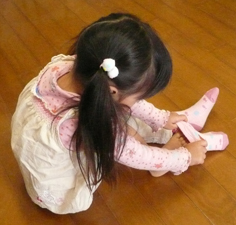
How to foster an emerging sense of order

Between 2 and 4 years old most young people begin to develop their sense of order.  This is the time when your child will become exasperated if you say the wrong word during story time or if you move her artwork or put away his toy before he was finished playing with it.  It can be a difficult time for parents and caregivers alike, because in the past your little one didn’t even notice when you put away his toys.  Now everything starts to become a negotiation because along with a sense of order, a stronger will and resulting tantrums also mark this stage of development.

This sensitive period for order can be challenging, but there’s no fighting against human development, and if you think about it, you wouldn’t want to anyway.  This is actually the perfect time to teach your child how to put away toys, straighten her room, and help out in the kitchen.  But in order to capitalize on your child’s innate desire to learn and this sensitive period for order heed this advice:  Attention to detail is the key to getting the most cooperation from your child during this time.

Let me illustrate further; Paying attention to minute details and showing your child all the tiny steps involved in tidying, cleaning, and putting things away create more interest and better results.  For instance, if you would like to teach your three year old to fold and put away his socks follow these steps slowly, carefully, and methodically (and wait until you have your child’s attention before moving on to the next step):

1)     Take newly dried clothes out of the dryer while they’re still warm

2)    Put them in a pile on the bed and invite your child to feel the warmth and play in the pile a little bit.

3)    Ask your child if he would like to play a sock folding game.  If yes, continue, if no, try another time.

4)   Ask your child to help you find two matching socks. Continue reading “How to foster an emerging sense of order”
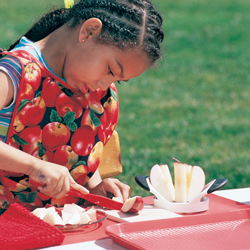
Autonomy is the holy grail of childhood

In my work with young people there are some needs that come up again and again.  The need for play is a great example.  Kids need lots and lots more play than we need and they let us know about their need in ways that are sometimes difficult for us.

But the unmet need that I notice most in young children is the need for autonomy.  Children desperately need to be able to do things on their own and to choose their own path and luckily for you, there are simple things you can do around the house to support your child’s autonomy.

First, take a tour through your home in your mind.  Starting at the front door, do kids have a place to put their coats and shoes when they get home?  Is the place for coats and shoes easily accessible?  For children under five years (and for older children and even adults) the easiest place to put a coat is on a hook near the front (or back) door.  And to put shoes on and take them off, a child-sized bench to sit on is quite useful.

As you move through your home in your mind, consider whether your child has access to the things she needs.  Can she reach toys and books in the living room?  Art supplies, dishes, water and a snack in the kitchen?  Is there a stool in the bathroom that makes using the toilet and washing hands easy?  Can he reach the towel to dry his hands?

Each room of your home should have an activity for your child available in case he wants to be in the same room with you, and in case he doesn’t!  Continue reading “Autonomy is the holy grail of childhood”

The magic question

Are you wanting more ease and cooperation from your kids this week?  I have a magic question that will get you exactly that.  One great thing about this question is that it also works well with other adults.   Another wonder of this magic question is that when people ask you this question you feel honored, cared for, and free to say yes or no.

This question empowers you and your loved ones to communicate openly, honestly, and freely.  It can even help you learn more about your children and their motivations.  OK, are you ready for it?  The magic question is, “Would you be willing to ____?”  Variations on this question might be “Would you?” “Could you?” or “Will you please?”

But a huge part of the magic of the question is that it’s a true request.  When you ask, “Would you be willing to help me carry in the groceries?” you’re actually asking for help, not demanding it.  So be careful with the variations unless you’re sure you’re truly asking.  Sometimes our demands can be subtle and veiled, but they’re demands none-the-less.

It’s easy to fall into the trap of demanding and ordering kids around, especially when they’re resistant and uncooperative.  “Brush your teeth” “Put on your shoes, we’re leaving” and “Stop hitting your sister” are the kinds of demands most kids experience daily.  If you’ve fallen into the habit of making lots of demands of your kids, you’re not alone.  The problem is that the more we demand, the less kids want to cooperate.  And the less kids cooperate, the more we demand.  It’s a vicious cycle, but you have the power to change the dynamics substantially, just by asking the magic question and being OK with whatever the answer is. Continue reading “The magic question”