
How to Keep Your Cool When Your Kids Are Freaking Out

Have you ever thought, “Well, maybe I should just give him what he wants so that I won’t have to deal with the impending tantrum”? If so, you’re certainly not alone. Dealing with the emotional outbursts our kids sometimes have can be disconcerting and stressful, especially when they activate our own emotional volatility.

Yet, it’s clear that a lack of boundaries causes children to experience heightened anxiety and other stress responses. So, how can we set clear boundaries AND reduce tantrums? And what about all of the feelings that come up when we witness our beloved children melting down?

The key to all of this is teaching children emotion regulation. But here’s the bad news, as with everything, our children learn far more from who we are and how we respond than they do from the words we say. So in order to teach our kids to regulate their emotions, guess what? We have to learn to regulate our own emotional states.

And regulating emotions is a LOT easier said than done. Luckily, I have some tips that will get you started on the right track. And once you’ve had a taste of meeting your child’s outbursts with composure, I’m pretty sure you’ll stay the course. It’s super empowering to know that we can choose our feelings (most of the time) and that we don’t have to get triggered by our kids’ freak-outs.

I’m currently reading “Peaceful Parent Happy Kids: How to Stop Yelling and Start Connecting” by Dr. Laura Markham and I highly recommend it. Yesterday I highlighted a quote from Dr. Markham. “Usually in parenting, and in life, the best response to upsetting emotions is to reflect, not react. In other words, don’t take action while you’re triggered.”

I don’t know about you, but this was a profound insight for me. When I’m triggered my job is to STOP and reflect on what’s going on for me and to avoid taking any actions toward my child. That way, I’ll minimize the likelihood that I’ll damage our relationship and maximize my modeling of emotion regulation.

So here are some first steps to take if you struggle with emotional outbursts:

1)   Begin to notice which emotions trigger you most. For some, anger is the scariest, but for others, sadness or anxiety can send them into an emotional tailspin.

2)   Now identify specific incidences where you were triggered and you didn’t respond in the way you would have liked. For instance, during bedtime, I sometimes get so frustrated with my daughter’s wiggling that I threaten to leave the room. Not my finest hour, but a perfect opportunity to notice my triggers.

3)   Next, imagine what it might look and feel like to be more composed and calm during a future similar incident.

4)   Make a plan for how you’ll calm yourself. Breathing deeply and tuning in to my feelings and needs works for me. But perhaps you’d rather shake your body, dance, or do some sort of grounding exercise.

Then, during a future episode:

1)   Remind yourself that your upset isn’t coming from your child’s behavior, rather it’s coming from your past experiences (and probably from a childhood experience) and now it’s a trigger for you.

2)   Recognize that you’re triggered and choose NOT to act. Instead, reflect on what’s coming up for you and allow your child to express her emotions unfettered.

3)   Do the calming activities you’ve decided upon.

4)   Tell your child, “It’s OK to cry.” Or “I’m right here if you need me.” Or “I understand, you’re really upset about this.”

5)   Don’t give in to any urge to let your child have what they want just to get them to stop screaming.

And during a future peaceful moment:

1)   Talk to your child during a calm moment and share your intention to yell less, be less punitive, or whatever your specific goal is. And share with your child about your own challenges with emotions. Let them know that they’re not alone in their inability to cope with big feelings and reassure them that you’re on it. Remind your child that it’s your job as their parent to help them learn better coping skills.

2)   Internally acknowledge any failures as progress toward your goal and celebrate your successes with your child. “Remember how upset I used to get when you cried? And now I can sit with you peacefully, even when you’re really upset. You helped me learn to do that!”

3)   Reevaluate your rules to make sure you’re only setting the boundaries that really matter to you. If it seems like an arbitrary rule, throw it out and let your child know about the change during a relaxed moment.

This is such a huge topic, far too much to cover in one article. But I hope these suggestions are helpful and I would love to share more! Feel free to contact me anytime.

And have a lovely week, Shelly

Testing the waters: How setting boundaries builds trust

I was on a family vacation to Hawaii last week (Happy Mother’s Day to me!) and we had a wonderful time. About half way through our trip we were in the kiddie pool and J was feeling hesitant at first. She wasn’t so sure that the water was such a fun place to be until two young boys started splashing, playing and having a great time. And then she was convinced. The boys’ parents were in the adjacent pool with a young baby and they kept calling out to the boys to settle down, stop splashing, and be nice. But I didn’t see anything at all wrong with the way the boys were behaving. They were just having fun and playing!

At one point one of the boys got brave enough to approach me and proceeded to put some sand on my arm. I could tell that he wasn’t sure how I’d react, but I just wanted to play, so I said “Hey! You put sand on my arm! Oh no! But watch this.” And then I slipped my arm under the water and washed off the sand. After that, he knew that we were playing a really fun game so he put more sand on my arm and I washed it off again. All the time I was encouraging him because I knew that if things got out of hand I could easily set a clear boundary. But I kept checking in with his parents through eye contact and it seemed to me that most of their remunerations were attempts to make sure that I was safe and comfortable.

The boys were just ecstatic to have an adult who would play with them and we splashed and swam and I got very excited about the big splashes they made. All the time their parents kept calling out to them not to splash too much, but I ask you, exactly how much splashing is “too much” splashing when you’re in a swimming pool? I got the distinct feeling that the parents were trying to reign in their boys because they were worried that I might feel overwhelmed. I tried to reassure them that I was in my element.

After about ten minutes of rowdy play one of the boys ran over to me and scratched my arm. I stopped him immediately by lightly touching his elbow to get his attention. Then I looked into his eyes and told him that scratching people is NOT OK, it hurt my body when he scratched me and I didn’t want him to scratch anyone again. He understood me perfectly and we continued to play for another ten minutes with no more scratching. In fact, there wasn’t any more boundary testing of any kind, after the scratching incident. I think he just needed to know exactly how far he could go, and whether I was a really fun pushover or an adult he could trust and with whom he could relax.

Besides tuning into a child’s needs and being willing to help them get their needs met, I think that setting clear and consistent boundaries is the best way to build trust with a child. It makes sense, right? If a child feels he is in charge he can never fully relax and know that he will be taken care of. On the other hand, if a child knows that there is a clear line that must not be crossed, he can play and have tons of fun within the bounds of our rules and agreements, always knowing that I will hold the line when needed. As the adult in the situation, I see this as a special part of my role in facilitating fun and joy with children.

One of the biggest challenges I’ve had as I’ve learned to set clear and consistent boundaries with children is to do so without malice. I used to get all worked up and take it personally when a child tested me or broke a rule. Unfortunately for both of us, my emotional charge only further escalated things and let the child know that I wasn’t to be trusted because I wasn’t able to hold the boundary with love.

After about twenty years of practice, I’m now able to set and maintain a boundary with a child AND be loving and kind in the process. I wasn’t angry with the boy for scratching me. I simply let him know that that behavior was unacceptable and wouldn’t be tolerated. And I did so without a bunch of negative emotional charge. After that, we both understood one another, we knew where the boundaries were, and he was easily able to play with me within the bounds of my rules.

So the next time you notice your child testing your boundaries, remember that the best thing you can do is to maintain clarity about your rules and hold fast to them with love and compassion for your child. That doesn’t mean you can’t revise a rule that no longer applies or doesn’t seem to be working for anyone. But your children need to know that you will consider their input, but that ultimately you will make a decision about what the rules are and you’ll maintain the rules and boundaries for everyone’s well-being.

How does this work at your house? Do you notice a difference between the times when you’re able to maintain emotional composure while setting boundaries versus the times when you “lose it.” Do you agree with my assertion that children will trust you more when you’re able to set clear boundaries? I would love to know your thoughts. Please share them in the comments below!

And have a wonderful week, Shelly

Joyful Discipline: Setting clear boundaries with joy in your heart

I’ve been doing some online research into discipline and wow, there’s a lot of misleading and just plain ineffective information out there! Just yesterday I saw an article that was actually quite disturbing to me. The article suggested a lot of punitive discipline but the one that really struck me was the idea of creating a “consequences jar” and when a child misbehaved, just going over to the jar and pulling out a random consequence and applying it to the child. Whoa. This is not only ineffective; it’s just plain mean. I don’t want my child to be afraid of doing the wrong thing and then forced to make up for it by performing some random task.

So, clearly I’m not an advocate of random consequences, spanking, punishments, or even time-outs but that might leave you wondering, “How can I set clear boundaries with my child in a way that’s kind and respectful, but also maintains some order and keeps us all safe and happy?” My answer is easy to understand and challenging to implement. Setting clear and consistent boundaries with joy in your heart is the key to effective, respectful discipline.

Thinking back over the past few weeks, consider the moments when you felt you needed to create or maintain a rule or boundary. How were you feeling in the moment? I find that I tend to restrict my daughter’s behavior the most when I’m feeling upset or overwhelmed. When I’m feeling creative and joyful, I rarely even need to stop her from what she’s doing!

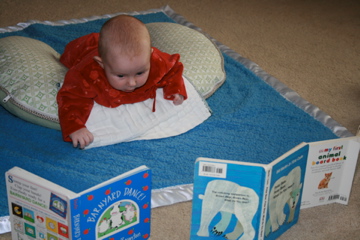
That doesn’t mean we don’t have rules. It does mean that our rules are based on either safety or exhibiting our values. For instance, I’ve never liked to see babies chewing on board books. I understand that for some people, destroying a board book due to teething seems like no big deal, but for me, it represents misuse of a valuable object.

So ever since my daughter could hold a board book, our rule has been, “Books are for reading, not for eating!” The rule was stated often as we initially established it, but it was said with joy and enthusiasm, not in a threatening or angry tone. And guess what? We still have beautifully pristine board books and a daughter who LOVES to look at them independently. Sure, she occasionally tests the boundary, and every single time I protect the book from her, smiling and playing with her as I remind her, “Books are for reading, not for eating, silly!” Sometimes this evolves into a fun game, other times I remove the books and we find something else to do, but most of the time, she would just rather look at and read the book than chew on it.

Recently Julia received an easel as a holiday gift and our rule is that the crayons must remain at the easel. She has a hard time remembering the rule, so I’ve figured out some ways to make it easier for her. I either remove the crayons, which means she has to ask for them (and then I supervise her with them and remind her to return them to the easel when she steps away), or I tie them onto the easel with a string. Either way, I’m making sure that the rule is observed, but I’m not angry with her for breaking it, instead, I want it to be easy for her to follow the rule. That’s what I mean about having joy in your heart as you maintain a boundary. For me, I know that if it’s turning into a power struggle, then I’m on the wrong path.

For those of you with older children, here’s a blog I wrote called “How I averted a power struggle and created a game instead” which has another example of setting a clear boundary with joy in your heart. This happened with a six year old boy who was really pushing my buttons.

So your homework, should you choose to accept it, is to sit down this week at a time when you’re feeling joyful and loving and write down all the rules of your household. Then take a look at them and decide whether any of them can be dropped. Next, identify the rules that are really important to you but are the most difficult for your kids to follow. Brainstorm about ways to make it easier for your children to follow these rules. Lastly, make a commitment to yourself that this week you’ll stop, breathe, and feel joy in your heart before you remind your child of the rules. “I love you so much, and this is not OK.”

Please share your thoughts about joyful discipline- does it work? Is it hard? Easy? I want to know!

A new take on discipline

What do you think of when you hear the word “discipline”?  When most people think about parenting and discipline they probably think of punitive discipline like time out, yelling, spanking, or taking away privileges.

I don’t want my daughter to be afraid of me or of the punishment I might hand down.  So I’ve chosen the most peaceful parenting I can possibly muster.  But if punitive discipline is out, does that mean I’m a total softie and my kids walk all over me?  Definitely not.

In fact, setting clear and consistent boundaries is one of the best ways to help your child feel secure.  In the Montessori schools in which I worked, we practiced a logical or natural consequences approach to setting boundaries with kids.  And it really worked!  Children understood why we did things a certain way and they were usually happy to cooperate.

Somehow setting boundaries was easier when it was my job to be completely respectful of the child.  Now that I think about it, it was much easier not to swear when I was a preschool teacher and my job was on the line.   But now that I’m a parent, I slip up sometimes.  It’s a much different challenge to be respectful of a child 24 hours a day than it is for six or eight hours a day five times a week.

Today I’d like to explore a different kind of discipline, the kind of discipline that allows us to complete a difficult task or to master a new skill.  Lately I’ve been thinking that by developing interests and practicing one or several disciplines myself as well as encouraging my child to do the same, the need for any other kind of discipline could simply melt away.  Maybe I’m crazy and my daughter just hasn’t hit her “difficult” period yet, but this sure seems to be working for us so far.

By encouraging her to develop her own interests and explore them independently, my relationship with my daughter becomes more about facilitating and supporting her desires, rather than circumventing them or redirecting her.  Oh, trust me, there are plenty of opportunities to redirect her.  But the more I’m able to just go with her flow and allow her to explore what she’s interested in, the more confident she becomes and the more she enjoys learning.

We’re setting up a positive loop.  She seeks out something interesting and explores it, she enjoys what she learns and then she seeks out something new and interesting again.  And we’re also building our connection because she understands that I deeply care about her and want her to explore her interests and fulfill her purpose in life.  So really, she’s developing self-discipline!

That way, in the times when I do need to set a firm boundary for safety or for some other reason, she knows that I’m not just trying to punish her.  I’m actually making choices based on what will give her the most freedom she can safely have.

So what do you think?  Can we reduce the need for “discipline” by supporting our children to develop their interests and practice self-discipline?  I would love to hear your take on my idea.  Please leave me a comment!

And have a fantastic week, Shelly