
Loving our kids no matter what gets thrown at us

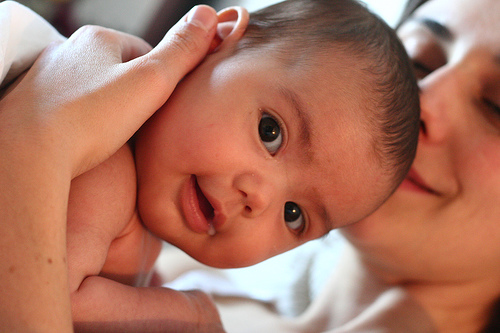
This morning as I hugged my baby to me, she squeezed me and I reveled in the moment of closeness and connection, until I realized she had wiped her booger on my shirt.  I’m not sure there’s much in life that’s more humbling than realizing that to my child, one of my roles is to be her human tissue and wastebasket.

At first I felt offended and wondered if snot removal was all she thought I was good for.  And then I settled in to a deeper realization that motherhood is millions of acts of service, some enormous (like giving birth) and some small (like taking a slobbery apple core) but essentially, I will give of myself to the best of my ability for as long as my child needs me.  I also realized that I should enjoy this time when my child is small and needs me so much, because I know that one of the most challenging acts of service lies ahead–letting go.

So for now, I’ll try to enjoy being a human tissue and later I’ll do my best to be a wastebasket with a smile so that eventually when my child no longer needs me as fiercely, I’ll be able to let go with the fond memories of a time when she couldn’t even sit up or tie her shoes.

As I thought about it more I realized that I could be my child’s wastebasket in more than one way.  Sure, like every mother, I will have a plastic baggie full of garbage in my purse at all times.  But I can also be a receptacle for her emotional boogers and garbage too. Continue reading “Loving our kids no matter what gets thrown at us”

Guest Blog: Family mediation- the power of the “third side”

Thomas-Hands-web

This week’s guest blog is from Jill:

Sometimes we think fighting is just “what kids (or adults) do,” rather than a way we engage when our needs aren’t getting met. I prefer to think of engaging peacefully as “what we do,” and that when we get off track, we can use a hand to get back to a place of connection.

I remember when my son was about three, his dad was in a bread-making phase. Sometimes I liked the results, and sometimes I didn’t. While at the local farmer’s market, my son and I found a particularly yummy loaf of walnut bread, and brought it home discreetly. When his dad saw it, he became incredulous.

“Bread??? You BOUGHT bread!?!?!?”

Canaan felt the tension here. I’ll never forget his response. He raised his body up, opened his arms to the two of us, and proclaimed,

“We all eat bread! There’s farmer’s market bread, and Da-da’s bread, and all kinds of bread to eat.”

Well, shall we let a thousand flowers bloom, or what?

I see this as his attempt to introduce a larger perspective, or “third side,” to his dad’s and my moment of polarization. Sometimes all this takes is showing up with a loving, aware presence.

I remember my stepmother discovering the term “triangualation” in the 80’s, and telling me it was “toxic.” She was referring to one person getting into, or in between two other people who were having a difficult time, creating a “triangle” of three people. Unfortunately, this was the only term in our universe at that time to describe a third person entering into an interaction with two others. There was no positive way to describe a third side to an entanglement.

Today, as a mediator and lifetime student of conflict resolution, I see many ways a third person can show up in a family and help to ease tensions for the other two or more people who are having a hard time to make things easier. This is something humans do intuitively, even when the results aren’t optimal. Kids do it, too, as my son demonstrated above. Continue reading “Guest Blog: Family mediation- the power of the “third side””

The development of will

Time OutWhat’s it like to be a 2-4 year old? (an excerpt from my soon to be released ebook!)

As an infant and young toddler your child saw himself as an extension of you.  He had very little sense of distinction between himself and his parents.  In fact, if you think about it you can understand why this would be so.  Just as we lift our own hand to our mouth if we want to put some food in it- your hand has automatically put food in your baby’s mouth every time he’s been hungry since his birth!  When he needs something, you provide it, so in a way, and in his mind, you’re an extension of him.

Now that he’s older he’s developing more complex language.  He’s learning to distinguish between “yours” and “mine”.  Well if there’s a “yours” and a “mine” there must be a “you” and a “me”.  Now your child begins to see himself as a separate entity with desires, hopes, dreams, and thoughts all his own!  Wow, what an exciting discovery.

A Stronger Will: Unmet needs for choice

Along with the discovery of self, your child is feeling stronger desires than ever before and she’s discovering her personal power.  She’s realizing for the first time that she can affect the outcome of a given situation.  Sure, when she was a baby, she realized that she could move a ball from here to there- but now she’s discovered that she can affect your behavior and have some control over the social dynamics in your home.  This is a huge step in social development.  She’s gone from a helpless being, who is happy to do whatever you want- to a willful child with a mind of her own.  And this is ultimately a good thing- although the transition can be extremely difficult for us.  Sometimes we just want that sweet little baby back (and that’s completely normal)!

If you consider your job as a parent to be raising a capable, independent, and contributing adult, then you can see this phase as a milestone toward that goal.  Now that your child has an ego, strong desires, and a stronger will she can really get things accomplished that she never could before.  Now is a wonderful time to help her develop a sense of responsibility by giving her more freedom coupled with, you guessed it, responsibility.

Easier said than done, right?  Continue reading “The development of will”

Following the child: How child directed games and activities can create connection, learning, and mutual cooperation

kids_playing_aqerThis week I watched a fascinating video about baby led breastfeeding.  It showed newborn, days old, and months old infants maneuvering themselves into a good nursing position with very little help from their mothers.  Babies were deliberate in their movements bobbing and clearly searching for the nipple.  And, when they found it on their own, many mothers reported that the latch was more comfortable than it had been when they had tried to help their babies find the nipple.  What an incredible innate ability babies have!

Watching newborn infants lead the way at breastfeeding reminded me of one of the foundations of Maria Montessori’s groundbreaking educational philosophies; follow the child.  Montessori asserted that children have an innate desire to learn and if we follow their lead, they will enjoy learning, retain more information, and continue to seek out even more knowledge.

But following the child doesn’t just work to help kids develop their intellect, it also helps them to find their power and leadership skills.  When we allow children to be in charge and take the lead, they will often surprise us with their creativity and take us in directions we never expected.

For instance, kids who are feeling powerless and frustrated about it will often make up games than involve enslaving their brothers, sisters, parents, or other adults.  It’s how they work out their frustrations about being a kid and how they learn to understand what it’s like to be in charge.

I’ve found that by allowing children to lead the way during some specifically designated child led play-time, kids become better able to cooperate and connect for the rest of the day.

I’ve even had experiences where I wasn’t sure why a child was grumpy or defiant and when I allowed the child to lead the play, I soon discovered what was really bothering them.  Kids have an amazing ability to work out their emotional challenges through play, but they have to be allowed the time, space, and attention to do so effectively. Continue reading “Following the child: How child directed games and activities can create connection, learning, and mutual cooperation”

What to do about potty talk

kids_potty_mouth_pm-thumb-270x270-1Isn’t it amazing what kids find funny?  I’ve been surprised more than once by what seems hilarious to a 2, 4 or 6 year old.  And then I remember, their sense of humor is just developing.  Kids this age have a challenging time understanding word play and innuendo, but they do know that burps, farts, and poop are some of the funniest things around.

I’m guessing you’ve especially had an opportunity to witness this phenomena if you have a little boy but some little girls love potty talk too.  Suddenly “poopy butt” or “potty head” is their new favorite nickname for everyone.

So, what to do?  Well, first of all, recognizing that this is a normal stage of development can help you breathe deeply and relax a little when your child says “penis” for the tenth time that day or calls the lady checking you out at the grocery store a “fart face”.  Patience is a huge key to allowing this stage to pass, but patience alone will probably not create the kind of verbal environment you’re wanting.

So, you’ll have to create boundaries, letting your child know what works for you and what doesn’t.  I invite you to give a little here, and recognize that using potty talk is a way that your child is experiencing joy, laughter, and humor.  But clearly it’s not appropriate to call the teacher names or to shout the names of certain body parts across the store.  So the first step is to decide where your boundary is.  And that can vary greatly depending on your own preferences. Continue reading “What to do about potty talk”