

You Don’t Have to Work So Hard to Entertain Your Baby

Well, the secret’s out. We’re expecting! And as I contemplate the inevitable chaos of introducing an infant into all of our lives there’s one idea that brings me a huge amount of peace and calm. It’s the notion that babies can actually entertain themselves.

I was first introduced to this idea by Janet Lansbury and if you want to explore this further, I highly recommend her website janetlansbury.com It’s filled with information about how to be respectful to even the youngest infants and some of the underlying messages I’ve gotten from her work with babies are:

1)   You don’t have to be Super-Mom, you’re already a super mom.

2)   You don’t need to hold your baby for every second of the day to foster proper bonding and development.

3)   Ultimately, even newborn babies are really good at meeting their own needs for learning and entertainment, when given the opportunity for independent play.

Sometimes these ideas seem to fly in the face of all of the attachment parenting information out there, but I don’t think the ideas are really at odds at all. In fact, I think that when we provide the nurturing and responsive environment for our children that we naturally want to give them, they respond by needing less reassurance and wanting more independence.

This is certainly what I’ve seen with my first daughter. As soon as she feels safe and comfortable, she’s ready to take on a new task or skill and she almost always wants to do it herself.

Even as a tiny infant, when she was fed, rested, and we were fighting a diaper rash, we’d leave her strapped to her changing table with a pre-fold underneath her just in case, put on some music and she would stay there happily for up to half an hour!

Other times I’d simply lay her down on a soft blanket on the floor, offer her one or two toys to explore and leave the room. And again, as long as her physical needs were met, she would rarely call out for me. So I got to fold laundry, cook dinner, or do whatever else I’d been neglecting for up to half an hour before she needed another diaper change or to nurse or some help falling asleep.

So if you’re a first time mom and are worried about how you’ll keep your baby entertained, or if you have other kids and you’re pretty sure the new baby won’t get the same kind of undivided attention that your first baby got, fear not. You can relax and trust your baby to learn and grow perfectly, even without your constant attention.

There are a few keys to encouraging this kind of independent play in infants (and toddlers for that matter) Here’s a quick check list:

1) Safety first—Make sure the space is safe from anything that could harm your baby, even if they move farther than you expect (because they probably will!). Check for long cords, electrical outlets, furniture that’s unstable (it’s best to attach bookcases to the wall), fluffy bedding, choking hazards etc.

2) Less is more—Young babies really don’t need 12 toys that blink and play music. A simple ball, a cloth or wooden teether, or even a kitchen utensil may be enough stimulation for a young developing brain. Some babies don’t even need a toy, they can be content just learning to move their bodies and looking around at the things in the room or in my daughter’s case, listening to music.

3) Give them space and time—If you’re not accustomed to leaving your baby alone, this one can be challenging. It’s an exercise in trust and an opportunity for self care.  But remember, offering your baby this time is helping him develop a longer attention span, reminding him that he’s safe, even when he’s left alone, and laying a strong foundation of self-reliance.

4) Be within earshot and available—Infants need to know that we’re there and available when they need us, so be sure you’re within earshot and available to respond quickly either verbally or physically if your baby cries out. When we respond quickly to their needs, babies relax and are able to feel safe even when we’re out of the room. But if we fail to respond when they need our help, we’re breaking a fragile trust and infants will easily learn to object to our being out of sight in order to be sure we’ll be there when they need us.

Just to be clear, I’m not suggesting that you leave your newborn alone for hours at a time or even for several hours a day, but the idea that we must be interacting with our babies 24/7 is just an impossible dream that undermines our own sanity.

Yes, it’s incredibly important to make eye contact, smile, talk to, hold, and sing to your baby. And I already know you’re doing those things. This is just a reminder that there’s absolutely no reason why you can’t take a shower, read a novel, or talk on the phone with a friend, even when you have an infant in the house.

And when we give our babies time alone, we’re not just taking care of ourselves by giving ourselves a much needed break, we’re also helping them develop crucial skills and allowing them to learn and grow at their own pace.

I’m curious, do you give your baby alone time? Or does this idea seem foreign? I would love to hear about your experiences. Please share your story with the rest of us!

And have a lovely week, Shelly
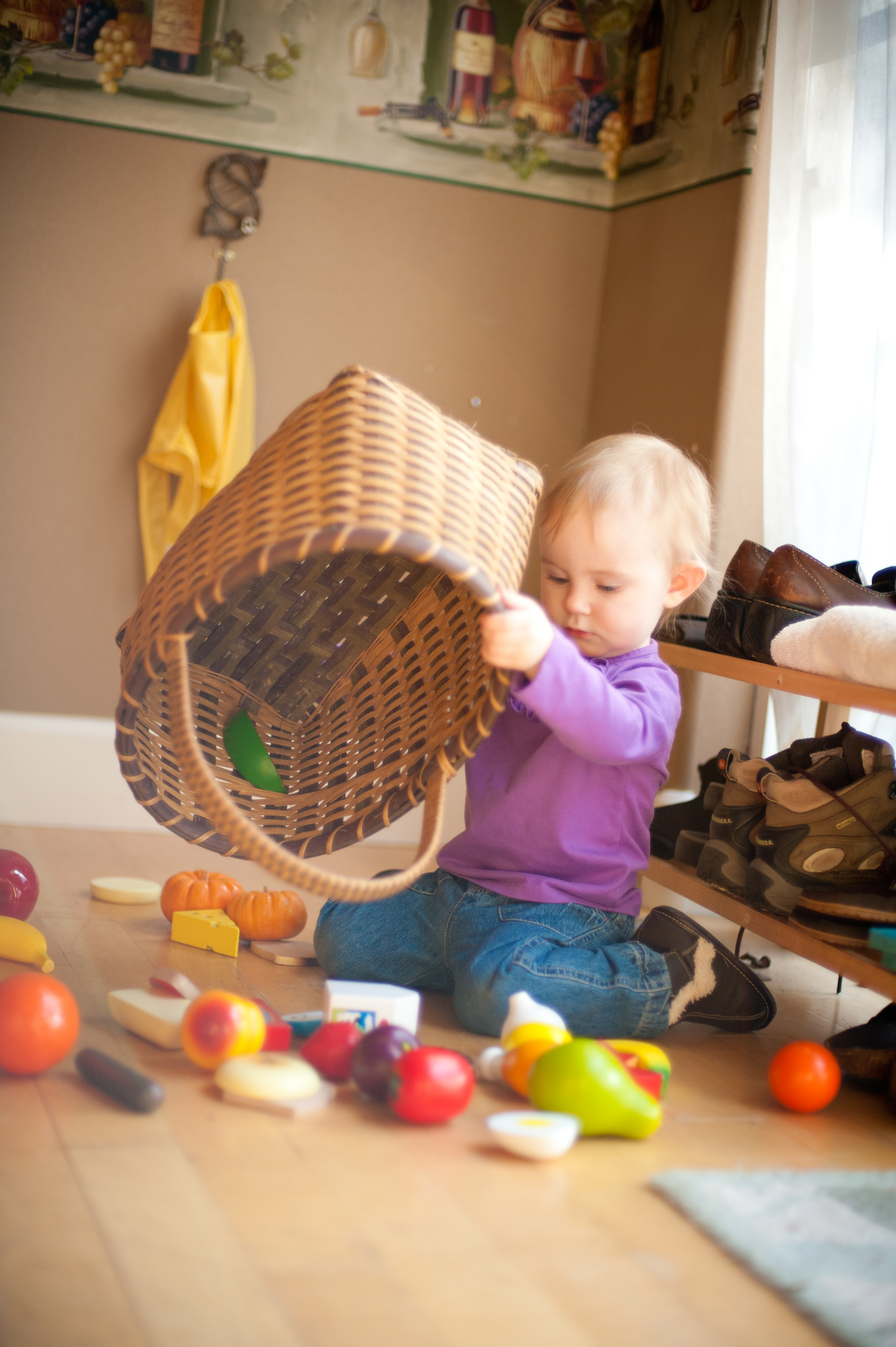
Five Steps to Independent Play

Independent play can be elusive when our kids are accustomed to being entertained, read to, or otherwise catered to, but things don’t have to stay that way. You can create an environment that entices your child to engage in hours of independent play with minimal supervision and virtually no need to guide or direct them. But there are some essential steps to take to make your foray into independent play a success.

Here are my five steps to independent play:

1)     Provide a safe space- First things first; if you aren’t absolutely certain that your child is safe, you’ll never be able to allow her to play alone in the other room. Safety is probably the most consistent barrier to independent play that I’ve observed in the homes of my friends, colleagues, and clients. On the other hand, when you know that your child can’t possibly pull the bookcase over on him or get into the medicine cabinet, you’ll be amazed at how much easier it is to let them do their own thing.

Here’s a list of potential hazards to be sure you’ve handled:

  • Drowning- children can drown in just a few inches of water at the bottom of a bucket. Coolers with melted ice, bathtubs that didn’t get drained, and even toilets can be a drowning hazard.
  • Strangulation- any cord longer than 12 inches can be considered a strangulation hazard. Be sure that all blinds cords are up and out of reach and that children don’t have access to ropes, ribbons, or strings that are longer than 12 inches.
  • Fire/Electrical- covers on all electrical outlets and knob or other safety covers on your stovetop are an important precaution.
  • Choking- Small items that can cause choking should be removed until children are at least three years old.
  • Falling furniture- Heavy dressers and bookcases cause injury to children every year. Be sure your furniture is bolted to the wall, especially if you have a climber (and even if you don’t).
  • Chemicals, medications & plastic bags- Cleaning chemicals, all medications (even over the counter) and plastic bags should all be out of reach or in a locked or childproof drawer or cabinet.

2)     Provide fascinating materials- what is your child deeply interested in? If you’re not sure, find out! When children are provided with materials that spark their interest, they will explore, experiment, and play for long periods of time. However, if they still have those same five books on the shelf that never get touched, it might be time to rotate something new into that unused space. Check out my homeschool blog for ideas of inexpensive and DIY materials that can provide hours of learning.

One more note on this, don’t assume that a very young child won’t be interested in complex topics or information. You’ve seen my daughter showing off her geography knowledge. She also loves to learn about birds and frogs from my adult field guides and photo books. My friend’s two-year-old son is obsessed with hockey, and I know a six year old who loves medieval history! Don’t underestimate your child’s interests.

3)    Provide ample opportunities & invite your child to play alone- I know you’re busy and you’ve got all sorts of fun and exciting activities to do, but take a moment to consider the trade off that happens when you over-schedule. Without a lot of unstructured time at home, your child doesn’t have the opportunity to develop skills in dealing with boredom or engaging in an independent self-directed activity. Instead, he’s looking over his shoulder expecting to be told what to do next. And by actively inviting your child to play alone, you’re actually supporting him in problem solving and creativity.

4)   Stop interrupting your child when he’s engaged in independent play- this is a tough one, even for me. I often forget that my daughter’s activities are just as important as my own agenda. But take time this week to notice all the moments when you’re actually interrupting your child’s concentration. Notice all the times when she’s playing alone and you’re bothering her with requests to put on her shoes and get out the door.

OK, now that you’ve noticed how often you interrupt your child, try to reduce your interruptions. Sometimes all it will take is finding one more thing you need to do and waiting for your child to seek you out. Other times you may have to restructure your day or skip that trip to the park you had been planning. Just remember that by allowing your child to come to a natural conclusion of independent play, you’re cultivating a long attention span, an ability to make clear choices about what to do next, and a bunch of other benefits I’m forgetting about right now.

5)    Make yourself less available & invite your child to do his work- this last step can be a tough one, especially if you’re the involved parent that I know you are. But if we want our children to develop their own skills in independence, decision-making, and engaging in meaningful self-directed work, we MUST take a step back and allow our kids to figure things out on their own sometimes. Check out this blog I wrote about how to set a clear boundary between your work and your child’s and check out that novel from the library that you’ve been meaning to read. Having a book is always a great way to remove your attention if you’d like to stay in the same room with your child. And since you’re not texting or on the computer, you’re modeling the importance of reading too! I also find that children are less likely to be distracted by my activities if I’m reading a book, rather than checking email. An open computer can be an irresistible invitation to a child.

I hope these suggestions have been helpful and I would love to hear about your own adventures in encouraging independent play. Please share your thoughts or stories in the comments below! And thanks so much for participating in our community!

Warm hugs, Shelly

Three Simple Activities Young Children Absolutely Love

Creating complex activities to entertain and educate your child can be time consuming, expensive, and disappointing, especially when they don’t like what you’ve created. But there are a few activities that I’ve used with children over the years that are always a big hit, cost very little, take almost no preparation, and consume young children in hours of play and exploration.

Too good to be true? No way! We’re talking about the magic of water play here, and when it comes to activities like these, simpler really is better. So here are my top three activities with zero prep time, minimal or no clean up, and an enormous capacity to engage the creative mind of a child.

#1 Bathroom sink water play

Just stop up the sink, put a stool under it, turn on the water to a very light trickle, throw in a bath toy and a cup, make sure there’s a towel nearby, and you’re done! Sure your child might soak themselves, so you might want to give them a smock, but playing in water is SO MUCH FUN for young children, you are sure to get at least 10 minutes, if not 30 from this activity. I especially like this one because it doesn’t matter what the weather is like, and children can ask for it or set it up themselves as they get a little bit older.

#2 A home made water table aka a plastic bin, some water and a few rocks

With minimal supervision, a plastic bin filled with an inch of water and a handful of rocks can entertain a young person for an hour, easy. The picture at the top of this post is ours. Who needs an expensive water table when an $8 plastic bin does the trick?! My 20 month old daughter played for about 40 minutes walking back and forth and adding one rock at a time, playing for a while in the water, and then going back to the bucket (on the other side of the yard) for another rock. Do keep in mind that young children can drown in about an inch of water if they fall into it head first, so you want to be sure you’re using a bin with shallow sides, and you do need to be nearby.

#3 Painting with water

Even after all these years of working with kids, I am still shocked at how popular this activity really is. With just a cup filled half way with water and a paintbrush, children can spend quite a bit of uninterrupted independent play-time painting the patio or sidewalk. This activity is so great because it requires absolutely NO clean up. Their “paintings” simply dry over time, creating a clean slate for the next creation! Children enjoy writing their letters and numbers, drawing elaborate pictures, playing tic tac toe, making shapes, and even creating water drawn obstacle courses. And somehow, even though they love doing the painting, young people are rarely upset by the temporary nature of their water paintings. In fact, in all the years I’ve used this activity, I’ve never seen a child cry over a dried up water painting.

I’m curious, do you already use these activities or are they new to you? Does this spark any new ideas about how you can engage your child in independent play? I would love to know YOUR ideas for similar activities. Please leave me a comment!

And have a wonderful week, Shelly