The truth about separation anxiety

OK, I’ll admit it, when I was a preschool teacher I used to shake my head at the moms who had such a hard time leaving their child.  It seemed obvious to me that by prolonging their goodbyes and furrowing their brows they were only escalating their child’s separation anxiety.  If they would just leave swiftly, their child would settle in and enjoy the day much sooner!

Now that I have my own child, I definitely have more compassion for those moms.  It’s so hard to leave sometimes!  And when your little one is clinging to you and asking you to stay, I imagine it’s almost impossible to walk away.

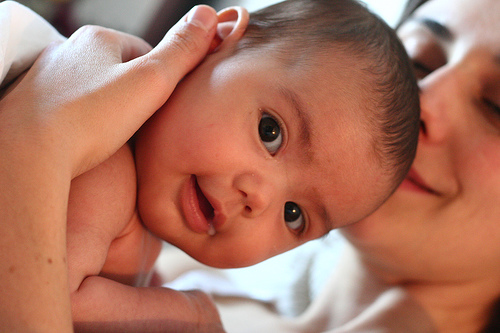
But as my daughter and I have our first experiences of separation anxiety, I’m realizing that right now, I’m actually more upset than she is!  And after seeing lots of young kids freak out when their moms leave them at preschool, I know that I had better get a handle on my own separation anxiety now, so that I don’t transfer my upset to my beloved child.

So, I picked up Elizabeth Pantley’s “No-Cry Separation Anxiety Solution” and I am really enjoying it.  Pantley says that separation anxiety for both parent and child is completely normal and natural and that it’s actually an indication of a strong and healthy attachment.  Whew!  What a relief!

OK, so now that I know that my upset is caused by my deep love for my child, I can relax a little bit and give myself some compassion.  I dearly, deeply love my daughter and want what’s best for her.  And intellectually I know that what’s best for her is to form and maintain ongoing relationships with several trusted adults and some peers.

But emotionally, sometimes I just want her all to myself.  There, I’ve said it.  So now it’s time to take stock.  And actually, I’m already making great progress in sharing her with other adults.  Her Grammy comes over twice a week, she has a Daddy day every week, and she spends several hours each week with our good friend who is a childcare professional.  She is starting to go on outings without me and so far it’s going well.

So in the moments when she needs me, I think it’s OK to go to her.  I’ve also been giving her more time by herself while I’m home and if she calls out  for me I simply call back, “Hey sweetie, I’m in here folding some laundry.  I’ll see you in a minute.”  If she gets upset, I go to her immediately, but often, just knowing that I’m nearby is enough to calm her.

Now that I think about it, I bet some of my separation anxiety comes from my own early childhood experience of going from my mom’s house to my dad’s house and back again every week.  No matter how happy I was to reunite with the parent I missed, I also had to say goodbye to a parent I loved dearly.  Hmmm, isn’t it amazing how our own experiences can color our experiences with our children?

I’m so curious, what have your experiences been with separation anxiety?  What helped you the most?  In Pantley’s book she shares a great idea about a magic bracelet that you fill with your love and send with your child to school or daycare.  I love that idea!  I also remember a children’s book about a mother raccoon (I think) giving her child a kiss on the palm that he got to take with him.  I think it’s so important to help children understand that our love stays with them even when they’re far from us.  And I guess I need to reassure myself that my daughter’s love stays too, even when she’s at her Grammy’s for the afternoon.

I hope you’re having a fantastic week.  Love, Shelly

Got giggles?

I’m curious, is there enough laughter in your home?  Do you often laugh and smile yourself?  Do your kids joke and play happily together?  Are there peals of laughter coursing through your hallways daily?  If not, then it’s time for a laughter make-over in your home.

Laughter is one of my favorite ways to release pent up emotions.  Sure, there are other ways like crying and anger release, but laughter is without a doubt the most fun emotional release for everybody in the household.

But how do you infuse your home with more joy and laughter?  I’ve got some ideas I’d like to share with you.

1) Be super silly- A young child’s sense of humor is fairly undeveloped which makes it fairly easy to make them laugh.  Doing something unexpectedly silly will often do the trick.  I like to put funny hats on, talk in an accent, dance around the room shaking my head and arms wildly or just act a little bit crazy.  Kids absolutely love it when we adults let loose and play with them in this way.  You’ll know you’re on the right track when they’re looking at you like you’re nuts or they’re smiling and laughing. Continue reading “Got giggles?”

Loving our kids no matter what gets thrown at us

This morning as I hugged my baby to me, she squeezed me and I reveled in the moment of closeness and connection, until I realized she had wiped her booger on my shirt.  I’m not sure there’s much in life that’s more humbling than realizing that to my child, one of my roles is to be her human tissue and wastebasket.

At first I felt offended and wondered if snot removal was all she thought I was good for.  And then I settled in to a deeper realization that motherhood is millions of acts of service, some enormous (like giving birth) and some small (like taking a slobbery apple core) but essentially, I will give of myself to the best of my ability for as long as my child needs me.  I also realized that I should enjoy this time when my child is small and needs me so much, because I know that one of the most challenging acts of service lies ahead–letting go.

So for now, I’ll try to enjoy being a human tissue and later I’ll do my best to be a wastebasket with a smile so that eventually when my child no longer needs me as fiercely, I’ll be able to let go with the fond memories of a time when she couldn’t even sit up or tie her shoes.

As I thought about it more I realized that I could be my child’s wastebasket in more than one way.  Sure, like every mother, I will have a plastic baggie full of garbage in my purse at all times.  But I can also be a receptacle for her emotional boogers and garbage too. Continue reading “Loving our kids no matter what gets thrown at us”

The dangers of praise

Although we tend to think of praise as beneficial to kids, recent research has shown that certain kinds of praise are actually detrimental to young people.  When we tell kids they’re “good” the unintended effects are that children begin to fear being seen as “bad”.

Personally, I think all kids are good all the time.  They’re just easier or more difficult for us to deal with based on their behavior, but that doesn’t make them “bad”, just more challenging for us.  But if we tell kids they’re good or talented or smart, the surprising consequence is that they tend to freeze up and become afraid of being seen as bad or un-talented or stupid.

In one study I read, kids were divided into two groups.  Each group was given an easy puzzle to solve.  After they completed the puzzle one group was told, “You’re so smart!” and the other group was told, “Wow, you tried really hard on that!”.  Then they were offered the opportunity to redo the easy puzzle or to try a more challenging one.

The kids who were told they were smart chose the easy puzzle more often, probably fearing that if they failed, they wouldn’t be praised as “smart” anymore.  On the other hand, the group who were told they tried hard were eager to challenge themselves and often chose the more difficult puzzle.  After all, even if they failed, they would still get praise for trying, so there’s nothing to lose! Continue reading “The dangers of praise”

Happiness is contagious

We are all inexplicably connected to one another by virtue of our deeply social nature as humans.  But recently, studies have shown exactly how those connections can actually affect our well-being.  This week I saw a show called “This Emotional Life” on Oregon Public Broadcasting (OPB).  The highlight of this particular episode was the fact that happiness is contagious.

You’re probably wondering how they know that, right?  Well, researchers created a hugely complex map of the interactions between specific people and those they’re connected with.  It was a jumble of names and arrows of different colors indicating the types of relationships.  Some people were related, others were friends or co-workers.

Out of all the data they collected, the most statistically significant finding was that happiness spreads through the map faster than the common cold.  So it looks like when you’re happy, your happiness spreads to those you come into contact with, who then share it with other people you may not have even met.  Your happiness can have a positive effect on people up to four degrees of separation from you!

With that in mind, consider the impact your happiness has on your family, and the impact theirs has on you.  This week, put some special focus on doing the things that bring you joy so that you can not only experience happiness but you can also spread it to the people you love.  And begin to notice how your child’s laughter can spread through your household like wildfire.  What can you do this week to foster joy and laughter in your home? Continue reading “Happiness is contagious”