The Top Ten Things I’ve Learned About Getting Organized

I used to resist organizing. I’d put it off until my drawers were overflowing and my closets bulged. But at some point, often at the worst possible moment, I’d be forced to handle the clutter that had built up beyond recognition.

I’ve turned a corner in this regard. I actually enjoy organizing and re-organizing now! And having a few days “off work” seemed like a great opportunity to re-organize some areas of my home that had been neglected of late.

So, the pantry got an overhaul last weekend and so did a strangely shaped cabinet in my kitchen. Now both are more usable, more pleasing to look at, I know what I have and I’ve gotten rid of the stuff I was keeping but no longer needed. It’s amazing how much space can be taken up by things that we rarely use, but that we still think we need to keep around. For me, a huge part of organizing is letting go of the things I think I need, but don’t actually use.

Whew! I’m so glad I tackled that pantry (thanks to my wonderful husband for the inspiration). What a nice feeling to start the New Year with! Next up, my office! Ha! That’s a joke, I’ve been working on organizing my office for at least a year. And, yes it’s far better than it has been in the past. Maybe I should add an organized office to my 2013 vision!

Do you enjoy organizing? Or do you experience it as a constant battle? Do you dread doing it with the kids around? Or is it fun to include them in the process?

I used to do all my re-organizing when my daughter was asleep because I was afraid she would take things from various piles, carry them around the house, or just need my attention while I was in the midst of my project. I still tend to do more organizing when she’s otherwise occupied, but now I’m no longer afraid of what will happen if she’s around while I’m moving things around.

I figure it’s probably good for her to see behind the curtain a little bit and start to understand that there are things that need consistent revisiting in order to keep our home tidy and accessible.

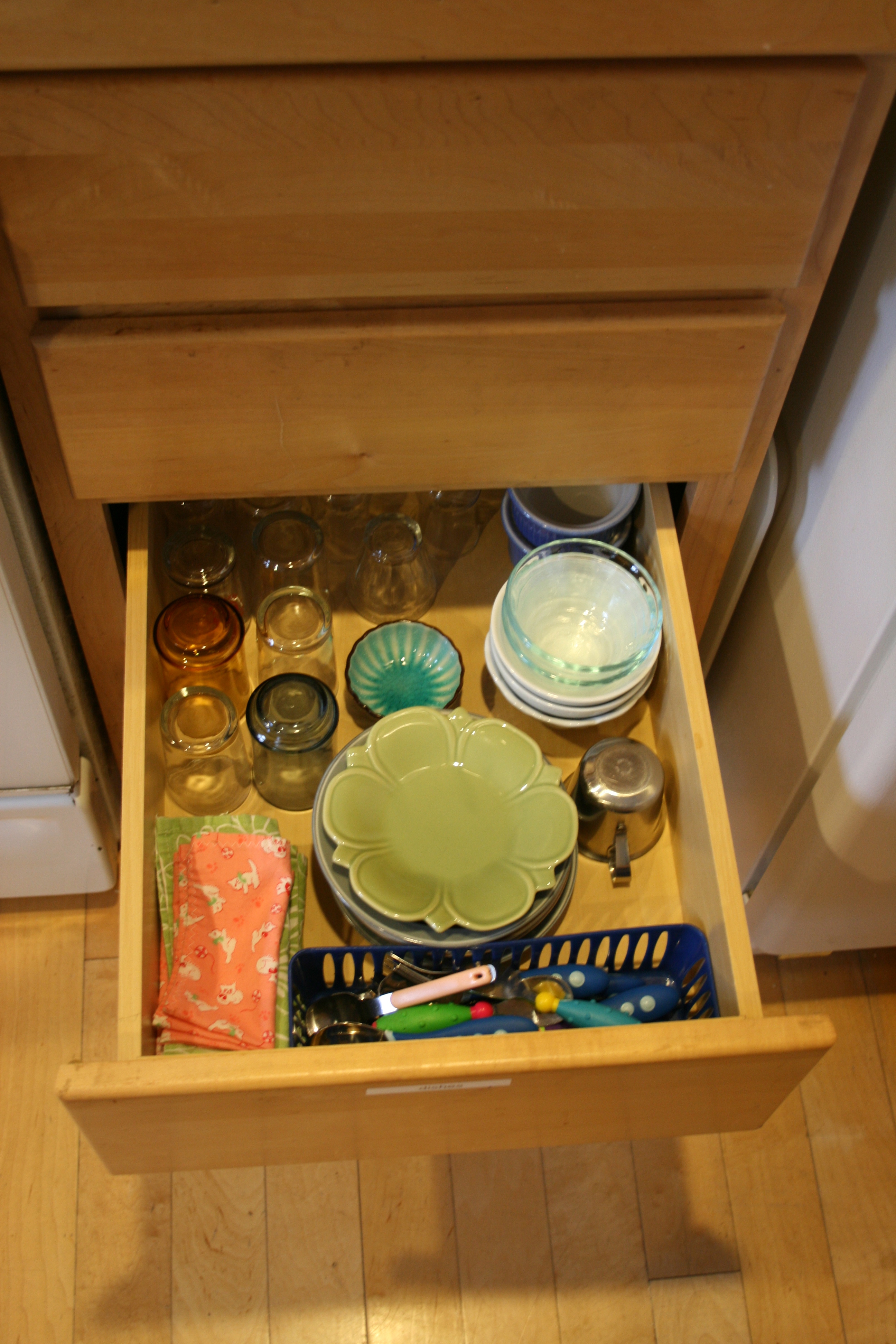
At almost two and a half, Julia is now responsible for putting her clean breakable dishes into her kitchen drawer after they come out of the dishwasher. She does this task with gusto each and every time I ask, but it’s only possible because we’ve kept her drawer well organized and it’s not overstuffed with items that are rarely used.

Here’s what I’ve learned about staying on top of organization lately.

1)   It’s never ending.

2)   I need empty bins, baskets and buckets to dump things into at the beginning of any reorganization attempt.

3)   I need bins, baskets, and buckets to hold ongoing in-process items like “giveaway” “to be filed” and “to be fixed.”

4)   I MUST have systems for dealing with things like junk mail, personal items, things that are broken and need fixing etc.

5)   It’s never ending.

6)   A place for everything and everything in its place is a fantasy right now (albeit one of my favorites), but I will achieve it. I WILL ACHIEVE IT.

7)   Keeping things from coming INTO my house is probably even more important than having a system for dealing with things once they’re here.

8)   Asking my daughter, husband, mom, and whoever else is willing to HELP me is crucial. I don’t have to do it all myself.

9)   It’s my job to set the expectations and to let my family members know when it’s time to straighten up (without throwing a fit by huffing around the house complaining about what a pit it is).

10)   It’s never ending, so I might as well enjoy the process.

I recently read “Getting Things Done” by David Allen and I realized that there are all sorts of ways that I’ve been undermining my own efforts to organize. Now I’ve got a clear plan and I’m chipping away at my bad habits bit by bit.

Do you know what’s keeping you from having the tidy and organized home you dream about? Or are things just fine as they are? I would love to hear about your own journey of staying organized at home. Please share a story or comment below!

And have a fabulous day, Shelly


Make your life easier, give kids their own drawer

When our daughter started to crawl we did what most parents do, we dashed around the house “baby proofing” everything in sight.  We moved dangerous things up or to cabinets that could be locked or secured.  I installed latches on cabinets containing cleaning products.  But as I looked around our home and imagined putting latches on every cabinet and drawer in the house, I got overwhelmed.

And then it hit me; maybe I didn’t actually have to install all those latches!  Of course, I realize that I might need to add a few as my daughter grows and gets into things more, but I came up with a solution that is working well and has caused the least work for everyone.  I gave my daughter her very own drawer.

As soon as she opened the bottom drawer in the kitchen for the very first time, I grabbed a bag, threw its original contents inside, and then tossed a few of her toys in the drawer.  I included some kitchen items like a metal spoon, a set of measuring spoons, and a plastic cup.  And voila!  She took to it like a bee to honey.

Now, whenever I’m cooking or we’re hanging out in the kitchen, she crawls right over, opens up her drawer and plays with her “kitchen toys.” She hardly even seems to notice that there are other cabinets and drawers nearby!

Office shelf

But I didn’t stop there, I gave her a drawer in the master bathroom and she occupies herself masterfully while my husband and I take our morning showers.

We have also designated the bottom two shelves of the living room bookcase to the little one, and in true Montessori form, I leave new and exciting toys on those shelves to encourage her exploration. She even has two shelves in my office that will have her “work” on them for years to come.

Sure, we also have a basket of toys in the kitchen, living room, and her bedroom too.  But she seems to enjoy her drawers even more, and I don’t have to look at the stuff inside when she’s finished, I just close the drawer!  Of course, the next step will be to teach her to close the drawers herself.  And after that, we’ll begin putting toys into the drawer and closing it when we’re about to leave the room.

Living room shelf

If you have an older child who doesn’t yet have any designated kid’s activity areas in the common rooms, I highly recommend you clear some space for your younger family members.  Then, stock their shelves and drawers with interesting activities that you’ll rotate when they lose their appeal.  And if you also provide a rug and/or a child sized desk or table that they can work at, you’ll be helping your child set up great work habits and helping yourself get some peace and quiet.  Because, when kids know where to look for an activity that they can explore on their own, they’ll go back to it again and again, and you’ll actually get some adult work done!

I would love to hear about your own solutions to support your child’s freedom and independence at home.  Please leave me a comment!

Have a fantastic week, Shelly

Financial consciousness

It’s spring-cleaning time!  Hooray!  Out with the old and in with the new.  Flowers are blooming, trees are budding and leafing out, and my husband and I are taking a good hard look at our finances.  Ouch.

I don’t know about you, but becoming aware of exactly what is happening in my financial life is challenging for me.  Recording my spending and then analyzing it is frightening.  Creating and sticking to a budget feels foreign, and planning our financial future feels like sitting at the bottom of a very deep well and inching my way up brick by brick.  And then there’s the issue of increasing our income and decreasing our bottom line.  So now I’m hyperventilating.  Well, not really, but you get my point.

But the thing is, if we don’t pay attention to our finances, we will continue to live paycheck to paycheck, never really saving for our future, and as retirement approaches we’ll be up a creek without a paddle.  On the other hand, if we take a good look at our finances and bring the light of awareness to our earning, spending, saving and such, we actually have the ability to set goals and strive for them.

And if there’s one thing I know from years and years of personal development, it’s that setting a goal is the quickest way to make a change.  When we strive for things, we can often achieve much more than we would otherwise.

Now here’s the kicker, if we turn away from the responsibility of our financial future, we’re not just hurting ourselves anymore, we’re hurting our children too.  And not just because we can’t provide the things we want to give them.  I mean sure, it’ll be nice to know that we can actually afford to buy our kids healthy food and fun toys, or maybe we plan to save up for their college education.  But the real disservice comes in our children’s dysfunctional relationship to money.

We are always teaching our kids.  No matter how much we’d like to pretend they’re not learning things unless we intend to teach them, the truth is, they’re absorbing our relationship to money.  They will use our financial health as a template on which to build their own beliefs about money.

That’s not to say that they’ll be the same as we are.  Some kids grow up in poverty, don’t like it, and go on to become millionaires.  Others grow up in decadence, never learning the value of hard work or the need to earn money, and end up in poverty.  Still others consciously choose one road or the other, or something in between.

I guess what I’m trying to say here is that we have a unique opportunity to help our children develop a healthy relationship to money.  But first, we have to start by healing our own relationships to it.  After we’ve examined our thoughts, beliefs, and actions around money and taken responsibility for our finances, we can teach our children to do the same.

I’m guessing we’ve all had the experience of telling our children no when they ask for something in line at the grocery store.  But I’m curious how we will tell them no and what message about money they will get from that.  Is it because “we can’t afford it” or because “we don’t choose to spend our hard earned money on candy” or will we remind them of that great vacation we’re saving up for?  I wonder how we can make our conversations about money inspiring, informative, and age appropriate for our children.

This week, take a good hard look at your financial wellbeing.  Are there areas that need your attention?  If all that’s already handled (is it ever really all handled?), then set some financial goals.  Finally, ask yourself, how will I teach my children about the beauty, wonder, and challenges of money this week?

Love to you all, Shelly

A cure for clutter: using a rug to define a workspace

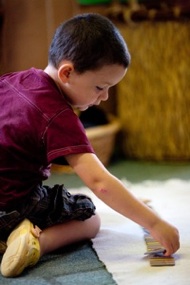
Are you tired of tripping over your child’s toys or bugging the kids to pick them up off the living room floor?  Using a rug to define your child’s workspace is a great solution that works well for everyone!

You might even already have a rug that will work well.  You want a rag rug, bathmat, or other rug that is about three feet by four feet in size and is easy to roll up.  To keep it out of the way when it’s not being  used, you can store your rug in a clean trash can, large vase, or other container when it’s rolled up.  And when your child is ready to get out her dinosaurs, remind her to get her rug first. This trick was taught to me by my friend who is also a parent and works for Oriental Rug Cleaning in Jupiter, FL, she the idea while working one day! Just make sure you don’t choose a rug that will get dirty easily.

Children often enjoy taking care of their workspace and will take great pleasure in laying out their rug and then setting out their toys or other activities.  And, by keeping the space defined you will notice several benefits.

First, your child will feel his work and play are honored and important when you make it a point to walk around his rug and encourage other family members to respect his space.  Second, you’ll cut down of sibling conflict when each child has his own space and both practice respecting one another’s space.  In the Montessori classroom children are required to ask permission to touch anything on someone else’s rug.

Also, if you need to move your child’s activity, it’s fairly easy to pick up two ends of the rug and drag it over to another spot without disturbing what’s on the rug.  That means that even though she starts a puzzle on the living room floor, you can pull it over to the hallway, or even into her room, when the family needs the floor space again. Continue reading “A cure for clutter: using a rug to define a workspace”

The simpler the better

Hey Everybody, I’m back!  My beautiful daughter is nearly 2 months old and I’m excited to be back in touch with you all.Before I go on, a special thanks to all my guest bloggers. You all really helped me out and provided great content for our awakeparent
community!

OK, so you know the principle of Occam’s razor?  It’s the one that states that the simplest explanation is usually the correct one.  Well, so far, it’s been showing up in my world as a new parent.  Here are some examples:  1) Which is simpler, that my husband purposely hid my fork from me or that I inadvertently tossed it into the sink and forgot about it? 2) Which is simpler, using a host of stain fighting concoctions to get the poop stains out of my cloth diapers or just putting them out in the sun for an hour? 3) Which is simpler, applying lots of special creams to my baby’s butt to get rid of diaper rash or just letting her little toosh get some air a few times a day?

I’m finding it absolutely amazing how time and again, the simpler solution is the better one!  It reminds me of a book I read years ago called “The Simple Living Guide” that offered lots of simple, easy solutions to all aspects of our ever more complicated lives.  If I recall correctly the author even wrote about things like getting rid of stuff so that you’d have less to organize and keep track of.

I love the principle of simplifying on many levels.  Continue reading “The simpler the better”