
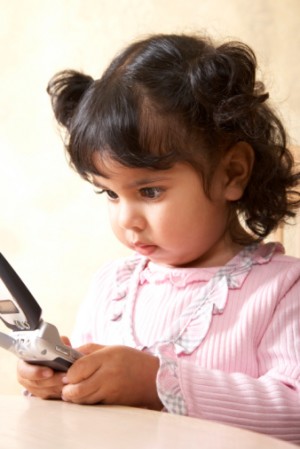
The trouble with texting

Last night as I was mindlessly flipping through television channels trying to find something interesting I happened upon a show in which young children were being interviewed by a journalist while their parents watched from a room nearby.  The kids were between the ages of three years old and six years old and the journalist was asking them about cell phones and texting.

“Do your parents ever text?” she asked.  The children nodded wildly and raised their hands to speak.  One little boy talked about how his mom was “always texting, texting, texting.”  Another child shared how she hates it when her mom takes phone calls instead of playing with her.  One child shouted, “I wish phones were never invented!” And another little girl talked about how she sometimes plays with six or seven toys at once because she likes to “multi-task” just like her Daddy.  Whoa.

The parents in the next room were a little bit shocked at how strongly the kids felt and ultimately shared that they felt embarrassed that they had prioritized their phones above their children in many instances.  One of the parents was perplexed though, because apparently her job requires that she be available and on call.  She wondered how she could be on call and still let her child know that he’s important to her.

I don’t have any answers for that particular parent, but the show got me thinking.  How much do we really NEED to be at the beck and call of our electronic devices, and how much have we unconsciously fallen into the trap of our shiny, fun toys?  And, considering that our children learn by imitating us, how much do we want our kids staring at screens and pushing buttons to communicate with friends, co-workers, and family members that are hundreds or thousands of miles away? Continue reading “The trouble with texting”
How to foster an emerging sense of order

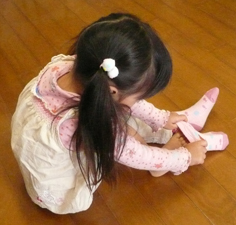
Between 2 and 4 years old most young people begin to develop their sense of order.  This is the time when your child will become exasperated if you say the wrong word during story time or if you move her artwork or put away his toy before he was finished playing with it.  It can be a difficult time for parents and caregivers alike, because in the past your little one didn’t even notice when you put away his toys.  Now everything starts to become a negotiation because along with a sense of order, a stronger will and resulting tantrums also mark this stage of development.

This sensitive period for order can be challenging, but there’s no fighting against human development, and if you think about it, you wouldn’t want to anyway.  This is actually the perfect time to teach your child how to put away toys, straighten her room, and help out in the kitchen.  But in order to capitalize on your child’s innate desire to learn and this sensitive period for order heed this advice:  Attention to detail is the key to getting the most cooperation from your child during this time.

Let me illustrate further; Paying attention to minute details and showing your child all the tiny steps involved in tidying, cleaning, and putting things away create more interest and better results.  For instance, if you would like to teach your three year old to fold and put away his socks follow these steps slowly, carefully, and methodically (and wait until you have your child’s attention before moving on to the next step):

1)     Take newly dried clothes out of the dryer while they’re still warm

2)    Put them in a pile on the bed and invite your child to feel the warmth and play in the pile a little bit.

3)    Ask your child if he would like to play a sock folding game.  If yes, continue, if no, try another time.

4)   Ask your child to help you find two matching socks. Continue reading “How to foster an emerging sense of order”

Busy bodies

One afternoon when I was about six or seven I saw my mom sitting in the living room staring off into space.  “Wacha doin’?” I asked.  “Nothing.” She replied calmly.  “Nothing?!” I thought, NOTHING??!!!  How could someone not be doing a thing?  That was impossible.  Hmmm.”  As I looked at her she seemed peaceful and happy and whole, so I figured that maybe, just maybe, not doing anything was an all right thing to do.

The older I get, the more I try to be like my mom in that moment.  Not the checked out staring off into nothingness part (although that’s kinda nice sometimes), but the part of her that is able just to sit, and contemplate life, and enjoy the present moment.  The more years I get under my belt, the more I appreciate just being.  And the less I think that it’s the “doing” that will define me in other people’s minds (or in their memory of me once I’m gone).  Not that doing is a bad thing; in fact I quite like doing things.  But remembering just to be; And to be peaceful and joyful as I go about my daily life.

This is a foreign concept to kids, or at least it was to me as a kid.  I just wanted to learn new things and grow and reach out in every way I could.  To just sit and breathe was the last thing on my mind.  You see, the thing is, kids are busy bodies.  I’m not sure exactly what it is about being young that makes us want to figure everything out as quickly as possible, or even gives us the notion that anything ultimately CAN be figured out.  But regardless of what drives them, young people are notoriously busy “getting into things”. Continue reading “Busy bodies”

The importance of observation

When it comes to babies, at my core, I am a scientist.  The process children go through as they transform from a fetus into a walking talking human child in just the first 2 years of life fascinates me.  It’s absolutely incredible really.  As a scientist, I want to understand all I can about this amazing process.  And if there’s one thing I’ve learned that is the same in both my scientific and my Montessori backgrounds, it’s that observation is the key to understanding child development.

My daughter has Erb’s palsy brought on by her shoulder dystocia during birth.  At first I didn’t notice anything wrong, and since most babies heal on their own without any intervention, I just assumed she would too.   She did seem to prefer to use her right arm and hand, but I didn’t know that wasn’t normal.

We have a wonderful pediatric physical therapist who is teaching me all about arm, shoulder and hand development in infants.  She’s taught me that at three months old, Julia shouldn’t have a handedness or preference for one side over the other.  So, I started paying closer attention to the specific movements we’re looking for and truly comparing her arm and hand development on the left with the development of the right.  Much to my amazement there are differences that had gone unnoticed by me in the past.  Although she’s starting to use her left arm more and more, she does raise her right arm above her head more often than she does with her left.

So, what does this have to do with you and with parenting in general?  My point is that if we’re not paying close attention to the physical, emotional, and social development of our kids, things can slip through the cracks unnoticed.  We have to take the time to actually pay attention to where kids are developmentally in order to know that they’re on track and, more importantly, in order to know how to challenge and encourage them to develop further. Continue reading “The importance of observation”

Finding joy in the mundane

Being with a newborn can often be super fun and rewarding and at other times it can be incredibly boring.  There’s not a whole lot of interaction happening yet but there is a lot of extra laundry and additional housework because we’re home more often.  But in the moments when I’m thinking I might go crazy if I have to wash the poop out of one more diaper, I remember something I learned from Thich Nhat Hanh’s book “Peace is Every Step”.  Every mundane moment of our lives is an opportunity to be present and enjoy life.

I want to say that again, because I think it bears repeating.  Every moment of our lives is an opportunity to be present and enjoy life.  That means that at every stop-light, every time we’re waiting in line at the store, and during every load of laundry we are given a gift.  The opportunity to enjoy the moment is always there.

As I was reading Peace is Every Step, I read a particular passage about dishes.  At the time I HATED doing dishes.  I avoided them, pushed them off on my boyfriend or housemate, and if I was forced to do dishes I grumbled and cursed my way through the experience.  I was definitely NOT enjoying any part of the experience.

But then I read Thich Nhat Hanh’s words about enjoying the warm soapy water and mindfully washing each dish with care and a switch flipped inside me.  Continue reading “Finding joy in the mundane”