
Redefining “Family Friendly”

I wish every public restroom had a child sized toilet. I want small tables and chairs that fit my daughter’s body in public spaces. I hope we are moving toward accepting, celebrating, and accommodating the small-bodied humans that make up a substantial portion of our population. But I’m tired of restaurants advertising themselves as “family friendly” just because they provide a high chair and the waiters won’t glare at me if my child accidentally drops food on the floor.

When I think of the words “family friendly” I imagine a place where parents and children are welcomed joyfully. I envision a place with activities that meet my interests AND the interests of my young child. And it’s a place where we all help each other out. To me “family friendly” means accessible, accepting, and even supportive of my whole family.

I want MOST of the world to be family friendly. And maybe more of it really is than I realize. But here in America, the land of the free, my child is stuck staring at knees, being put into carts and chairs she can’t climb into on her own, and unable to sit on a toilet that doesn’t threaten to swallow her whole.

Needless to say, I’m upset by all this.

That’s not to say there isn’t hope though. I have seen child-sized toilets in exactly two public places in the past ten years. More and more parks and play spaces are sprouting up. But again, I wonder, why does “child-friendly” have to mean big plastic wheels that spin with no apparent purpose?

When I was little I can remember using a water pump, you know, the metal kind that you have to pump up and down a bunch of times before any water comes out. My friends and I loved to work the handle up and down, up and down, and then to catch the water in buckets ready for the deluge that we knew was coming. We needed the water to add to the sand so we could build sandcastles or maybe we used some of it to water flowers that were wilting in the summer heat.

So when I envision child friendly spaces in public places, they’re not just a bunch of toys. Instead, I imagine beautiful wooden furniture, access to books, art materials, puppets, costumes, and the means to clean up any messes they might choose to make. I see children working together at a task that is meaningful for them. Or else feeling so free and comfortable that they can completely lose themselves in pretend play.

Last weekend my husband and I took our daughter to the High Desert Museum. They have a homesteader’s cabin and ranch from 1904 and every week there are volunteers dressed up in period dress sharing information about what life was like in the early 1900’s. There are all sorts of fun things for children to do there, but there was one little girl having the most fun of all. Can you guess what she was doing?

She was sweeping the porch with a child-sized broom. She tried a few different brooms until she found the one she liked the best, and for the next twenty minutes while we were meandering around, watching the chickens, and looking at the ranch hand’s quarters, she happily swept every inch of that porch.

Now that’s what I’d call “family friendly.”

Do you think public spaces are child and family friendly? What is your vision for the future of our public space? Please leave me a comment!

And have a wonderful week! Warmly, Shelly

A new take on discipline

What do you think of when you hear the word “discipline”?  When most people think about parenting and discipline they probably think of punitive discipline like time out, yelling, spanking, or taking away privileges.

I don’t want my daughter to be afraid of me or of the punishment I might hand down.  So I’ve chosen the most peaceful parenting I can possibly muster.  But if punitive discipline is out, does that mean I’m a total softie and my kids walk all over me?  Definitely not.

In fact, setting clear and consistent boundaries is one of the best ways to help your child feel secure.  In the Montessori schools in which I worked, we practiced a logical or natural consequences approach to setting boundaries with kids.  And it really worked!  Children understood why we did things a certain way and they were usually happy to cooperate.

Somehow setting boundaries was easier when it was my job to be completely respectful of the child.  Now that I think about it, it was much easier not to swear when I was a preschool teacher and my job was on the line.   But now that I’m a parent, I slip up sometimes.  It’s a much different challenge to be respectful of a child 24 hours a day than it is for six or eight hours a day five times a week.

Today I’d like to explore a different kind of discipline, the kind of discipline that allows us to complete a difficult task or to master a new skill.  Lately I’ve been thinking that by developing interests and practicing one or several disciplines myself as well as encouraging my child to do the same, the need for any other kind of discipline could simply melt away.  Maybe I’m crazy and my daughter just hasn’t hit her “difficult” period yet, but this sure seems to be working for us so far.

By encouraging her to develop her own interests and explore them independently, my relationship with my daughter becomes more about facilitating and supporting her desires, rather than circumventing them or redirecting her.  Oh, trust me, there are plenty of opportunities to redirect her.  But the more I’m able to just go with her flow and allow her to explore what she’s interested in, the more confident she becomes and the more she enjoys learning.

We’re setting up a positive loop.  She seeks out something interesting and explores it, she enjoys what she learns and then she seeks out something new and interesting again.  And we’re also building our connection because she understands that I deeply care about her and want her to explore her interests and fulfill her purpose in life.  So really, she’s developing self-discipline!

That way, in the times when I do need to set a firm boundary for safety or for some other reason, she knows that I’m not just trying to punish her.  I’m actually making choices based on what will give her the most freedom she can safely have.

So what do you think?  Can we reduce the need for “discipline” by supporting our children to develop their interests and practice self-discipline?  I would love to hear your take on my idea.  Please leave me a comment!

And have a fantastic week, Shelly

Building trust by telling the truth

As I listen to my daughter playing in her baby pool for the first time, with her Grammy watching over her, I feel so grateful for every experience we get have together.  And I can finally understand some parents’ almost pathological need to protect their children.

There are all sorts of dangers both seen and unseen in our world today and it can be overwhelming when we focus on what could go wrong.  A simple pool of water can become scary.  But sometimes we take the job of protecting our children too far.  By being honest with our kids, they may experience some pain, but they’re sure to fare better in life than they would otherwise.

When I talk with parents about being more honest with their children I hear all sorts of objections.  “Are you sure it’s appropriate to tell my child that?!” and “I don’t want to burden him with my feelings.”  But I think it’s a very slippery slope to withhold information from our children in order to “protect” them.  It actually seems to do just the opposite.  It hurts our kids when we don’t tell them the truth and they end up learning that they can’t count on us.

As a child, one of the things I admired most about my mom was how brutally, really, honest with me she was.  Granted, she didn’t offer a bunch of unsolicited information, but when I asked her a frank question, I knew I could count on her to answer honestly.

When I was five or six I asked my mom what the worst word in the world was.  And, after asking me to promise never to use it, she leaned down and whispered the “f word” into my ear.  I was shocked and in awe of my moms commitment to honesty.  And until I was a teenager, I never used it.  I was just curious, and I wanted to be prepared in case someone else used “bad words” in my presence.  Obviously it was a pivotal moment for me, considering I still remember it so vividly.

My mom was also very honest about sex, even when I was very young.  By the time I was 4 years old, I knew exactly where babies came from and I knew the scientific names of both male and female body parts.  As a teenager, talking to my mom about sex was easy because we’d already been talking about it for 10 years!  We had built a foundation of truth and trust that I knew I could rely on.

I’m so grateful for that foundation now, because as I got to know other girls and young women in my teens and twenties, I realized that my mom’s honesty was really quite rare.  Most of my friends’ moms had never talked with them about contraception or their monthly moon time, and as a result many of my friends were confused about the facts, unprepared to protect themselves from STDs and pregnancy, and several of them ended up with unwanted pregnancies.

I want my daughter to be informed and well prepared for life on her own.  So I think I’ll take my mom’s approach and be truthful with my child about her body, sex, and even my own feelings.  I want her to have that same foundation of trust and a deeply ingrained knowledge that no matter what, she can count on me to be honest with her.

I can only hope that by talking with her about challenging topics now, when she’s young, it will make it that much easier for us to talk about the tough stuff when she’s a teenager and young adult.

I’m curious, what’s your experience with being brutally honest with your children.  Have you seen benefits from being committed to the truth?  Have you experienced the pain of disconnection when you weren’t honest?  Please leave me a comment and share your story below.

Have a fantastic and vulnerably revealing week, Shelly

Don’t “should” on me!

Language is a powerful thing.  I’m constantly amazed at how simple word choices can make such a huge difference in my everyday life.  For instance, if I think to myself, “I can’t…” I feel deflated and ineffectual, but when I think, “I choose not to…” I feel inspired and powerful.

We each make choices about which words we’ll use to describe our lives every single day.  Don’t we all have a friend who almost constantly whines and complains?  Or know someone who uses language that is offensive to us?  I do my best to be hyper aware of my language and which words I choose to use.   I want to use words that are empowering and inspiring as much as possible, especially around my daughter.

When I first became aware of my word choices and their power, I noticed that I apologized a LOT.  I said “I’m sorry” dozens of times a day. I also discovered that I was afraid to speak up, worried about taking up too much space, and I rarely expressed myself very powerfully.  In a way, I was apologizing for my very being!  But it didn’t feel very good, so I systematically trained myself to stop apologizing habitually, and now I only apologize when I really mean it.

As I continued to explore consciously choosing my words, I realized there was a very specific word that I actually despise.  The word is “should.”  Every time I heard the word “should” I was reminded of other people’s expectations for me, and all the times I had been externally motivated.  I realized that I had been living my life to please other people, but I wasn’t really enjoying it at all! So I began working to develop a strong internal motivation, a clear inner sense of yes and no,  and I abolished the word “should” from my vocabulary.

My friends and I worked together to remind one another when “should” crept back into our language by stopping and saying, “Did you just ‘should’ on me?!”  Bringing a little bit of humor to our mission to abolish “should” made it a fun game that we could all play together.  And it really helped to have the support of people who were all committed to conscious word choices.  By the way, if you want an easy and empowering word replacement, try “could” instead of “should.”  It works almost all of the time!

Now that I’m a mom, I’m reminded yet again how important it is to be aware of the words we use when we talk to our kids.  Of course tone of voice, affect, and energy are often even more important than word choice.  But I still think it’s worthwhile to pay attention to the words we use.

After all, our kids will surely parrot those words back to us, and who really wants their 4 year old saying, “Mommy, you should eat your vegetables before your chocolate.”  Personally, I would much rather hear someone ask me if I would or could, rather than telling me that I should.  Don’t the young people in our lives deserve that same respect from their elders?  I sure think so!

I would love to know what you think about the word “should” and it’s impact on young people.  Please share your opinion or story below!

Thanks for being here and have a great day, Shelly

Guest Blog: Family mediation- the power of the “third side”

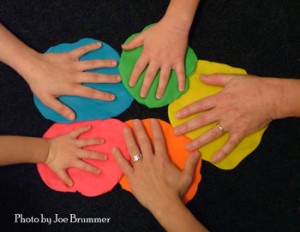
Thomas-Hands-web

This week’s guest blog is from Jill:

Sometimes we think fighting is just “what kids (or adults) do,” rather than a way we engage when our needs aren’t getting met. I prefer to think of engaging peacefully as “what we do,” and that when we get off track, we can use a hand to get back to a place of connection.

I remember when my son was about three, his dad was in a bread-making phase. Sometimes I liked the results, and sometimes I didn’t. While at the local farmer’s market, my son and I found a particularly yummy loaf of walnut bread, and brought it home discreetly. When his dad saw it, he became incredulous.

“Bread??? You BOUGHT bread!?!?!?”

Canaan felt the tension here. I’ll never forget his response. He raised his body up, opened his arms to the two of us, and proclaimed,

“We all eat bread! There’s farmer’s market bread, and Da-da’s bread, and all kinds of bread to eat.”

Well, shall we let a thousand flowers bloom, or what?

I see this as his attempt to introduce a larger perspective, or “third side,” to his dad’s and my moment of polarization. Sometimes all this takes is showing up with a loving, aware presence.

I remember my stepmother discovering the term “triangualation” in the 80’s, and telling me it was “toxic.” She was referring to one person getting into, or in between two other people who were having a difficult time, creating a “triangle” of three people. Unfortunately, this was the only term in our universe at that time to describe a third person entering into an interaction with two others. There was no positive way to describe a third side to an entanglement.

Today, as a mediator and lifetime student of conflict resolution, I see many ways a third person can show up in a family and help to ease tensions for the other two or more people who are having a hard time to make things easier. This is something humans do intuitively, even when the results aren’t optimal. Kids do it, too, as my son demonstrated above. Continue reading “Guest Blog: Family mediation- the power of the “third side””