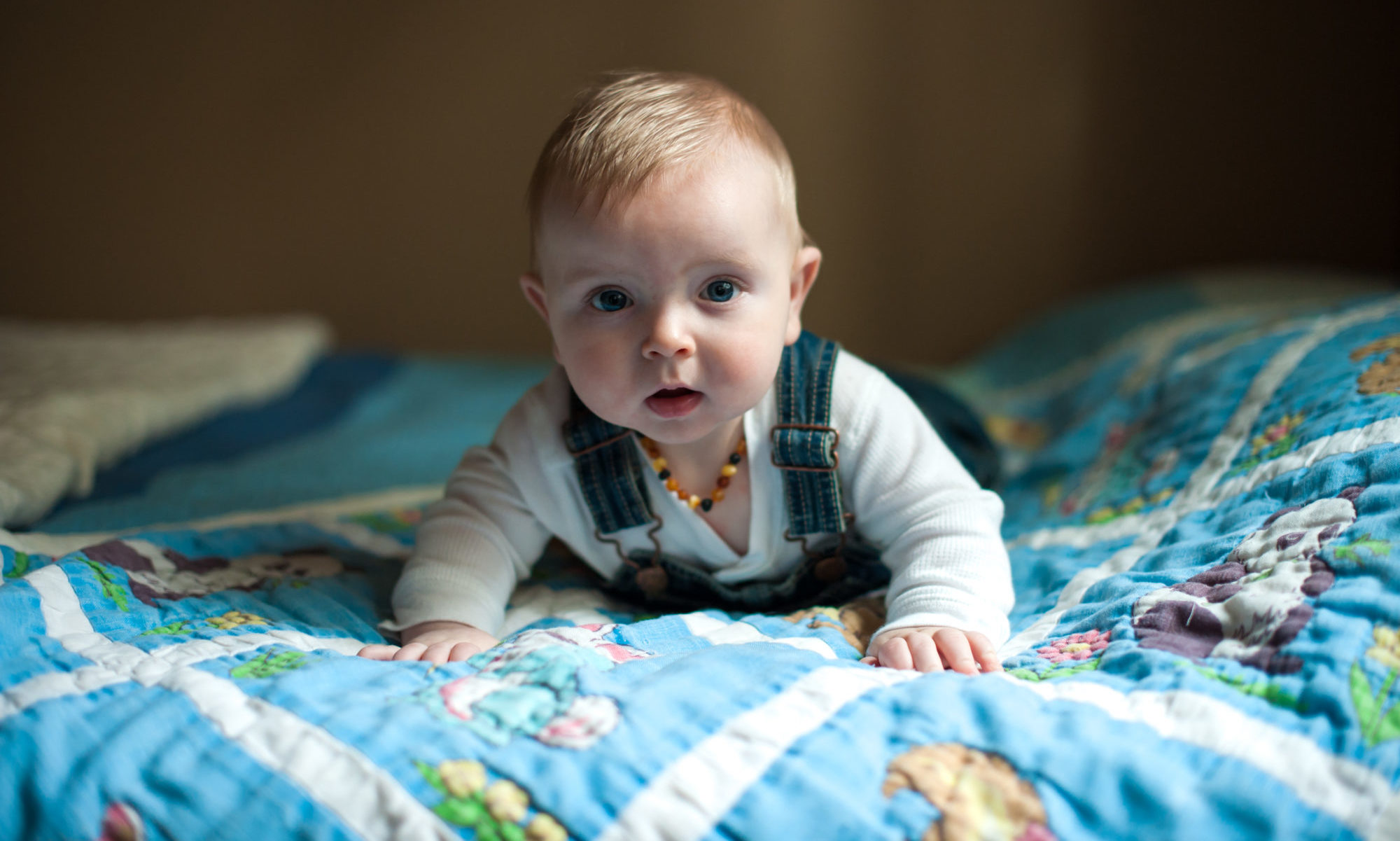
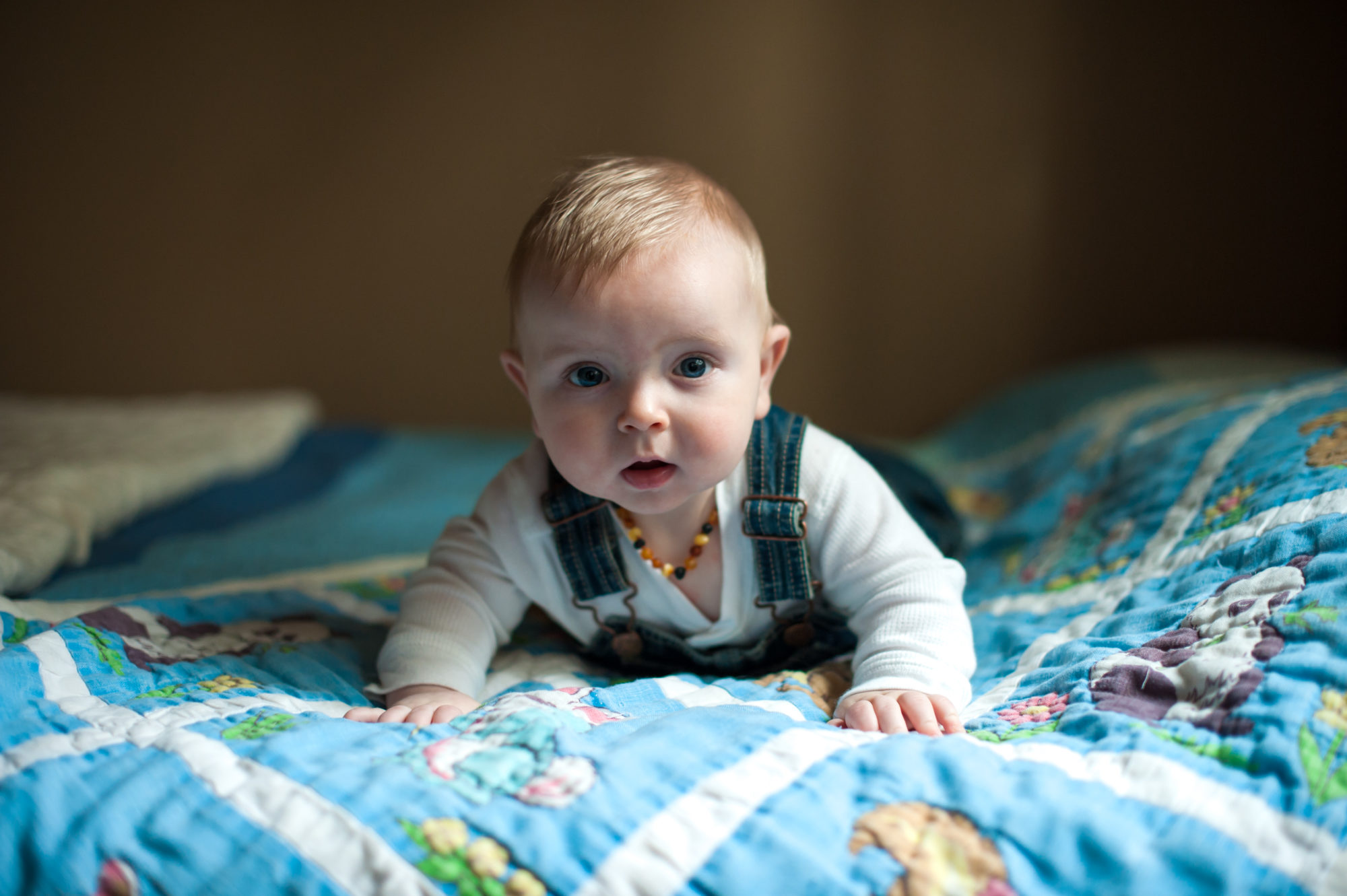
The Secret to Drastically Reducing Infant Falls

During early infancy, babies pretty much stay where you put them. My mom refers to this stage of development as the happy paperweight stage. But once babies are a few months old, they begin to move. Some infants are rolling over and scooting as early as 4 months!

Don’t fret if your baby doesn’t roll over or sit up exactly on “schedule,” every baby develops at a different rate. But once your little one does begin to move around, falls can be a big hazard.

Avoiding some falls is fairly easy, just put your baby on the floor! But at other times you might be on a low bed, couch, or in another location and it’s a good idea to develop healthy and safe habits as early as possible.

Obviously when babies reach this stage of development it is no longer safe to leave them unstrapped on the changing table and walk away or even to leave them in the middle of a large high bed. The floor is the safest place for a baby who is learning to move, scoot, and crawl.

You do also need to do some baby proofing pronto. Cover outlets (electrocution hazards), remove cords and strings (strangulation hazards), add gates to stairways, and anchor furniture to the wall.

But if you want to reduce accidental falls, show your infant daily how to maneuver off of a low bed or couch safely, and they will learn to do it themselves fairly quickly. With enough repetition, getting down safely becomes second nature.

Before I share my “secret” let’s review some infant development research. Studies have shown that new crawlers are actually quite careful not to fall. Babies who were new crawlers participated in a study in which they were encouraged by their mothers to crawl across a plexi-glass surface that had a checkerboard pattern underneath it.

When the checkerboard pattern was directly beneath the plexiglass, babies happily crawled across to their mothers. However, if the checkerboard pattern was placed 3 feet below the plexiglass, babies perceived the drop off and refused to crawl across, even though it was completely safe to do so. Even when encouraged by their mothers that it was safe to cross, nearly 100% of infants refused to crawl across the perceived abyss. I share this study to remind us all that babies do have a survival instinct and even though we think of them as completely impulsive, they really don’t want to fall on their heads.

OK, here’s the “secret” key phrase (and action) to reducing falls:

FEET FIRST

Let’s say you’re hanging out with your baby on the couch when it becomes obvious that she’s interested in a toy across the room. She reaches for the toy and in your mind’s eye you imagine her tumbling headlong off the couch after the toy, banging her head along the way. At this point, gently hold your baby’s arm or leg and say, “Feet first.” And then help her turn around and maneuver so that her feet hang down first and she can scoot off the couch feet first, facing the couch. This is always the safest way for a baby to descend.

When your baby is young, you can physically guide him safely all the way down to the floor and as he develops more strength, you can intervene less and less. But it’s very important to repeat the phrase, “Feet first,” each and every time.

If you do this consistently, you’ll have a crawler and toddler that confidently knows how to safely descend from stairs, beds, couches, and the like and you’ll be able to relax into the knowledge that he knows exactly how to get down, FEET FIRST!

My husband and I both used this technique with each of our children and I honestly cannot think of a single time that our kids fell off of anything head first when they were babies. Sure, my 3yo jumps off of things head first now to experiment with his body and its boundaries, but our babies didn’t careen off of the bed.

To be fair, we don’t use bed frames and simply put our box spring and mattress right on the floor. This is a Montessori style bed that is easy for a young child to climb in and out of independently, so if your bed is up on a frame, it may not be safe to encourage your baby to go feet first off the bed until she is tall enough to manage it.

But in general, by using the phrase “feet first” and supporting babies to descend safely, you’ll drastically reduce falls and protect your infant from many potential head injuries. I’ve used this technique with many of the babies in my care too, and it has always helped.

So here’s to a future filled with capable independence for your baby and calm confidence for you. Have a fabulous week!

Make your life easier, give kids their own drawer

When our daughter started to crawl we did what most parents do, we dashed around the house “baby proofing” everything in sight.  We moved dangerous things up or to cabinets that could be locked or secured.  I installed latches on cabinets containing cleaning products.  But as I looked around our home and imagined putting latches on every cabinet and drawer in the house, I got overwhelmed.

And then it hit me; maybe I didn’t actually have to install all those latches!  Of course, I realize that I might need to add a few as my daughter grows and gets into things more, but I came up with a solution that is working well and has caused the least work for everyone.  I gave my daughter her very own drawer.

As soon as she opened the bottom drawer in the kitchen for the very first time, I grabbed a bag, threw its original contents inside, and then tossed a few of her toys in the drawer.  I included some kitchen items like a metal spoon, a set of measuring spoons, and a plastic cup.  And voila!  She took to it like a bee to honey.

Now, whenever I’m cooking or we’re hanging out in the kitchen, she crawls right over, opens up her drawer and plays with her “kitchen toys.” She hardly even seems to notice that there are other cabinets and drawers nearby!

Office shelf

But I didn’t stop there, I gave her a drawer in the master bathroom and she occupies herself masterfully while my husband and I take our morning showers.

We have also designated the bottom two shelves of the living room bookcase to the little one, and in true Montessori form, I leave new and exciting toys on those shelves to encourage her exploration. She even has two shelves in my office that will have her “work” on them for years to come.

Sure, we also have a basket of toys in the kitchen, living room, and her bedroom too.  But she seems to enjoy her drawers even more, and I don’t have to look at the stuff inside when she’s finished, I just close the drawer!  Of course, the next step will be to teach her to close the drawers herself.  And after that, we’ll begin putting toys into the drawer and closing it when we’re about to leave the room.

Living room shelf

If you have an older child who doesn’t yet have any designated kid’s activity areas in the common rooms, I highly recommend you clear some space for your younger family members.  Then, stock their shelves and drawers with interesting activities that you’ll rotate when they lose their appeal.  And if you also provide a rug and/or a child sized desk or table that they can work at, you’ll be helping your child set up great work habits and helping yourself get some peace and quiet.  Because, when kids know where to look for an activity that they can explore on their own, they’ll go back to it again and again, and you’ll actually get some adult work done!

I would love to hear about your own solutions to support your child’s freedom and independence at home.  Please leave me a comment!

Have a fantastic week, Shelly

Guest Blog: So, Who’s Calling the Shots? And How?

brar01_kazdinThis week’s guest blog is by Kheyala:

I was a kid – a very good kid – who knew what it was like to be raised on a very short leash.  For this reason, when I had my own little one, I was more than committed to allowing her the freedom which I had been denied.  The trouble was, by the time she’d reached a year and a half, I found myself with a little tyrant running my house.  Or should I say her house!

I thought to myself, “Oh my gosh.  I cannot imagine what the ‘terrible twos’ will bring, let alone the teenage years, when this is what I’ve got to reckon with now!”  That was the moment this insight came to me; a beautiful, timeless insight that remains true to this day (she’s 12 now) and has proved since to be just as extraordinarily effective and beneficial for every other child who as fallen under my care.

I must meet this young person’s energy directly, in equal measure to what is coming at me. Not one ounce more – or I’m the bully and that’s painful to us all – and not one ounce less, or she’s the one running the show, and at 18 months she is not yet qualified to run the show!

If you tune in to your own body as well as to the child’s after having met his or her energy directly and equally, I am certain you will experience the same visceral relief that I do.  Whenever the force is met with equal measure, it neutralizes it.  The child will actually relax in that neutrality.  After all, it’s tough to run the world!

In that moment, the little person will know he or she is safe and that someone else who is wise and capable is now holding down the fort.  All is well.  And you, too, will relax in your own power-sans-aggression, your own natural place in the universe as the human being in the room with the most life experience. Continue reading “Guest Blog: So, Who’s Calling the Shots? And How?”

Setting boundaries with kids

boyIn my parenting coaching I get a lot of questions from parents about how to discipline effectively and what to do instead of time-outs, spanking, yelling and other common discipline tactics.
When I think about the word “discipline” I think it sets up a disconnecting power dynamic where I’m in charge all of the time and the kids in my life must do what I say, or “behave”, and submit to my dominance.

On the other hand, without any “discipline” I imagine complete chaos and no sense of leadership.  So, instead of discipline, I like to talk about setting boundaries.

We all need boundaries whether with ourselves, our parents, children, employers or employees.  It’s healthy to have and keep clear boundaries, but somehow, many of us have never learned to recognize, implement, and maintain healthy boundaries.

I just read the novel “The Undomestic Goddess” by Sophie Kinsella.  It was a fun read but what struck me the most about it was how few boundaries the main character had at the beginning of the book.  Samantha was a high-powered lawyer at a leading Houston lawyer firm.  She was going for partner and as a result, she was available to her law firm 24/7.  No kidding.  The woman couldn’t even put her blackberry down for an hour to get a massage!  She was the epitome of someone without any healthy boundaries and without a life of her own.  Instead, she was completely owned by her law firm!

Do you ever feel owned by your kids and family?  Have you forgotten to set boundaries and maintain a healthy sense of self?  Well this week it’s time to turn it around.  Continue reading “Setting boundaries with kids”

Trusting Kids

kid-rock-climbingIt’s easy to become overprotective of kids, especially our own.  It’s as if we can suddenly see 10 steps ahead and we KNOW that something horrible is about to happen.  But what if our children don’t actually need our warnings, fears, and concerns in order to keep themselves safe?

When I was in college I learned about this incredible study that was done with babies who had recently learned to crawl.  They were placed on a piece of inch thick Plexiglas with a checkerboard pattern underneath.  Babies crawled around easily on the surface and came to their moms who were encouraging them from the other side of the surface.

Then, babies were put on another Plexiglas surface with the same checkerboard pattern just beneath the Plexiglas for about 3 feet and then a visual drop-off; the checkerboard pattern was a few feet below the Plexiglas. All the babies were completely safe from falling because the Plexiglas was strong and supporting them, however, even with their moms encouraging them and calling them from the other side of the room, babies refused to cross onto the area where it appeared there was a 3-foot drop.  They believed it wasn’t safe, and so they stayed where they were certain not to fall.   Amazing, right?! Continue reading “Trusting Kids”