
“Back Off!” Empowering Young People to Claim Their Personal Space

Most of the stuff I write about is focused on peace, love, and compassion, but there’s a point where the best defense really is a good offense. Several weeks ago my daughter was at the library and a bigger kid ran over to her and pushed her down. His mother apologized profusely, Julia was dazed and confused, and I was left wondering, “How could I have prevented this?”

My daughter is often quiet and reserved, especially when she’s in a large group or if she’s feeling overwhelmed. And the library is usually teeming with both kids and adults when we go there for story time. So I thought about how I could empower her to stand up for herself in the face of a larger child intent on pushing, hitting, or biting her.

And then I remembered what we do when our dogs get into her face and she doesn’t like it. We say, “Back off Zoe!” or “Back off Jasper!” We had recently expanded to include our four chickens in this practice because Julia was getting scared of their pecking. So I taught her to move forward, put her hand out, and say “Back off chickens!” And it works! The animals really respond to her.

So I decided we would use this same phrasing with people who are moving toward us aggressively. When we feel afraid, we put out our hand and say “Back off!” Sure enough, after a couple of weeks of practice with the animals, my daughter was at the library with her Grammy when a larger child came toward her quickly with a puppet aimed at her face. Julia immediately put her hand out and forcefully said “Back off!” to the boy with the puppet. My mother-in-law said that all the adults were left with their mouths hanging open and the boy was just as surprised as everyone else was. He did back off and went to play elsewhere.

When I heard the story my heart swelled and I felt so proud. I am so happy to know that my daughter can protect herself from harm even though she’s not yet two years old. Although I hope she rarely has to use this skill, I think it’s an essential one for all children. To be empowered to protect oneself from harm could mean the difference between being bullied or victimized and not. Learning to powerfully say things like “Stop! No! Stay back! Don’t touch my body!” can alert others to a potential threat and often will cause predators to move on, rather than be noticed.

So how do you talk to your kids about personal space and protecting themselves from danger? Do they know what to say and do when they feel afraid? I would love to hear your story so please leave a comment below.
And have a wonderful day. Warm hugs, Shelly
Your Work/My Work

In the Montessori classrooms I’ve worked in, there are usually twenty-four children between three and six years old and just two adults. Each child has free choice of hundreds of possible activities in the classroom, and in order to maintain peace and order, we HAVE to create some rules and boundaries.

One of the rules is that we respect one another’s work. We don’t touch each other’s work, we don’t walk on someone else’s work rug, and we don’t clean up after each other. Each person is responsible for getting out, completing, and putting away their own work.

Several months ago I taught a class to parents of Montessori students and when I described the reverence and care we have for our work, a mother perked up. “Oh!” she said, “So THAT’S why my son gets so upset when I clean up his toys, he’s always complaining that I’m not respecting his work, but I didn’t understand why until now!”

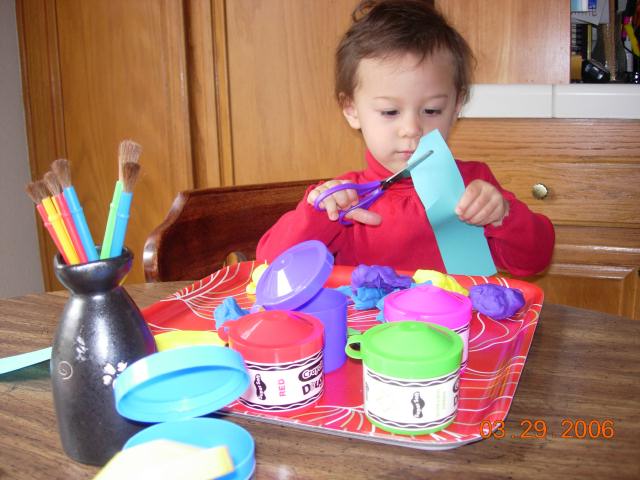
I believe strongly in Montessori philosophies and use many of them as guidelines in my home with my daughter and now that she’s approaching two years old I’m beginning to understand what a huge difference this has made in the peace and order of our home.

First, I do my best to respect her work and often ask her to clean up after herself, before offering any help. So when she leaves something out, she can reasonably expect it to be there when she gets back. This provides stability in her mind and encourages her sense of order. She knows where she can find her things and she knows that there is no magical clean up fairy.

As an aside, I actually did think that something like a clean-up fairy existed when I was a young child. I had no concept of my preschool teachers staying after school to clean up, or of my mom and dad picking up after I was in bed. I just thought things magically reappeared in their original locations!

Of course, I’m happy to help my daughter clean up if she needs support, but I don’t make a habit of going around behind her and cleaning up after her.  As a result, I overheard her with her books yesterday. She was looking at the pages and talking about the content of the book and when she got to the end of the book she said, “Back” and put the book back on the shelf!

But here’s the real kicker. I also ask her to respect MY work. That means that she understands that my work is important and I’m committed to its completion. So when my daughter asks me to play with her I will often respond with, “Sure! I would love to play farm with you, but I’d like to finish my dishes work first, so you can go get started without me, or you can watch me finish my work, and then I’ll join you!”

One of the things I love about this is that she’s learning that life is filled with “work” that people enjoy and want to complete before moving on to new tasks. This promotes the concept of follow through while it also helps her to delay gratification while she waits for me to join her in her chosen activity.

I know without a shadow of a doubt that my daughter understands that her wellbeing is my top priority. And, I also want her to know that my own wellbeing is hugely important to me as well. The order of my environment helps me to feel peaceful and relaxed so that when I do sit down to play with her I can completely focus on her, rather than constantly thinking about my enormous to do list and only giving her my partial attention.

I’m sure I’ll write another post about organization and it’s psychological impact on us, but for now I’ll just say, it’s OK to let your child know that you have work to do when you’re at home. If we model respect for their work, they’re bound to learn to respect ours too. And when we honor and respect one another’s work, peace and love have plenty of room to thrive.

So, how do you balance playtime with work time at your house? I would love to learn some of your secrets to success in this area! Please share a comment below.

And have a fantastic week, Shelly

Understanding willful toddlers

I’m generally a happy and optimistic person.  Don’t get me wrong, I’ve had dark moments, but for the most part I enjoy my life and am grateful for it.  However, when I’m with a toddler who seems intent on pushing my buttons, I am hating life.   It seems like no matter what I do to please the little tyrant, I’m still fending off testing behavior hour after hour.

Here are a few empowering thoughts, assumptions, questions, and some dialogue that have helped me change gears and reconnect with a young person after I’ve felt frustrated or hurt:

Q: My 20 mo. old son is throwing things in clear defiance of my wishes.  It seems like he WANTS to upset me.

New interpretation: He’s just asking to play.

Challenge: How can we make it a safe/fun/mutual game?

Inside Shelly’s head:

Oh no, he’s going to throw that.  “Stop!”, He throws it anyway and aims at something breakable but misses.  “Wow, I’m so glad you aimed away from the flower pot!  That flowerpot is fragile and breakable and it would be expensive to replace it.  Hmmm, I wonder what would be good to throw something at…Oh!  I know!  Let’s throw beanbags into the special hole we made!  I want the red beanbag, which one do you want?  I’m going to throw it into the hole.  Can you make it into the hole? C’mon!  Let’s go get the beanbags!”

Q:  My 18 mo. old daughter uses a blood curdling scream when she wants attention and sometimes for no reason that we know of. Continue reading “Understanding willful toddlers”

Holiday family time

Ahh, the joys of the holidays, we get to travel far distances and celebrate with people we may or may not like very much, all in the name of family togetherness.  Luckily for me, I adore pretty much everyone in my family, but I know that’s not the case for everyone.  And even though I love my family, the stresses of traveling with a baby are not something I’m looking forward to.

I’ve heard from my clients that the holidays are often more stressful than fun and tend to disrupt children’s routines and rhythms, making it difficult to get back into the groove once they return home.  I’m not sure what there is to do about that except to try your best to stick to the routine as much as possible even when you’re in a different time zone.

I do, however, have some great tips for how to handle potential conflicts that may arise after everyone has a few drinks under their belts, and how to deal with the “suggestions” you’ll inevitably encounter as your family members observe your parenting style.

For starters, get clear about why you’re doing the things you’re doing BEFORE aunt Margie tells you about how when she was raising her kids she swatted them with switches and they never “back talked” again.  Here are some ways to maintain your own parenting style and share it with your family compassionately. Continue reading “Holiday family time”

Three ways to stop yelling and still be heard

Although we’re all aware, caring, conscious parents, you know as well as I do that there are times when we lose control and we find ourselves saying the very words we swore we’d never say to our kids. I’m sure there have even been times when you *gasp* yelled at your kids. So, what can you do instead of yelling when you want to be heard and your little ones seem completely oblivious to your existence? I’ve got three great strategies, new things you can do in moments when you’re about to yell or scream. So, try these and let me know how it goes!

Strategy #1 Whisper

I know it’s counter-intuitive, but it’s also like using reverse psychology. When you walk up and whisper in your child’s ear, they will be compelled to listen and become quiet themselves (so they can hear you). I’ve been shocked by how well this has worked in the classroom and in a house full of kids. I think it’s because Continue reading “Three ways to stop yelling and still be heard”