
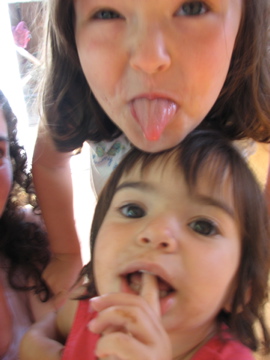
Is Big picking on Little?

Siblings. They can play well together, enjoy one another, and be super sweet to each other, and then in an instant the tables can turn. Suddenly you’re rushing to the aid of one child, admonishing the other, and feeling frazzled and confused about what really happened.

A LOT can happen in an instant, and it’s unrealistic to think that you can be there in every moment. So, what can you do to foster a healthy sibling relationship and what is the appropriate response when things go haywire?

If your kids are experiencing some difficulties in their relationship the very first thing to do is to consider the big picture. What is the overall feeling between them? Does your younger child feel afraid of your older child? Does your older child seem to feel jealous of attention the younger child receives?

Once you’ve identified the overall tenor of the relationship, from your perspective, consider talking to your kids about their friendship. Ask them how THEY feel their sibling treats them. Really take their feedback into your overall image of what’s really going on.

Next, consider the past week or two. Can you identify the specific triggers to the behavior you don’t want? For instance, have you noticed that every time you’re reading a story to your younger child, your older child runs up and hits him? Or does your younger child tend to invade your older child’s space resulting in a conflict?

As you think about the conflicts of the past week or month, be sure to consider all sides. Avoid the temptation to blame all conflicts on the older child, just because she’s older. Sometimes, the behavior of a younger child can be the triggering event too. And, any time you find yourself thinking that one child is the culprit and the other is a completely innocent bystander, stop yourself.

Most often there’s a dynamic between the two (or three) that needs to shift and if your beloved child feels that you’re taking sides against her, she may feel hurt and betrayed. Instead, try to empathize with both parties.

Now that you’ve identified some specific triggers to behavior that doesn’t work for you, you’re well on your way to fostering a kind and caring relationship between siblings.

So, if you’re clear about what the triggers are you have a few choices.

You can: 1) Prevent and avoid the trigger altogether by

a) identifying and addressing the unmet needs of the aggressor or

b) letting go of unrealistic expectations and creating a more doable scenario

2) Offer an alternative to the negative behavior that is even more fun

3) Be a safe haven for a frustrated or fearful child

Here’s an example. Let’s say Ben is hitting his little sister Sally, whenever she comes near his action figures. You can prevent the conflict by realizing that when Ben plays with his action figures he’s needing space and safety, he wants to know that his sister isn’t going to mess up his game, so you can invite him to play in his room with the door closed, or give him a rug to indicate his play space and then help his sister respect his space.

If Sally isn’t able to respect his space when he’s in the shared living space, then putting a closed door between them is a great way to help her. Or, you could invite Ben to play at the kitchen table where Sally can’t reach his toys. Alternatively, you can invite both kids to dance and sing with you in the living room instead of playing with action figures, or maybe they’d like to play a dress up game and put on a play for you.

And lastly, if Ben knows that he can come to you when Sally interrupts his game, and you’ll actually help him figure out a way to continue his independent play, he’s more likely to call out to you or come and get you, rather than hitting Sally. One the other hand, if he knows he’ll get the half baked response, “Why don’t you just let your sister play?” then he feels he’s on his own and has to do whatever it takes to protect his game.

I’d better wrap this up for today, but I would love to hear about what’s happening for you and what works or doesn’t work at your house!

Have a fantastic week, Shelly

Why rough housing is good for kids

I get a lot of questions from concerned parents about rough housing, wrestling, and other physical play. Dads want to know if it’s OK to wrestle with their kids, and moms are concerned that somebody will inevitably get hurt. Often it seems that physical play of this sort does end with the younger or smaller child in tears. But as I was doing research for my thesis in 2007 I ran across some studies that changed my mind about so called “rough housing.”

One study in particular stands out in my mind. It was conducted on a playground where researchers observed boys playing a tackling game. Researchers thought that they would find the game to be violent and detrimental to kids, but they actually found just the opposite. They observed that in playing this seemingly violent game, rarely did anyone get hurt, and when someone did get hurt, the other boys reacted with caring and compassion toward their fallen playmate.

And, after failing to find what they were looking for, the researchers changed their tack and began to look for behaviors that showed kindness and caring, such as a pat on the back, a hug, or helping one another get up. They quickly realized that the vast majority of the interactions between the kids on the playground were those kind and caring gestures!

In fact, they further realized that it was because of the seemingly violent nature of the tackling game that kids were given more opportunities to offer a helping hand or a hug than they would have otherwise. So that’s when I realized, that with some clear ground rules, wrestling between kids or between kids and adults could actually be a really joyful and beneficial activity for everyone involved.

So the next time your child runs to you crying, “My brother hurt me!” you can see it as an opportunity to nurture and comfort your child (which builds your connection) AND as an opportunity to show an older child how to take even better care of his younger sibling (which will build their connection).

Now, I’m not recommending that you force your older child to offer disingenuous nurturing, rather, that you model for your children how to care for one another. I also think it’s useful to keep in mind that there have likely been lots of other moments when the older sibling did take care of the younger one, that you might not have seen. Of course, the opposite can also be true.

So, if you’re not sure what’s really going on between your kids, take some time to observe them together and keep a tally for yourself. How many times did they touch or hug in a loving way? How many times did they touch in a hurtful way? What was your favorite moment? Why? What kinds of things did they say to each other? Ideally, you would tuck yourself away in a corner and seem to ignore them, so that they can play normally, forgetting that you’re even in the room.

But do be careful not to allow your preconceived notions or biases to show up in your observations. An observation should be completely neutral and without judgment, such as “Carl jumped on the bed and Henrietta fell off,” rather than “Carl viciously knocked Henrietta off the bed.”

I mentioned ground rules earlier and here are the ones I like for wrestling and rough housing at my house:

1) We stop if someone gets hurt and help them

2) We stop when someone says stop

3) We only use our bodies and pillows (no hard objects)

4) We stay on the carpet or bed

I’m so curious, have you found rough housing to be a connecting activity at your house? What are your ground rules? Please share your wisdom with us!

And have a wonderful week, Shelly

Sleep more, learn more

Wow, this week has been all about sleep research.  I’ve been reading “Nurture Shock” by Po Bronson & Ashley Marryman and whoa, the new sleep research is startling!  I also watched a Nova special on sleep, and then last night my husband and I watched an episode of Star Trek Next Generation where the whole crew suffers from sleep deprivation due to lack of REM sleep.

It’s all pretty interesting stuff, so here’s what I’ve learned so far…

1)     We dream in all stages of sleep, not just REM sleep and scientists think that REM sleep dreams are specifically designed as practice to help us figure out how to handle emotionally difficult situations.

2)    Children today get an hour less sleep per night than children did just 30 years ago.

3)    Just 15 min. of extra sleep at night has been shown to give kids higher cognitive functioning, better test scores and better grades in school.

4)   A LOT of the symptoms of both ADHD and clinical depression are identical to symptoms of long-term sleep deprivation.

5)    A lack of sleep causes chemical changes in the body that may be the underlying cause of the obesity epidemic here in the US.

6)    Sleep is crucial to learning and if allowed to sleep in between lessons, subjects show marked improvements in newly learned skills.

7)    While adults only spend 4% of sleep in the slow wave stage of sleep, Children spend almost 40% of their sleep there.

Clearly, there’s a LOT going on regarding sleep and the optimal functioning of our amazing brain.  From our own experiences we know that sleep is crucial to learning.  Haven’t you ever learned something new and then gone to sleep and dreamed about it all night long?  Well, the research bears out this intuitive knowledge that sleep is crucial to learning.

So, why are kids getting less sleep?  Well, I have some theories.  First, screen time and bright lights at night have been shown to disrupt our circadian rhythms, so kids are having a harder time falling asleep because they’ve recently been exposed to bright lights or screens.  And then there’s the fact that so many working parents are working such long hours that they barely get to see their kids in the evening.  So parents are keeping their kids up later so that they can have some time together during the week.  And children don’t seem to be complaining.  Obviously they will try to stay up as late as we will let them, not realizing the long-term consequences of sleep deprivation.

So, as conscious, aware parents, we have got to put our children’s long-term health and well-being above our momentary desire for fifteen more minutes with them at the end of a long day.  Now that we have this new, proven knowledge of the importance of sleep, it’s our job to take action.

We need to reclaim the “lost hour” and boy will we be glad when we have.  After taking a good hard look at the research, I’m convinced that by putting sleep first, we’ll all end up with happier, more focused, higher functioning, and better adjusted kids.  And what could possibly be more important than that?

Have a restful week, Shelly

Nursing, co-sleeping, and having great sex

I’ve been reading a bunch of stuff online lately about nursing and co-sleeping becoming a wedge between parents and negatively affecting their sex lives.  Sure, sleeping with a baby causes us to change the timing and sometimes the location of sex, but my husband and I have found a great way to keep romance alive while I’m nursing and co-sleeping with our daughter.  We like to call it “date nap”.

I had thought that my daughter would be a more sound sleeper than she is.  Both her father and I LOVE to sleep, but she seems more worried about missing out on things than concerned about her beauty sleep and she tends to awaken at least once and sometimes several times in the evening.  Since I often nurse her back to sleep at that time, having a date night and leaving her with a sitter, hasn’t been an option that I’m willing to try.

Honestly, these days I’d really rather be home with my daughter than out on the town, but skipping date night all together sounds like a recipe for disaster in our marriage.  We absolutely love spending time just the two of us.  So, we came up with a solution that works well for us- date nap.  Whether it’s during the day on the weekend or in the evening after she’s in bed, my husband and I watch movies, soak in the hot tub, talk, and have sex, while our daughter peacefully sleeps.

I can see how this would become even more challenging if we had an older child who was no longer napping, but I still think that if we prioritize our romantic relationships, we can enjoy thriving sex lives AND raise confident, self-assured, well attached kids.   That is to say, I can continue to nurse on demand and co-sleep with my daughter without jeopardizing my marriage.

In fact, my husband is just as committed to our nursing and to everyone getting the best possible sleep as I am.  So he’s willing to get creative about our love life in order to ensure the best start for our daughter.  If I’m honest, I think he actually enjoys the fact that we have to sneak around and sometimes end up in unusual locations.  It’s always a good idea to change things up once in a while, we wouldn’t want to get into a rut!

So this week, take stock, is your sex life suffering because of your commitment to your kids?  If so, is there a way you can integrate great sex back into your life even while you remain true to your parenting values?  I would love to hear what you think about “date nap” and would enjoy any other suggestions you have for keeping your sex life alive and vibrant while raising kids.  Please leave me a comment.

Have a wonderful, sensual, fun, and connected week, Shelly

P.S. If you’re in the SF Bay area (or are willing to travel there), my friends Erwan and Alecia have a fantastic live course called the Pleasure Course that will completely transform your sex life and help you experience more connection and pleasure than you ever knew was possible.  Seriously, these guys are the real deal.

It’s OK to cry

“Dagny III” by Christee Cook

Have you ever noticed that when a child cries, often the first things out of our mouths are things like, “You’re OK” (minimizing their experience) or “Oh no! Don’t cry!” (asking them to deny their experience) or even, “What’s wrong?!” (asking them to think about and describe the upsetting event).

None of these acknowledge the child’s feelings or provide an open, loving environment in which a child can fully feel and express his emotions. I know, it’s an unconscious reaction we have all had at one time or another, but this week it’s time to shine the light of awareness on the way we speak to an upset child.

So, if we could choose exactly how to respond, how would we? We might say something like, “I see you’re upset, do you need a hug?” or “Wow, that was really scary, wasn’t it?” or one of my personal favorites, “It’s OK to cry.”  We might even choose just to sit with them and witness their emotional expression.

I especially wish more boys were told that it’s OK to cry, because after all, it really is OK! In fact, people who are in touch with and at peace with their emotions will fare better in life than those who deny or stuff their emotions.

Studies have shown that holding in emotions like anger, frustration, and resentment, can have long term negative effects on heart health. So, by encouraging kids to acknowledge and express their emotions, we’re helping to ensure a long and healthy life for them both physically and emotionally.

On the other hand, it can be uncomfortable for us to listen to a child who’s crying, wailing, or raging. But I think that’s because we all have our own withheld emotions that we’re fighting to keep hidden. If we felt free to express our emotions as they came up in the moment, we might not feel quite so uncomfortable when our children cry or scream. I’ve certainly found this to be the case in my own life.

For a long time I was uncomfortable with sadness. I didn’t acknowledge my own, and I definitely didn’t want to be around others who were upset. I did everything I could to soothe, redirect, or even ignore any sadness that I came into contact with. And then something shifted for me.

I was hanging out with some close friends of mine, and one of our friends just started to cry. I was a little bit uncomfortable, but I was more fascinated with how unashamed she seemed about her sadness. Pretty soon the crying turned into wailing and I realized that except in movies, I had never actually seen anyone wail! I was moved to tears myself and I came away from the experience realizing that expressing sadness could be deeply moving and beautiful.

I’ll never forget how my friend looked afterward. She was so open, beautiful, free, and light. I had never seen her look so gorgeous and so at peace. So I decided that sadness wasn’t actually something to be avoided at all costs. I realized that in fact, crying could be a relief and a release. And I began to allow my own tears to flow more freely.

I like to imagine my emotions like a big pipeline. When I was holding them in, my pipe was clogged and just a trickle of emotions was getting through. But after practicing to express and celebrate my emotions as they arise, I’ve opened up my pipeline and now all my emotions can travel through it with ease. Now I feel everything with more intensity and I love it!

I am able to cry in an instant, if I’m moved to, but I can also laugh more authentically and have even experienced tears of joy (which I used to think was a bunch of hooey).

Wouldn’t it be amazing if our children never had to go through the process of suppressing their emotions and then rediscovering them? What if they could feel and express their feelings without interruption for their entire lives?  I sure hope for that for my daughter.

So this week, pay special attention to how you automatically respond when a child is upset. Then make a conscious choice about how you WANT to respond and practice it. I would love to hear your thoughts and experiences, so please leave me a comment below.

Have a wonderful week, Shelly

P.S. If this topic is dear to your heart, check out my audio program Perspectives on Feelings for a more in depth discussion of holding space for big emotions.