
How to Quickly and Easily Reduce Screen Time

We’ve all been hearing about the ill effects of screen time on developing brains and each of us have a slightly different way of dealing with the information. Some people argue that the research isn’t in yet (there is actually quite a bit of research on this topic and most of it is quite disturbing), others are convinced that it couldn’t be nearly as harmful as the researchers purport. Some parents claim it’s their only break, and they really really need a break, and trust me, I hear you on that one.

But the truth is that we humans didn’t evolve to sit still for hours watching a screen, and when we do so as young children, it really does negatively impact our brain development. Attention span goes down, emotional regulation and control is negatively affected, self-control and the ability to plan ahead are impacted and even if we don’t want to admit it, we all know that our kids are not their best selves after a few hours of watching television. A lot of the current research is showing that it may not necessarily be the screens themselves, or even the content of shows, rather it’s the lack of social interaction that most negatively impacts kids.

Because of all of this, my son’s preschool has recommended that the students attempt to have a “screen free April.” At first I thought, “There is no way we can make it the whole month without a single show.” But then I heard about the incentive. The head of school has offered us $$ off our May tuition if we can make it through the entire month without using screens with your 3 year old.

Once I knew about the incentive, I was motivated. And as it turns out, my motivation was all we really needed to reduce our kids’ screen time drastically. I’m embarrassed to admit that my kids have very easily transitioned and it has actually been harder for we adults to give up our “free time” than it is for the kids to adjust to zero screen time.

Zero screen time?!!

To be fair, we already had a maximum of 2 hours per day and they typically didn’t watch that much even before the challenge, but I was amazed at how quickly both of our kids adjusted to the zero screen time challenge. After just a few days, they both completely stopped asking for shows!

Last weekend my daughter came down with a stomach bug and I nearly caved. Being sick with a fever and upset stomach without the option to zone out in front of the TV just sounds like torture to me, but after asking my husband and friends for some support, we decided to tough it out and I am so glad we did!

On day 15 and my 7-year-old daughter announced, “It’s a lot easier to live without screen time than I thought it would be!” OK, so here are the 5 simple things we’ve done differently during screen free April. I am surprised at how little effort these alternatives are actually requiring and more than a little bit embarrassed to admit that I’ve been the one driving my kids to the screen, even though I know full well that it’s not good for their development.

#1 Books on CD from our local library-

I ran over to the library and picked up about 10 chapter books on CD and this has been the #1 favorite screen time alternative for both my 7 and 3 year old. The two of them will spend hours together just listening and drawing or coloring. It’s really sweet to see them connecting in this way. Podcasts could serve a similar purpose but we prefer the low-tech option.

For extra credit, ask your kids about the plot to ensure that they really understand the story line or ask specific questions about the book, characters, or action to help them gain a deeper comprehension of the content. Historical fiction has started some very interesting conversations at our house this month!


#2 More time outside

More time in the back yard, more parks, and more walks by the river. This one does take a little bit more effort and planning, but the positive impacts of nature on our physiology greatly outweigh the hassle it is to actually get outside. We’re going to make an effort to keep this one going even after we re-introduce screen time.

Some highlights so far have been the nature art that my kids and I created at the base of one of our favorite trees, placing bird feed in our back yard and then watching the birds from inside with binoculars and discussing them, creating a natural shelter for our garden gnome, and hearing the kids talk excitedly about how they walked “all the way” to the high school with Grandpa (it’s only about 5 blocks from our house, but they had never done it before!).

#3 Art

Cover the kitchen table with newspaper, add a few sheets of paper, some markers, crayons, colored pencils, or paint and then sit back and supervise your children’s creative genius at work! Or jump in and create with them. Art is hugely therapeutic, so this one is going on the “to be continued even after April” list. The only problem we’ve had with this one is that they don’t want it to end and eventually we need the table back for dinner!

A friend of mine also suggested playing with modeling clay and I am constantly amazed at how long my children will sit and play with their clay. They trade colors with each other, help each other, and enjoy destroying their creations almost as much as making them! If your child is still putting things into her mouth, you may want to use play dough instead. While the clean up is a bit more intensive with play dough, toddlers sure do love the texture and feel of it, and it helps them develop manual muscle control which prepares the hand for writing later.

#4 Board Games

I’ll admit, I really don’t enjoy board games, I’m more of a puzzle person, but since we’ve gone screen free I have seen the grandparents bring out more board games, dominoes, the marble track, and other toys and games that engage the imagination. I’m always amazed at how much my kids enjoy winning a board game. We do have a few cooperative board games that I enjoy a bit more than the competitive ones. Hoot Owl Hoot is a big favorite of my 3 year old’s.


#5 Imaginitive play

The ability to play imaginary games is quickly becoming a lost art of childhood due to the overuse of screens and technology. Unfortunately, this skill is incredibly important to proper cognitive development and the development of the prefrontal cortex. Self-control, planning, and many of our higher cognitive functions rely on our ability to imagine and plan for multiple possible scenarios. This is part of the reason that the storyline curriculum is so successful.

Since we’ve cut out screens, my son often asks, “Will you play with me?” and then happily engages in whatever type of play we’re up for. Playing catch has been a big hit, but I’ve been trying to engage his imagination more and I can already see a positive result! After a couple of weeks of playing a few different imaginary games I now hear him playing by himself more often. He describes the situation to his stuffed animals, talks in different voices, and creates elaborate story lines.

I am feeling so grateful that my son’s Montessori preschool has challenged us to a screen free April! Without the challenge (and the incentive) I wouldn’t have realized how unnecessary much of the screen time was and how much more we’re connecting with each other, now that we’ve cut it out. This is going to give me much more of a backbone when it comes to saying no to screen time in the future too. Now that we’ve developed so many great alternatives, and we’ve broken the habit, I’m guessing that my kids will be asking much less often and watching considerably less.


5 Habits that Make Parenting Easier

Parenting can be the most wonderful and the most challenging experience of our lives. Things that used to seem easy, like getting to an appointment on time or grocery shopping can become all but impossible. We can easily slip into bad habits that create tension, power struggles, and conflict with the very people with whom we most want to connect, our family members.

The good news is that there are also some really good and positive habits that you can begin to practice that will make every aspect of parenting easier and more fun. And once you’ve engrained these into your life, the daily struggle becomes far more bearable and the moments of joy and ease continue to increase.

Here’s a list of the five habits I most rely upon to make my life as a parent easier. These habits help promote cooperation, connection, and may even get you some down time, imagine that!

1)  Warnings for EVERY transition

If there is one thing that makes time with children easier, it’s offering warnings about upcoming events. I know it sounds simple, but it really makes a huge impact.

When I started working with kids as a nanny, I didn’t have this habit, but I soon learned its value when my time with children went from a constant battle at every transition to a smooth and easy transition almost every time.

The trick is to get into the habit of offering a 10 minute, 5 minute and 1 minute warning before EVERY transition. About to have dinner? Offer warnings. Headed out to the store? Warnings. Almost bath time? Warnings.

When you get into the habit of offering these warnings about upcoming transitions, children learn that they don’t have to immediately stop what they’re doing. Instead, they have the opportunity to wind down their play or art project and they are often able to get on board with the next item on the agenda. And even when they’re not able to say yes to a trip to the grocery store, at least they feel honored and respected by your attentiveness and dedication to the warning system.

 2) Regular Sleep Schedules

Sleep deprivation is a very real culprit when it comes to maintaining a positive mood and being willing to cooperate with others. This is true both for you and for your kids. When we are sleep deprived, we’re just not as resourceful, happy, or able to adjust. And kids need a LOT of sleep.

My favorite book on sleep is “The No-Cry Sleep Solution” by Elizabeth Pantley. One of the many things I love about this book is that it contains charts so that you can get into the habit of recording your child’s sleep. What I like about this is that it can be a reality check. You may think your 3 year old doesn’t need a nap any more, but depending on how much nighttime sleep she’s getting, she very well may. There’s a great chart in the book that lists the amount of sleep children need based on their age and how most kids break up their total sleep between nighttime sleep and naps.

The great thing about getting into a regular sleep schedule is that your child’s body will learn when naptime and bedtime are and getting them to sleep becomes easier. My daughter will often even say, “I’m tired, I think it’s naptime Mommy.” We rarely have a struggle at bedtime and I think that’s because our routine is so consistent that it just seems like sleep time around 7pm.

 3) Gratitude, Kindness, & Appreciation

It’s easy to fall into the trap of negativity, always pointing out the things our children are doing wrong, but this habit rarely helps a child snap out of it. In fact, by putting attention on the things we don’t want, we’re actually conditioning our kids to do more of those things. After all, that’s what gets them the attention they so desperately need. You see, children don’t consciously distinguish between positive and negative attention. They just know on some fundamental level that they need attention, and either kind will suffice.

But when we can get into the habit of appreciating what we do like, noticing the things we’re grateful for, and treating our kids with gentle kindness, they blossom before our eyes. I don’t mean we should ignore bad behavior entirely, just that when kindness and appreciation are our habit, we’ll naturally get more of the behavior we want and less of what we don’t want.

That’s because children are hard wired to seek our approval, after all, they rely upon us for their very survival. They deeply WANT us to be pleased with them, even in the times when it seems like they’re doing everything they can to push our buttons. So, instead of seeing the boundary pushing as an attempt to rattle you, begin to see it as a request for connection and safety. Your child is saying, “Will you still love me, even if I misbehave?”

The more we can reassure our kids that they are innately wonderful and deeply loved and appreciated, the less they’ll need to test or challenge us at every turn. Of course, there’s a certain aspect of testing behavior that is just personality based. Some kids will push our boundaries more frequently, regardless of how often we remind them that they are unconditionally loved. And most kids are incredibly sensitive to our energy and will know just how sincere our appreciation and acknowledgment really is. I think that kids who test us more often just need even more gratitude, appreciation, and acknowledgment for the qualities that we most enjoy.

4)  Asking for Help

I don’t know about you, but I have a tendency to do it all myself by default. I somehow think that it’s normal to do child-care, buy the groceries, put them away, clean the kitchen, cook a healthy meal, feed my family, put away the leftovers, and play a game with my daughter while I’m doing the dishes. That. Is. Not. Normal. Or at least it shouldn’t be.

Yes, you may be a stay at home mom or dad or a single mom or dad. You might not have family members that live nearby. But no matter what your circumstances, the old adage, “It takes a village to raise a child,” is still true. We MUST get into the habit of asking for help. And that includes asking our kids for help.

Believe me when I tell you that it’s in your child’s best interest to be a contributing member of your household. And if you do have a partner at home, it’s crucially important that you ask for support when you need it, and sometimes even when it would just be really nice. A recent study found that couples who did chores together were more satisfied with the division of labor and had greater marital satisfaction than couples who did chores separately.

And if you don’t have a partner at home, developing the habit of asking for help is key to your survival. By asking friends and family members to help you, you’re expanding your circle of connections and offering people the opportunity to contribute to you. That’s exactly what creates a feeling of community and helps you keep your sanity. Yes, sometimes it’s difficult to ask for help. Do it anyway.

5) Daily Snuggles

Maybe this is my primary love language, physical touch, speaking here, but snuggling up with my daughter is one of the highlights of my day, every day. By making daily snuggles a habitual part of our daily routine we both fill up our love tanks and remember what’s important to us. When her little arms reach around my neck and she says, “Mommy, I love you TOO much!” I simply melt. These moments are what make all the hard work, sacrifice, stress, and difficulty of parenting 100% worth it.

Make sure you get your tank filled on a daily basis. And if you’re not sure what it is that fills up your tank, think about the moments when everything feels good and right. And make more of those moments. Build them into your day so that they become a habit. And then go back to those wonderful moments in your mind, whenever you start to feel stressed or freaked out.

So, there you have it, my five habits to help make your parenting journey easier and more enjoyable for everyone. I hope they work as well for you as they do for me!

Have a fantastic week and please share your own ideas for habits that make parenting easier.

Photo by Heidi Thomas Thomasandvelophotography.com

The Secret to Improving Your Child’s Attention Span

The way to help children improve their attention span is counter-intuitive. You might think that giving children tasks that require their continued attention would help. Or maybe challenging them to accomplish long and complex sequences will help memory and cognition, improving attention span. But the current research is showing something counter to what we might think.

In fact, research shows that allowing kids to have unstructured playtime can actually improve their ability to focus on a task. In the book “Nurture Shock” by Po Bronson I learned about a kindergarten program which encourages children to choose a character to play in an imaginary play scenario that lasts for several hours. Researchers found that the children who were able to remain in character did better on later academic tests than children who were taught their letters and numbers instead of engaging in imaginary play.

The real take away here is that imaginary play and unstructured playtime are tools that children use to learn real life skills that will benefit them forever. It might seem like “child’s play” to us, but to them, this type of play involves acting out potential scenarios, doing scientific experiments, and using critical thinking skills.

So what’s the secret to improving your child’s attention span?

Offering them big chunks of unstructured time to explore their own interests and engage in imaginary play.

Our daughter Julia wakes up at about 6:30am every day of the week and lately I’ve been helping her get to the bathroom and then climbing back into bed with my husband on the weekends. For several weekends in a row Julia has happily played by herself and allowed us to sleep in.

One morning she found the box of stickers and this is what she did:

The Secret to Improving Your Child's Attention Span

DSCN2130


I was impressed and here’s why. Not only did she use her fine motor skills to get each of the tiny stickers off of the sticker paper and on to her robe independently. She focused on this task for well over an hour without interruption. She put over a hundred stickers on her robe one by one. And she’s not yet three years old. I think we’re on our way to a very well developed attention span!

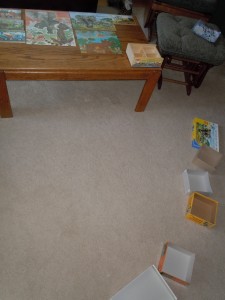
The following weekend she impressed me even more. Here’s what she did while we slept:


DSCN2141

DSCN2140

I love the way that she displayed her finished puzzles and the fact that she also lined the boxes up on the floor was interesting too. And just for the record, this is four 12 piece puzzles, two 24 piece puzzles and a 35 piece puzzle. And she didn’t wake us up for help even once.

So what does your child like to do when given uninterrupted alone time?

When Julia was smaller she would spend up to an hour looking at books in her bedroom. Sure there was a huge pile of books on the floor afterward, but she had entertained herself for an hour…with books! And we did work on putting them away together, so now, she happily puts away most anything she plays with.

Just a quick disclaimer here, safety is very important any time you’re allowing young children to have time alone without direct supervision.

Please make sure that the environment is free of hazards whenever you leave your child alone.

There’s one more secret to helping your child expand his attention span, remembering not to interrupt his work. Again, while it might just seem like meaningless play to us, children are engaged in the work of becoming the adults they hope to be. When we remember to respect their time and attention by refusing to interrupt when they’re engaged or by simply waiting for them to approach us, we’re helping them learn more independence and encouraging their natural urge to go deeply into the subject at hand.

If every time a child becomes engrossed in something he gets interrupted and asked to do something else instead, he’s not as likely to develop a deep and long lasting desire to dive in to his own interests. Instead, he may become overly attuned to the needs and desires of the people around him, believing that it’s more important to do what others require of us than it is to develop our own driving interests.

Oh, one more thing I forgot to mention, screen time does NOT count as independent play. In fact, excessive screen time has been linked to shorter attention spans and an inability to focus on real world tasks. So, if you’re in the habit of using the screen to get some time to yourself, I hope you’ll consider some other options.

So this week your challenge, if you choose to accept it, is to allow your kids to have some extra alone time, unstructured playtime, and wide swaths of time when they’re not interrupted. You might be as surprised by the results as I was when I woke up to that table full of puzzles.

Have a great week, Shelly

7 Keys to Getting Kids to Listen

Isn’t it amazing how selectively our kids listen to us? If they don’t like what they’re hearing, they have an uncanny ability to tune it out and engross themselves in a book or toy instead. I’m sure you’ve experienced this universal kid skill. The thing is, it’s not just children who tune out. We do the exact same thing to them all the time. In fact, I’m guessing we’re where they learned the skill in the first place.

Not a pretty picture, but a good place to begin if we want our kids to truly listen and respond to us when we speak to them.

1)   Listen to children—

Good listening skills are not innate, they’re learned, just like any other skill. Children don’t naturally understand that it’s considered disrespectful to avoid eye contact. They’re just doing what comes naturally to them, avoiding conflict or confrontation.

By modeling good listening skills to your child, you’re showing them exactly what you’re wanting. And since kids are hard wired to imitate their parents, they’re already more likely to listen well and respond respectfully when they’re exposed to those behaviors every day.

So the next time you find yourself tuning out as your child is telling a long involved and possibly nonsensical story, breathe, relax and give him your complete attention. Make eye contact, and give the appropriate social signals that you’re engaged. You might even want to ask some follow up questions just to be sure you heard correctly.

2)   Practice Compassion—

Rather than taking “not listening” as an affront, considering it rude or disrespectful, try to see it for what it is, a genuine attempt to keep the peace.

If you think about the specific times when your child is most likely to employ the avoidance strategy of “not listening,” you may see a pattern. He avoids listening when you ask him to clean up his toys. Or she won’t make eye contact after she’s hit her sister. Most often, children are attempting to avoid conflict, embarrassment, added work, or punishment when they refuse to give us their attention.

So I recommend practicing empathy and compassion as you approach a child who isn’t listening. By showing your child that you understand what’s happening for him, you’re much more likely to get his attention and eventually to get your own message across.

3)   Get close and be very very quiet—

Our natural reaction when kids don’t listen is to speak louder and louder until we’re yelling across the house feeling more and more frustrated. “I KNOW she can hear me,” you think. Don’t be so sure.

When we yell, our kids shut down, go into fight or flight, and are actually less able to listen and process information. Instead, try going over to your child and whispering in his ear.

I first tried this as an assistant teacher in a Montessori classroom. Peace is a huge part of the Montessori curriculum and maintaining a peaceful classroom that provides the most potential for learning and focus is hugely important. Rather than raising our voices in the classroom, we were taught to walk over to the child, get down on her level, gently tap her shoulder, make eye contact and quietly speak to the child.

Amazingly, this works like a charm! Even in situations that were about to go haywire, my calm and quiet reminders helped the children remember the rules and follow them more easily. And in the times when I forgot, got upset, or raised my voice, guess what happened? The volume and energy in the whole classroom was negatively affected.

And I can tell you from experience that the exact same thing happens at home. When we’re able to maintain a calm and peaceful tone of voice, our kids can hear us and are much more likely to respond in the ways we’d like.

4)   Only say it ONCE—

This one is hugely important. Think about it this way, every time you repeat yourself, you’re actually training your kids not to listen to you the first time. When they know that you’ll say it 10 times, there’s really no need to pay attention the first 9 times. Kids can be pretty sure they’ll hear it again and again, so why even tune in?

On the other hand, when you refuse to repeat yourself, children learn quickly that they must pay attention or they might miss crucially important information.

Now I don’t mean that you can never repeat yourself if your child is genuinely curious and truly didn’t hear you the first time. It’s just the incessant repetition with no response that is troublesome. And if you’re not sure if they heard you the first time, ask!

5)   Tell them exactly how you’d like them to respond—

As I mentioned before, children don’t come already equipped with all of the information they need to respond to us or other people in socially acceptable ways. They actually have to learn the appropriate responses. So instead of getting frustrated, let’s try some patient instruction.

When my daughter doesn’t respond in the way I’d like, I simply model it for her or ask her to do it. I’ll say, “I hear you Mommy,” and wait for her to repeat, or I’ll ask, “Will you please let me know that you heard me? You can say, ‘OK Mom!”

And if your child isn’t quite as cooperative as mine is, offer them some responses that meet everyone’s needs. “I hear you Mom and I’ll take care of that after I’m finished with my puzzle.” Or give them the option of giving you a thumbs up if they’ve heard you.

6)   Ask them to repeat it—

We’ve already gone over the importance of NOT repeating yourself, so how can you be sure your child really heard and understood your request? Ask them to repeat what you’ve said. “Hey Julia, did you hear what I asked a moment ago? Can you tell me what I said?” Or be playfully forgetful, “Wait, what did I just say? I can’t even remember! (wink wink)”

The most important part of this practice is remaining completely calm and relaxed as you ask your child to repeat your words. The repetition is not a punishment, it’s simply an attempt to ascertain whether your communication has been effective.

When we have tension in our voices as we ask these types of questions we’re not likely to get a positive response. Remember, no one likes to be forced to do anything so keep an inviting rather than a demanding tone of voice and you’ll have a lot more success.

7)   Have some fun—

Never forget that being playful and easygoing is the quickest way to get a child’s attention. Getting upset only triggers kids into shut down mode, but playing a fun game is a sure-fire way to engage and invite children into your world.

Rather than getting angry, see if you can figure out a way to make listening to you more fun than the alternative. Turn it into a game of who has super keen hearing, or who can guess what you want when you act it out in pantomime. Try learning sign language together or make your request in song and dance.

By lightening up and learning to play and have more fun, you’re showing your kids that you’re willing to step into their world a little bit more and I’ve found that whenever I’m willing to do that, children are happy to reciprocate.

I’m so curious whether you’ve tried these keys yourself and how they’ve worked for you. Please share your insights and stories below!

And have a wonderful week, Shelly

Why We Montessori (my new school just opened!)

About six months ago I realized that Julia is ready for preschool. She loves to go to story time at the library, enjoys social interactions, is absorbing information at a phenomenal rate, and is beginning to test the rules and boundaries, all indicators of readiness for greater social challenges. So I went and visited a hand full of preschools in my area. Most of them wouldn’t admit a child under three years old and since Julia isn’t quite two yet my choices were somewhat limited to a few Montessori toddler programs with pretty steep price tags.

I’ve worked in Montessori classrooms for years and while I loved the programs I visited, I balked at the price. Then I visited some programs that were not Montessori and I was again reminded why I love the Montessori classroom so much. The chaos, clutter, and lack of clear boundaries that I observed at some of the other schools I visited re-inspired me to continue to use Montessori philosophies to teach Julia at home. The only problem was that I don’t have any other children, so there’s no mixed age classroom and a distinct lack of peer interactions.

So I decided to open a Montessori-Inspired preschool and toddler house here at home two mornings a week. This was my first week of class with just one new student, but I was already impressed by the children’s immediate ability to engage with their work, follow my rules and directions, clean up after themselves, and innovate new and interesting ways to explore the environment. My new school is already a success!

Now Julia is getting the social interaction she’s been craving and she is already more physically adventurous after watching her new friend climb jump and play. Hooray! Plus, now I have an even better excuse to spend my evenings creating learning materials. Yes, I really am that much of a Montessori geek. Three part cards are rocking my world right now. More on that in a future post, but for now I’ll just say it’s wonderful to be back in a Montessori classroom.

Here’s a list of a few of my favorite things about Montessori vs. Traditional preschool environments:

Montessori Traditional
Peaceful, quiet, and focused on individual exploration; children are engaged in meaningful learning and expanding their interests and attention spans. Chaotic and loud; children are running around like maniacs with few opportunities for sustained attention.
Lots of choices and children are each doing their own thing, which emphasizes awareness of ones own interests, needs, and desires. The whole group does things together which emphasizes herd mentality and going along with the group.
Mixed ages means children can both learn from one another and teach one another. Varied social experiences and celebration of each child’s unique skills and expertise are the norm. Same ages grouped together means children have little experience navigating social interactions with older and younger children. A child’s only mentor is the teacher.
Clear rules, boundaries, and expectations about the use of materials and the need to put activities away so that the next person can use them creates a culture where cleaning up is just a matter of course. Children end up enjoying cleaning and often choose cleaning activities for fun! Undefined expectations about how to use toys and materials can lead to destructive behaviors as children search for the boundaries. Children are given free reign to create a huge mess and then inconsistently asked to help clean up at the end of the day but never develop a deeper care for their environment.

So, there you have it. Just a few of the reasons that a Montessori or Montessori-Inspired environment is the only one my daughter will be in. And to those of you out there who choose Waldorf for your kids, I’m curious about how you would include the Waldorf philosophies and practices in my chart. I don’t know much about Waldorf but from what I do know, the philosophies sound interesting and aligned with my heart, but my observations of Waldorf in action have been less than stellar. I would love to be converted to a Waldorf lover (although I think Montessori education will always be my first love). So, please leave me a comment to teach me more about why Waldorf is another great choice for conscious parents!

And have a fantastic week. Love, Shelly