My Screen-Free Airplane Adventure (with my 21 month old Daughter)

I took my very first solo airplane ride with my daughter last week and at first I was not sure how it would go. As I began to pack, I realized that I was really nervous about being stuck on an airplane alone with a toddler and for a couple of days I considered nixing my previous commitment to screen free living for my little one. I thought it might be easier to manage the trip if I brought along my husband’s iPad and chocked it full of children’s books and fun drawing apps.

But after some consideration, I decided that I just didn’t feel good about introducing my daughter to the iPad because I was scared she wouldn’t be able to entertain herself on the airplane. Instead, I came up with a solid plan to entertain and engage her with books, rhymes, toys, finger puppets, a small doll, crayons, and stickers. And it worked!

The photo at the top is only part of my airplane kit, but as you can see it contains some small animals (my daughter LOVES her toy animals), some finger puppets (yes I did use funny voices), a pad of paper, and some stickers all in a beautiful box. I took her interests into consideration when I created the kit. So if you were to do something similar, you might include toy cars, tractors, or dinosaurs. Or you’d add books about insects, birds, a small music box or whatever else interests your child. I included a list of our favorite rhymes, songs, and the story books that I have memorized due to sheer repetition. That list definitely came in handy.

We also packed a very first chapter book, “Charlotte’s Web” because I thought J was ready to listen and talk about the characters. And I had a book of Shel Silverstein’s poetry, a current favorite bedtime book. I took a couple of board books with lots of animal photographs and vocabulary to learn as well.

Essentially, I figured out what would engage us BOTH in long hours of conversation and exploration and I packed it all into our carry-on. The highlight of the trip for me was when I set her up with her toy animals and a couple of board books, strapped her into the unoccupied seat next to me, and then sat back and actually took a nap! She entertained herself for about thirty minutes, always keeping one hand on my arm to check in, and then she fell asleep too. I was shocked.

We used different items and various strategies to ensure that the entire trip was enjoyable. And if you’re thinking that this only works on a short flight, let me tell you, we missed our first connection due to weather conditions and ended up on a five airport, 20 hour long, overnight airplane adventure. She didn’t shed a tear the entire time.

I certainly can’t take all the credit for our success. I will be the first to admit that my daughter is exceptionally amiable and easy going, but I do think that we avoided a lot of potential upset when we came utterly prepared to entertain ourselves for hours and hours. Oh, and I also brought a BUNCH of yummy snacks.

So if you’re dreading air travel with a little one, let me reassure you, you CAN have a nice easy flight (or four) by engaging your child in his interests and providing opportunities for exploration and play.  One more highlight: on the flight home she was playing with her tiny baby doll while I was gazing out the window and I heard her pretending that her doll was at the park going down the slide and riding on the swings. I love her imagination!

Have you had a successful flight with a young person? What were the keys to your easy and fun air travel? Please share your story with us in the comments below.

And have a lovely week, Shelly

Open and close activities are a big hit!

Have you ever noticed how much young children love to open and close things? And how they’ll repeat the opening and closing action again and again? If you think about it, we open and close things all the time in our daily lives, so why wouldn’t children want to learn this important skill? One of the things that continues to surprise me about open/close activities for children is how many times they’ll repeat the action. I’ve seen kids absorbed in this work for well over thirty minutes at a time.

In the Montessori classroom we always had an open and close activity that the kids would gravitate toward, so I knew my daughter would enjoy learning to open and close things. But I had no idea just how MUCH she would enjoy it! We currently have an Open/Close activity in my office and every time my office door is open, my daughter makes a bee-line to it, takes the objects out of the box and begins to open and close them again and again and again.

Here’s a video I took last week…

My 13mo. old daughter doing her open/close activity from Shelly on Vimeo.

One of the great things about this activity is that it can grow with your child. Right now I have a couple of small metal tins, a small jar with a lid, and a plastic container with an attached lid in the activity for my 13 month old. But when she’s 3 years old, we’ll have a coin purse with a zipper, a box with a latch, and some other more challenging items.

Even if your child is 7 or 8 years old, you can find fun things to put in an open/close activity. Most 8 year olds I know LOVE figuring out how to lock and unlock padlocks or even the front door of their house. Of course you’ll have to decide what you’re comfortable with.  Learning to open and close plastic baggies and food containers can be a fun challenge too.  Remember diaries with locks?

So, the next time you get annoyed that your little one is emptying your purse out on the floor of the restaurant, remember, he’s just trying to learn about opening, closing, and containment. Oh, and he’s probably also looking for a toy or a treat too and I’m guessing he’ll find one!

Consider creating an open/close activity to keep at home, or a portable one for when you’re out and about. You can offer a lunch box filled with containers or an old purse you’re willing to give to your child. Begin collecting small items that have unique and interesting closures.

Once you have a few items compiled, arrange them in a basket or box and display the activity in an accessible location. When your child shows interest in the new “work,” sit down together and demonstrate opening and closing each item before allowing her to explore the activity on her own.

For added interest for your older child, include a small car, animal, doll, or action figure inside each container. For your reader, label the containers and invite your child to put the appropriate item back into the container when he’s finished playing.

We are having so much fun at our house with our open and close activity. I would love to hear about your experience with this fun work! Please share a comment below. And have a great week! Warmly, Shelly

Spinning and swinging for fun, focus, and emotion regulation

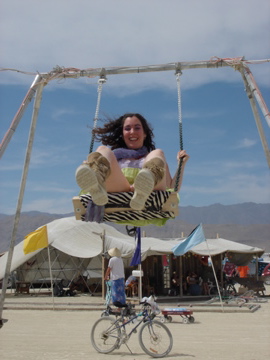
The vestibular system is responsible for balance, focus, and even plays a role in emotion regulation. But the best way to activate the vestibular system is by moving through space. So, if your child is having trouble with focus or emotion regulation, try encouraging movements like spinning and swinging and you’ll notice a huge change.

At Montessori school, we used the swings to help kids focus at least several times a week. I even activate my own vestibular system by doing somersaults whenever I’m feeling socially anxious. (So if we’re at a party together and I sneak into a back hallway for a moment, you know what I’m up to.) The thing is, it really works! After a few forward rolls, I feel so much happier and better able to engage and be social. If you don’t believe me, I challenge you to try it for yourself.

But I’m not writing this to help adults with their social anxiety, rather, I want young people who get labeled as “out of control” or informally called “adhd” to have solutions to anxiety, aggressiveness, or lack of focus that are easy, fun, and free of negative side effects. So, the next time you see your kids spinning in circles, remember that they’re self-regulating and it’s really good for their brains. Plus, it’s just fun and it feels good to spin around in circles!

For months now my daughter has enjoyed shaking her head back and forth. She’ll shake her head and then look up and smile. I usually join her just because it’s fun, but now I’m remembering that shaking our heads or moving our heads through space in other ways is actually crucial to brain health and wellbeing. The vestibular system needs input!

And, now that we humans spend less time running through the forest and more time sitting in front of screens, it’s even more important that we consciously choose to activate those systems.

So, your homework this week is to dance, wiggle, spin, jump, cartwheel, and swing with your kids. It’s good for everybody’s brain and it’s a great strategy to teach your child for times when he’s feeling worried, bored, or disconnected.

Have a fabulous week! Warmly, Shelly

Calling all drama queens and comedians

School is out for the summer, which is great fun for the kids and a bunch of extra work and shuffling for you.  It’s challenging to make the transition from having the kids in school all day to having them home, or finding enough activities to keep them busy and engaged.

Some children really thrive on a slow paced, relaxed, summer schedule.  But other kids go a little bonkers when you take away the social outlet of school.  If you’ve got a drama queen or a comedian on your hands, consider sending them to an acting camp.

Through my work with young people I’ve found that lots of kids who seem to be “acting out” or are “too wild” just need an appropriate outlet for their energy and enthusiasm about life.  They need an activity that is both intellectually and physically challenging, so that they’re engaging many different parts of their brain.  Acting camp could be just the thing these kids are craving.

During an acting camp, kids get to play fun games that teach them the basics of improvisation and acting.  With those tools in their back pockets, many young people can redirect their “wild” energy into comedy improv, or putting on a production either by themselves, with friends or siblings, or with a church group or neighborhood group.

And, as their skills develop, you’ll enjoy their antics more and more, and they’ll get the positive attention they’re really craving.  It’s really a win-win.

But if acting camp isn’t available in your area or doesn’t fit into your budget well, the internet is filled with information about super fun comedy improv games you can play with your family without any special training.

One of my favorite sites for that kind of information is Improv 4 Kids

Here are a few fun improv games off the top of my head:

1) Yes And- Go around the circle and create something fun like the most fun amusement park, the best sandwich, the ideal playground, or the coolest new invention.  Each person adds an idea and then the next person exclaims, “YES!! And…” and adds another dimension to the vision.

2) Making up a silly song- This is easiest with a familiar tune and a list of words that rhyme.  You might want to start off with Raffi’s “Down by the Bay” and then branch out when the kids have the hang of it.

3) Using props in interesting ways- Get some stuff from the kitchen and around the house and put it into a box.  Set an egg timer and then let your child reach into the box, grab something and pretend it’s something else.  Robin Williams is particularly good at this game!

So, I hope you’ll check out all the possibilities in your area for acting and improv classes for kids.  Who knows, maybe you’ll spark a life long love of theatre!  As always I would love to hear your thoughts and stories.  Please leave me a comment!  And have a wonderful week, Shelly

Oh, and I was interviewed in Inspired Lady Radio on Monday.  If you’d like to listen to the show which features me and Lori Petro, go to  BlogTalkRadio “Thanks, but this is my child“.