Happy Mother’s Day! A Video Interview with Dr. Laura Markham

I recorded this video a little bit over a year ago as a part of an online eCourse I was creating, but I never finished the course and I just can’t withhold this gem of an interview any longer. So, to celebrate Mother’s Day I wanted to share this wonderful interview with Dr. Laura Markham with you.

Dr. Laura is such a fantastic resource for families and I am so happy to share her with you! I hope you enjoy the interview and I would love to hear your feedback and/or comments, so please feel free to share your thoughts below. And have a wonderful Mother’s Day. You are a gift to your family, the world, and to me. And I’m so so grateful you’re here. Love and hugs, Shelly

Have a wonderful Mother’s Day! Big hugs and love, Shelly

5 Ways Bringing Montessori Home Makes Life Easier

There are lots of reasons why I love Montessori education. It’s respectful, holistic, intellectually and socially stimulating, and child-directed. But one of my favorite things about Montessori is how much easier it is to be an adult spending time with children in a Montessori environment than it is in most any other environment. Here are the top five reasons why bringing Montessori philosophies into your home will make your life much easier.

1)   Cooperation and community mindedness are built in

In the Montessori classroom the children are a community. Everyone works together to keep the environment clean and organized. That means that when someone accidentally spills hundreds of tiny beads all over the floor, all the children in the immediate area gather around and help clean up the mess. Each child is also responsible for cleaning up his or her individual work before choosing a new activity.

By bringing these simple rules and philosophies into your home, you’ll help your child experience consistency, learn responsibility, and best of all, your floor won’t be completely covered with 25 different toys at a time.

Instead, your child will learn to get one or two items out at a time and then joyfully put his work away before getting out something else. Establishing these rules does take a little bit of extra work for you at the beginning, but once your kids are in the groove, it won’t take much effort from you to keep the toys off the floor and on the shelf where they belong (note: you do have to provide the shelf).

2)   Cleaning and cooking skills develop early

Children also learn to sweep, dust, mop, wash a table, and use a sponge at Montessori school.  They also learn to pour, use tongs, cut vegetables, peel an egg, and much more. These skills easily translate to home, all you need to do is invite your child to participate in household tasks and before you know it, you’ll have an awesome little helper on your hands.

Child sized cooking and cleaning tools help kids engage in these tasks easily. And as long as you’re modeling joyful cleaning and cooking yourself, your kids will happily join in the fun. We have a child-sized duster that gets tons of use at our house.

3)   Self directed play and learning give you a breather

One of my favorite things about Montessori education is its emphasis on self directed, individual work. By providing a shelf full of choices and a rug or table to contain her work, my daughter will happily choose activities and play independently for hours a day.

Yes, some kids will have more or less success with independent play. There is definitely a personality aspect to attention span and willingness to explore the environment alone, but these skills can always be developed further through practice. And wouldn’t it be nice to be able to sit back and read a novel while your child occupies himself?

4)   Care of the self is commonplace

Young children love to develop skills that allow them to be more autonomous and independent, especially when it comes to self-care like washing, brushing, dressing, and using the toilet. Montessori practices encourage these efforts by providing low mirrors, child sized tools, stools, hooks, and other aids to help children become successful at these important tasks as early as possible.

That frees you up to focus on other things while giving your child a healthy sense of accomplishment. So, instead of washing your child’s face, give her a cloth and ask her to go look in the mirror and wash her own face. Encourage your toddler to learn to undress and your older child to dress himself. Some of these tasks may be challenging at first, but overcoming challenge is an incredibly useful skill for kids. And just imagine how much time and effort you’ll save when your child consistently puts on her own shoes and coat!

5)   Peace education promotes harmony

Peace education is an important part of the Montessori philosophy. Maria Montessori worked tirelessly for world peace in her lifetime. By introducing the concepts of peace, effective conflict resolution, and empathy for others, children build social and emotional skills that will benefit them for their entire lives.

By bringing these ideas home, you can encourage sibling harmony, inner peace, and practices that will promote a peaceful home. For instance, there is no yelling in the Montessori classroom, instead, teachers approach children individually to remind them to use a quiet voice. This promotes a peaceful environment that is more conducive to learning and concentration.

Most classrooms also have a peace table, peace rug, or other such space specifically designated for meditation, conflict resolution, and other peaceful activities. At our house, we have a lavender filled eye pillow that is our “peace pillow.” If one of us feels agitated, we lie down, put the eye pillow over our eyes, and breathe deeply as we relax. By modeling this practice for my daughter, I’m teaching her useful emotion regulation skills by modeling a healthy response to stress.

All five of these Montessori ideas will bring more peace, ease, and cooperation to your home. I would love to hear whether you use any of these practices in your home and what benefits you’ve noticed.

Have a wonderful week!

 

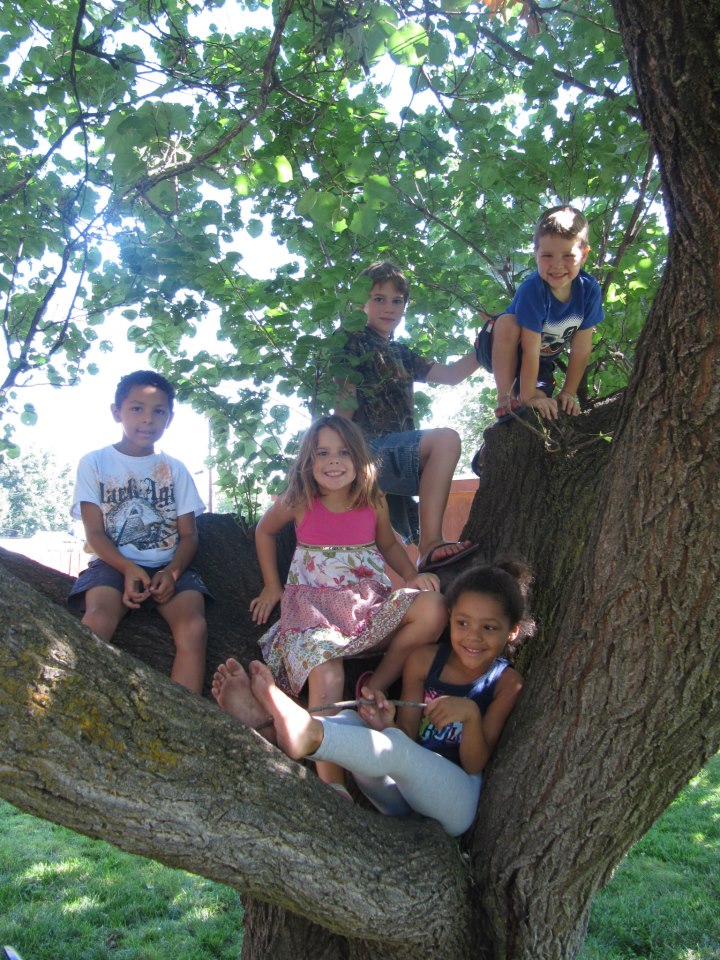
5 Reasons to Encourage Your Kid to Climb a Tree

There are lots of reasons to encourage kids to climb trees, but many of them can begin to seem unimportant when faced with the possibility of our beloved child falling out of one. Besides the fact that kids just love it, here are my top five reasons, backed by science, to support tree climbing despite its inherent risks.

1)   Being Outside Reduces Stress

Many studies over the past 20 years have shown that spending time in nature reduces cortisol levels, lowers blood pressure, increases resilience, and supports cognitive function. And climbing trees is a great way to help kids engage in an outside activity that is fun and challenging.

By encouraging this type of outdoor play and discovery, you’re putting your child into an environment that she has evolved to enjoy and appreciate.

2)   Connecting With Nature Is Good For Us and the Planet

Helping your child develop a personal relationship with nature has lots of benefits both to your child and to the environment. We humans are funny. When we care about something deeply, we’ll work incredibly hard to preserve it. So, by helping your child connect with nature, he is better off because of all of the benefits mentioned above and the environment is better off because your child will work hard to preserve the nature he loves so dearly.

Working with children showed me that when kids understand the direct implications of their impact on the environment, they’re motivated to reduce their carbon footprint and are easily able to change their habits to live in more harmony with nature. For instance, after learning about landfills, many children become recycling activists in their homes and schools. And after a trip to a local water treatment facility where we got to engage in hands on demonstrations, I saw a marked improvement in water conservation efforts and interest in overall watershed health.

3)   Climbing Trees is Good for Physical Development

As I began to write this article I spoke to a local 7 year-old boy. I asked him, “what’s your favorite thing about climbing trees?” and he responded immediately, “Climbing!” Kids love the challenge of deciding where to put their feet and hands, and the exhilaration of getting high up into a tree. There’s a physical challenge and a huge sense of accomplishment that goes along with tree climbing. I wish more kids were encouraged to climb trees.

Developing hand/eye coordination, muscle strength, and the ability to assess their own safety are all skills that benefit kids. And they’re the same skills that are often found lacking in today’s screen focused world.

4)   Taking Risks Helps Kids Learn Their Strengths and Limitations

By challenging themselves physically, kids learn their strengths and limitations quickly. They know when it’s easy, when it’s hard, and when they start to feel unsafe. It’s important for children to have the experience of pushing themselves and knowing when to step back and play it safe. You may be surprised to find that children have quite a strong sense of self-preservation when they’re allowed to exercise it.

Yes, this does require us to step back, stop saying, “be careful!” and allow our kids to explore without us hovering and monitoring their every move. I know it can be difficult, and if you really have a tough time with it, I’d recommend sending the kids out with their dad (or other masculine role model). I’ve found that in general dads are much better at letting kids take physical risks than moms are. As much as super child safe playground like those made by sites like https://www.softsurfaces.co.uk/ are good for the really little ones, there comes a time where the little ones need to grow up and learn to make mistakes and scrape their elbows and knees a little.

Even so, it’s still important to develop this ability for yourself, mom. Eventually we’re going to have teenagers on our hands and if we don’t allow our kids to take calculated risks now, they won’t be prepared for the life and death decisions they’ll be required to make once drinking and driving enter into the picture.

5)   Spending Time in Nature Encourages Scientific Discovery

Are your kids curious about birds, bees, squirrels, and raccoons? Spending time outside climbing trees is a wonderful way to encourage scientific interests. Maybe they’ll discover a next and get to watch baby birds being fed by their parents. Or perhaps they’ll discover a new species of beetle, never before catalogued.

By encouraging kids to climb trees, you’re really encouraging them to explore the natural world in all it’s glory. How does a plant grow? Where does a tree get its nutrients? What does decomposition look like? And what happens if a bird’s nest is disturbed?

Children are natural scientists and will create experiments, hypotheses, and conclusions about everything in life. Why not encourage them to conduct some of their research in the canopy?

So, let’s all go out and climb a tree! And let’s make sure our kids get the opportunity to spend time outdoors, climbing trees, playing, making up songs and stories, coming up with wild theories, and just forging a relationship with this wonderful, wild, beautiful world we live in.

Have a great week, Shelly

The Secret to Improving Your Child’s Attention Span

The way to help children improve their attention span is counter-intuitive. You might think that giving children tasks that require their continued attention would help. Or maybe challenging them to accomplish long and complex sequences will help memory and cognition, improving attention span. But the current research is showing something counter to what we might think.

In fact, research shows that allowing kids to have unstructured playtime can actually improve their ability to focus on a task. In the book “Nurture Shock” by Po Bronson I learned about a kindergarten program which encourages children to choose a character to play in an imaginary play scenario that lasts for several hours. Researchers found that the children who were able to remain in character did better on later academic tests than children who were taught their letters and numbers instead of engaging in imaginary play.

The real take away here is that imaginary play and unstructured playtime are tools that children use to learn real life skills that will benefit them forever. It might seem like “child’s play” to us, but to them, this type of play involves acting out potential scenarios, doing scientific experiments, and using critical thinking skills.

So what’s the secret to improving your child’s attention span?

Offering them big chunks of unstructured time to explore their own interests and engage in imaginary play.

Our daughter Julia wakes up at about 6:30am every day of the week and lately I’ve been helping her get to the bathroom and then climbing back into bed with my husband on the weekends. For several weekends in a row Julia has happily played by herself and allowed us to sleep in.

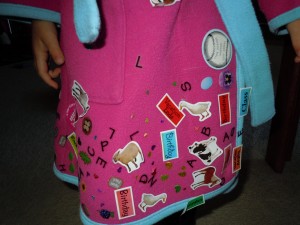
One morning she found the box of stickers and this is what she did:

The Secret to Improving Your Child's Attention Span

DSCN2130


I was impressed and here’s why. Not only did she use her fine motor skills to get each of the tiny stickers off of the sticker paper and on to her robe independently. She focused on this task for well over an hour without interruption. She put over a hundred stickers on her robe one by one. And she’s not yet three years old. I think we’re on our way to a very well developed attention span!

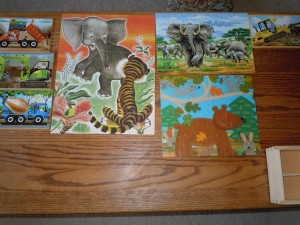
The following weekend she impressed me even more. Here’s what she did while we slept:


DSCN2141

DSCN2140

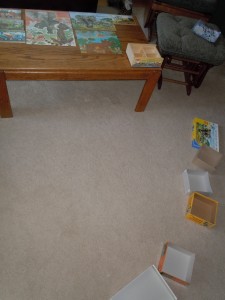
I love the way that she displayed her finished puzzles and the fact that she also lined the boxes up on the floor was interesting too. And just for the record, this is four 12 piece puzzles, two 24 piece puzzles and a 35 piece puzzle. And she didn’t wake us up for help even once.

So what does your child like to do when given uninterrupted alone time?

When Julia was smaller she would spend up to an hour looking at books in her bedroom. Sure there was a huge pile of books on the floor afterward, but she had entertained herself for an hour…with books! And we did work on putting them away together, so now, she happily puts away most anything she plays with.

Just a quick disclaimer here, safety is very important any time you’re allowing young children to have time alone without direct supervision.

Please make sure that the environment is free of hazards whenever you leave your child alone.

There’s one more secret to helping your child expand his attention span, remembering not to interrupt his work. Again, while it might just seem like meaningless play to us, children are engaged in the work of becoming the adults they hope to be. When we remember to respect their time and attention by refusing to interrupt when they’re engaged or by simply waiting for them to approach us, we’re helping them learn more independence and encouraging their natural urge to go deeply into the subject at hand.

If every time a child becomes engrossed in something he gets interrupted and asked to do something else instead, he’s not as likely to develop a deep and long lasting desire to dive in to his own interests. Instead, he may become overly attuned to the needs and desires of the people around him, believing that it’s more important to do what others require of us than it is to develop our own driving interests.

Oh, one more thing I forgot to mention, screen time does NOT count as independent play. In fact, excessive screen time has been linked to shorter attention spans and an inability to focus on real world tasks. So, if you’re in the habit of using the screen to get some time to yourself, I hope you’ll consider some other options.

So this week your challenge, if you choose to accept it, is to allow your kids to have some extra alone time, unstructured playtime, and wide swaths of time when they’re not interrupted. You might be as surprised by the results as I was when I woke up to that table full of puzzles.

Have a great week, Shelly