Parenting exhaustion

Boy, is it exhausting to be a parent or what?!  You start off with the nighttime wake ups but at least when they’re that little, they’re not moving around too much.  Remember when you’d put them down and they’d just stay put?!  It’s like a distant memory, right?

And, by the time you’re actually getting a good night’s sleep (except for the occasional accident or vomiting in the bed), they’re running around like crazy people and screaming, “Play with me! Play with me!” and wanting to go to the park and the pool and everywhere else they can think of.  Whew!  I feel tired just thinking about it.

I’ve heard some divorced parents admit that they’re actually relieved when they’re kids go to their co-parent’s house.  And now that I’m a parent myself, I can see why!  It really does take a village, doesn’t it?  I think we should all have statues erected in our honor if we survive parenthood long enough to see our adult children become exhausted parents.

As a kid, one of the things I never understood was why my parents didn’t have the energy to play with me all the time or take me wherever I wanted.  The idea that resting would be more fun than constant activity was a completely foreign concept.  I think the only time I was still was when I was mesmerized by the television or forced to sleep.

One of the things I loved about being a nanny for twins was that at least they always had each other to play with.  But the truth is, you can’t always just pawn off the littler kids with the bigger kids.  In fact, sometimes that creates more of a hassle than a help.

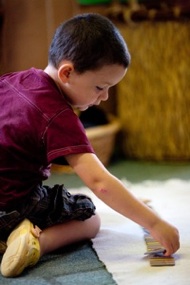
So, what do we do when we’re tuckered out and our kids are raring to go?  Well, I like to set them up with a self-directed activity and then sit nearby and read a book or rest while they are engaged in playing and learning at the same time.  Here’s a post I wrote a while back about some things kids can do mostly on their own.

There are tons of things that kids would love to do themselves, but often it feels like more work to let them.  Take cooking for instance.  Everyone I know loves to eat cookies.  And kids love to mix and bake them too.  Sure, they’re likely to make more of a mess than you would, but amazingly, they also often ENJOY cleaning up too!  I wrote a post about how to get kids to help with clean up too.

But, once you have them set up with an activity, the really challenging part begins.  We as parents must choose to take care of ourselves and actually REST, rather than jumping up to do another load of laundry or cleaning up after our kids while they’re still making a mess.  We need to learn to stop and take a break!

So, what can you do to maximize the 5-10min. window you have when the kids are happily engaged?  Here’s a list of some of my favorites:

1)     Close my eyes and take deep breaths (or meditate)

2)    Read a novel

3)    Take a bath

4)   Sit outside and watch the wind blowing through the trees

5)    Yoga

6)    Take a cat nap

7)    Smell the roses (literally)

What are the things that you could do to maximize the few minutes of restful time you can squeeze out of the day?  And how else do you deal with the exhaustion of parenting?  Please let me know, I could really use some help on this one!

Have a great week, Shelly


Make your life easier, give kids their own drawer

When our daughter started to crawl we did what most parents do, we dashed around the house “baby proofing” everything in sight.  We moved dangerous things up or to cabinets that could be locked or secured.  I installed latches on cabinets containing cleaning products.  But as I looked around our home and imagined putting latches on every cabinet and drawer in the house, I got overwhelmed.

And then it hit me; maybe I didn’t actually have to install all those latches!  Of course, I realize that I might need to add a few as my daughter grows and gets into things more, but I came up with a solution that is working well and has caused the least work for everyone.  I gave my daughter her very own drawer.

As soon as she opened the bottom drawer in the kitchen for the very first time, I grabbed a bag, threw its original contents inside, and then tossed a few of her toys in the drawer.  I included some kitchen items like a metal spoon, a set of measuring spoons, and a plastic cup.  And voila!  She took to it like a bee to honey.

Now, whenever I’m cooking or we’re hanging out in the kitchen, she crawls right over, opens up her drawer and plays with her “kitchen toys.” She hardly even seems to notice that there are other cabinets and drawers nearby!

Office shelf

But I didn’t stop there, I gave her a drawer in the master bathroom and she occupies herself masterfully while my husband and I take our morning showers.

We have also designated the bottom two shelves of the living room bookcase to the little one, and in true Montessori form, I leave new and exciting toys on those shelves to encourage her exploration. She even has two shelves in my office that will have her “work” on them for years to come.

Sure, we also have a basket of toys in the kitchen, living room, and her bedroom too.  But she seems to enjoy her drawers even more, and I don’t have to look at the stuff inside when she’s finished, I just close the drawer!  Of course, the next step will be to teach her to close the drawers herself.  And after that, we’ll begin putting toys into the drawer and closing it when we’re about to leave the room.

Living room shelf

If you have an older child who doesn’t yet have any designated kid’s activity areas in the common rooms, I highly recommend you clear some space for your younger family members.  Then, stock their shelves and drawers with interesting activities that you’ll rotate when they lose their appeal.  And if you also provide a rug and/or a child sized desk or table that they can work at, you’ll be helping your child set up great work habits and helping yourself get some peace and quiet.  Because, when kids know where to look for an activity that they can explore on their own, they’ll go back to it again and again, and you’ll actually get some adult work done!

I would love to hear about your own solutions to support your child’s freedom and independence at home.  Please leave me a comment!

Have a fantastic week, Shelly

Attune to your child…some of the time

Attunement:  it’s a word that gets thrown around a lot in the world of parenting and psychology, but what does attunement really mean?  Attunement is an innate ability that almost all humans have to internally and externally match the experience of another person with whom they’re connecting.  When we see someone crying, we easily and naturally feel sadness ourselves.  When we are with someone who just found out that they won a big contest, we feel excitement too.

But attunement is not simply empathy for another person’s emotional experience.  It’s an energetic matching game.  We may feel the sadness, but we’re not really attuning unless we’re matching the physical and non-physical energy of the person we’re with.  Attunement is the ultimate connection.  It’s a joining and sharing of an experience, an experience of oneness.

I often feel this oneness while nursing my daughter or in playful moments when she’s on the changing table or when we’re rocking in the rocking chair and she relaxes, resting her whole body against mine.  Connection through attunement is incredibly important for secure attachment to happen.  And, the oneness can’t happen all the time.  In fact, it would feel awfully strange to even attempt to experience attunement for an entire day.

We need connection, and we need separation too.  In fact, it’s the dance between connection and separation that makes our human experience so rich and dynamic.  We may experience a beautiful moment of attunement and later we’ll each go off by ourselves to have some solitude.  It’s an ebb and flow like so many other things in life.  And each part is just as important as the other.

Right now I’m reading a really interesting novel told from a five-year-old boy’s point of view.  The thing I find so fascinating about it is how accurate the author is about the details of the thoughts and emotions the little boy experiences.  The boy has a favorite spoon he calls “meltedy spoon” and when I read the words “meltedy spoon” I am instantly transported back into the classroom with 3-5 year olds.  What a perfect example of really attuning to the mind of a five year old.

This week, pay special attention to the moments of attunement that you share with your child and then consciously allow your child to separate from you when he’s ready.

Instead of hovering over him at the park, intruding on his playtime, bring a book and let him have his own experience.  Then, after an especially fun moment, he might just run over to you and excitedly share what happened.  That’s your opportunity to put the book down, make eye contact, feel the excitement in your own body and attune with him.  Maybe you’ll even be inspired to jump up and run around with him for a while.

But again, as soon as you notice him going off on his own, resist any urge you might have to follow, and go back to your book instead.  By allowing your child to determine the length of the cycle between attunement and separation, you’re reassuring him that you’re available when he needs you, but you’re not going to interrupt his flow.

If, on the other hand, your tendency is to encourage your child to play on her own more often so that you can do your adult activities, then your challenge this week is to really stop, drop what you’re doing, and attune to your child when she reaches out for connection.  Remember, that means matching her energy.  So, if she’s slow and methodical, you’ll practice slowing down too.  And if she’s giggling and gasping for breath, see how much you can feel what that must feel like.  Pay attention to any sensations in your body as you practice attuning with your children.  Often, we can find new levels of empathy when we’re willing to try to step into our children’s shoes more fully.

I would love to hear about your own experiences of attunement and separation.  Is the natural ebb and flow easy or difficult for you?  Does your timing match up with your child’s?  And how do you feel when you notice your child coming toward you or moving away from you?

I hope you’ll all have a fantastic week, Shelly

A cure for clutter: using a rug to define a workspace

Are you tired of tripping over your child’s toys or bugging the kids to pick them up off the living room floor?  Using a rug to define your child’s workspace is a great solution that works well for everyone!

You might even already have a rug that will work well.  You want a rag rug, bathmat, or other rug that is about three feet by four feet in size and is easy to roll up.  To keep it out of the way when it’s not being  used, you can store your rug in a clean trash can, large vase, or other container when it’s rolled up.  And when your child is ready to get out her dinosaurs, remind her to get her rug first. This trick was taught to me by my friend who is also a parent and works for Oriental Rug Cleaning in Jupiter, FL, she the idea while working one day! Just make sure you don’t choose a rug that will get dirty easily.

Children often enjoy taking care of their workspace and will take great pleasure in laying out their rug and then setting out their toys or other activities.  And, by keeping the space defined you will notice several benefits.

First, your child will feel his work and play are honored and important when you make it a point to walk around his rug and encourage other family members to respect his space.  Second, you’ll cut down of sibling conflict when each child has his own space and both practice respecting one another’s space.  In the Montessori classroom children are required to ask permission to touch anything on someone else’s rug.

Also, if you need to move your child’s activity, it’s fairly easy to pick up two ends of the rug and drag it over to another spot without disturbing what’s on the rug.  That means that even though she starts a puzzle on the living room floor, you can pull it over to the hallway, or even into her room, when the family needs the floor space again. Continue reading “A cure for clutter: using a rug to define a workspace”

How to foster an emerging sense of order

Between 2 and 4 years old most young people begin to develop their sense of order.  This is the time when your child will become exasperated if you say the wrong word during story time or if you move her artwork or put away his toy before he was finished playing with it.  It can be a difficult time for parents and caregivers alike, because in the past your little one didn’t even notice when you put away his toys.  Now everything starts to become a negotiation because along with a sense of order, a stronger will and resulting tantrums also mark this stage of development.

This sensitive period for order can be challenging, but there’s no fighting against human development, and if you think about it, you wouldn’t want to anyway.  This is actually the perfect time to teach your child how to put away toys, straighten her room, and help out in the kitchen.  But in order to capitalize on your child’s innate desire to learn and this sensitive period for order heed this advice:  Attention to detail is the key to getting the most cooperation from your child during this time.

Let me illustrate further; Paying attention to minute details and showing your child all the tiny steps involved in tidying, cleaning, and putting things away create more interest and better results.  For instance, if you would like to teach your three year old to fold and put away his socks follow these steps slowly, carefully, and methodically (and wait until you have your child’s attention before moving on to the next step):

1)     Take newly dried clothes out of the dryer while they’re still warm

2)    Put them in a pile on the bed and invite your child to feel the warmth and play in the pile a little bit.

3)    Ask your child if he would like to play a sock folding game.  If yes, continue, if no, try another time.

4)   Ask your child to help you find two matching socks. Continue reading “How to foster an emerging sense of order”