Watch what you say because your baby really is listening

The past few weeks my husband and I have been trying our hardest to remove some of the more colorful language from our vocabularies so that our baby’s first words aren’t profanity. Not that we curse all that much, but knowing children as I do, I know that it only take a few exposures to a word for kids to learn them, especially during the time when they’re busy expanding their vocabularies at a phenomenal rate at around 18 months old. So we’ve been saying funny things like “fire-pants!” and “rats!” or even my husband’s famous “son of a bench!”

The truth is, recent research shows that children can learn a new word after just ONE exposure and they’ll remember that word for weeks and even months, even if they haven’t heard the word since! The study itself was pretty interesting. I read about it in my new favorite book “The Scientist in the Crib” by Gopnik, Meltzoff, and Kuhl. In the study they brought 18-month-old children into the lab, showed them an apple corer and said, “Look! A dax.” Children remembered the name of the “dax” for several months even with no further exposure to apple corers in the mean time.

The process kids are going through at around 18 months when they enter their naming explosion is called “fast mapping” and that’s when your little one starts pointing to everything in sight and asking you to name it. “Whatsat?” they’ll ask repeatedly, as you well know. They also start naming everything they can and they want you to repeat things over and over again. It can be a little annoying. But when we dig in to what kids are actually doing during this time, it becomes fascinating and amazing. Continue reading “Watch what you say because your baby really is listening”

Autonomy is the holy grail of childhood

In my work with young people there are some needs that come up again and again.  The need for play is a great example.  Kids need lots and lots more play than we need and they let us know about their need in ways that are sometimes difficult for us.

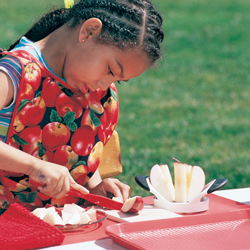
But the unmet need that I notice most in young children is the need for autonomy.  Children desperately need to be able to do things on their own and to choose their own path and luckily for you, there are simple things you can do around the house to support your child’s autonomy.

First, take a tour through your home in your mind.  Starting at the front door, do kids have a place to put their coats and shoes when they get home?  Is the place for coats and shoes easily accessible?  For children under five years (and for older children and even adults) the easiest place to put a coat is on a hook near the front (or back) door.  And to put shoes on and take them off, a child-sized bench to sit on is quite useful.

As you move through your home in your mind, consider whether your child has access to the things she needs.  Can she reach toys and books in the living room?  Art supplies, dishes, water and a snack in the kitchen?  Is there a stool in the bathroom that makes using the toilet and washing hands easy?  Can he reach the towel to dry his hands?

Each room of your home should have an activity for your child available in case he wants to be in the same room with you, and in case he doesn’t!  Continue reading “Autonomy is the holy grail of childhood”

The magic question

Are you wanting more ease and cooperation from your kids this week?  I have a magic question that will get you exactly that.  One great thing about this question is that it also works well with other adults.   Another wonder of this magic question is that when people ask you this question you feel honored, cared for, and free to say yes or no.

This question empowers you and your loved ones to communicate openly, honestly, and freely.  It can even help you learn more about your children and their motivations.  OK, are you ready for it?  The magic question is, “Would you be willing to ____?”  Variations on this question might be “Would you?” “Could you?” or “Will you please?”

But a huge part of the magic of the question is that it’s a true request.  When you ask, “Would you be willing to help me carry in the groceries?” you’re actually asking for help, not demanding it.  So be careful with the variations unless you’re sure you’re truly asking.  Sometimes our demands can be subtle and veiled, but they’re demands none-the-less.

It’s easy to fall into the trap of demanding and ordering kids around, especially when they’re resistant and uncooperative.  “Brush your teeth” “Put on your shoes, we’re leaving” and “Stop hitting your sister” are the kinds of demands most kids experience daily.  If you’ve fallen into the habit of making lots of demands of your kids, you’re not alone.  The problem is that the more we demand, the less kids want to cooperate.  And the less kids cooperate, the more we demand.  It’s a vicious cycle, but you have the power to change the dynamics substantially, just by asking the magic question and being OK with whatever the answer is. Continue reading “The magic question”

Guest Blog: How to intervene when other adults disrespect your child

eye childThis week’s guest blog is from Jill:

I’m happy to be back at AwakeParent.com as a guest blogger today. I wanted to share with you some thoughts on dealing with other adults in your life who interact with your children. As parents striving for greater consciousness, I have found it can sometimes be painful when other adults interact with our precious children in ways that don’t support the experience we’re trying so hard to create.

At times, I have both asked and been asked by other adults to treat a child differently.  This hasn’t gone very well!  The time I was asked not to interact with a child in the way I wanted to I felt a sense of shame, even though intellectually I agreed with the parent’s boundary. What happened? I touched a child’s hair without permission. Not a big deal, in the grand scheme of things, perhaps, but really, how would I feel if someone I didn’t know reach out and started fondling my tresses, rather than ask? I could see in the parent’s eyes that that was exactly what he was tuned into. I got it; still, I felt small.

I have also not found a way to make such a request of another adult that feels both compassionate and authentic. When I have made such requests, it’s also felt alienating, rather than connecting. It seems no one likes to hear, “Please don’t do that to my child.”

Here’s what I think is going on, and what we can do about it.  One, I think a vulnerable part of us comes forth when we connect with a child.  I want to treat this part of myself and others with gentleness and compassion, so I want to honor all good faith attempts to connect with children.  Two, if I intervene on his behalf, I do my own child a bit of a disservice. I exercise my autonomy instead of allowing him to exercise his.  At the same time, I want to intervene if it looks like my child would rather not be experiencing what’s happening.

So, if my son looks uncomfortable though not in danger (or being tickled), or like he’s just tolerating something an adult is doing, I ask him, within the other person’s earshot, and with a lighthearted attitude, “Is that okay with you?”  Often he says “no,” and almost always the adult apologizes to him, and does not seem offended. This way, I’m also training my son to check in with himself, and ask “Is this OK with me?”

I think most adults genuinely want to connect with children in mutually consensual ways, but we feel awkward because we so seldom see this kind of behavior modeled for us. I still feel slightly embarrassed sometimes when I do manage to treat my child with complete respect, because it’s not what I’ve seen modeled. However, occasionally someone will say they were touched or moved by how I interacted with my son. Maybe we can all help to awaken in each other our deep yearning for all beings, large and small, to be treated with complete respect.

Back in real life, our beloved friends and relatives may not follow our lead as quickly as we would like—or at all, for that matter—people generally default to what they’re familiar with. However, what I’ve noticed is that the more we can respect and embrace the adults’ loving intentions at the same time as we model respect for our children (by lightheartedly asking the child if what’s happening is OK with them), the less likely we will be to trigger shame in the other adult, and to feel triggered ourselves. I want to remind myself and others that we adults are always doing the best we can with the young people in their lives. I want us all to try to support each other where we are, even as we hold out possibilities for where we might be.

I’d love to know your thoughts on this.

Warmly,

Jill

Jill Nagle is the cofounder of Awakeparent.com, and former regular blogger. Currently, she blogs at Zendesk.com, works as a freelance writer and content strategist, and does family mediation with a focus on creative family structures. She works over the phone as well as in person. Learn more here: http://tinyurl.com/thirdsidemediation


The development of will

Time OutWhat’s it like to be a 2-4 year old? (an excerpt from my soon to be released ebook!)

As an infant and young toddler your child saw himself as an extension of you.  He had very little sense of distinction between himself and his parents.  In fact, if you think about it you can understand why this would be so.  Just as we lift our own hand to our mouth if we want to put some food in it- your hand has automatically put food in your baby’s mouth every time he’s been hungry since his birth!  When he needs something, you provide it, so in a way, and in his mind, you’re an extension of him.

Now that he’s older he’s developing more complex language.  He’s learning to distinguish between “yours” and “mine”.  Well if there’s a “yours” and a “mine” there must be a “you” and a “me”.  Now your child begins to see himself as a separate entity with desires, hopes, dreams, and thoughts all his own!  Wow, what an exciting discovery.

A Stronger Will: Unmet needs for choice

Along with the discovery of self, your child is feeling stronger desires than ever before and she’s discovering her personal power.  She’s realizing for the first time that she can affect the outcome of a given situation.  Sure, when she was a baby, she realized that she could move a ball from here to there- but now she’s discovered that she can affect your behavior and have some control over the social dynamics in your home.  This is a huge step in social development.  She’s gone from a helpless being, who is happy to do whatever you want- to a willful child with a mind of her own.  And this is ultimately a good thing- although the transition can be extremely difficult for us.  Sometimes we just want that sweet little baby back (and that’s completely normal)!

If you consider your job as a parent to be raising a capable, independent, and contributing adult, then you can see this phase as a milestone toward that goal.  Now that your child has an ego, strong desires, and a stronger will she can really get things accomplished that she never could before.  Now is a wonderful time to help her develop a sense of responsibility by giving her more freedom coupled with, you guessed it, responsibility.

Easier said than done, right?  Continue reading “The development of will”