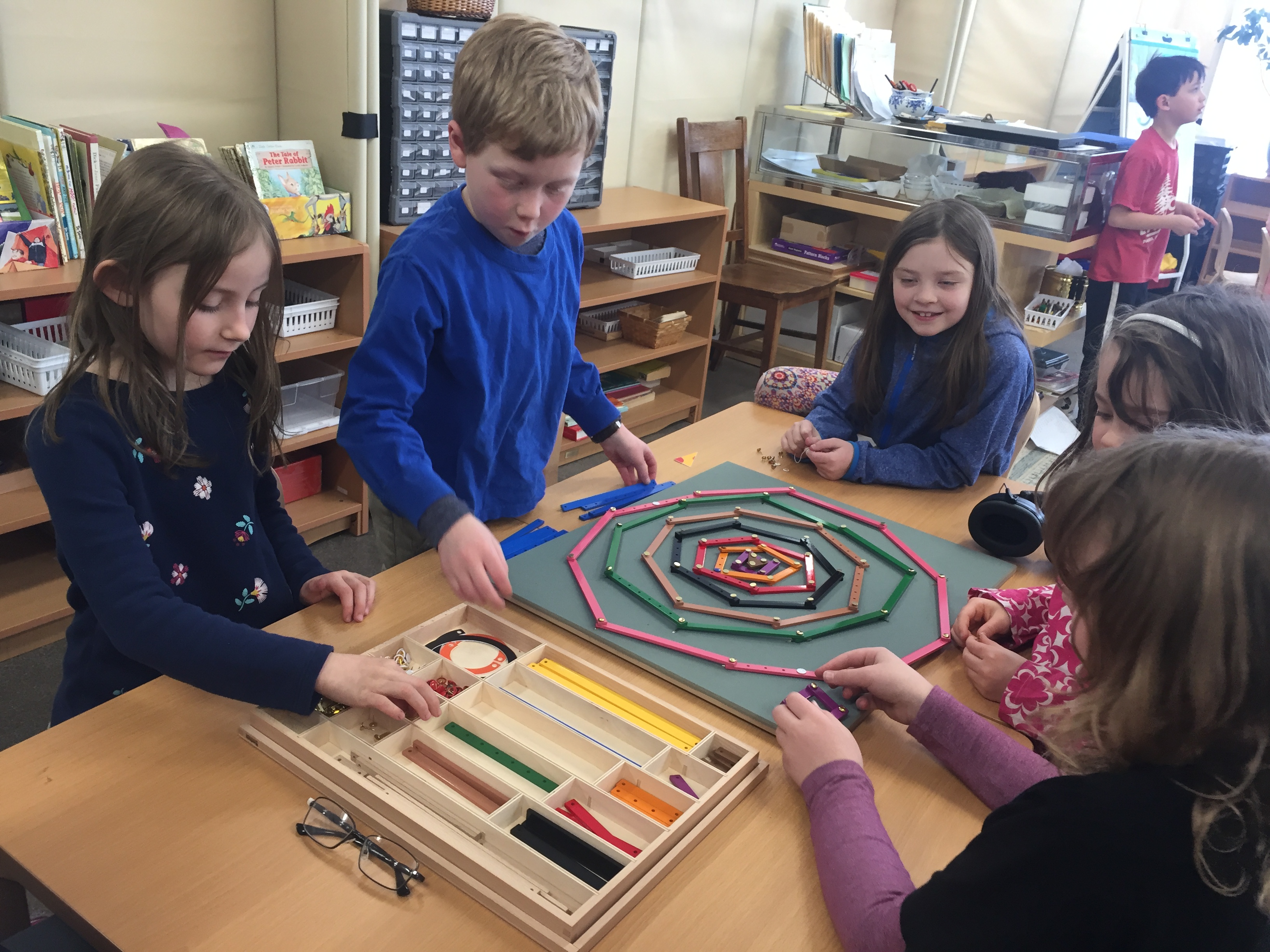
Why I Started A Montessori Charter School

When I moved to Bend, Oregon I was surprised to learn that while there were several thriving Montessori preschool programs, there were no Montessori elementary programs at all! As a former assistant teacher in a Montessori lower elementary class (1st-3rd grade) I knew that the freedom to move about the classroom and to focus on areas of interest were crucial to support deep learning. I witnessed students diving deeply into their interests and I saw the head teacher use student interests to draw them in to other subjects. Overall I just loved the sense of freedom and responsibility that the students experience in a Montessori elementary classroom. And the work they produced was impressive and often far above grade level.

So, when my daughter entered preschool and was thriving in a Montessori program, I knew that I would want her to continue in Montessori. It’s exceptionally important to me that she be treated as a whole human being and that she continue to develop her emotion regulation, conflict resolution, and other “soft skills” along with her academic work.

Educating the whole child

One of the things I love about Montessori is that the teacher is not focused on how much information he or she can present to my child, rather, Montessori teachers are focused on helping my child develop her internal motivation to learn and grow and take responsibility for her own learning. This attitude, along with the meticulously designed materials which captivate a child’s interest, encourages exploration and provides opportunities to learn a wide variety of information and practical life skills.

I knew I couldn’t afford to pay tuition all the way through middle school and I had heard that a few of the Montessori preschools had tried to get a tuition based elementary program off the ground, but they had trouble retaining older students since our public schools in Bend are so good. So some friends and I decided that a public, tuition free Montessori charter school would best serve our community and our own kids.

Montessori in the public sector

After having worked in several private Montessori schools, one thing I noticed was that while the Montessori method was initially developed to help low income and mentally challenged students, it is now most accessible to families with the means to pay tuition. I was saddened to learn that the very students Maria Montessori most wanted to help were missing out on her incredible teaching methods, mostly because the materials are expensive and public Montessori schools are still burgeoning in the US. I was happy to learn that many of the public schools in France are Montessori schools!

The process of starting a charter school was not as easy as I had anticipated! It took us several rounds of denials before we were finally approved by our local school board to open a Montessori charter school. Luckily, with the help of many volunteers and the receipt of the Oregon Department of Education’s Planning grant, we were finally able to open our doors in the fall of 2017!

Other options just aren’t Montessori

During my daughter’s first grade year, we were forced to try a public magnet school since there were no Montessori options. We chose a school with a democratic philosophy, mixed ages, and some freedom to work outside of grade level. But because it was not a Montessori school, my daughter found it loud, chaotic, and she chaffed at her lack of freedom to explore her interests. She often complained that they didn’t give her enough time to read and that she was forced to do what everyone else was doing. I also didn’t like hearing about frequent screen time (mostly educational) and she came home with candy as a reward on quite a few occasions.

Growth mindset and intrinsic motivation

In a Montessori classroom, we’re focused on developing the internal motivation of the student, so letter grades, rewards, and frequent external praise are not used. Instead, we expect a child to gain a sense of accomplishment by working hard and completing a large project and we all listen as they present their research findings to the class during circle time. This gives students the opportunity to practice their public speaking skills as they share what they’ve learned with their classmates.

I could go on and on about all of the wonderful benefits of a Montessori elementary education, but for now I’ll just share that the perseverance and grit that was required to get this school off the ground has forever changed me. I will never again shy away from a large project because it seems too big, takes too long, or because we’ve hit a roadblock. If there’s one lesson my daughter and I have both learned through this process, it’s that when you’re determined to create something, you can absolutely succeed as long as you don’t quit, find helpers, and keep moving forward no matter what obstacles you encounter. Our Montessori charter school is now serving over 100 students and with plans to grow every year, I know that this school is already making a big difference in the world. So, if there’s something you’re passionate about creating, don’t shy away from your dreams, go out there and create it! You’ll be so glad you did.

This article was also published in the Rebel Priestess Magazine

The Secret to Drastically Reducing Infant Falls

During early infancy, babies pretty much stay where you put them. My mom refers to this stage of development as the happy paperweight stage. But once babies are a few months old, they begin to move. Some infants are rolling over and scooting as early as 4 months!

Don’t fret if your baby doesn’t roll over or sit up exactly on “schedule,” every baby develops at a different rate. But once your little one does begin to move around, falls can be a big hazard.

Avoiding some falls is fairly easy, just put your baby on the floor! But at other times you might be on a low bed, couch, or in another location and it’s a good idea to develop healthy and safe habits as early as possible.

Obviously when babies reach this stage of development it is no longer safe to leave them unstrapped on the changing table and walk away or even to leave them in the middle of a large high bed. The floor is the safest place for a baby who is learning to move, scoot, and crawl.

You do also need to do some baby proofing pronto. Cover outlets (electrocution hazards), remove cords and strings (strangulation hazards), add gates to stairways, and anchor furniture to the wall.

But if you want to reduce accidental falls, show your infant daily how to maneuver off of a low bed or couch safely, and they will learn to do it themselves fairly quickly. With enough repetition, getting down safely becomes second nature.

Before I share my “secret” let’s review some infant development research. Studies have shown that new crawlers are actually quite careful not to fall. Babies who were new crawlers participated in a study in which they were encouraged by their mothers to crawl across a plexi-glass surface that had a checkerboard pattern underneath it.

When the checkerboard pattern was directly beneath the plexiglass, babies happily crawled across to their mothers. However, if the checkerboard pattern was placed 3 feet below the plexiglass, babies perceived the drop off and refused to crawl across, even though it was completely safe to do so. Even when encouraged by their mothers that it was safe to cross, nearly 100% of infants refused to crawl across the perceived abyss. I share this study to remind us all that babies do have a survival instinct and even though we think of them as completely impulsive, they really don’t want to fall on their heads.

OK, here’s the “secret” key phrase (and action) to reducing falls:

FEET FIRST

Let’s say you’re hanging out with your baby on the couch when it becomes obvious that she’s interested in a toy across the room. She reaches for the toy and in your mind’s eye you imagine her tumbling headlong off the couch after the toy, banging her head along the way. At this point, gently hold your baby’s arm or leg and say, “Feet first.” And then help her turn around and maneuver so that her feet hang down first and she can scoot off the couch feet first, facing the couch. This is always the safest way for a baby to descend.

When your baby is young, you can physically guide him safely all the way down to the floor and as he develops more strength, you can intervene less and less. But it’s very important to repeat the phrase, “Feet first,” each and every time.

If you do this consistently, you’ll have a crawler and toddler that confidently knows how to safely descend from stairs, beds, couches, and the like and you’ll be able to relax into the knowledge that he knows exactly how to get down, FEET FIRST!

My husband and I both used this technique with each of our children and I honestly cannot think of a single time that our kids fell off of anything head first when they were babies. Sure, my 3yo jumps off of things head first now to experiment with his body and its boundaries, but our babies didn’t careen off of the bed.

To be fair, we don’t use bed frames and simply put our box spring and mattress right on the floor. This is a Montessori style bed that is easy for a young child to climb in and out of independently, so if your bed is up on a frame, it may not be safe to encourage your baby to go feet first off the bed until she is tall enough to manage it.

But in general, by using the phrase “feet first” and supporting babies to descend safely, you’ll drastically reduce falls and protect your infant from many potential head injuries. I’ve used this technique with many of the babies in my care too, and it has always helped.

So here’s to a future filled with capable independence for your baby and calm confidence for you. Have a fabulous week!

10 Ways to Help Your Kids Deal with Your Separation

As a child of divorce myself, I can share my own experience to help you navigate your separation in the way that will best support your children and allow them to adjust to the new reality of having two separate homes. I may write more on the topic of healing or ending your romantic relationship, but today let’s focus on how you can help your children thrive, even in the midst of your separation.

Please note, I’m writing this article with the assumption that you were married and that both parents will continue to be involved in your children’s lives. If that’s not the case, there are still some points that will be helpful, but others may not apply or you may need to change the language to suit your needs, for instance, you can replace the word spouse with girlfriend/boyfriend/partner as needed. My hope is that all children will be encouraged to have some connection and relationship to both of their parents whenever possible.

1. Be honest, but don’t share too many details

Children, especially those under 5 years old, need clear and consistent messages that they can rely on. Being wishy washy or confused about whether you’ll divorce or get back together is fine within your adult relationship, but be careful not to draw your children into your indecision. Children need to understand the hard facts so that they can adjust to their new reality. And they are not your emotional support system. Rather, you are theirs, so if you find yourself talking to your kids about your relationship, please stop, refer to number 5 below, or call a friend.

Your kids also need a consistent message from both parents, so it’s important to get on the same page with your spouse on this point. What is our message to the children and can we both agree to share a consistent message? Perhaps you’ll say something like, “Mom and Dad have decided to live separately for the next 6 months. We both still love you and that will never change, but right now, we need space from each other.”

If your older child asks follow up questions about why or what happens after 6 months, you can let them know that adults have complicated relationships and that you haven’t decided yet, but try to keep your responses concise and consistent, without a lot of emotional content (whenever possible). And never ever share the details of your upset with your spouse with a child under 12.

2. Remind them that you’ll love them no matter what and none of this is their fault

I’m sure you’ve noticed that young children are very self-centered. Because of this developmentally appropriate inability to focus on others along with a tendency to think that the world revolves around them, children often assume that when bad things happen, it’s their fault. It’s important to make sure that your kids know that your love for them and the other parent’s love for them will not change, just because you’re no longer living together. They should also be reminded that your decision to live separately has absolutely nothing to do with them. This is one thing my parents did right during their divorce, and I’m certain that it made a positive impact on me to know for sure that both of my parents still loved me no matter what and that I didn’t cause their problems.

3. Be kind to your spouse

OK, I know this one sounds like a tall order right now, this was one of the most traumatic aspects of my own parent’s divorce. They were furious with each other and they let me see it. I heard them yelling at each other over the phone. There were slammed doors. And the tension between them was palpable for YEARS. In fact, for most of my life I believed that while they both loved me, my parents hated each other. That was a difficult burden to bear, especially since they were my whole world at 5 years old.

So, if you’re able to maintain civility with your spouse, please do so. It’s OK to argue in front of the kids, but only if you make up in front of them too. It’s also OK to have lots of feelings about your spouse that you don’t share with your kids. But in order for children to feel safe and secure, it’s important to show them that even though you’ve chosen to live separately, you still respect each other, and you support one another’s right to have a good and healthy relationship with your children.

Obviously if there is sexual or physical abuse happening, this may not be possible. But even in cases of abuse, it’s important for children to be allowed to maintain some contact with their parent if that’s what they want. Every child is different and will process their experiences differently. In the case of abuse, rely on a therapist, social worker, or other healthcare professional to help you decide how much contact and what kind to allow.

This is something my parents did right. Even though they weren’t able to maintain a civil tone with each other, they did ensure that I got to see and have relationships with each of them and that was a huge gift. I am so incredibly grateful to have such a close relationship with each of my biological parents, even though neither of them are perfect and they both made mistakes.

So please do your best not to villainize your spouse to your children. No matter how tempting it might be to punish your spouse by keeping them away from your kids, remember that these types of actions will ultimately harm your children much more than they will teach your spouse a lesson.

4. Talk about their feelings

Providing emotional support for your kids is one of your most important jobs as you navigate your separation. They may not be ready to talk about their feelings about the separation in particular, but even so, you can talk about their feelings about all sorts of other things. Kids may not even realize that their upset about a situation at school could actually be related to their upset about your separation, and that’s perfectly OK. The crucial piece is to make sure you’re talking about feelings regularly and helping your child make sense of their emotional world.

I highly recommend the book, Nonviolent Communication by Marshall Rosenberg. This book has helped me navigate many conflicts and has taught me how to respond with true empathy (it may not be what you think) as well as how to give myself empathy. These skills will help increase your child’s emotional intelligence which will make a huge positive impact for him throughout his life.

5. Get yourself some therapy

It’s super important to maintain your own health and wellbeing as much as possible during this stressful and challenging time. Therapy, coaching, or counseling is an absolute must for your emotional wellbeing as you navigate your separation and make decisions about how to proceed.

Self-care is the key to being able to be there for your kids right now. For some, that might look like extra baths with essential oils, late night phone calls with friends, or a weekend getaway. For others it’s getting to the gym regularly, eating healthier, or reading an inspiring book. Tune in to yourself and find several things you can do to support your own journey, so that you can be even more available to support your children during this transition.

6. One on one time with each child

This is a good practice, even when you’re not dealing with challenges. Kids need to know that they are important to you and one of the ways they know that they matter is when we set aside a specific time to spend with them, one on one. Turn off your phone and take your kiddo on a picnic, to a park, for some other activity, or just play together in the back yard. Give your child your full and undivided attention and do the things that make them feel cherished.

You may want to check out the book The Five Love Languages of Children by Gary Chapman and Ross Campbell. Once you know what your child’s primary and secondary love languages are, you’ll be more likely to find effective ways to fill up their love tank.

Do make sure you’re actually enjoying the time together too though. If you’re miserable, your one on one time with your child will flop. So find an activity you’ll both enjoy. For bonus points, tell your child 5 things you love about them and why you’re grateful for them.

7. Never use your kids as a bargaining chip

This is the #1 biggest pitfall you face as you navigate your separation. If you threaten to take the kids, seek full custody, or infringe on your spouse’s parental rights even a little bit, you’re doing your kids a huge disservice. Instead, be an advocate for their relationship with your spouse. Even though you no longer choose to live together, you obviously both want what’s best for your kids. And the research is clear, relationships with multiple loving adults provide better outcomes for kids.

Do your best to separate your own feelings about your spouse from those of their beloved children. Try to find opportunities to support their continued connection. Agree on a schedule and then stick to it as closely as possible. Children need consistency and clarity to feel safe and secure. So if every Friday night is pizza night at Daddy’s house, they’re more likely to relax into the routine and adjust to the new normal.

8. Spend some time in nature

Time in nature reduces your blood pressure and cortisol levels and exposes you to microbes that can actually make you happier! Studies have shown that even just 10 minutes in nature can make a significant positive impact on your mood and stress hormone levels. So, if you’re feeling blue or not sure what to do, go outside!

Teaching kids to use time in nature to help them de-stress, get a bit of exercise, and enjoy the sights and smells of the natural world is setting them up for future success. Finding effective strategies to handle their big feelings will be a huge asset for them later in life.

9. If the kids show signs of distress, get them some therapy or a support group too

My parents tried to send me to therapy when they first divorced but the therapist said I was handling things well and didn’t need the extra help. Two years later when my parents were locked in a custody battle and I was having unexplained stomach aches every day, my dad’s girlfriend, who happened to be a social worker and would later become my step mom, recommended that I get some professional support.

I was missing my mom terribly and wasn’t coping well. So she recommended that my dad sign me up for some group therapy with some other kids who were experiencing a similar situation. It was enormously helpful to know that I wasn’t alone and to get to play games and talk about my situation openly with other kids, as well as an adult. It’s not the kind of thing we talked about on the playground at school.

So if your child is having regular emotional outbursts, crying daily, having unexplained physical symptoms, or seems disconnected from their feelings entirely, get some professional help for them. In my opinion, it is always worth the cost of therapy to help a kid through a difficult transition.

10. If you’re dating, save the introductions until after the divorce is final, and even then, tread very lightly

I’m going to be blunt here. Until your divorce is final, please DO NOT introduce your kids to your new fling. It can be extremely confusing for kids to meet someone as the “babysitter” or “friend” only to later discover that they are in fact your new romantic partner. Just don’t go there. Depending on your state’s divorce laws, this could also cause you a whole bunch of trouble as you negotiate your divorce.

In fact, even after a finalized divorce, please tread lightly in this area. Meeting a string of people you’re casually dating is not helpful for your children. Only introduce your kids to a new romantic interest if you’re getting serious and the kids have had some time to process the truth that their parents will not be getting back together.

Also, don’t watch The Parent Trap, or any other movie that could give your kids false hope about you getting back together. But do read books about separation and divorce and answer their questions as honestly as possible while keeping their development in mind.

I guess I had quite a bit to say on this topic! May your relationships with your children continue to grow and thrive, even as you navigate your separation from your spouse or partner.

Warmly, Shelly



Pre-parenting 101 Agile Parent Podcast!

Hey there! I recently had a lovely conversation/interview with John and Jahaira about their plans to get pregnant and become parents. We talked about early childhood development, sustaining a nurturing relationship with a partner before baby arrives, parent/child dynamics, mindset, and cultivating critical thinking in very young children. Also, we had fun and discussed how we might handle it if we were to see a child being spanked in a public place. Their podcast will be ongoing, so I hope you’ll check it out!

You can listen on itunes here:

https://itunes.apple.com/us/podcast/pre-parenting-101-shelly-birger/id952485811?i=334079282&mt=2

or on Sound Cloud here:

https://soundcloud.com/agileparents/pre-parenting-101-with-shelly-birger-phillips

Or you can go directly to John and Jahaira’s website and listen here:

http://www.agileparents.com/1/

Have a great week! Warmly, Shelly


4 Secrets to Effective Gentle Discipline

You’re clear that you want to be a kind, caring, and compassionate parent. You don’t want to yell or spank your kids, but sometimes it’s hard to know if gentle discipline is actually working.

There are time when your kid is completely out of control and it’s confusing to figure out what to do about it when threatening, coercing, bribing, and punishing are all off the table. But there are things you can do that will dramatically increase cooperation without the destructive effects of coercion and punishment.

1)   Keep Your Cool—

This is crucially important but MUCH easier said than done. Essentially, we’re teaching our kids emotion regulation by providing a healthy example for them. So the more we can breathe, relax, and express boundaries dispassionately, the better things will go.

If you find yourself loosing it, try disengaging from your child and take a moment to cool off in another room. It may also be helpful to name your emotions, “I’m feeling really frustrated so I’m going to go into my room for a few minutes and we’ll talk more when I’m more relaxed.”

If emotions are heated, save the conversation about why your child should follow the rules for another time. When kids are emotionally activated, they’re unable to learn anything new and you’ll just get more and more upset thinking that they’re not listening, when in reality, they’re unable to process any information because they’re so emotionally triggered.

2)   Compassion for Kids—

Recognizing that children act out because they’re hurt, confused, or struggling in some way can be a huge eye opener. Children do not want to push our buttons, no matter how much it seems like they do. Rather, they’re trying to get their needs met and they’re learning how to advocate for themselves, sometimes in ways that make us want to scream.

The truth is that a misbehaving child is asking for empathy, and understanding. They just haven’t learned very effective ways to win our support yet. So instead, they whine, hit, scream, spit, and try all sorts of ineffective strategies. Seeing these behaviors as a cry for help and an experiment can make it much easier to treat our kids with compassion when their behavior is out of control.

3)   Play—

When kids are defiant, as strange as it seems to us, they’re often expressing a need for play. By being playful with your contrary child, you can turn defiance into cooperation. But beware, what works one time is not guaranteed to work the next time. So you’ll need a whole bunch of potential games to play at any given moment. If being playful isn’t your usual MO, I’d recommend sitting down and coming up with a list of games and ways to play when you’re faced with a child who doesn’t want to cooperate. Refer to your list when you find yourself wanting to control and force your child to cooperate.

Here’s my own list of games to get you started:

  1. Play the “you better not do that!” game
  2. Pretend she doesn’t know how to do it and ask her to prove it
  3. Ask her to teach her doll how to do it
  4. Talk in a funny voice
  5. Sing a silly song about it
  6. Pretend she’s a baby and do it for her
  7. Pretend we’re animals and hop, roar, or slither our way through
  8. Put her in charge
  9. Let her know that I’ll be very surprised if I notice it’s already done
  10. Make it a race and time how long it takes

4)   Setting Clear Boundaries—

Children desperately need boundaries, but they also need a limited number of rules to follow and some amount of flexibility depending on the situation. That can make setting clear and consistent boundaries seem like some sort of unattainable nirvana of gentle discipline. Especially when it seems like they only listen to us when we lose it and yell at them. So here are my strategies for how to set consistent boundaries in a gentle way:

a) Make a short list of essential rules. These are things that are safety issues, or things that drive you batty and you will not abide. Make sure your list has no more than 5 items of these “non-negotiable” rules.

b) During a time when everyone is calm, ask your child to agree to the rules and have a discussion about why these rules are so important to you. Ask your child what she thinks of the rules and if there are any she’d like to remove or add. Really have a discussion with your child about this and be sure to let her know that while you’ll take her ideas into consideration, and you hope you can all agree, ultimately you’re the parent(s) so you’ll make the final decision on the rules for your family.

c) Do your best to make it almost impossible for your child to break the rules. For instance if your rule is “we always hold hands in the parking lot” make sure YOU take your child’s hand or wrist every time. If the rule is “no hitting the baby” provide additional supervision, space between siblings, and begin to remove the baby from the room if you notice your older child getting agitated.

d) Come up with a protocol for what you’ll do if the rule is broken. I don’t advocate any form of punishment, however, you do need to know exactly what you’ll do if the rule is broken to encourage adherence to the rule in the future and to acknowledge that the rule has been broken. Having this protocol in place can also help you keep your cool and remember that your child is simply testing the boundaries, which is a huge part of learning and understanding rules.

In the above examples you might choose to go back home because parking lots aren’t safe or you may separate the kids if hitting occurs. There are times when I have removed toys or other objects, especially when they’re dangerous and I occasionally limit my daughter’s mobility (i.e. sit by her bedroom door so that she cannot leave at bedtime) It’s up to you to decide what you’ll do based on your 5 most important rules.

e) Be more flexible with limits you’d like to set but which aren’t as essential to safety or sanity. The more freedom and autonomy your child experiences outside of the main rules, the more likely his needs for freedom will be met and he’ll choose to adhere to the major rules.

f) Address the underlying needs. Whenever kids act out it’s because they need something. When we can identify the need and address it directly, we reduce the incidents of pushing the limits and we nurture and care for our child in a way that really nurtures and supports them. For instance, often the need underneath hitting is either for space and/or touch. By checking in and either offering some alone time or snuggles, we eliminate the reason our child broke the rule in the first place.

Alright, so there you have it! I would love to know if these strategies work for you too, so please share your story or idea below.

And have a fabulous week, Shelly