Back into Diapers Again

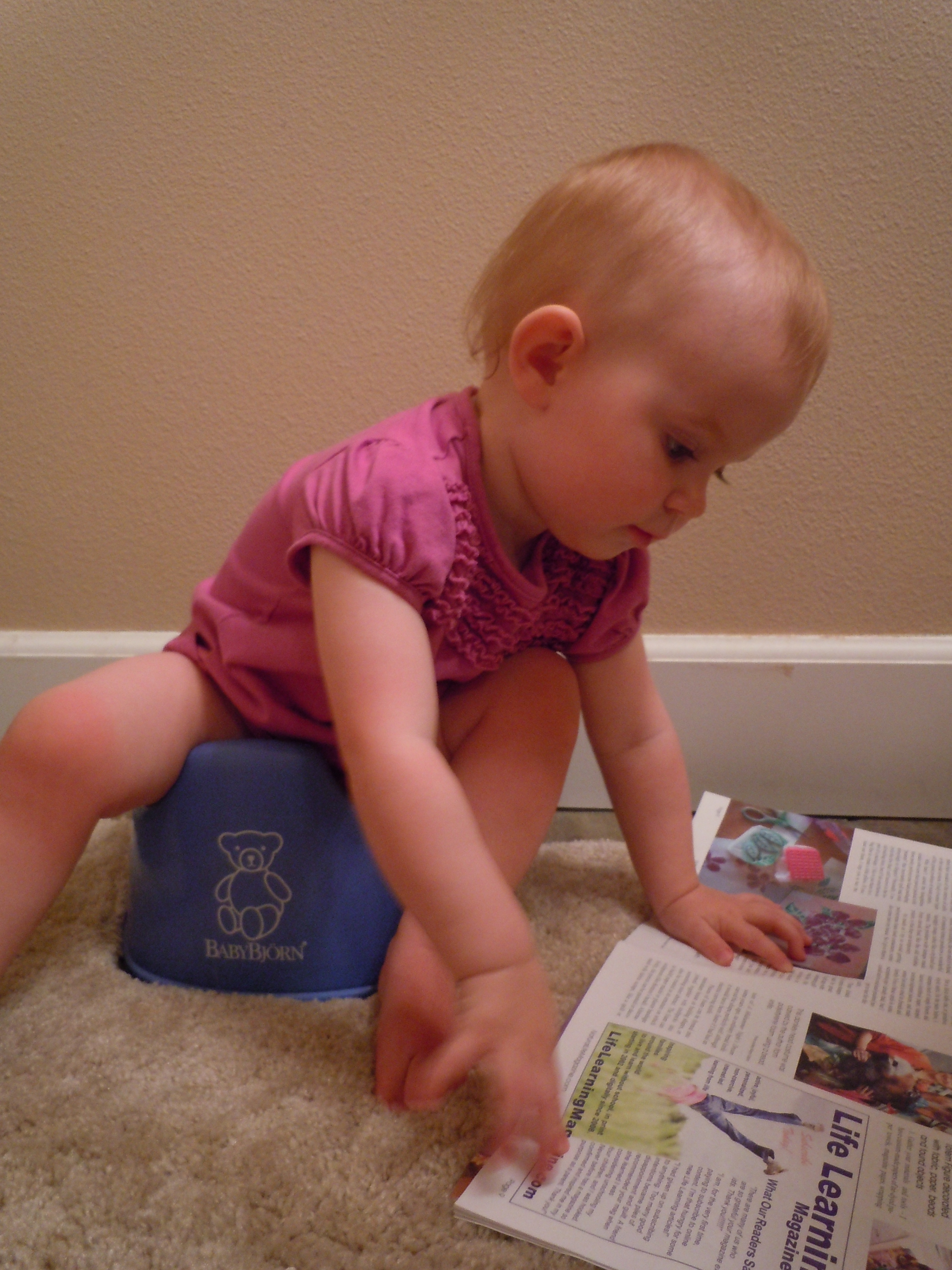
Toilet learning is something that so many parents struggle with, yet somehow I thought I’d make it through unscathed. Julia has been using the potty occasionally since she was just a couple of months old. You can read about our early Elimination Communication journey here.

But this week I realized that I’ve been rushing her and so I’ve decided to back way off and try again when she’s more interested and ready.

She’s a pro at knowing when she has to poop and has done that consistently on the potty since she was about six months old! Hooray! However, peeing is another story.

I’ve been “catching” her pee for her whole life, but unless she’s nude, she doesn’t seem to understand that she’s about to go. It’s fascinating to me that all summer long, we’d just leave her pants off and she would always run to the potty when she needed to go. But as soon as we put a pair of training underwear on, she seems to lose the ability to anticipate going and she definitely doesn’t have any interest in running over to the potty. She’d much rather pee in her underwear.

We’ve done all sorts of things to encourage her like playing games, racing to see who can pee first, showing her doll how to go on the potty, reading books about the potty etc. I’ve even started to ask her to pull down the wet undies herself (which is hard!) and take them to her diaper bin.

But the truth is, she just doesn’t seem to mind running around in wet underwear and she kind of enjoys any new task I offer that invites her to take more responsibility for herself and her things. So, rather than being a motivator for change, taking care of her wet underwear is just another fun new task that she can accomplish with pride.

Since I do my best not to bribe her, I’m at a bit of a loss as to how to motivate her to keep her underwear dry. I mean really, what’s in it for her?

Last week was the worst. She seemed to clue in to the fact that all the adults in her life would like her to keep her underwear dry and since she’s two and a half, the lure of defiance and subsequent feelings of power were just too strong to resist. She started to hold it while sitting on the potty and then go in her pants ten minutes later. Needless to say, I was frustrated with the backsliding.

But since she has NEVER yet told me, “Mama, I have to pee,” I’ve decided that she’s just not ready yet, and we’re going back into diapers for a time. I just need to let go of my hope that she would have learned to go on the potty by now and relax into the knowledge that she’ll learn it when she’s ready and motivated to learn.

“If you want to pee in your pants, that’s fine, that’s what diapers are for, so we’ll just go back to diapers and when you’re ready, we’ll try underwear again.” She is fine with it. In fact, I think she’s relieved that she doesn’t have to run to the potty every hour. She’s busy learning and growing in so many other ways, and she’s just not interested in potty learning right now.

She did mention that the diapers are more bulky and uncomfortable than the underwear is. Maybe that will help to motivate her when she’s more ready.  And when it’s warm again, we can let her run around in the buff, which somehow makes it easier for her to tell she’s about to pee.

I know a lot of preschools in my area require children to be “potty trained” before admittance (at around 3 years old) which can be quite stressful if you’d like to enroll your child, but he’s not yet using the toilet reliably. Luckily, we’re homeschooling for the time being, so no worries there.

I’m curious, how did you handle toilet learning? Did you resort to bribes? Do you think that’s OK? Or did you just wait until your child showed a genuine interest? What seemed to motivate them to learn to use the toilet? And at what age did it happen?

I guess I’ll run over to the library and check out “The No-Cry Potty Training Solution” Oh, and by the way, if you’re struggling to figure out whether your child is ready or not, I like this quiz for “potty training” readiness from Elizabeth Pantley.

Have a great week! Warmly, Shelly
Learning is NOT Linear: The Ebb and Flow of Learning & Growing, Retreating & Regressing

When I first began studying child development I thought things happened in a pretty linear fashion. First you learn to crawl, then you walk, after that you learn to talk and so on. And if you study information about ages and stages, you can come to the same misinformed conclusion.

But after 20 years of experience with young people, I can tell you for certain, learning is not linear. Children might learn and grow in one area and retreat and regress in another and they can do it all at the very same time. When we forget about the non-linear life experience of learning and growing, we set ourselves up for disappointment and we have unrealistic expectations of our children.

I’m sure you’ve experienced the complete exasperation of staring at your child who could tie her shoes yesterday, but is in a teary puddle on the floor today. Or you’ve seen your toddler go in and out of diapers over the past year. Or maybe you’ve seen your baby feed himself successfully a total of one time.

We tend to get so excited about the developmental milestones that we sometimes forget that there’s an actual person reaching for them. And a person is a hugely complex individual. Lots of factors can impact learning and growth, not the least of which is stress. Unfortunately, children today are experiencing far more chronic stress than our biology has been required to deal with in times past.

I recently read a longitudinal study (I can’t remember exactly where) that showed that when people had grown up in an urban environment, they had more stress hormones in their system as adults when compared with children who grew up in a more rural setting. The conclusion of the study was that the stress of our childhood directly impacts our lifelong release of stress hormones.

Now I’m not trying to give you a guilt trip of you’re raising your kids in an urban environment. There are plenty of benefits to an urban lifestyle. But my point is that children are multidimensional and things like stress can greatly impact learning.

For a child, even a change of routine can be enough to trigger a regression of some kind. And then there are the regressions that seem to come out of nowhere and which we can’t seem to tie to any particular event or experience. The thing is, children are just doing their best to learn and grow in every moment, and sometimes that looks like retreating or regressing into a safer, more familiar experience, like wearing diapers, or baby talk.

OK, so why am I writing about this today? Well, I’ve been working toward night weaning my daughter and it has been a bit of a rocky road. I say working toward because I have been resolving to night wean and then changing my mind for the past month. I know she’s not a fan of the weaning plan and she lets me know that repeatedly and loudly. But I also know that I’ll be a happier mom when I can get a full night’s sleep in bed with my wonderful husband, rather than co-sleeping with my daughter and nursing all night long. And lately it has literally been ALL NIGHT LONG. I’m exhausted.

Meanwhile, my daughter has been learning to read (whoa!) and learning geography at a level I would expect of a six or seven year old. But she still wants to nurse about ten times a day (and all through the night). So, that’s why I needed the reminder that even as a child excels in one area, he might need a little bit of extra time, attention, snuggles and care in some other areas.

And if you think I’m kidding about the geography, here’s a video we recorded to prove her abilities to my brother:

Have you noticed the non-linear nature of learning? How does this show up at your house? I would love to hear from you, so please leave a comment!

And have a fantastic week, Shelly

Noticing your child’s signals about next developmental steps

A friend and I were talking the other day and she mentioned that one of her biggest challenges with providing activities for her children is knowing where they’re at developmentally. I can relate. Figuring out which activities will be engaging and challenging without being frustrating for kids can be a confusing undertaking. So here are some of the questions I ask myself as I’m preparing Montessori activities for my daughter to do at home.

1)     What topic or skill is she most interested in right now?

2)    What action or activity does she seem to enjoy most and like to repeat?

3)    Which items on the shelf are being ignored? (they are probably too easy)

4)   Which items on the shelf are most popular?

5)    When does she get frustrated? (probably too difficult)

These questions help me identify possible new activities, create extensions for activities that are too easy, and remove activities that are too challenging. They also help me identify any sensitive periods of development my child might be in currently.

My daughter is in several sensitive periods right now. She is absorbing language, practicing her verbal skills and memorizing books, asking for multiple repetitions. She is very interested in putting things in and taking things out of boxes, baskets and the like with repetition. And she enjoys using wind instruments like whistles and recorders.

So I often ask myself “How can I provide opportunities for her to further develop her interests and skills?”  And inevitably when I ask myself the question, answers arise. Obviously we’re reading books like crazy, I mean right now she is read at least a dozen books every single day and often she wants each book read multiple times in a sitting.

And then I’m also sensitive to opportunities to hone her skills when we’re out an about. The other day we went to a market near our home where they provide working child-sized grocery carts. We had a handful of items on our list so I asked my daughter to find the items on the list (I helped her locate them) and she delighted in putting four cans of chicken noodle soup into the cart all by her self. We continued through the store searching for what we needed.

When we had everything on our list she was happy to push the cart up to the check out line and talk with the mom and baby in line behind us while we waited for our turn. Then she preceded to hand the checkout guy every item in the cart one by one. All the adults were very impressed but Julia just seemed satisfied with her work and with the social interactions she was having. She wasn’t looking for praise (and honestly she didn’t get much more than a “Thanks honey!”). Instead, she was simply continuing to develop her skills, pushing herself to do more and better than she had ever done before. It was really fun to watch!

So what is your child most interested in right now? How can he further develop an emerging skill? And which activities can you think up that will help foster his love of learning?

Here’s a sampling of activities for Julia right now (she’s 17 months old).

1)     Coloring with large whole hand grasping crayons

2)    Spooning beans from one dish to another

3)    Books, books, and more books

4)   Putting blocks, books, and other toys away

5)    Bean or water bin

If you need some suggestions for your child’s age/developmental stage, leave a comment!

And have a fantastic week, Shelly