A cure for clutter: using a rug to define a workspace

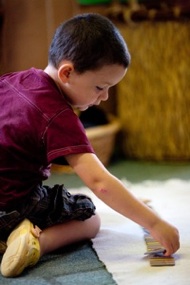
Are you tired of tripping over your child’s toys or bugging the kids to pick them up off the living room floor?  Using a rug to define your child’s workspace is a great solution that works well for everyone!

You might even already have a rug that will work well.  You want a rag rug, bathmat, or other rug that is about three feet by four feet in size and is easy to roll up.  To keep it out of the way when it’s not being  used, you can store your rug in a clean trash can, large vase, or other container when it’s rolled up.  And when your child is ready to get out her dinosaurs, remind her to get her rug first. This trick was taught to me by my friend who is also a parent and works for Oriental Rug Cleaning in Jupiter, FL, she the idea while working one day! Just make sure you don’t choose a rug that will get dirty easily.

Children often enjoy taking care of their workspace and will take great pleasure in laying out their rug and then setting out their toys or other activities.  And, by keeping the space defined you will notice several benefits.

First, your child will feel his work and play are honored and important when you make it a point to walk around his rug and encourage other family members to respect his space.  Second, you’ll cut down of sibling conflict when each child has his own space and both practice respecting one another’s space.  In the Montessori classroom children are required to ask permission to touch anything on someone else’s rug.

Also, if you need to move your child’s activity, it’s fairly easy to pick up two ends of the rug and drag it over to another spot without disturbing what’s on the rug.  That means that even though she starts a puzzle on the living room floor, you can pull it over to the hallway, or even into her room, when the family needs the floor space again. Continue reading “A cure for clutter: using a rug to define a workspace”

Understanding willful toddlers

I’m generally a happy and optimistic person.  Don’t get me wrong, I’ve had dark moments, but for the most part I enjoy my life and am grateful for it.  However, when I’m with a toddler who seems intent on pushing my buttons, I am hating life.   It seems like no matter what I do to please the little tyrant, I’m still fending off testing behavior hour after hour.

Here are a few empowering thoughts, assumptions, questions, and some dialogue that have helped me change gears and reconnect with a young person after I’ve felt frustrated or hurt:

Q: My 20 mo. old son is throwing things in clear defiance of my wishes.  It seems like he WANTS to upset me.

New interpretation: He’s just asking to play.

Challenge: How can we make it a safe/fun/mutual game?

Inside Shelly’s head:

Oh no, he’s going to throw that.  “Stop!”, He throws it anyway and aims at something breakable but misses.  “Wow, I’m so glad you aimed away from the flower pot!  That flowerpot is fragile and breakable and it would be expensive to replace it.  Hmmm, I wonder what would be good to throw something at…Oh!  I know!  Let’s throw beanbags into the special hole we made!  I want the red beanbag, which one do you want?  I’m going to throw it into the hole.  Can you make it into the hole? C’mon!  Let’s go get the beanbags!”

Q:  My 18 mo. old daughter uses a blood curdling scream when she wants attention and sometimes for no reason that we know of. Continue reading “Understanding willful toddlers”

The magic question

Are you wanting more ease and cooperation from your kids this week?  I have a magic question that will get you exactly that.  One great thing about this question is that it also works well with other adults.   Another wonder of this magic question is that when people ask you this question you feel honored, cared for, and free to say yes or no.

This question empowers you and your loved ones to communicate openly, honestly, and freely.  It can even help you learn more about your children and their motivations.  OK, are you ready for it?  The magic question is, “Would you be willing to ____?”  Variations on this question might be “Would you?” “Could you?” or “Will you please?”

But a huge part of the magic of the question is that it’s a true request.  When you ask, “Would you be willing to help me carry in the groceries?” you’re actually asking for help, not demanding it.  So be careful with the variations unless you’re sure you’re truly asking.  Sometimes our demands can be subtle and veiled, but they’re demands none-the-less.

It’s easy to fall into the trap of demanding and ordering kids around, especially when they’re resistant and uncooperative.  “Brush your teeth” “Put on your shoes, we’re leaving” and “Stop hitting your sister” are the kinds of demands most kids experience daily.  If you’ve fallen into the habit of making lots of demands of your kids, you’re not alone.  The problem is that the more we demand, the less kids want to cooperate.  And the less kids cooperate, the more we demand.  It’s a vicious cycle, but you have the power to change the dynamics substantially, just by asking the magic question and being OK with whatever the answer is. Continue reading “The magic question”

The simpler the better

Hey Everybody, I’m back!  My beautiful daughter is nearly 2 months old and I’m excited to be back in touch with you all.Before I go on, a special thanks to all my guest bloggers. You all really helped me out and provided great content for our awakeparent
community!

OK, so you know the principle of Occam’s razor?  It’s the one that states that the simplest explanation is usually the correct one.  Well, so far, it’s been showing up in my world as a new parent.  Here are some examples:  1) Which is simpler, that my husband purposely hid my fork from me or that I inadvertently tossed it into the sink and forgot about it? 2) Which is simpler, using a host of stain fighting concoctions to get the poop stains out of my cloth diapers or just putting them out in the sun for an hour? 3) Which is simpler, applying lots of special creams to my baby’s butt to get rid of diaper rash or just letting her little toosh get some air a few times a day?

I’m finding it absolutely amazing how time and again, the simpler solution is the better one!  It reminds me of a book I read years ago called “The Simple Living Guide” that offered lots of simple, easy solutions to all aspects of our ever more complicated lives.  If I recall correctly the author even wrote about things like getting rid of stuff so that you’d have less to organize and keep track of.

I love the principle of simplifying on many levels.  Continue reading “The simpler the better”

Simple changes at home can help kids feel comfortable and capable

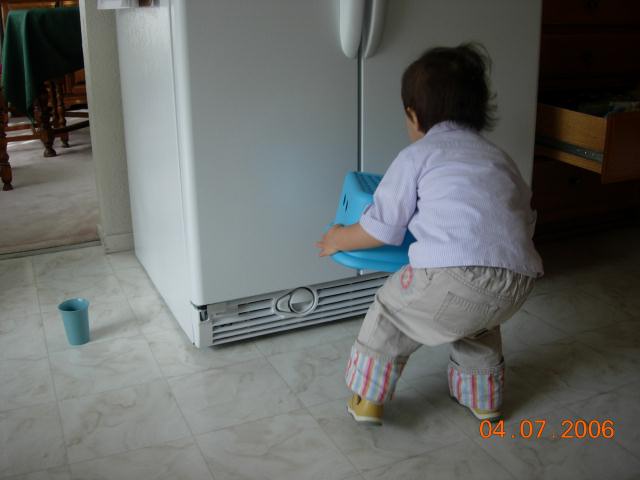
DSCN0589When I worked in Montessori schools I was consistently amazed at how happy, engaged, and capable the kids in my class were.  This got me thinking, “If kids can be this self-sufficient and joyful in a classroom, then why not at home too?!”  I’ve noticed that young people often feel frustration at living in a an adult-centered world. I can remember feeling irritated about not being able to see over the counter, or out the car window (before the advent of booster seats).

Although young people make up a significant portion of our population, they don’t pay the bills, so they usually aren’t catered to in the way that adults are. Most furniture is not built to accommodate them. There are often no stools provided where needed, especially in public.

Even going to the bathroom in a public restroom and washing one’s hands can be quite difficult for a person with a small body. Doors are large and too heavy; tools are too big for their hands… I think you get the idea.DSCN0590

So if there’s a place where a child can find solace from these frustrations, I hope it will be their home.  I would be inspired to live in a world where a child’s home is a place where she can reach the counter top, make herself a snack, and take care of her personal hygiene easily. I’ve found that when young people are given the tools they need to be able to have these freedoms, they are more peaceful and often much more responsible. Trusting young people to care for themselves and giving them the necessary tools to do so, fosters a sense of self-care, self approval and healthy pride.


DSCN0591Consider the daily activities of the child in your home. What does he do and what would make his tasks easy to accomplish without asking for adult intervention? Is there a convenient place for him to hang his coat when he enters his home? (Tip: for very young children, a low hook is the easiest place for a jacket) Can he reach the sink easily for hand washing? Are there art activities, games, puzzles and books that are within easy reach?  Does your child have comfortable furniture that fits his body?

Ask your kids what changes they’d like to see in their home environment. And consider what changes would ultimately make things easier for all family members. For instance, if children’s dishes are where they can reach them and they know where the carrot sticks are and that carrots are an acceptable snack, they can simply let you know what they’re doing (or not, depending on your house rules),  without needing you to stop what you’re doing and fix them a snack. Also, consider asking older children to help younger children. Requesting the help of your older child (without demanding) can foster teamwork and interdependence between siblings.

Ultimately, your children want to feel capable and supported in their home, and although that might require some rearranging and consideration, it’s not much work to provide possibilities for autonomy and it’s almost no work for you once they know how to care for themselves! So, take a look around your home this week to be sure that everyone in your family has access to:

Water (for drinking and washing)DSCN0600
Food
Clean clothing
Warm clothing
Books/toys/art supplies
Towels and cleaning supplies
Art at eye level
Full-length mirror in bedroom
Things to nurture like a plant or a pet

So, I hope you’ll use this list as a guide, and talk with your child about what sort of changes would make life at home easier, more fun, and more equitable.  When we honor children by taking the time and making the effort to accommodate their needs, they feel treasured in ways they can’t even express.  But I’m sure you’ll notice the difference!  I’d love to hear about how simple changes around the house have made a difference in your kids lives.  Please leave us a comment below.