20 Easy Ways to Get Kids to Laugh Without Tickling

People have always known it and now science is beginning to prove that laughter really is the best medicine. After a good laugh we’re more relaxed, our blood vessels function better, we’ve released feel good hormones into our system, reduced our pain levels, boosted our immune system and even reduced blood sugar levels!

And that doesn’t even cover the psychological effects of laughter. People with a good sense of humor have been shown to recover from depression more quickly and they’re less likely to become depressed in the first place. There’s no question that laughter puts us in a better mood. So how can we help our kids release their pent up emotions through laughter?

Tickling is often the go-to method of getting young children to laugh. But when we’re tickling kids, they may or may not be enjoying it, and we have no way of telling whether they’re having fun or are upset. I can remember being tickled as a child and fearing that it would never end. I couldn’t catch my breath, I couldn’t stop laughing, and I couldn’t even tell the person tickling me that I was no longer having fun.

That was until my mom came up with a way for me to control the tickling. We played a game in which I got to tell her when to start and when to stop tickling. And only then, did I feel safe during tickling.

So, if you typically resort to tickling to induce laughter in your child, I hope you’ll consider checking in to see whether it’s something they actually enjoy, and setting up a way for them to control the tickling.

And in case you’re wondering, there are tons of other ways to get young kids to laugh. And you don’t have to become an expert at comedy improv to do it (although it couldn’t hurt!).

Here are a few of my favorites:

1) Surprise them

2) Fall down

3) Put on a silly hat

4) Speak in a funny voice

5) Be forgetful

6) Run away from them

7) Chase after them

8) Pretend to “get” them

9) Use an accent

10) Pretend you’re the baby

11) Dance wildly

12) Pillow fight

13) Potty talk

14) Speak in gibberish

15) Mess up your hair

16) Knock something over

17) Pretend they’re getting into trouble “Don’t do that! Oh no! She did it again!”

18) Beg for something

19) Cling to them

20) Fake laugh or fake cry

The idea here is to make yourself the more vulnerable, forgetful, inept, and clumsy one and allow your child to take a position of power over you. This almost always results in peals of laughter, and don’t worry, kids know that this is a game and that you’re still ultimately in charge.

So, how will you invite and induce more laughter this week? My final tip? If you find something that works and makes your kid laugh, keep doing it!

I hope you’ll have a laughter filled week. Warm hugs, Shelly

4 Ways to Make Sure Kids Know You’re On Their Side

Kids have a different way of thinking about life and their experiences than we adults do. They have a tendency to blame themselves for other people’s behavior. And they often make up wildly inaccurate reasons for why things happen the way they do. That’s all perfectly normal and experience will eventually show them that they’re not responsible for their brother’s broken arm or for a huge snowstorm.

But sometimes it can be difficult for a child to distinguish between friend and foe from moment to moment, even in their own home. One minute we’re their hero because we let them have a special treat, then next, we’re the enemy who won’t allow them to go to the party, or draw on the walls, or run naked through the house.

And when a child thinks her parent is the enemy, the connection suffers and the child is less likely to cooperate in the future. That’s a huge reason why research has shown that punishment is actually counterproductive. Sure, it lessens the incidents of the offense when kids are in our presence, but overall, punishments teach kids to hide their actions, figure out ways not to get caught, and live a more secretive life.

If you want your kids to adhere to certain rules because they see the value of those rules, connection is the key and punishment is a losing strategy. So how can we be sure our children know that we’re on their side, even if we won’t let them do everything they want to do?

Here are four ways to be sure your kids know that you’re a team:

1)   Sit side by side

When we’re across from each other, we have a tendency to be more antagonistic, we often feel defensive, protective and fearful in this position, especially if the other person is larger, has more power, and is upset about something. Instead, try sitting side by side, which encourages teamwork and helps us feel like we’re working together to solve a problem.

2)   Help them win their argument

Help them win their argument—When a child is arguing his position it’s easy to produce a stronger argument or to simply say no. Instead, try helping your child to strengthen his argument. Give him insider tips to how to convince you to change your mind. And if it’s something you can wiggle on, allow your child to win the argument and convince you to change your mind. This gives kids a sense of power and accomplishment and it teaches them that you’re willing to work WITH them, rather than against them.

3)   Offer empathy

When your child is upset about something, don’t try to convince her out of her feelings, instead, reflect those feelings back to her so that she knows you understand. “Wow, you’re really upset about that. It sounds like you’re feeling sad right now, is that right?” When your child is having big feelings, avoid explaining your position, convincing her to feel differently, minimizing her feelings, or changing the subject. And make sure your child knows that it’s OK to feel the way she feels and that emotions are a normal and natural part of life.

4)   Explain the reason for the rules

If your child questions the rules, explain them to him. Do this only if your child is reasonably relaxed but is curious. “The reason we always hold hands when crossing the street is because there’s safety in numbers. If you fell down, I could help you up. And since I’m taller than you, people driving cars can see me more easily and they’re less likely to accidentally hit you. I want you to be safe, so that’s why we always hold hands when crossing the street.” Avoid pat phrases like, “because I said so” as they don’t give a child any additional information and they imply that you can arbitrarily set rules for no logical reason. From a child’s perspective this can seem much more like a dictatorship than a team.

By using these four strategies, you can help your child learn to trust that you’re on their side and that even when you’re enforcing rules that they don’t like, you’re doing it for the good of the family, and not just because you wan them to suffer.

I’m curious, have you used these strategies before? Do you think they’ve helped you maintain a closer connection to your child? Or are you struggling to resist the urge to punish your kids? I would love to hear about your experience. Please share your thoughts below.

And have a wonderful week!

Warmly, Shelly

Hooray for Mistakes!

I’ve been reading a very interesting book about exactly why intrinsic motivation is so important for children AND for adults. It’s called “Mindset: The New Psychology of Success” by Carol S. Dweck and in it Dweck describes two opposing mindsets we all experience.

She refers to the first as the “fixed mindset.” This is the voice in our heads that tells us that we have a fixed amount of talent, intelligence, or skill at a certain task and there’s nothing we can do to change it. This mindset also associates effort with a lack of natural talent. This is the part of you that thinks you’re just not a fill in the blank kind of person. “I’m not artistic.” Or “I’m just not very playful.” Are examples of the fixed mindset.

The other mindset is called the “growth mindset.” When we’re in the growth mindset we believe that we can learn and grow and become better at anything that we put effort into. The effort becomes part of the fun as we develop our skills and reach for our goals.

Interestingly, when we tell children things like, “good job” we’re inviting them into a fixed mindset. Our focus is on the outcome, rather than the effort or the journey of discovery. And, once we’ve labeled them as “good” or “smart” or “talented” children in the fixed mindset suddenly have something to loose if they fail. So, they stop trying at all. Not exactly the result we were wanting when we offered the praise in the first place.

On the other hand, when we focus on the effort, “Wow, you really put a lot of effort into that!” we’re inviting them to see effort as a part of the learning process (which it is!). In this mindset, children will experiment, try harder and harder puzzles, and get excited about learning new stuff. Now, that’s what we’re wanting for our kids, right?

The thing I’m finding most interesting is that people in the growth mindset often celebrate their mistakes, rather than sinking into a hole of despair about them. And that one choice, to celebrate our mistakes rather than getting down about them, makes a HUGE difference in our overall ability to learn something new.

This is true for children and adults alike. So as I’m reading this book, I’m thinking, I know a lot of moms who are in a fixed mindset about mothering. We think that we should already be good at it, or that we’re just naturally bad at it and there’s not much we can do about growing our mothering abilities.

But I’m here to tell you that even if you’ve been doing all sorts of things you don’t want to be doing with your kids, you CAN change. You absolutely can learn and grow as a parent. And from over here in the growth mindset, that learning is half the fun of parenting!

So this week, instead of beating yourself up for the thing you said or the tone you used or the way you treated your child, imagine that there really are new skills that you’re discovering through these incidents. Try to figure out what those skills and next steps might be and then get excited about learning them!

If you’re yelling, you can learn to manage your emotions more effectively and come to your children with more composure more of the time. That doesn’t mean you won’t fail. But from this mindset, every “failure” is another step closer to success!

If you’re experiencing power struggles, or whining, or tantrums, or any number of parenting challenges, you can see these things as new opportunities, rather than as a life sentence.

The belief that things can change is a powerful belief, and it’s one that I use often, especially when I feel stuck in a situation I don’t enjoy. So, what is it that you’d like to learn this week? What would you like to change? How do you want to grow and stretch yourself?

I can’t wait to hear all about what you’re up to!

Sending warm hugs, Shelly

The Top Ten Things I’ve Learned About Getting Organized

I used to resist organizing. I’d put it off until my drawers were overflowing and my closets bulged. But at some point, often at the worst possible moment, I’d be forced to handle the clutter that had built up beyond recognition.

I’ve turned a corner in this regard. I actually enjoy organizing and re-organizing now! And having a few days “off work” seemed like a great opportunity to re-organize some areas of my home that had been neglected of late.

So, the pantry got an overhaul last weekend and so did a strangely shaped cabinet in my kitchen. Now both are more usable, more pleasing to look at, I know what I have and I’ve gotten rid of the stuff I was keeping but no longer needed. It’s amazing how much space can be taken up by things that we rarely use, but that we still think we need to keep around. For me, a huge part of organizing is letting go of the things I think I need, but don’t actually use.

Whew! I’m so glad I tackled that pantry (thanks to my wonderful husband for the inspiration). What a nice feeling to start the New Year with! Next up, my office! Ha! That’s a joke, I’ve been working on organizing my office for at least a year. And, yes it’s far better than it has been in the past. Maybe I should add an organized office to my 2013 vision!

Do you enjoy organizing? Or do you experience it as a constant battle? Do you dread doing it with the kids around? Or is it fun to include them in the process?

I used to do all my re-organizing when my daughter was asleep because I was afraid she would take things from various piles, carry them around the house, or just need my attention while I was in the midst of my project. I still tend to do more organizing when she’s otherwise occupied, but now I’m no longer afraid of what will happen if she’s around while I’m moving things around.

I figure it’s probably good for her to see behind the curtain a little bit and start to understand that there are things that need consistent revisiting in order to keep our home tidy and accessible.

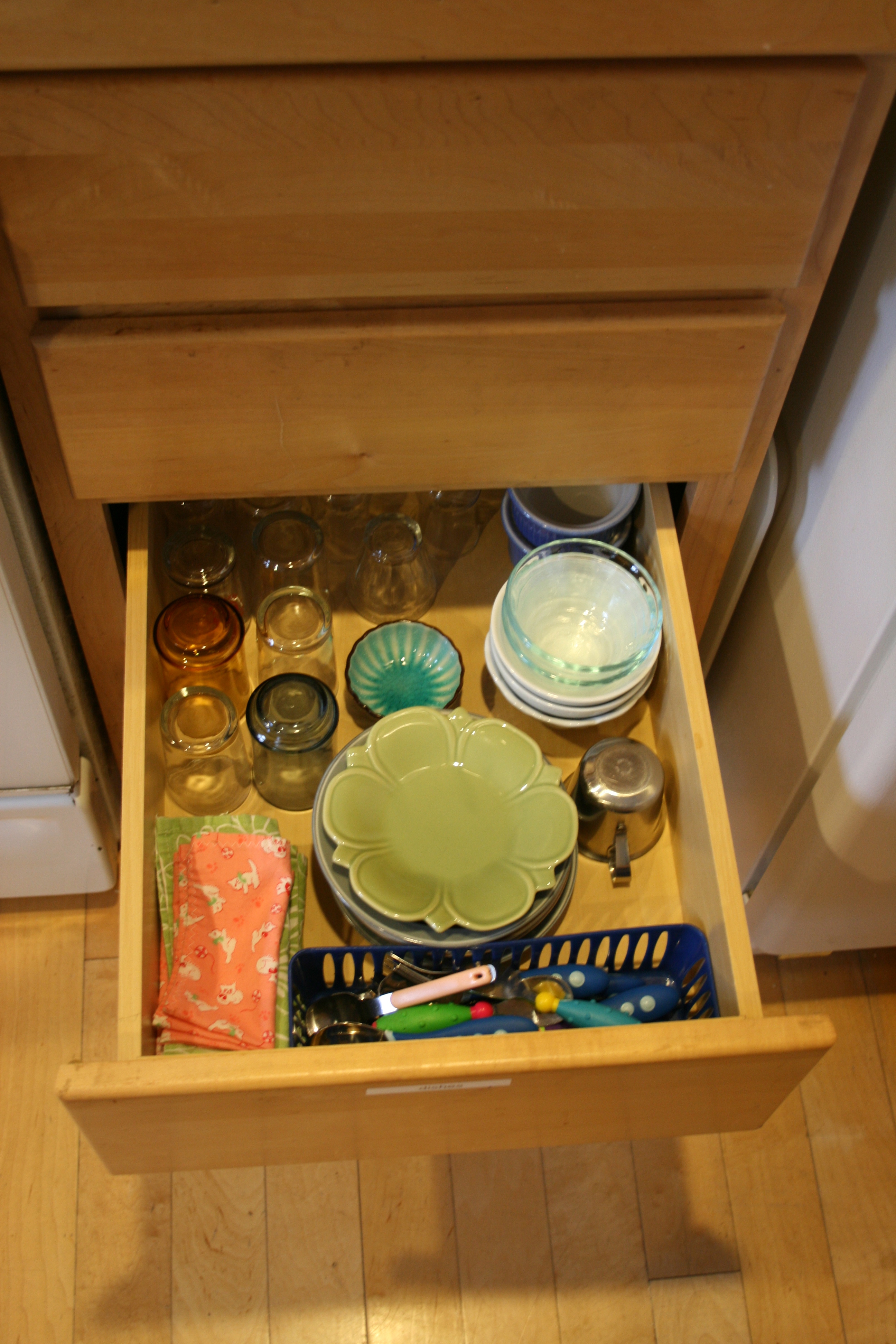
At almost two and a half, Julia is now responsible for putting her clean breakable dishes into her kitchen drawer after they come out of the dishwasher. She does this task with gusto each and every time I ask, but it’s only possible because we’ve kept her drawer well organized and it’s not overstuffed with items that are rarely used.

Here’s what I’ve learned about staying on top of organization lately.

1)   It’s never ending.

2)   I need empty bins, baskets and buckets to dump things into at the beginning of any reorganization attempt.

3)   I need bins, baskets, and buckets to hold ongoing in-process items like “giveaway” “to be filed” and “to be fixed.”

4)   I MUST have systems for dealing with things like junk mail, personal items, things that are broken and need fixing etc.

5)   It’s never ending.

6)   A place for everything and everything in its place is a fantasy right now (albeit one of my favorites), but I will achieve it. I WILL ACHIEVE IT.

7)   Keeping things from coming INTO my house is probably even more important than having a system for dealing with things once they’re here.

8)   Asking my daughter, husband, mom, and whoever else is willing to HELP me is crucial. I don’t have to do it all myself.

9)   It’s my job to set the expectations and to let my family members know when it’s time to straighten up (without throwing a fit by huffing around the house complaining about what a pit it is).

10)   It’s never ending, so I might as well enjoy the process.

I recently read “Getting Things Done” by David Allen and I realized that there are all sorts of ways that I’ve been undermining my own efforts to organize. Now I’ve got a clear plan and I’m chipping away at my bad habits bit by bit.

Do you know what’s keeping you from having the tidy and organized home you dream about? Or are things just fine as they are? I would love to hear about your own journey of staying organized at home. Please share a story or comment below!

And have a fabulous day, Shelly


How to Write an Effective Vision

So last week I shared my list of intentions for 2013 and I also shared that simply setting intentions is not enough to really make the changes you’re wanting. I recommended turning that list of intentions into a Vision with these qualities:

1)   Everything is stated in the positive (no exceptions).

2)   It is written in present tense, as if all of this is already true.

3)   It is a narrative and when you read it you truly FEEL how you will feel when you accomplish the goals within.

4)   You MUST share your vision with at least three people.

Now that you have your list of intentions, let me walk you through the process of creating a vision that will easily and effectively draw forth the results you’re wanting. I’m going to break down each of these parameters and then I’ll offer you an example of my own vision in process.

1)   Everything is stated in the positive (no exceptions).

This is crucially important since in my experience we get more of whatever we put our attention on. This is especially true when it comes to parenting. If I focus on my daughter’s whining and how annoying it is, voila! I get more whining. On the other hand, if I put my attention on an activity or behavior that I enjoy, again, I get more of it.

So, as you’re writing your vision, be sure to double and triple check it to make sure you’re saying things like “My daughter asks for what she needs before she’s in distress” instead of “My daughter never whines.” If you have any specific questions about this part, feel free to send me a message and I’ll let you know if I find anything that could be worded more positively.

2)   It is written in present tense, as if all of this is already true.

Again, I can’t overstate the importance of this rule when writing an effective vision. Statements like, “Someday I will learn to control myself and use a kind tone of voice.” will only serve to reinforce the fact that you’re not there yet.

Instead, try, “Whenever I feel irritated, I take a deep breath and remind myself that we are all just trying to meet our needs. Then I notice whether I can speak calmly or if I need a moment alone either to express my emotions in a healthy way or to step further into composure. My children support my intention to speak to them calmly, and remind me to take a break if they think I need one.”

3)   It is a narrative and when you read it you truly FEEL how you will feel when you accomplish the goals within.

The reason that writing a vision can be so effectives is because it creates a memory within us of how it feels to have accomplished these goals and to be living in this specific way. When we have a vague idea what we might want, we’re unlikely to get it. On the other hand, when we know exactly what it is we want to create, we figure out ways to go about manifesting that very thing. Your vision might be completely different from mine in content, but if you want it to be effective, just make sure that you feel the way you want to while you’re reading it. Whatever imagery, details, or people you need to include, go for it. It can be whatever you want it to be, and should actually be so awesome you almost can’t believe your “luck.”

Humans have a long and rich tradition of narration and story telling and I don’t think it’s just a lark or a distraction from reality. Rather, I see story telling as one of the most effective ways we have to make sense of our reality and to encode memories in helpful ways that allow us to continue to develop. Remembering every detail of our lives doesn’t work well, which is why memory doesn’t work that way. Remembering the parts of our lives that are important to us, the stories that are meaningful, or teach us a specific lesson, that’s where the juice is.

So when you’re writing your vision, be sure you enjoy reading it and that it has a clear storyline or the ability to transport you into the scene in the same way that a good movie or memorable novel can. If the narrative doesn’t move you, keep working on it or ask for help until you can come up with something that does.

4)   You MUST share your vision with at least three people.

Here’s where the rubber really meets the road. Now that you’ve created a narrative that really speaks to you, inspires you and excites you, you need to share it with other humans. Why? Because we don’t live in a vacuum. We are social creatures and guess what happens when you share your vision with a trusted friend or family member? You’re sharing something meaningful and vulnerable which means that your friends and family get to learn something more about who you are and what you want. But the magic really happens because you’re DECLARING your intentions. Essentially it’s the difference between secretly loving someone but being too fearful to tell them and actually shouting from the rooftops, “I LOVE KEVIN!!!”

You’re not just wishing or hoping for life to change in these important ways, you’re DOING something about it. You’re creating a new reality in your own mind, and then when you share your thoughts with others, they become more real. The same thing happens when you complain to your girlfriends. Your friends commiserate with you to make sure that your reality IS reality, whether good or bad. This is part of why it’s so important to stay positive, because we get more of whatever we focus on.

OK, so I promised you an example from my own vision. So here’s a part of a first draft…

First, here’s my original list of intentions:

1)   Help Julia learn to fall asleep on her own with little help from an adult

2)   Keep track of all expenditures and get spending under control

3)   Find new ways to save money and make wise long term financial decisions

4)   Double (at least) my income from 2012

5)   Lose 13 more pounds and continue to exercise regularly

6)   Create my first Awake Parent eCourse and launch it successfully

7)   Grow my list to 10,000 subscribers

8)   Take classes just for me (voice lessons, belly dancing etc.)

9)   Swim lessons for Julia

10)  Get pregnant???

Now, here’s my first attempt at a vision that encompasses them…

Wow, my life is so incredibly awesome! I am happily surprised at how much I enjoy money management now, in fact, I’ve just discovered yet another way to save money on household expenses and I am looking forward to my next appointment with my financial advisor like a kid with a cookie jar. It’s so much fun to see our retirement accounts growing and growing!

When I woke up this morning I couldn’t wait to head over to the gym for my usual hour-long work out. I love to sweat and read my novel. My work out time has really become the “me” time that nurtures and fulfills me. I’ll definitely be able to continue my cardio work-outs all the way through this pregnancy.

I am elated at how much money I’m bringing in this year. All of my money worries have been handled and now I get to have fun saving and planning for our future! I am so honored that my clients trust me to support them and their development and continue to be so incredibly generous and loyal. And I’m super excited that my first eCourse is such a big hit!

I have thousands of subscribers to my newsletter and my online business has built so much momentum that it continues to grow without additional effort on my part. I’m looking forward to hiring my first employee this year. But what really feels great about growing this business is all of the people and families I’m helping. I’m finally getting the word out about connection parenting, respect for young people, and effective gentle discipline that works. Hooray!

OK, so you get the idea. This is definitely not finished and it is NOT a final draft, but can you FEEL the excitement?! I think the last two paragraphs need the most work. I need to hone in on what most inspires me about this work and why I think it makes such a huge difference in the world. Now THAT will be an inspiring vision to step into!

So, I hope this article was helpful and if you have any questions or want to share your vision with us, feel free to add it to the comments.

Have a fabulous week! Love, Shelly