
Your Work/My Work

In the Montessori classrooms I’ve worked in, there are usually twenty-four children between three and six years old and just two adults. Each child has free choice of hundreds of possible activities in the classroom, and in order to maintain peace and order, we HAVE to create some rules and boundaries.

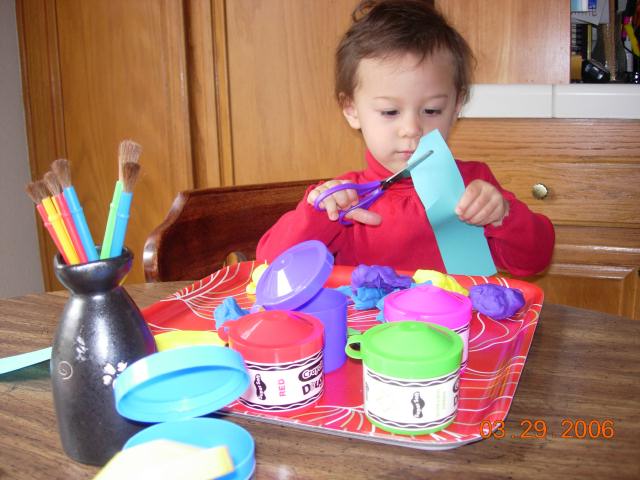
One of the rules is that we respect one another’s work. We don’t touch each other’s work, we don’t walk on someone else’s work rug, and we don’t clean up after each other. Each person is responsible for getting out, completing, and putting away their own work.

Several months ago I taught a class to parents of Montessori students and when I described the reverence and care we have for our work, a mother perked up. “Oh!” she said, “So THAT’S why my son gets so upset when I clean up his toys, he’s always complaining that I’m not respecting his work, but I didn’t understand why until now!”

I believe strongly in Montessori philosophies and use many of them as guidelines in my home with my daughter and now that she’s approaching two years old I’m beginning to understand what a huge difference this has made in the peace and order of our home.

First, I do my best to respect her work and often ask her to clean up after herself, before offering any help. So when she leaves something out, she can reasonably expect it to be there when she gets back. This provides stability in her mind and encourages her sense of order. She knows where she can find her things and she knows that there is no magical clean up fairy.

As an aside, I actually did think that something like a clean-up fairy existed when I was a young child. I had no concept of my preschool teachers staying after school to clean up, or of my mom and dad picking up after I was in bed. I just thought things magically reappeared in their original locations!

Of course, I’m happy to help my daughter clean up if she needs support, but I don’t make a habit of going around behind her and cleaning up after her.  As a result, I overheard her with her books yesterday. She was looking at the pages and talking about the content of the book and when she got to the end of the book she said, “Back” and put the book back on the shelf!

But here’s the real kicker. I also ask her to respect MY work. That means that she understands that my work is important and I’m committed to its completion. So when my daughter asks me to play with her I will often respond with, “Sure! I would love to play farm with you, but I’d like to finish my dishes work first, so you can go get started without me, or you can watch me finish my work, and then I’ll join you!”

One of the things I love about this is that she’s learning that life is filled with “work” that people enjoy and want to complete before moving on to new tasks. This promotes the concept of follow through while it also helps her to delay gratification while she waits for me to join her in her chosen activity.

I know without a shadow of a doubt that my daughter understands that her wellbeing is my top priority. And, I also want her to know that my own wellbeing is hugely important to me as well. The order of my environment helps me to feel peaceful and relaxed so that when I do sit down to play with her I can completely focus on her, rather than constantly thinking about my enormous to do list and only giving her my partial attention.

I’m sure I’ll write another post about organization and it’s psychological impact on us, but for now I’ll just say, it’s OK to let your child know that you have work to do when you’re at home. If we model respect for their work, they’re bound to learn to respect ours too. And when we honor and respect one another’s work, peace and love have plenty of room to thrive.

So, how do you balance playtime with work time at your house? I would love to learn some of your secrets to success in this area! Please share a comment below.

And have a fantastic week, Shelly

Redefining “Family Friendly”

I wish every public restroom had a child sized toilet. I want small tables and chairs that fit my daughter’s body in public spaces. I hope we are moving toward accepting, celebrating, and accommodating the small-bodied humans that make up a substantial portion of our population. But I’m tired of restaurants advertising themselves as “family friendly” just because they provide a high chair and the waiters won’t glare at me if my child accidentally drops food on the floor.

When I think of the words “family friendly” I imagine a place where parents and children are welcomed joyfully. I envision a place with activities that meet my interests AND the interests of my young child. And it’s a place where we all help each other out. To me “family friendly” means accessible, accepting, and even supportive of my whole family.

I want MOST of the world to be family friendly. And maybe more of it really is than I realize. But here in America, the land of the free, my child is stuck staring at knees, being put into carts and chairs she can’t climb into on her own, and unable to sit on a toilet that doesn’t threaten to swallow her whole.

Needless to say, I’m upset by all this.

That’s not to say there isn’t hope though. I have seen child-sized toilets in exactly two public places in the past ten years. More and more parks and play spaces are sprouting up. But again, I wonder, why does “child-friendly” have to mean big plastic wheels that spin with no apparent purpose?

When I was little I can remember using a water pump, you know, the metal kind that you have to pump up and down a bunch of times before any water comes out. My friends and I loved to work the handle up and down, up and down, and then to catch the water in buckets ready for the deluge that we knew was coming. We needed the water to add to the sand so we could build sandcastles or maybe we used some of it to water flowers that were wilting in the summer heat.

So when I envision child friendly spaces in public places, they’re not just a bunch of toys. Instead, I imagine beautiful wooden furniture, access to books, art materials, puppets, costumes, and the means to clean up any messes they might choose to make. I see children working together at a task that is meaningful for them. Or else feeling so free and comfortable that they can completely lose themselves in pretend play.

Last weekend my husband and I took our daughter to the High Desert Museum. They have a homesteader’s cabin and ranch from 1904 and every week there are volunteers dressed up in period dress sharing information about what life was like in the early 1900’s. There are all sorts of fun things for children to do there, but there was one little girl having the most fun of all. Can you guess what she was doing?

She was sweeping the porch with a child-sized broom. She tried a few different brooms until she found the one she liked the best, and for the next twenty minutes while we were meandering around, watching the chickens, and looking at the ranch hand’s quarters, she happily swept every inch of that porch.

Now that’s what I’d call “family friendly.”

Do you think public spaces are child and family friendly? What is your vision for the future of our public space? Please leave me a comment!

And have a wonderful week! Warmly, Shelly

Sometimes what kids need most from us is nothing at all

I think one of the most challenging lessons I’ve learned as a teacher and as a parent is when NOT to intervene. It is actually excruciating for me to hear a child struggling and not rush over to help. But sometimes doing nothing is actually the best thing we can do for a child. When we sit back, shut up, and allow our children to experience their struggle fully, they also get to experience the joy of conquest and the knowledge that they can rely on themselves to work through a challenge.

If you know me at all, you know that I’m not suggesting we allow our children to experience constant struggle. Emotional upset is counterproductive to learning overall. However, there are moments when we all rush in too quickly, offer too much coaching, or otherwise deflate the attempts our children are making to learn something new.

It’s human nature to want to help a younger, smaller, struggling human. But what message are we sending when we constantly intervene on behalf of our children?

Rushing out the door, we put the coat on our child because it’s faster than waiting for him to do it himself. We feed our toddlers by spoon because “she eats more this way.” We help an older with his homework so that we can all enjoy pizza and a movie together.

And the underlying message our kids are receiving is, “You aren’t able to do it yourself. You need my (older and more capable) help. And struggling is not OK.” And then we wonder why our kids eventually stop trying to excel and just do the bare minimum that’s required of them.

I think that the message that children are incapable is being ingrained in them from infancy. On the contrary, the infant’s brain is arguably the most intelligent thing on Earth. Even tiny infants are capable of incredible feats of deduction, learning and memory. They just have a hard time moving their bodies and communicating verbally.

But as soon as we see them as the intelligent and capable beings they truly are, it’s actually quite amazing how much they really CAN communicate. And, by the time they are walking and talking, children are capable of all sorts of interesting and helpful tasks when given the opportunity to learn and perform those tasks.

OK, so let’s say we’re all on the same page here and we agree that even very young children are incredibly intelligent and capable. Now what? Now, it’s our job to bring more awareness to whether, when, and how we step in to support their learning. Offering our unsolicited fear as in, “Wait! Stop! Don’t do that! You might fall/spill/trip” is NOT helpful. Neither is too much verbal information ABOUT the given task. Instead, what children need is a safe place to EXPERIENCE and EXPERIMENT with the things they’re inspired to learn about.

Here’s a video of my daughter playing with her new farm toy. As you’ll see, she gets frustrated, but I don’t say or do anything. In fact, when I see her turn her head toward me (later in the video) I avert my eyes so as not to disrupt her play with eye contact.

Here are my top five rules for how to support my daughter in her quest for autonomy:

1)     If she’s frustrated, take a breath, relax my body and if the frustration continues remind her to ask for help when she needs it. “I’m available to help you if you need me.” There’s a “but I trust you can do it on your own” attitude inherent in my tone of voice.

2)    Bite my tongue when I have advice, suggestions, or negative feedback about how she’s doing a new task. Remain neutral if there’s something that MUST be communicated. For instance “I see some water spilled here,” with a flat tone of voice.

3)    Offer LOTS of opportunities for new activities. Notice which ones she gravitates toward and consider other similar activities. When she’s engaged in an activity, DON’T INTERRUPT with words, actions, or eye contact.

4)   Remember that all messes can eventually be cleaned up. Don’t cry (or yell or roll my eyes) over spilled milk (or paint, or mud, or broken eggs)

5)    Invite her to do it. Show her how to do it. And invite her to do it again.

I’m so curious how you handle this at your house. Do you feel you intervene too much or too little? And what are your rules to support your child’s exploration and learning?

I hope you’re having a fantastic week. Warm hugs, Shelly

Why Family Rituals Create Confident Kids

Have you ever noticed how young children like to do things the same way day after day? Let’s say you just happened to make a joke at the beginning of lunch one day, so they remind you of the joke every day for the next two weeks. Sound familiar? Or, you cut the crust off of their bread once, so now they MUST have their crust cut off every time.

It can be maddening, but it is also deeply linked to how a young child learns. Repetition is absolutely crucial to learning. So the desire to re-enact daily and weekly rituals is one way that children make sure they’re really “getting it.”

We all have daily and weekly rituals whether they are consciously created or unconsciously enacted. There is a certain way we do things. So this week is all about bringing more mindfulness to the rituals we have and to the ones we’d like to create with our children.

For example, at the beginning of every meal (or snack) I ask my daughter to climb up into her seat by herself and then I buckle her in. At the end of the meal I wipe off her hands and face with a wet cloth and then hand it to her. She proceeds to wipe off the table and then removes her bib and places it on the table. After the table is clean and the bib is off, I unbuckle her and she climbs down.

This is a ritual that is still evolving. But eventually she will set the table with a placemat, dishes, utensils, and a napkin before a meal and she will clean up afterward by placing dishes in a “dirty dish” bin and putting her used napkin in the hamper to be washed.

You might have a ritual around bedtime and/or bath time or even play time. Part of your ritual might involve incantations like when we say “It’s pajama time…Oh yeah!” every night before bed. Or when we sing the “clean up” song when it’s time to pick up our toys. The point is not that we adopt the same rituals, in fact, doing so would probably reduce the value of our family rituals. The point is that there is a certain way that WE in OUR family do things. It’s unique to us. It’s co-created by all of us and it makes us smile when we think about it.

I can still remember a ritual my mom and I used to have before I would go to bed at night. We would play some little games, read some books, and then just before it was lights out we would race to say, “Ready…set…go! Good night, sleep tight, don’t let the bedbugs bite, sweet dreams, I love you, I beat you!” It was our own personal before bed tongue twister and we both really enjoyed it. You can tell I really loved it because I STILL remember it all these years later.

By creating and practicing this kind of mindful repetition, you’re giving your child a deep sense of security. Children really love to know what to expect so that they can fully participate in life and learning.

So what are the rituals in your family? Are there any that you’d like to transform? Or add to? Are there some that might be missing that you can create together?

I would love to know about your special rituals and how you practice them. Please share your story with us all! Warm hugs, Shelly

A Case Against the ExerSaucer

I find it almost unbelievable how popular the ExerSaucer has become in American culture. Since when did we agree to put a huge piece of brightly colored plastic in our living rooms so that our infants will be entertained? I object to the ExerSaucer on so many levels I hardly know where to begin.

Besides being horrifically ugly and made of unsustainable petroleum byproducts, I object to the name. The first part “exer” seems to imply that a child will get exercise through engagement with the toy. However, all the children I’ve seen playing in them are actually moving their bodies much LESS than they would if they weren’t propped up in the huge contraption.

I also object to how it orients an infant. The recommendations I saw suggested putting infants inside as soon as they can sit unassisted. But this standing position is unnatural for babies that young to engage in for extended periods.

Usually when babies are standing with our assistance they’re doing so for a few moments at a time, on our laps and for not longer than a couple of minutes. However, I’ve seen parents leave their infants in their ExerSaucer for much longer than that. Sure, a child can relax her legs and sit in the seat, but again, I find it unnatural for a baby to be in such an upright position all alone and surrounded by brightly colored plastic toys fully 360 degrees around her body.

The other thing that concerns me about these devices is the temptation to use them. When we put our children into a device to entertain them, rather than engaging in a conversation, cooing and singing, or even leaving them to explore the floor on their own, we’re sending a disturbing message. First, we’re telling young infants that all this excitement is perfectly normal and to be expected which sets them up for boredom and disappointment when they’re one day forced to engage in the “real” world. And second, we’re telling them that we would rather put them in a huge plastic contraption than hold them and engage with them.

I also feel worried because babies seem to really enjoy these toys, which just encourages us to put them in again and again and for longer periods of time. “Oh, I’ll just pop him in his saucer while I make dinner, he loves that thing!” I suspect that what’s really happening is that babies are getting over-stimulated which can look like excitement to an untrained eye. But personally, I would MUCH rather set my infant up on a blanket nearby, or even in an infant seat or highchair, because at least they aren’t quite as obnoxious.

There, I’ve said it. I hate so many things about the ExerSaucer it’s hard to even keep track of them all. But all this negativity is getting me down, so what am I recommending INSTEAD of the saucer?

I’d like to see more families playing together, singing together, making dinner TOGETHER. I’d like to see more parents holding, cuddling, kissing, and snuggling their babies. I’d like to see more parents taking a stand against the social ‘norm’ and refusing to live with brightly colored plastic kid’s toys, choosing instead to feature a few beautifully carved wooden toys or a collection of puppets.

In fact, when I tell other parents that we don’t have any of that “plastic crap” at our house, they look at me incredulously and say things like, “How did you keep it away?! We were GIVEN most of this stuff!” To which I reply, “I told everyone the rules before my daughter was born.”

Here are my rules:

1)     If it’s plastic, don’t bother giving it to me, I’ll just sell it to the re-sale baby store

2)    If it’s battery operated and makes noise see above. I HATE stepping on toys and waking up babies when they make loud noises. That is NOT happening at my house.

3)    If it’s wooden, yes.

4)   If it’s on my Amazon wishlist (or other registry)- hooray!

Don’t think that just because you didn’t set up some boundaries before your child was born, you can’t start now. You can. Come on parents, we really are in charge here.  We don’t let aunts, uncles, cousins, and grandparents pick out our furniture, so why would we let them pick out the toys we give to our kids? Let’s take back control of our home environments! And down with the ExerSaucer, I seriously hate those things.

Have a great week! Warmly, Shelly