Happy Mother’s Day! A Video Interview with Dr. Laura Markham

I recorded this video a little bit over a year ago as a part of an online eCourse I was creating, but I never finished the course and I just can’t withhold this gem of an interview any longer. So, to celebrate Mother’s Day I wanted to share this wonderful interview with Dr. Laura Markham with you.

Dr. Laura is such a fantastic resource for families and I am so happy to share her with you! I hope you enjoy the interview and I would love to hear your feedback and/or comments, so please feel free to share your thoughts below. And have a wonderful Mother’s Day. You are a gift to your family, the world, and to me. And I’m so so grateful you’re here. Love and hugs, Shelly

Have a wonderful Mother’s Day! Big hugs and love, Shelly

8 Ways to Help Kids With Anger

Emotion regulation is one of the biggest challenges children face. Heck, emotion regulation is one of the biggest challenges anybody faces! So how can we help kids learn to feel, express, and experience their emotions in a healthy and productive way? Joy and happiness are easy to encourage and enjoy. But when kids feel frustrated and angry, it can be difficult to hold space for them and help them ease back into a regulated state without minimizing or squashing their emotional expression.


So here are my 8 ways to help your child with anger:

1)   Reflect—

“It sounds like you’re feeling frustrated…is that right?” or “It seems like you’re still upset about that, are you?” are great conversation openers. Instead of asking a young child how they’re feeling, try guessing his feelings and then check in to see if you’ve guessed correctly. This helps kids to more correctly identify their feelings when they’re in the midst of them since thinking of the right words can be difficult when we’re emotionally activated. But do be careful not to simply assume you know what’s going on. It’s important to check in and ask so that our kids know that we’re tuning in and curious, rather than forcing our own ideas about what’s going on upon them.

2)   Listen—

Instead of offering advice or suggestions, first, simply listen. Rather than asking questions or telling stories about how much you understand what they’re going through, just breathe, relax, and feel your heart as you get down on his level, make eye contact, and listen to your child.

3)   Empathize—

Focus on the feelings and their underlying needs. For instance, “Are you feeling frustrated because you need some space from your brother?” or “Are you feeling upset because you need my attention and I’ve been unavailable?” By noting the need underneath the feelings, you’re helping your child (and yourself!) to better understand what’s happening and how to help herself avoid a future incident.

For instance, when kids understand what they’re needing, they’re more likely to be able to ask for it! And when you are able to connect feelings to their underlying needs, you can help your child by prompting her to ask. “It sounds like you’re getting frustrated. What would help? A snack? Some time alone? How can you ask for what you’re wanting right now?”

4)   Hold space—

Sometimes the greatest gift we can give to someone with big feelings is to simply witness them and hold space for them while they express themselves. Of course you do need to make sure the expression is safe for you and your child, but many times, simply being there and relaxing your own body can be a wonderful grounding rod for a child who’s feeling out of control. You don’t need to say anything at all, but if you feel the need, something simple like, “I’m here,” “I hear you,” or “It’s OK to feel angry (sad, upset)” is best.

5)   Offer alternatives—

Hitting people is not OK, but if your child seems to desperately need to hit something, offering a healthy alternative can be incredibly helpful. Hitting a bed, couch, or pillow can be a good redirect for a child who has trouble controlling her body and lashes out at people. Ultimately, you want your child to be able to let go of her anger without needing to hit, but allowing her to hit an inanimate object can be a good interim step on the way toward a more advanced method of processing anger. The same goes for throwing, spitting, or any other unwanted behavior. By offering a healthy outlet, you can help your child learn self-control AND allow her to express her feelings through her body.

6)   Reconnect—

Many children who experience an explosion of anger have feelings about the outburst afterward. Sometimes they feel scared, ashamed, or worried about what happened. Reconnecting after an outburst is a great way to remind your child that you love him no matter what. It’s also a time when he’s ready to hear your reassurances that it’s OK to have big feelings and stories about how you feel angry sometimes too. Tune in to your child’s favorite way to reconnect, whether it’s snuggling, physical play, or some other cherished family ritual. Also remember to respect your child’s time frame as some kids need some alone time to process what happened before they’ll be ready to reconnect with you.

7)   Envision the future—

After the incident is over, talk with your child about how you might handle a future similar situation. During an upset, your child is unable to process any new information and will simply shut down further if you attempt to problem-solve or make suggestions about what to do differently next time.

But later, when the emotions have cooled, you can ask questions and offer ideas about how you can both handle the situation better next time. This helps kids get into the habit of envisioning a more appropriate way to deal with their upset. You might practice some breathing and relaxation techniques, or role-play a similar situation. Be sure to ask your child what she thinks would help and really listen to her suggestions. Children have an innate wisdom about how to help themselves.

8)   Model what you want—

This one might be the most difficult to implement, but it’s also the most important. Children get their cues about how to behave from us. So if we aren’t able to stop ourselves from exploding in anger, we can hardly blame them when they do the same thing. If you’ve noticed that you’re having your own “tantrums” then it’s time to do some self-empathy and begin to catch your upset, and address it BEFORE you’re yelling or breaking things.

You can apply all of the above keys to your own exploration of healthy anger release. And remember, it’s OK to feel angry, it’s how we behave when we’re angry that makes the biggest impact on our relationships. If you feel that your own anger gets out of control at times, I highly recommend seeking professional help. A therapist or life-coach can help you learn how to deal with your own anger in healthy ways and then you can model that for your kids.

One more note on this. Humans have an incredible ability to empathize with others that is helped by special neurons called “mirror neurons.” Simply put, these mirror neurons are activated by the emotions in the people around us and cause us to feel what others are feeling. What this means for your parenting is that the more at peace you are, the more peaceful your children will be, and the more activated you feel, the more upset they will get.

So, if you notice your child getting upset, first try to calm yourself down and then help your child. And trust that if you’re able to maintain your composure, your child will be more likely to regain his composure sooner too.

I know that a lot of these suggestions are easier said than done, but I trust that your efforts in emotion regulation for both yourself and your child will pay off big time. Please don’t hesitate to post comments with thoughts, questions, or other suggestions. I appreciate your participation here!

And have a great week, Shelly

Helping Kids Eat Healthy Foods

Here’s a question I hear a lot from parents of toddlers (and older children too): “How do I get them to eat nutritious foods?” Well, I’m going to give it to you straight, but you might not like what I have to say on the subject.

The current research is clear about two things:

1) Eating meals together as a family produces healthier eating

2) Your kids will eat what you eat

So, if you don’t want your children to drink sugary soda, guess what? You’re going to have to give it up.

Of course, we’ve found a temporary way around that one, we just tell our daughter that we’re having an “adult drink” and so far, she accepts that. But we know it won’t last forever, and truly, sugary drinks are quickly becoming the next national health crisis. We have got to get over our addiction to them.

When my daughter was just starting solid foods I kept a list of the foods I had introduced and made sure to offer new ones every week. I’m not quite sure why I stopped that, but if you find yourself in a rut, try making a list of all of the foods you know your child will eat, and then make another list of foods to introduce. Go through your list systematically and record their responses.

Don’t give up if your child says they don’t like Brussels sprouts (or any other vegetable). Instead, find new ways to prepare them and offer them multiple times throughout the week or month.

Children’s taste buds change a lot as they mature, so just because they didn’t like it in April, doesn’t mean they won’t enjoy it in October. Children also enjoy refusing foods as a way to have some control over their lives, and sometimes just to see if they can get an emotional reaction. My recommendation is to relax, let go of your attachment to them eating your world famous chicken soup, and keep offering them the healthy foods you love to eat. Eventually you’ll win them over.

Here are some “foods” to watch out for:

  • Hydrogenated or partially hydrogenated oils
  • Added sugars (including fructose, corn syrup, dextrose, sucrose and more)
  • White breads and crackers
  • Fried foods
  • Foods high in saturated fat
  • Sugary drinks (including juices)

And here are some foods to encourage:

  • Fruits (any and all whole fruits are healthy)
  • Vegetables (a wide variety of colors and textures)
  • Nuts and legumes
  • Lean meats and fish
  • Whole grains
  • Calcium rich foods

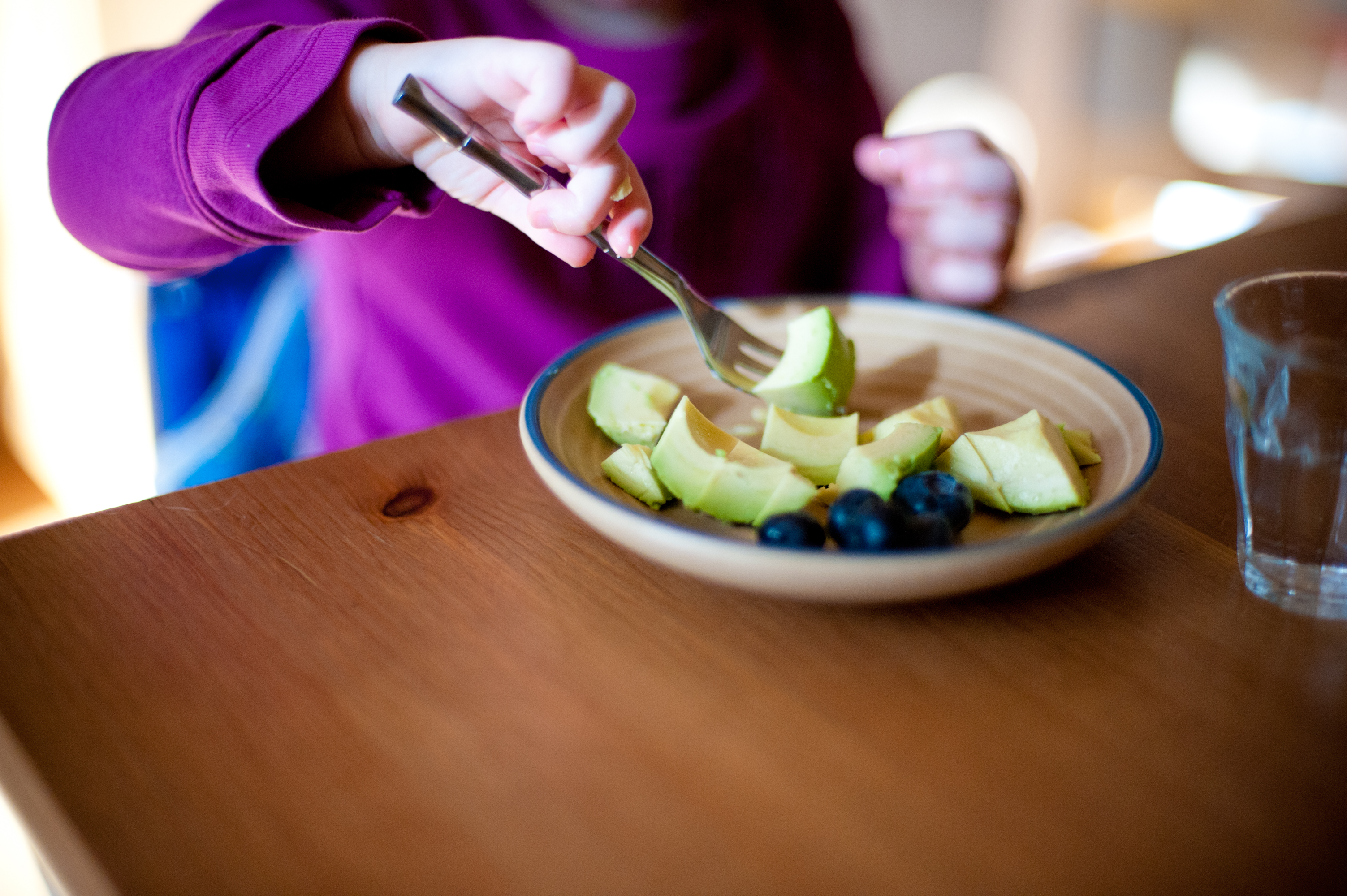
At our house, I’ve found that it’s much easier to encourage my daughter to eat fruits and veggies when that’s what we have around the house and on the table. She inevitably asks to eat whatever we’re eating, so when everything available is something I’d feel good about feeding her, I know we’re on the right track.

There are lots of strategies you can employ for how to encourage healthy eating. Sometimes I offer the green vegetables first when Julia is hungriest and then I add cheese and fruit toward the end of the meal. We also keep a large bowl of fruit on our kitchen counter and everything processed is hidden away in the pantry. That way, when we need a quick snack, fruit is the quickest, easiest, and most available choice. Plus it’s delicious and nutritious!

If your child is particularly stuck on “kid foods” like macaroni and cheese and pizza, try making your own whole-wheat and low fat versions of their favorite foods.

Another strategy is to engage children in the activities of cooking. When kids prepare their own food, they’re much more likely to want to eat it.

I enjoyed reading Jessica Seinfeld’s cookbook “Deceptively Delicious” in which she shares recipes with hidden healthy ingredients, usually in the form of vegetable purees added to traditional meals.

And while I love it that she figured out a way to get her kids to eat their veggies, I’m not sure how I feel about the fact that they don’t know about it. Personally, I’d rather model healthy eating that’s above board.

I want my daughter to get into the habit of eating fruits and vegetables so that when she’s faced with other choices, as she gets older, she already knows that she loves squash, sweet potatoes, lentils, and black beans.

I know that modeling healthy eating works because just last week as I ate a spinach salad, my daughter asked, “Can I have some?” and then proceeded to scarf down about 10 pieces of raw baby spinach. I hadn’t really offered her raw spinach before, assuming that she’d prefer it cooked. But she loved it!

So my recommendation if you’re having trouble getting the kids to eat their veggies, is to continue to enjoy your own plate of delicious vegetables and keep offering them some time after time until one day they decide they really like them.

When you’re packing snacks for a day out, be sure to include some fresh fruit and vegetables along with the standby applesauce (with no added sugar) and cheesy crackers that you already know they love.

Two more things:

1) We have to let go of the idea the every meal has to be well balanced and eaten heartily. Kids have variable appetites, some days they’ll eat everything you put in front of them, and other days just a few bites of food is enough. So, start to think about your child’s nutrition on a weekly, rather than a daily basis.

2) Let go of the idea that by refusing the food you’ve prepared, your child is somehow trying to hurt your feelings. They’re not. They’re just being kids and we have to trust them to know what their bodies need (as long as we’re providing nutritious options). When we get attached to a specific outcome, children often rebel. No one wants to be forced to do anything, so the more you can model healthy eating and then let go and trust, the more likely it is that your child will choose to eat healthy foods.

Have a healthy week!

Warmly, Shelly


Hooray for Mistakes!

I’ve been reading a very interesting book about exactly why intrinsic motivation is so important for children AND for adults. It’s called “Mindset: The New Psychology of Success” by Carol S. Dweck and in it Dweck describes two opposing mindsets we all experience.

She refers to the first as the “fixed mindset.” This is the voice in our heads that tells us that we have a fixed amount of talent, intelligence, or skill at a certain task and there’s nothing we can do to change it. This mindset also associates effort with a lack of natural talent. This is the part of you that thinks you’re just not a fill in the blank kind of person. “I’m not artistic.” Or “I’m just not very playful.” Are examples of the fixed mindset.

The other mindset is called the “growth mindset.” When we’re in the growth mindset we believe that we can learn and grow and become better at anything that we put effort into. The effort becomes part of the fun as we develop our skills and reach for our goals.

Interestingly, when we tell children things like, “good job” we’re inviting them into a fixed mindset. Our focus is on the outcome, rather than the effort or the journey of discovery. And, once we’ve labeled them as “good” or “smart” or “talented” children in the fixed mindset suddenly have something to loose if they fail. So, they stop trying at all. Not exactly the result we were wanting when we offered the praise in the first place.

On the other hand, when we focus on the effort, “Wow, you really put a lot of effort into that!” we’re inviting them to see effort as a part of the learning process (which it is!). In this mindset, children will experiment, try harder and harder puzzles, and get excited about learning new stuff. Now, that’s what we’re wanting for our kids, right?

The thing I’m finding most interesting is that people in the growth mindset often celebrate their mistakes, rather than sinking into a hole of despair about them. And that one choice, to celebrate our mistakes rather than getting down about them, makes a HUGE difference in our overall ability to learn something new.

This is true for children and adults alike. So as I’m reading this book, I’m thinking, I know a lot of moms who are in a fixed mindset about mothering. We think that we should already be good at it, or that we’re just naturally bad at it and there’s not much we can do about growing our mothering abilities.

But I’m here to tell you that even if you’ve been doing all sorts of things you don’t want to be doing with your kids, you CAN change. You absolutely can learn and grow as a parent. And from over here in the growth mindset, that learning is half the fun of parenting!

So this week, instead of beating yourself up for the thing you said or the tone you used or the way you treated your child, imagine that there really are new skills that you’re discovering through these incidents. Try to figure out what those skills and next steps might be and then get excited about learning them!

If you’re yelling, you can learn to manage your emotions more effectively and come to your children with more composure more of the time. That doesn’t mean you won’t fail. But from this mindset, every “failure” is another step closer to success!

If you’re experiencing power struggles, or whining, or tantrums, or any number of parenting challenges, you can see these things as new opportunities, rather than as a life sentence.

The belief that things can change is a powerful belief, and it’s one that I use often, especially when I feel stuck in a situation I don’t enjoy. So, what is it that you’d like to learn this week? What would you like to change? How do you want to grow and stretch yourself?

I can’t wait to hear all about what you’re up to!

Sending warm hugs, Shelly

Forced Apologies Undermine Conflict Resolution Skills

Remember what it was like when you got into a squabble with your siblings or friends and at the end there was the inevitable, “Say you’re sorry” and you half-heartedly responded, “I’m sorry” and then the two of you were supposed to “make up” and play together again as if nothing had happened?

I don’t know about you, but I felt angry and frustrated when this happened to me as a child. And I never really meant it, even when I said it. And the other kid knew that I didn’t mean it. They didn’t mean it either. And it took a while before we were able to actually let it go and be true friends again.

Now as an adult I see that forcing children to apologize when they’re not really sorry actually undermines their internal drive for social cohesion and conflict resolution. I want children to actually empathize with one another, understanding the impact that their words or actions might have had upon another. And then I’d like them to genuinely apologize because they want to. If they’re not ready to apologize, that doesn’t mean they need to be isolated and “think about what they’ve done.”

On a deep level I trust that all children have positive intentions behind their actions. Even when I don’t understand the intentions, they might. I also trust that children want to live in peace and harmony as much as possible. So, while siblings might fight, they also rely on one another for companionship and nobody enjoys the uncomfortable silences and hurtful words that accompany holding a grudge for a long period of time.

Ultimately, apologies are a tool for reconnection when we’ve done or said things that have created a rift in our relationships with others. So why not teach children to use this tool when and where they see fit?

Just the other day my daughter was sitting on my lap. She got excited and head butted me in the face. “Ouch!” I cried out, “You just head butted me. Ow, that really hurts.” Although I’ve never taught her to or asked her to say she’s sorry, she immediately apologized for inadvertently hurting me. And then she offered to kiss the spot that hurt. I was so touched by her genuine apology! And I knew for sure that she wasn’t giving me some canned or memorized speech. Even at two years old, she knows how to repair any damage caused by her actions.

On the other hand, when we ask children to apologize prematurely we are actually devaluing the process of working through conflict. We’re sending the message that we ought to just quickly apologize, even if we don’t feel sorry as a way to smooth over the incident. We’re also inadvertently teaching kids that conflicts should be avoided, rather than used as an opportunity to connect further and get to know each other better.

So this week, rather than asking children to say they’re sorry, let’s try trusting that they already know what to do. Let’s talk with them about how they feel, how they think they’ve been hurt or wronged, validate their feelings, and share new and different perspectives with them.

“Huh, I wonder why he said that to you. Do you think he might have been having a bad day?” or “Well, I guess you could retaliate by not inviting her to your birthday party, but what about talking with her about how you feel about what happened?”

I’ve consistently seen four year olds effectively work through conflicts by talking with each other. It often sounded like this,

“I didn’t like it when you pushed me, that hurt my body.”

“Oh, I didn’t mean to, I wanted you to move because you were blocking the road.”

“Next time, please tell me to move instead of pushing me”

“OK, I’m sorry I hurt your body, does it still hurt?”

“Yes”

“I will go and get an icepack for you.”

“OK, thanks!”

Sure, we had been working with these children for months on how to communicate their needs and desires clearly and how to listen to another person who is upset. And we modeled nonviolent communication and repair strategies often. But with some modeling and guidance, I think all children can learn to resolve their conflicts peacefully.

How are your kids doing with the important task of conflict resolution? Do they need you to intervene whenever they have a disagreement? Or are they able to share their feelings with one another and empathize with others? And how much do they tell you about the social dynamics at school and in other social groups?

I hope you’re having a great week and I can’t wait to hear from you!

Warmly, Shelly