How I Became an EC Mom

OK, so for those of you who don’t know, EC stands for elimination communication. Yep, you guessed it; this blog is about peeing and pooping, so if you’re the least bit squeamish on that topic, read no further! A friend of mine asked me to share about our EC journey, so here it is:

The first time I heard about elimination communication it sounded completely insane to me. I heard wild stories of families who NEVER used diapers and I pictured an entire house covered in plastic drop cloths with some pretty gross repercussions. Sure, if we were living outside and could just hold our babies away from our bodies like I read about in “The Continuum Concept,” I could imagine not using diapers. But I live in a house, and it really bothers me when my dogs or cats fail to go in their designated locations, so why would I allow my child to just pee and poop all over the place? At that moment I decided that EC was not for me.

But after my daughter was born, I read a really great article in Mothering magazine (Oh how I wish they were still publishing!) about elimination communication. In the article the author described lots of different ways that families could go about practicing EC to various degrees. Some families used diapers some of the time, and other used them most of the time but also watched for signals from their child that it was time to go. Through the article I was introduced to the idea of “catching” my child’s pee and poop and that’s when it happened. I became an EC mom.

A good friend of mine had given me TONS of great baby gear hand me downs, so I dug out the small Baby Bjorn potty you see in the photo. When my daughter was about a month old I took off her cloth diaper and sat her up on the potty. She didn’t seem to like the feeling of the cold plastic on her toosh, so I grabbed a pre-fold, cut a hole in it and put it between her butt and the potty. That one sacrificed cloth diaper made all the difference! After that, my little one was happy to sit on the potty whenever I thought to try. But, she didn’t actually go in the potty yet. That was OK with me though, I just wanted her to get used to sitting on the potty and wasn’t attached to achieving any specific goals yet, I think this is key in proper potty training. Looking back at my baby calendar I see that she had her first poop on the potty at 8wks and her first pee at 10wks old!

After my little one had some better muscle control and was able to sit in her Bumbo (around 4 months old) I put the potty in front of the mirror in her room and sat with her for up to 10min. at a time. She loved her potty time! We would make faces, look at books, and talk about increasing our intrathecal pressure, complete with grunting. and bearing down together. At that point she would occasionally go during potty time. We were making progress!

I still wasn’t able to see any signs from her or predict when she would need to go, but we just tried a little potty time here and there when the mood struck me. And then we introduced solid foods at 6mo. Whoa! Suddenly my daughter’s poops became solid and then I noticed that she seemed to go at around the same time, during the morning between wake up and her first nap. After some experimentation I narrowed it down and caught a poop! I was so happy not to have to scrub that cloth diaper that I became determined to catch more.

At some point during her sixth month, I realized that I always pee when I wake up in the morning, so she might need to as well. I tried putting her on the potty first thing after we woke up in the morning and magic happened. She peed AND pooped that first morning and has almost every morning since. I was elated! I had suddenly gone from soaking, scrubbing, sunning, washing and drying poopy diapers to simply dumping the poop in the toilet and getting on with our day!

Now we put her on the potty after she wakes from sleep and a couple more times throughout the day and she almost always pees. She clearly knows what the potty is for (and has since around that six month mark) and although she will hang out for up to thirty minutes if needed, she more often goes within five to ten minutes and then waits for me to wipe and re-diaper her. Yesterday, for the very first time, she finished her business and then stood up.

I know that a lot of EC parents talk about the importance of noticing the cues and the deep connection they feel with their child about these important bodily functions, but for us, EC is more about practicality and ease.

I also like the notion that I’ll never have to “potty train” my child. Sitting on the potty is just something we do every day already. And just for the record, I don’t think our version of EC is something we could only do because I’m a work from home mom. We’ve taken our potty to Grammy’s house and even on vacation with us! All of my daugher’s grandparents and babysitters have used the potty with her seamlessly.

The next step in our journey will be to teach my little one how to signal when she needs to go. So, I’ve begun signing “toilet” every time I say the word potty. No luck yet, but given our success so far, I’m not too worried. I’m pretty sure that she’ll put two and two together in no time.

So, how many of you have gone on your own EC journey? I would love to hear how it went or is going. Please share your stories with us!

And have a wonderful week, Shelly

Why rough housing is good for kids

I get a lot of questions from concerned parents about rough housing, wrestling, and other physical play. Dads want to know if it’s OK to wrestle with their kids, and moms are concerned that somebody will inevitably get hurt. Often it seems that physical play of this sort does end with the younger or smaller child in tears. But as I was doing research for my thesis in 2007 I ran across some studies that changed my mind about so called “rough housing.”

One study in particular stands out in my mind. It was conducted on a playground where researchers observed boys playing a tackling game. Researchers thought that they would find the game to be violent and detrimental to kids, but they actually found just the opposite. They observed that in playing this seemingly violent game, rarely did anyone get hurt, and when someone did get hurt, the other boys reacted with caring and compassion toward their fallen playmate.

And, after failing to find what they were looking for, the researchers changed their tack and began to look for behaviors that showed kindness and caring, such as a pat on the back, a hug, or helping one another get up. They quickly realized that the vast majority of the interactions between the kids on the playground were those kind and caring gestures!

In fact, they further realized that it was because of the seemingly violent nature of the tackling game that kids were given more opportunities to offer a helping hand or a hug than they would have otherwise. So that’s when I realized, that with some clear ground rules, wrestling between kids or between kids and adults could actually be a really joyful and beneficial activity for everyone involved.

So the next time your child runs to you crying, “My brother hurt me!” you can see it as an opportunity to nurture and comfort your child (which builds your connection) AND as an opportunity to show an older child how to take even better care of his younger sibling (which will build their connection).

Now, I’m not recommending that you force your older child to offer disingenuous nurturing, rather, that you model for your children how to care for one another. I also think it’s useful to keep in mind that there have likely been lots of other moments when the older sibling did take care of the younger one, that you might not have seen. Of course, the opposite can also be true.

So, if you’re not sure what’s really going on between your kids, take some time to observe them together and keep a tally for yourself. How many times did they touch or hug in a loving way? How many times did they touch in a hurtful way? What was your favorite moment? Why? What kinds of things did they say to each other? Ideally, you would tuck yourself away in a corner and seem to ignore them, so that they can play normally, forgetting that you’re even in the room.

But do be careful not to allow your preconceived notions or biases to show up in your observations. An observation should be completely neutral and without judgment, such as “Carl jumped on the bed and Henrietta fell off,” rather than “Carl viciously knocked Henrietta off the bed.”

I mentioned ground rules earlier and here are the ones I like for wrestling and rough housing at my house:

1) We stop if someone gets hurt and help them

2) We stop when someone says stop

3) We only use our bodies and pillows (no hard objects)

4) We stay on the carpet or bed

I’m so curious, have you found rough housing to be a connecting activity at your house? What are your ground rules? Please share your wisdom with us!

And have a wonderful week, Shelly
The trouble with texting

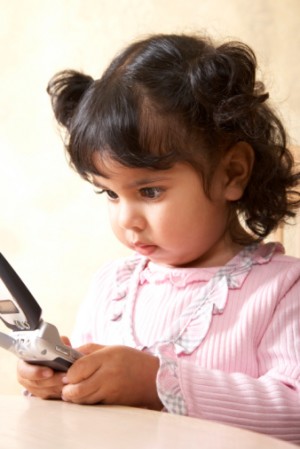
Last night as I was mindlessly flipping through television channels trying to find something interesting I happened upon a show in which young children were being interviewed by a journalist while their parents watched from a room nearby.  The kids were between the ages of three years old and six years old and the journalist was asking them about cell phones and texting.

“Do your parents ever text?” she asked.  The children nodded wildly and raised their hands to speak.  One little boy talked about how his mom was “always texting, texting, texting.”  Another child shared how she hates it when her mom takes phone calls instead of playing with her.  One child shouted, “I wish phones were never invented!” And another little girl talked about how she sometimes plays with six or seven toys at once because she likes to “multi-task” just like her Daddy.  Whoa.

The parents in the next room were a little bit shocked at how strongly the kids felt and ultimately shared that they felt embarrassed that they had prioritized their phones above their children in many instances.  One of the parents was perplexed though, because apparently her job requires that she be available and on call.  She wondered how she could be on call and still let her child know that he’s important to her.

I don’t have any answers for that particular parent, but the show got me thinking.  How much do we really NEED to be at the beck and call of our electronic devices, and how much have we unconsciously fallen into the trap of our shiny, fun toys?  And, considering that our children learn by imitating us, how much do we want our kids staring at screens and pushing buttons to communicate with friends, co-workers, and family members that are hundreds or thousands of miles away? Continue reading “The trouble with texting”

What we can learn from Chinese mothers

Have you heard about the new book out that purports that Chinese mothers are better than western mothers?  I haven’t read the book, but I did read an article about it and I was horrified to say the least.  In the article I read there was a story of the author berating, cajoling, threatening, and punishing her child in order to get her to learn a piano piece.  The child did in fact master the piece, so the author says that her parenting was effective.  I disagree.  I think it’s wonderful that her child overcame a challenge and learned a difficult piano piece, but I disagree with HOW the mother went about the lesson.  I don’t think it’s ever OK to mock your child or call him names, even if your intent is to motivate.

But there was something in the article that I did agree with. The author said that overcoming a challenge provides a boost in confidence for young people.  I agree entirely.  She also wrote about the fact that Chinese mothers are willing to spend hours and hours tutoring, drilling, and helping their children with challenging lessons.  And I began to wonder, are we western mothers willing to do the same?  Would I sit down with my daughter for as long as it took her to learn her multiplication tables?  To be perfectly honest, I had to answer “maybe.”

As I considered the subject further I realized that I do know lots of parents who I think rely too heavily on computers and television to teach their children.   What if we were to take our American ingenuity and work ethic and apply it to the job of teaching our kids?

Your challenge this week is to get down in the trenches with your child and really support him in the skill or ability he’s most struggling with.  Continue reading “What we can learn from Chinese mothers”

Creating the culture of your home

kids_smallIt seems like just about the time we feel we’ve given all we can and we need some “me time” kids suddenly need even more from us.  We can become frustrated and resentful and begin to give out of obligation or guilt, rather than giving from true generosity.  If that’s what’s happening for you, my invitation for this week is to take a break, stop giving for a moment, and reset.

See, the adults in the household are the ones who create the culture of the home, and if you’re spewing out frustration, resentment, and irritation, then pretty soon, you’ll start to see those same sentiments emanating from your kids.

On the other hand, if you can take a step back for a moment and really consider what kind of culture you WANT to have in your home, you can absolutely create that for yourself and your family.  With a little bit of foresight a strong commitment to consistency, you can have the kind of cooperation, kindness, care and generosity you most want to permeate your family.

But here’s the trick, YOU have to model for your kids exactly who and how you want them to be.  Here are some steps to get you headed in the right direction:

Step 1- Take care of your self. Are there ways in which you’ve been neglecting yourself?  Are you getting enough rest, nourishment, exercise, and alone time?  If not, brainstorm with a friend or partner about what you can do differently so that you can take better care of yourself.  When you’re well rested, nourished, and feeling great, you’re much more likely to be the example you want to be for your kids. Continue reading “Creating the culture of your home”