How to foster an emerging sense of order

Between 2 and 4 years old most young people begin to develop their sense of order.  This is the time when your child will become exasperated if you say the wrong word during story time or if you move her artwork or put away his toy before he was finished playing with it.  It can be a difficult time for parents and caregivers alike, because in the past your little one didn’t even notice when you put away his toys.  Now everything starts to become a negotiation because along with a sense of order, a stronger will and resulting tantrums also mark this stage of development.
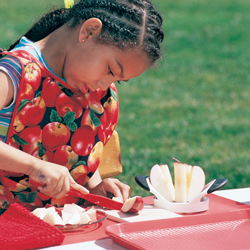
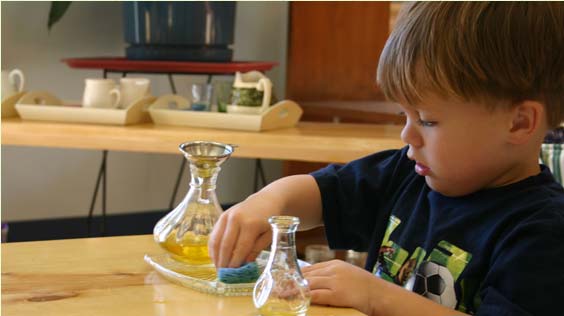
This sensitive period for order can be challenging, but there’s no fighting against human development, and if you think about it, you wouldn’t want to anyway.  This is actually the perfect time to teach your child how to put away toys, straighten her room, and help out in the kitchen.  But in order to capitalize on your child’s innate desire to learn and this sensitive period for order heed this advice:  Attention to detail is the key to getting the most cooperation from your child during this time.

Let me illustrate further; Paying attention to minute details and showing your child all the tiny steps involved in tidying, cleaning, and putting things away create more interest and better results.  For instance, if you would like to teach your three year old to fold and put away his socks follow these steps slowly, carefully, and methodically (and wait until you have your child’s attention before moving on to the next step):

1)     Take newly dried clothes out of the dryer while they’re still warm

2)    Put them in a pile on the bed and invite your child to feel the warmth and play in the pile a little bit.

3)    Ask your child if he would like to play a sock folding game.  If yes, continue, if no, try another time.

4)   Ask your child to help you find two matching socks. Continue reading “How to foster an emerging sense of order”

Autonomy is the holy grail of childhood

In my work with young people there are some needs that come up again and again.  The need for play is a great example.  Kids need lots and lots more play than we need and they let us know about their need in ways that are sometimes difficult for us.

But the unmet need that I notice most in young children is the need for autonomy.  Children desperately need to be able to do things on their own and to choose their own path and luckily for you, there are simple things you can do around the house to support your child’s autonomy.

First, take a tour through your home in your mind.  Starting at the front door, do kids have a place to put their coats and shoes when they get home?  Is the place for coats and shoes easily accessible?  For children under five years (and for older children and even adults) the easiest place to put a coat is on a hook near the front (or back) door.  And to put shoes on and take them off, a child-sized bench to sit on is quite useful.

As you move through your home in your mind, consider whether your child has access to the things she needs.  Can she reach toys and books in the living room?  Art supplies, dishes, water and a snack in the kitchen?  Is there a stool in the bathroom that makes using the toilet and washing hands easy?  Can he reach the towel to dry his hands?

Each room of your home should have an activity for your child available in case he wants to be in the same room with you, and in case he doesn’t!  Continue reading “Autonomy is the holy grail of childhood”

Focus on the process, not the product

As many of you know, for the five years after college I was a preschool teacher in Montessori classrooms.  I was very intrigued my Maria Montessori and her methods, but what struck me most was her philosophy.  There are quite a few key Montessori philosophies that I subscribe to, but today I want to share one that’s near and dear to my heart.  Montessori said, “It’s the process, not the product.”

What she meant is that for young people, it’s the process of learning that is to be enjoyed and savored.  Too often we put the emphasis on our kid’s paintings, drawings, or little cut out shapes, but we forget that it’s the experience of painting, drawing, and cutting that matter most to our child’s development.

For children, it’s easy to enjoy the process because they haven’t yet been conditioned to value product over process.  You can see evidence of this in that many three or four year olds will spend time creating a piece of artwork only to forget it at school or toss it aside when it’s finished.  We are the ones who teach children to value their art by featuring it on the refrigerator or espousing it’s many wonderful qualities.  But is our value of product over process something we really want to teach our kids? Continue reading “Focus on the process, not the product”

The importance of observation

When it comes to babies, at my core, I am a scientist.  The process children go through as they transform from a fetus into a walking talking human child in just the first 2 years of life fascinates me.  It’s absolutely incredible really.  As a scientist, I want to understand all I can about this amazing process.  And if there’s one thing I’ve learned that is the same in both my scientific and my Montessori backgrounds, it’s that observation is the key to understanding child development.

My daughter has Erb’s palsy brought on by her shoulder dystocia during birth.  At first I didn’t notice anything wrong, and since most babies heal on their own without any intervention, I just assumed she would too.   She did seem to prefer to use her right arm and hand, but I didn’t know that wasn’t normal.

We have a wonderful pediatric physical therapist who is teaching me all about arm, shoulder and hand development in infants.  She’s taught me that at three months old, Julia shouldn’t have a handedness or preference for one side over the other.  So, I started paying closer attention to the specific movements we’re looking for and truly comparing her arm and hand development on the left with the development of the right.  Much to my amazement there are differences that had gone unnoticed by me in the past.  Although she’s starting to use her left arm more and more, she does raise her right arm above her head more often than she does with her left.

So, what does this have to do with you and with parenting in general?  My point is that if we’re not paying close attention to the physical, emotional, and social development of our kids, things can slip through the cracks unnoticed.  We have to take the time to actually pay attention to where kids are developmentally in order to know that they’re on track and, more importantly, in order to know how to challenge and encourage them to develop further. Continue reading “The importance of observation”

Stimulating young minds

Learning doesn’t just happen at school. You can stimulate your child’s mind at home with these simple activities:

Sometimes when kids seem to need a lot of extra attention, are bugging you constantly to watch TV and movies, or are generally in your face 24/7, they might actually be asking for more intellectual stimulation.   When kids get bored, they turn to you for help, but they might not know exactly what they’re wanting.

If you think this might be what’s happening in your household, I’ll give you some ideas and examples of simple things you can do to stimulate your child’s mind, support more independence, and encourage self-directed activities.

First, consider your child’s favorite things.  Does she love dinosaurs, dolls, horses, or art?  Does he enjoy cooking or playing in the sandbox?  These preferences can inform which kinds of activities your child will enjoy right now.  Let’s say she’s into dinosaurs.  She loves to play with her dinosaurs and sometimes corrects you when you call them by the wrong name.

So, how can you create an engaging, self-directed activity that will build on your child’s knowledge and encourage her to learn even more about dinosaurs?

If you have a book in which dinosaurs are classified into carnivores and herbivores, you can create a fun activity that she can do on her own.  If you combine her basket of dinosaurs and the book about carnivores/herbivores, add a green piece of construction paper on which you will write “Herbivores” and a red piece of paper on which you will write, “Carnivores” you have a fun game!  Just show her how to set out each piece of paper, choose a dinosaur from the basket, look in the book to check whether this dinosaur is a carnivore or a herbivore, put the dinosaur on the appropriate piece of paper and then choose another dinosaur!

When she has classified all of her dinosaurs she can come get you and you can discuss her reasoning.  Be careful not to correct your child’s work at this point.  The idea is to encourage self directed activity that is intellectually stimulating and if she thinks she’s going to get a “bad grade” at the end, there’s no motivation to do the activity again.  However, if you sit with her and ask questions like, “Wow, I’m confused, I thought a stegosaurus was a carnivore, how did you know it’s an herbivore?” then she gets to teach you, and teaching is an even more stimulating way to learn something.

Another idea for a pre-reader is to make small paper signs that say things like door, mop, sink, book, ball, table.  Put tape on the back of each and then invite your child to find the items and tape the signs on.  Pretty soon, your child will begin to recognize words even before he’s able to read!

You can also adapt this activity by using a basket of miniature items and laminated cards with words on them for beginner readers.  Easy words like dog, cat, and hat can be matched up with a tiny toy dog, cat, or hat.  Kids love these types of matching games and they learn while they play!

To make this game easier for a child who’s not reading yet, create sets of cards.  First, create two matching cards each with a sticker, picture or drawing of a cat and write the word cat below.  Now cut the word off of the second set of cards.  Now you have three sets of cards- a control set with pictures and words, a set with pictures only and a set with words.  Show your child how to match up the control set with the other sets.  Again, remember, it’s not important that they get it right, it’s just important that they’re engaged and having fun with it!  I find that it helps to do this activity at a table or on a small rug on the floor so that their workspace is contained.

I hope that some of these ideas have sparked your creativity and your desire to stimulate your child’s mind.  Please write to me with your thoughts, other ideas, questions, and stories about how these activities work for you!

Big hugs, Shelly