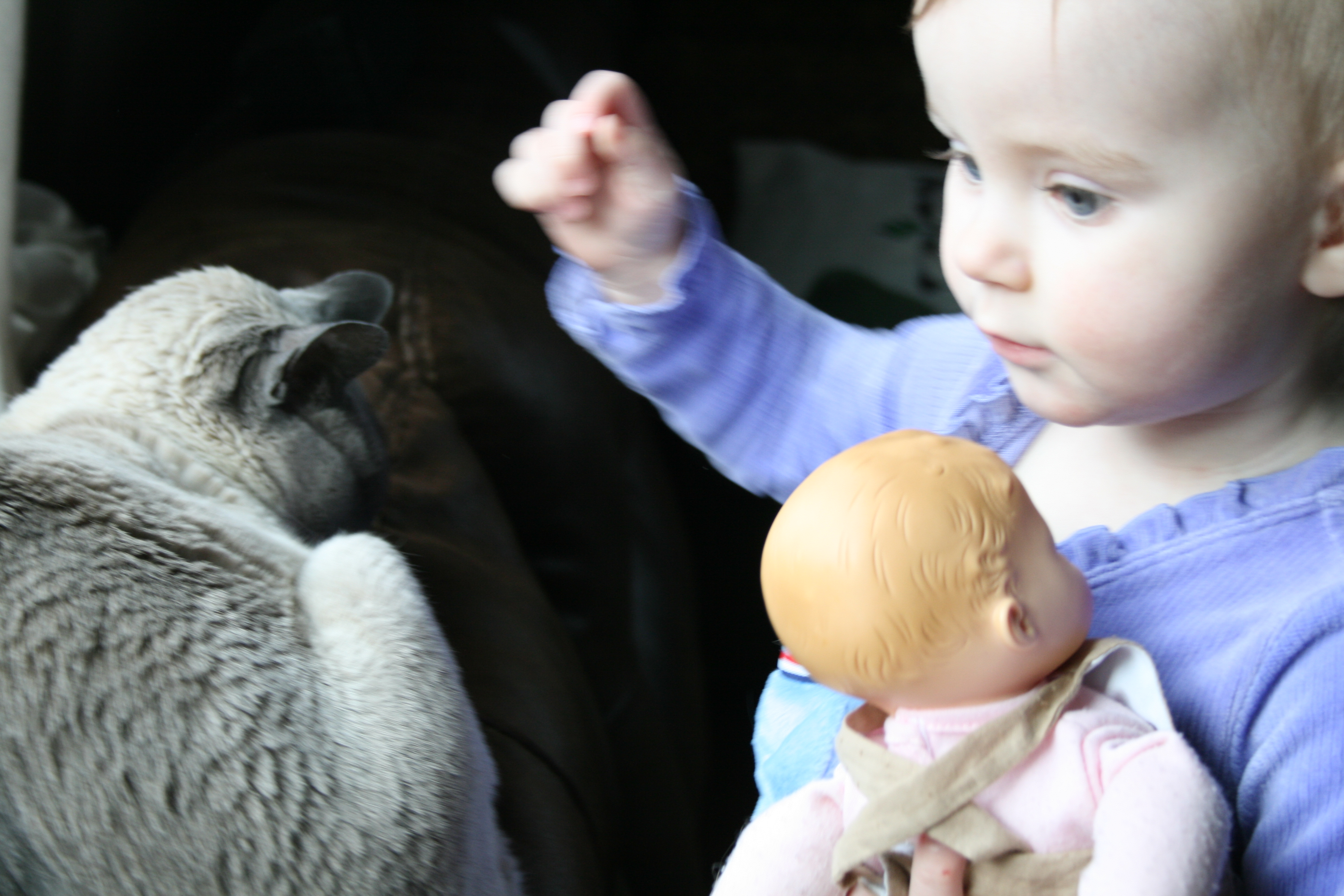

What to do When Kids Ask Why? Why? Why? Why? Why?

The “Why” stage has hit. My daughter cannot seem to stop herself from repeatedly asking why. Almost every kid I’ve known goes through this at some point and if you’re anything like me, you find this incredibly irritating. “Why,” you ask? And I remember the long ago voices of my parents tightly saying, “Because I said so!”

I used to hate that answer but now I think I understand it a bit better. The repetition that I found so comforting and habit forming as a child, is just really very annoying as an adult.

So here’s the approach I take. I like to consider the underlying need that’s being expressed by the question. I think that when kids repeat the question why, they have a need for information. If you think about it, repeating the question why is actually a pretty easy way to get more information about a given topic. But it’s still super annoying. So what can we do about it?

I try to teach my daughter new strategies to meet that need for information.

I give her various options by modeling different ways to ask for what she wants, for instance:

“Can you please tell me more about that?”

“What else?”

“I want to know more!”

or, “Do you have a story about this?”

By helping my daughter to expand her repertoire of ways to get further information about a given topic, I’m addressing her desire, and helping her to get that need met more often. Adults will happily continue to give her more information as long as they’re not irritated by the way she’s asking.

And, by taking this approach, I also feel far less irritated, simply because I’m aware of the underlying need behind her behavior. When I see this behavior as an attempt to learn more, I have a lot more patience for her repetitive questions.

There’s something else I like to do when kids repeatedly ask “Why?”

I give them far more information than they could possibly want on the topic at hand.

I deluge them with details, use large vocabulary words, and talk about the overall processes at hand. This does two things, first it meets a child’s need for information and second, it assumes they’re smart enough to figure out the level of detail I’m providing. My dad is a pro at this approach. By the time I was three I already knew tons of information about how to lay a foundation and use a plum line.

Both of these will support a child’s further learning and growth and I find this to be a fun game to play, rather than an irritation. How much do I really know about why the sky is blue? And exactly why does the water go down the drain? What happens to our trash after the truck picks it up at the curb? And how does our food get to the grocery store?

If you don’t know the answer to your child’s questions, do some research together! The best way for children to grow a voracious appetite for learning is to witness their parents continuing to learn and grow. I’ve noticed that children love to imitate adults and they especially appreciate it when we show our vulnerability and limitations.

Kids feel more connected to us when they realize that we’re all in the same boat, learning and growing together. So instead of getting frustrated by the way they’re asking, let’s try teaching them some new strategies and helping them to figure out ways to learn and do research on their own.

As a child, whenever I didn’t know the definition of a word or how to spell it, my mom always had the same answer, “Look it up!” I didn’t like her response so much then, I would have rather had her tell me how to spell it, but now I feel empowered by my ability to discover the answers to my questions.

The internet is an incredibly useful tool sometimes! And if you don’t want your kids to have the screen time, offer them some analog reference materials. If they’re older, you might even want to assign them a research project complete with a report and presentation at the end. You may be surprised at how much fun it can be for an older sibling to teach the whole family about his area of interest.

After all, the summer is a wonderful time to continue to do research and experimentation. Who says science projects can only happen at school?

If none of these strategies seem to be working in the moment, I like to turn the questions right back around and ask my child what she thinks. “Why do you think it’s that way?” or “Do you have a theory about why that might be?” or even, “Can you tell me what you know about this topic?” By asking a question in response, I’m inviting my child to think about what she knows and how she can share what she knows.

After all, teaching someone else is one of the best ways to learn something.

So there you have it, my simple strategies for how to get rid of the incessant repetition of the question “Why,” and a little bit of inspiration to help your kids continue to learn and discover, even though school’s out.

I hope you’re having a lovely week, Shelly

12 Ways to Encourage Failure and Why You Definitely Want to Do it

Now why in the world would I suggest that you’d want to encourage your child to fail? Well, current research is telling us interesting things about which character traits are associated with lifelong achievement and success. It’s also showing us that these “traits” are not simply inborn, but can be actively taught.

Character traits like grit, perseverance, and tenacity turn out to be much higher predictors of accomplishment than test scores, grades, or even IQ. It turns out that even smart kids who lack these skills often end up leaving college without a degree or have a difficult time holding down a job. On the flip side, even children who aren’t academically gifted can achieve great things if they have the drive and tenacity to keep reaching toward their goals.

So, how do children learn something like perseverance? They learn it through experience. About six months ago I noticed that if my daughter wasn’t able to do something on the first try, she would throw herself down and cry in frustration, refusing to try again. “I can’t do it,” she’d intone through her tears.

For a while I wasn’t sure how to respond to her upset. I didn’t want to encourage her to stuff her feelings of frustration, but I also knew it was important for her to learn to persevere. And then I read, “How Children Succeed: Grit, Curiosity, and the Hidden Power of Character” by Paul Tough. What an enlightening read!

After absorbing a bunch of new information, I decided to offer some reassurance and to encourage Julia to keep trying, even when she didn’t succeed initially. I said things like, “Just keep trying and eventually you’ll succeed,” and “Everyone makes mistakes.” After a few weeks, I knew these messages were getting through to her because one day she failed at a task and instead of the usual meltdown, she calmly announced, “Sometimes you have to try more than once before you succeed.”

So I decided to make a list of quick and easy ways to encourage failure.

Here it is:

1) Acknowledge and challenge, “Wow! You did it! Want to try something even harder?”

2) Encourage, “I know you’ll succeed eventually if you just keep trying.”

3) Offer a demonstration, and then let them try “Would you like me to show you how? OK, now you try.”

4) Suggest a new strategy, “When I get frustrated, sometimes it helps me if I walk away and try again later.”

5) Share your observations, “I see that you’re using your right hand to hold it and your left hand to push it through.”

6) Ask for a lesson, “Hey, I noticed that you’re able to do ______, will you please teach me how?”

7) Discover their strategies, “How did you decide to do it that way?”

8) Present a problem, “I need your help to figure this out, how do you think we should go about solving this?”

9) Remind them of past challenges, “Hey, remember when you were littler and you couldn’t climb up the jungle gym? And now it’s super easy for you!”

10) Help them keep track of their accomplishments, “Hey, you can do it now! Do you want to add this to your list of accomplishments?”

11) Remind them that circumstances can alter the outcome, “I know you were able to do it last week, but right now you’re hungry and tired and that makes things more difficult. I’m sure if you try it again after a snack and a rest you’ll have better luck.”

12) Celebrate the failures,Hooray, you failed! That means you’re trying something really challenging. I feel so proud when I see you trying something difficult. You’ll always learn more if you continue to challenge yourself.”

Do any of these seem foreign to you? If so, you might have some work to do on your own relationship to failure. Remember, when Thomas Edison invented the light bulb, he tried 10,000 things chemical compositions that didn’t work, before he found the one that did. Here’s what he said about his so-called failures. “I have not failed. I’ve just found 10,000 ways that won’t work.” Now that’s the epitome of grit, perseverance, and tenacity.

And no matter what your child ends up doing, these character traits will serve her well. So this week, see how many of these 12 you can implement with your kids. And then watch as they develop more resilience and tenacity before your very eyes.

Have a fantastic week, and even if you don’t, find a way to learn and grow from the challenges you face! Warm hugs, Shelly

Photo by Suzette Hibble

Want to Instantly Turn Defiance Into Cooperation? Try This!

Some of the most frustrating moments I’ve experienced while being with young people are those times when I really need their cooperation and instead I get met with defiance. I’m trying to get out the door and they refuse to put on their shoes. I want to sit down for dinner and they’re running around the house screaming. I’d like to brush their teeth and get them ready for bed, and they just want to keep playing. Ugh!

I’ve tried lots of strategies to transform those moments, and now that my daughter is approaching 3, I’ve been getting even more opportunities to help her move from defiance to cooperation. Granted, we’ve done a LOT of work to develop ongoing cooperation already, but there are times when I can see, she’s just not interested in going along with what I’m wanting. She wants to assert herself, choose her own path, and often in those moments what’s most fun is to choose the exact opposite of what I want.

So, what do I do? I quickly change my position. Don’t put on your shoes. I do NOT want to see those shoes on your feet.” This reversal instantly encourages my daughter to continue to “defy” me with a glint in her eye as she deviously puts on her shoes.

I protest loudly, “No, no, no! Stop that right now! Oh no, she’s doing it!” And she begins to giggle as she rushes to do all of the things I “don’t” want her to do. “Well, whatever you do, don’t put on your jacket. Hey! You little rascal! What do you think you’re doing?! Get back here! Don’t you dare climb into your car seat! Oh no!”

My daughter absolutely loves this game because she gets to express her defiance, without actually causing any real conflict. And she gets to be the powerful one while I’m relegated to mock frustration and helplessness as she does all the things I’m so desperate to stop her from doing.

In case you’re wondering, it’s obvious to everyone that we’re playing a game. In fact, after playing this game whenever needed over the past few months, now Julia actually asks to play it when she’s not feeling particularly cooperative.

“Will you tell me NOT to do it?” she’ll ask.

And I’m happy to oblige. This game has turned countless moments of potential conflict and parental frustration into a super fun game full of giggles. And best of all, I get the cooperation I was asking for in the first place. It’s really a win-win.

So right now, consider an area of conflict that you’ve been experiencing with your child. Is there a way to reverse your position so that your kids can defy you by doing exactly what you’re wanting? Can you completely let go of your frustration and upset and play with your child instead? Between your new found playfulness and the reversal of power involved, your child will be helpless to resist the fun to be had.

Just one warning though, you do actually have to be able to drop your attachment to the outcome and have some fun. If kids sense that you’re only playing the game to get them to do what you want, it won’t be nearly as fun or effective. So do your best to fully step into character, be the weak and helpless one, and beg them not to do the thing you’re actually wanting. And if they start giggling, you know you’re on the right track!

I would love to hear about your experiences with this and other similar games. Please share your story with me below!

And have a wonderful week, Shelly

Terrified of the Terrible Twos? How About Terrific Twos Instead!

Yes, it is true that two-year-old children don’t have much impulse control or emotion regulation skills and that coupled with their very strong preferences has given them a bad reputation as irrational and explosive. I’ve been told all sorts of things about “the terrible twos,” especially when I was a nanny and again as I prepared for motherhood. But it really doesn’t have to be this way. Tantrums and other toddler behaviors that are difficult for us are actually just a signal that a child’s needs aren’t fully being met. Luckily, we CAN meet those needs and enjoy far less of those pesky behaviors.

A couple of years ago I saw an amazing documentary film called, “Edison’s Day” which is about a 20 month old boy whose parents are both Montessori trained. Their whole home is set up to accommodate the budding independence of toddlerhood.  And their son Emerson is clearly thriving as he’s included in meaningful work, helpful tasks, and independent activities throughout his day. If you want to be completely inspired by what a toddler can accomplish if given the opportunity, definitely watch “Edison’s Day.”

I’ve done my best to set up my home in a similar way and have always encouraged my daughter Julia to develop independence as well as nurturing her ongoing cooperation in every possible moment.

And with a few adjustments to your home environment, the way you handle transitions, and your daily routines, you can have terrific twos just like Julia and Edison have! Here are some tips to get you started:

1)   Track your child’s ability to communicate and offer help.

Sign language, guessing what he wants and verbalizing for your child, and helping a child to simplify a sentence can all support toddlers in gaining the confidence to communicate their needs. “You want the cup? Can you sign ‘please’? OK!”

2)   Set up a leaving home and arriving back at home routine

complete with low hooks, a bin or basket for shoes, and a playful but consistent attitude. “We put our shoes away when we come inside.”

3)   Warn toddlers of an impending transition with plenty of time for them to get on board.

“We need to go to the grocery store. Would you like to go now or in 5 minutes? Is there anything you’d like to bring with you?”

4)   Empower your child with the skills and knowledge of the daily routine, self-care practices, and household tasks.

Toddlers are FAR more capable than we might think, so invite your child to try new things and try not to do things for them if they’re capable and willing to do it themselves.

5)   Establish a few very clear rules, post them publicly, and ask everyone in your child’s life to help you maintain those boundaries.

Also, offer an acceptable alternative if your child breaks a rule. “It’s not OK to throw books, but here’s a ball you can throw instead!”

6)   Establish a consistent daily routine and ask your child to anticipate what happens next.

“Do you remember what we do after we take off our shoes and coat?…That’s right! We go to the bathroom.”

So, why do these things make such a huge difference in the life of a two year old? For young people, routines create security. So the more predictable the daily routine is, the more likely your two year old will know what to expect and feel comfortable and prepared for what’s next.

And then there’s their budding independence. The “I do it,” stage. The more we can embrace and nurture a toddler’s autonomy, the happier and more relaxed they will be. That’s because a toddler’s main goal in life is to grow up and become a capable adult. They want to be just like us, so let’s help them learn how!

Have a fantastic week, Shelly

Do You Recognize the 7 Warning Signs of a Toddler About to Hit or Bite?

It seems to come out of nowhere. One second your toddler is playing peacefully near a friend, and the next moment the other child is running to you screaming, “He bit me!” or “She hit me!” You feel embarrassed, confused, and unsure how to proceed. Meanwhile the other child’s mom is staring at you like, “Aren’t you going to DO something about this?!”

You’re sure your friend or family member is expecting you to put your child in time out, but you’ve heard that punishment undermines your connection with your child, so what to do?

Obviously you need to address this with your child, however, a child who just hit or bit is clearly not in a learning mindset. Instead, your sweet child has stress hormones coursing through her system and is in fight, flight, or freeze mode.

Start by going over to your child, hug or hold her, make eye contact and use a simple phrase like, “Hitting people is not OK.” After that, you may want to empathize, “Were you scared your friend was about to take your toy away?”

Remember, a child who’s acting out is using her best strategy to communicate her needs. She’s not trying to hurt others or annoy you. She simply doesn’t know how else to protect her personal space or express her upset.

The good news is, kids can learn these skills quickly if you’re willing to give it some effort. The key to helping a child learn a new coping strategy is to catch the child BEFORE he employs the strategy you don’t like and then offer a suggestion in the moment when you can see he’s about to hit, bite, scratch, kick or whatever else your child does to protect himself.

So, if you have a child who resorts to hitting or biting, get ready to supervise closely for the next few weeks. Trust me, this intense supervision definitely pays off. You can rest assured that if you’re consistently there to stop your child from doing the unwanted behavior and you also offer an acceptable alternative, you’ll eradicate these behaviors in a few short weeks.

But how do you know when a child’s about to bite or hit?

Here are the 7 warning signs to look for:

1)   There’s no adult supervision or adults are involved in a conversation.

2)   Your child is tired, hungry, and/or irritable.

3)   Your child is frowning or looks unhappy whenever a friend comes near.

4)   Your child is acting possessive of a particular toy or item.

5)   You hear your child try to say “No,” raise his voice or begin to yell.

6)   Your child is clinging to you and/or whining.

7)   You see your child begin to act aggressively, with little body checks, shoves, or other physical acts.

While each child is different and has her own unique warning signs, you’ll find that once you’re looking for signs and signals that your child is about to hit or bite, you’ll begin to notice his particular way of ramping up his upset.

But if we can intervene before kids act out, we’re not just stopping them from a destructive and hurtful behavior, we’re also helping them learn to regulate their emotions and use more effective strategies for calming themselves down and establishing healthy boundaries with their friends.

And once your child feels comfortable setting clear boundaries, she’ll be much more likely to relax and enjoy her time with friends. When you feel confident that your child has the skills to use his words or other strategies, you can relax your supervision a bit. But you may want to remind everyone of the ground rules, before you leave the room.

Have a great week! Warmly, Shelly