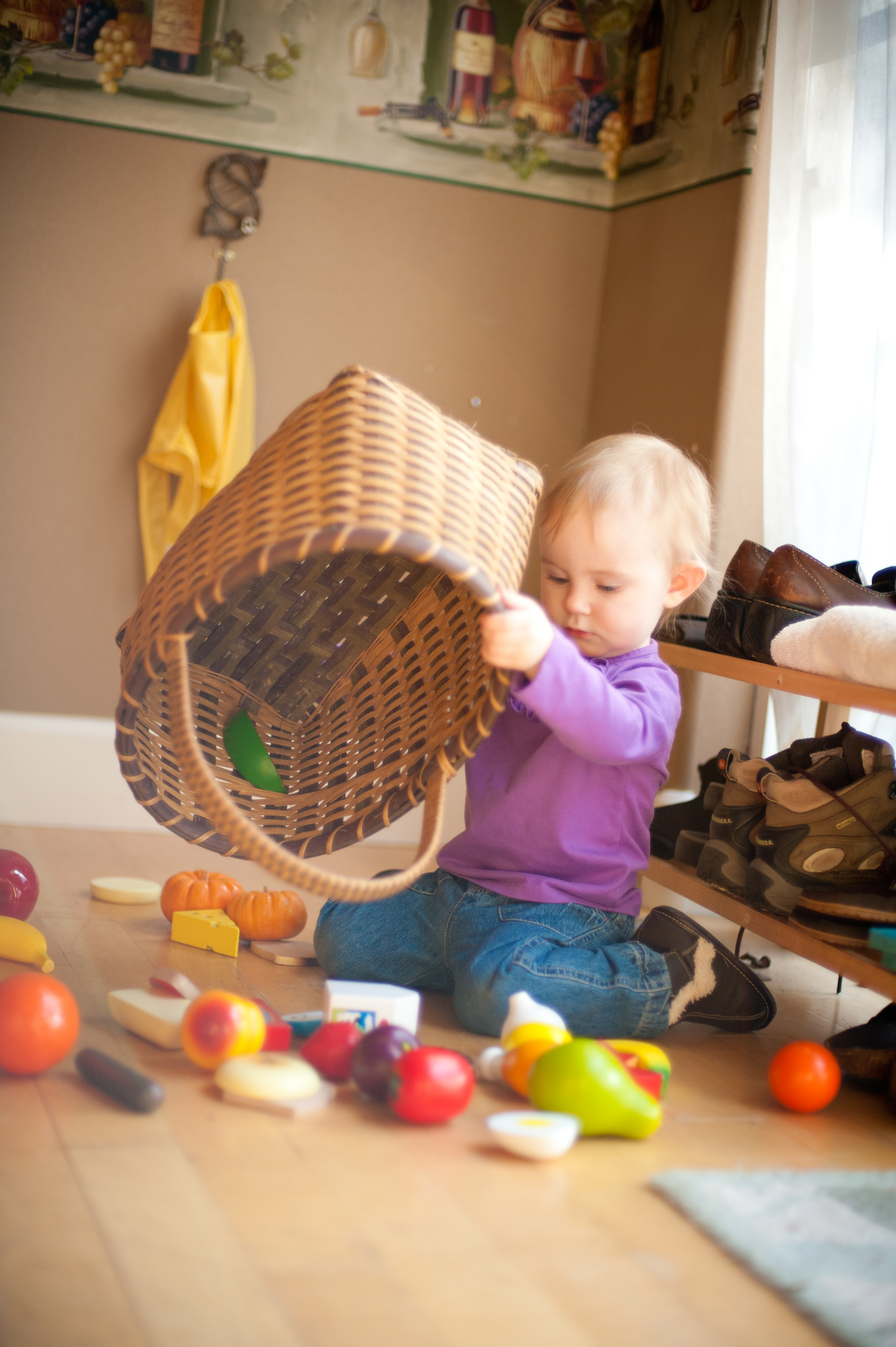

Helping Kids Eat Healthy Foods

Here’s a question I hear a lot from parents of toddlers (and older children too): “How do I get them to eat nutritious foods?” Well, I’m going to give it to you straight, but you might not like what I have to say on the subject.

The current research is clear about two things:

1) Eating meals together as a family produces healthier eating

2) Your kids will eat what you eat

So, if you don’t want your children to drink sugary soda, guess what? You’re going to have to give it up.

Of course, we’ve found a temporary way around that one, we just tell our daughter that we’re having an “adult drink” and so far, she accepts that. But we know it won’t last forever, and truly, sugary drinks are quickly becoming the next national health crisis. We have got to get over our addiction to them.

When my daughter was just starting solid foods I kept a list of the foods I had introduced and made sure to offer new ones every week. I’m not quite sure why I stopped that, but if you find yourself in a rut, try making a list of all of the foods you know your child will eat, and then make another list of foods to introduce. Go through your list systematically and record their responses.

Don’t give up if your child says they don’t like Brussels sprouts (or any other vegetable). Instead, find new ways to prepare them and offer them multiple times throughout the week or month.

Children’s taste buds change a lot as they mature, so just because they didn’t like it in April, doesn’t mean they won’t enjoy it in October. Children also enjoy refusing foods as a way to have some control over their lives, and sometimes just to see if they can get an emotional reaction. My recommendation is to relax, let go of your attachment to them eating your world famous chicken soup, and keep offering them the healthy foods you love to eat. Eventually you’ll win them over.

Here are some “foods” to watch out for:

  • Hydrogenated or partially hydrogenated oils
  • Added sugars (including fructose, corn syrup, dextrose, sucrose and more)
  • White breads and crackers
  • Fried foods
  • Foods high in saturated fat
  • Sugary drinks (including juices)

And here are some foods to encourage:

  • Fruits (any and all whole fruits are healthy)
  • Vegetables (a wide variety of colors and textures)
  • Nuts and legumes
  • Lean meats and fish
  • Whole grains
  • Calcium rich foods

At our house, I’ve found that it’s much easier to encourage my daughter to eat fruits and veggies when that’s what we have around the house and on the table. She inevitably asks to eat whatever we’re eating, so when everything available is something I’d feel good about feeding her, I know we’re on the right track.

There are lots of strategies you can employ for how to encourage healthy eating. Sometimes I offer the green vegetables first when Julia is hungriest and then I add cheese and fruit toward the end of the meal. We also keep a large bowl of fruit on our kitchen counter and everything processed is hidden away in the pantry. That way, when we need a quick snack, fruit is the quickest, easiest, and most available choice. Plus it’s delicious and nutritious!

If your child is particularly stuck on “kid foods” like macaroni and cheese and pizza, try making your own whole-wheat and low fat versions of their favorite foods.

Another strategy is to engage children in the activities of cooking. When kids prepare their own food, they’re much more likely to want to eat it.

I enjoyed reading Jessica Seinfeld’s cookbook “Deceptively Delicious” in which she shares recipes with hidden healthy ingredients, usually in the form of vegetable purees added to traditional meals.

And while I love it that she figured out a way to get her kids to eat their veggies, I’m not sure how I feel about the fact that they don’t know about it. Personally, I’d rather model healthy eating that’s above board.

I want my daughter to get into the habit of eating fruits and vegetables so that when she’s faced with other choices, as she gets older, she already knows that she loves squash, sweet potatoes, lentils, and black beans.

I know that modeling healthy eating works because just last week as I ate a spinach salad, my daughter asked, “Can I have some?” and then proceeded to scarf down about 10 pieces of raw baby spinach. I hadn’t really offered her raw spinach before, assuming that she’d prefer it cooked. But she loved it!

So my recommendation if you’re having trouble getting the kids to eat their veggies, is to continue to enjoy your own plate of delicious vegetables and keep offering them some time after time until one day they decide they really like them.

When you’re packing snacks for a day out, be sure to include some fresh fruit and vegetables along with the standby applesauce (with no added sugar) and cheesy crackers that you already know they love.

Two more things:

1) We have to let go of the idea the every meal has to be well balanced and eaten heartily. Kids have variable appetites, some days they’ll eat everything you put in front of them, and other days just a few bites of food is enough. So, start to think about your child’s nutrition on a weekly, rather than a daily basis.

2) Let go of the idea that by refusing the food you’ve prepared, your child is somehow trying to hurt your feelings. They’re not. They’re just being kids and we have to trust them to know what their bodies need (as long as we’re providing nutritious options). When we get attached to a specific outcome, children often rebel. No one wants to be forced to do anything, so the more you can model healthy eating and then let go and trust, the more likely it is that your child will choose to eat healthy foods.

Have a healthy week!

Warmly, Shelly



My Top 12 Resources for New Parents

I just found out that a good friend of mine is pregnant. Well, technically his wife is pregnant. But as soon as I found out I immediately wanted to create a list of resources for them so that they wouldn’t have to go through the heaps of conflicting and confusing information out there (unless they really want to).

I know my friend and I are aligned on many topics, but within about five minutes of talking with him it was clear that he was about to embark on a whole new world (parenting) that he has never really researched before.

So, here’s my list of the top twelve resources I recommend for new parents. I used these all myself and include an explanation about why I trust the resource or what I like about it.

Here goes:

1)     Baby Center’s Pregnancy Calendar: Although Baby Center is a pretty mainstream resource and includes some information that isn’t completely aligned with my attachment parenting and natural lifestyle I still really enjoyed the pregnancy calendar. I could go there and see how my baby was developing week by week and read about the miracle that was happening inside my body. Fun fun fun!!!

On a not so fun note, Baby Center also has a miscarriage support group. Miscarriage happens more often than is generally believed and women who experience it need to seek immediate support from friends, family, counselors, and support groups. If you’ve experienced a miscarriage, please don’t go through it alone. Reaching out for support can be hard, but it’s crucial to the healing process.

2)    Movie: The Business of Being Born Although this film was somewhat disturbing to watch, I think it’s important to realize how and why birth in hospital has become the norm in America and to recognize that there are other choices out there. And if you do choose a hospital birth, I hope you’ll know your rights so that you aren’t forced into any procedures or medications you don’t actually want. This one is an eye opener for sure.

3)    Birthing class: Hypnobabies I loved my hypnobabies class SO MUCH and it really helped me with the pregnancy and first two stages of birth. The affirmations were incredibly uplifting and the daily practice of self-hypnosis is a wonderful way to unwind and relax. I still use some of the techniques I learned in this class! And even if Hypnobabies isn’t for you, definitely take a class about birth. You’ll be glad you did.

4)   Consider hiring a midwife and/or doula. If you’re planning a homebirth I highly recommend hiring both a midwife and a doula. And even if you plan to birth at the hospital, a doula is a must. A doula’s entire job is to be there for emotional support for the birthing mother. This has multiple benefits from decreasing pressure on dad to helping mama remember what procedures and medications she does and doesn’t want. I would not want to birth without this crucial support.

5)    La Leche League is a wonderful organization committed to helping women breastfeed successfully for as long as they wish. There are local groups all over the place and they’re mother led (no “expert” telling you what you’re doing wrong). I found the group meetings very encouraging and connecting and my local leader was available by phone to personally answer all my questions. Do beware, this organization is all about breastfeeding, so conversations about using formula might not go over so well.

6)    I also HIGHLY recommend Kelly Mom dot com for really great research based information about breastfeeding. I was on Kelly Mom all the time in the first few months of breastfeeding and continue to use it as my #1 resource for all things breastfeeding related.

7)    If you’re having a boy, you’ll have to decide whether or not to circumcise him. I sincerely hope you’ll chose to leave him intact. Here’s some information about why: http://www.intactamerica.org/learnmore and if you do leave him intact, you’ll need to know how to properly care for an intact penis so definitely check out this article about the importance of NOT retracting the foreskin.

8)    Even before your baby is born you’ll have to decide whether you want to follow the recommended schedule for vaccinations (since they’ll offer you the Hep B vaccine at birth). I found Dr. Sears’ book on the subject “The Vaccine Book” incredibly informative and well balanced.

9)    Dr. Harvey Karp has developed a theory about the missing 4th trimester that really makes sense to me. And his techniques for calming fussy babies really work. While I don’t recommend calming your baby using these techniques all the time (babies do need to express their feelings just like the rest of us), there are times when I think Karp’s 5 S’s were the difference between peace and rest and hours of purple crying for us. I read the book and watched the DVD but I think viewing the DVD once or twice will give you all you’ll need to use these techniques when you know your little one is needing help to relax and rest. Oh, and our local library had it, so see if you can check it out before you run out and buy it.

10) Although I know she’ll cringe when she sees that I’ve recommended her right after the above, Janet Lansbury is a fierce advocate for infants and toddlers. She shares practical information about how you can be there for your child without interrupting or overpowering their innate desire to learn and grow naturally. And after reading her articles you’ll be left with a greater respect and awe of infants than you ever thought you’d have. And you might also realize that parenting an infant doesn’t have to be as all consuming as popular culture would have you believe.

11)    Dr. Laura Markham is a wonderful resource for parents. She supports parents in using respectful and developmentally appropriate responses to the challenges of parenting young children. Every time I read her stuff I’m left thinking, “yes, yes, and yes.”

12)  And lastly, Hand in Hand Parenting is one of my greatest inspirations. When I first witnessed a friend holding space for her child to feel his big feelings I was left speechless. Recognizing that tantrums are a cry for connection has completely shifted how I respond to my own daughter when she freaks out. And I think this work has also deepened my own commitment to feeling and expressing my feelings, no matter how unpopular they might be.

OK, so there you have it. These are my top 12 resources for new parents. I just realized I didn’t include any books, so I’ll have to do another post on my recommended parenting books another time! I hope you’re all having a great week and I would love it if you’d add any important resources I’ve forgotten to the comments. Thanks!

Love, Shelly


Seven Strategies to Transform Challenging Moments

Sometimes I wish my child wasn’t such a perfect reflection of my emotional state. I was grumpy yesterday and how did my daughter respond? By not listening, not helping, and saying no to everything. I knew that she was just responding to my own “no” energy, yet I somehow couldn’t pull myself out of my funk and become more of a “yes.” Instead, I just simmered in my “everything’s wrong” mentality and watched my child’s behavior become more erratic, clingy, defiant, and reactive as the day wore on.

Usually I can shift things when I feel us heading toward the downward spiral of negativity, but yesterday, not so much. I did finally decide to take the dogs for their walk and being outside in the sunshine, getting some exercise and watching the dogs frolic did help lift my dark mood.

And then I realized that I have bunches of strategies for how to anticipate and transform challenging moments and I can usually use them with creativity and ease. But it seems that at the times I most need them, they’re nowhere to be found.

So this week I’ve decided to write down seven strategies for how to shift things when everything seems to be going downhill. Here they are:

1)    Notice any patterns— He usually melts down in the afternoon around 4pm. She typically freaks out when it’s time to leave the park. He often asks for candy when we’re in the check out line. She wants to watch videos whenever her uncle comes to visit. As you begin to notice the patterns, you might be surprised to learn that your child associates things that seem completely separate to you. This information can be golden if you’re trying to change things up.

2)   Identify what doesn’t work— If you’re unclear what doesn’t work for you, it’s unlikely a change will occur. On the other hand, if you know for certain, exactly what is not working, an alternative will likely come to mind. Don’t be afraid to let your child in on this information. “You know, I’m starting to dread going to the grocery store with you because the last few times you’ve had tantrums. It’s fine with me that you have big feelings, we all do. But I don’t enjoy sitting on the floor in the grocery store while you scream. Do you think we could try something different today?”

3)   Make a plan for a similar future incident— When I was a nanny, one of my charges started biting his brother. I knew that if it had happened once, it was likely to happen again, so his mom, dad, and I came up with a plan to redirect his biting to an inanimate object. We followed up by watching for warning signs, identifying patterns and being on alert at certain times of day.

4)  Take a break— Sometimes the best thing to do is to walk away, take a break, take some deep breaths and focus on myself for a minute or two. Often I find that when I take the time to really reflect on what’s going on for me and I can give myself some empathy or reach out to a friend or loved one for connection, I’m able to shift my energy and my daughter responds in kind.

5)   Be dramatic— I couldn’t seem to get the kids to help clean up their work. I was asking nicely (sort of) and trying to turn it into a game (but my heart wasn’t really in it). Then I finally realized that I could completely freak out about how awesome it was that my student had put a single toy into the basket. “Wow! That’s so COOL! Thank you SO MUCH!!! I LOVE it when you help me out!” Big hugs and cheers ensued. Pretty soon, all the toys were in the basket. Wild, over the top enthusiasm worked here, and I’ve also had success with pretending to faint, running away screaming, or otherwise acting out my internal experience dramatically. It feels good to express myself and it’s fun for kids to see unexpected behavior from the adults in their lives.

6)   Act it out— Children respond incredibly well to puppetry, acting, storytelling and the like. If you’re experiencing a consistent issue with a child, often the best thing to do is to act it out and explore each person’s experience through role-playing and storytelling. Warning: you have to be over the heat of your emotion about the incident or this will come across as lecturing, rather than playing. So take some time, think it over and when you have compassion for your child’s experience, try this one out.

7)   Notice the difference— “Hey, remember how we were working on asking nicely by saying please and then saying thank you when you get what you’ve asked for? Well, I’ve really noticed your efforts. In fact, I was very surprised yesterday when you asked for the sidewalk chalk. You said please without even being reminded!

So, do you use these strategies already? Are there others that work for you that I’ve forgotten to include? I love it when you share your stories, strategies, and ideas with us all. Please let us know what you think by leaving a comment below.

And have a great week, Shelly


Five Steps to Independent Play

Independent play can be elusive when our kids are accustomed to being entertained, read to, or otherwise catered to, but things don’t have to stay that way. You can create an environment that entices your child to engage in hours of independent play with minimal supervision and virtually no need to guide or direct them. But there are some essential steps to take to make your foray into independent play a success.

Here are my five steps to independent play:

1)     Provide a safe space- First things first; if you aren’t absolutely certain that your child is safe, you’ll never be able to allow her to play alone in the other room. Safety is probably the most consistent barrier to independent play that I’ve observed in the homes of my friends, colleagues, and clients. On the other hand, when you know that your child can’t possibly pull the bookcase over on him or get into the medicine cabinet, you’ll be amazed at how much easier it is to let them do their own thing.

Here’s a list of potential hazards to be sure you’ve handled:

  • Drowning- children can drown in just a few inches of water at the bottom of a bucket. Coolers with melted ice, bathtubs that didn’t get drained, and even toilets can be a drowning hazard.
  • Strangulation- any cord longer than 12 inches can be considered a strangulation hazard. Be sure that all blinds cords are up and out of reach and that children don’t have access to ropes, ribbons, or strings that are longer than 12 inches.
  • Fire/Electrical- covers on all electrical outlets and knob or other safety covers on your stovetop are an important precaution.
  • Choking- Small items that can cause choking should be removed until children are at least three years old.
  • Falling furniture- Heavy dressers and bookcases cause injury to children every year. Be sure your furniture is bolted to the wall, especially if you have a climber (and even if you don’t).
  • Chemicals, medications & plastic bags- Cleaning chemicals, all medications (even over the counter) and plastic bags should all be out of reach or in a locked or childproof drawer or cabinet.

2)     Provide fascinating materials- what is your child deeply interested in? If you’re not sure, find out! When children are provided with materials that spark their interest, they will explore, experiment, and play for long periods of time. However, if they still have those same five books on the shelf that never get touched, it might be time to rotate something new into that unused space. Check out my homeschool blog for ideas of inexpensive and DIY materials that can provide hours of learning.

One more note on this, don’t assume that a very young child won’t be interested in complex topics or information. You’ve seen my daughter showing off her geography knowledge. She also loves to learn about birds and frogs from my adult field guides and photo books. My friend’s two-year-old son is obsessed with hockey, and I know a six year old who loves medieval history! Don’t underestimate your child’s interests.

3)    Provide ample opportunities & invite your child to play alone- I know you’re busy and you’ve got all sorts of fun and exciting activities to do, but take a moment to consider the trade off that happens when you over-schedule. Without a lot of unstructured time at home, your child doesn’t have the opportunity to develop skills in dealing with boredom or engaging in an independent self-directed activity. Instead, he’s looking over his shoulder expecting to be told what to do next. And by actively inviting your child to play alone, you’re actually supporting him in problem solving and creativity.

4)   Stop interrupting your child when he’s engaged in independent play- this is a tough one, even for me. I often forget that my daughter’s activities are just as important as my own agenda. But take time this week to notice all the moments when you’re actually interrupting your child’s concentration. Notice all the times when she’s playing alone and you’re bothering her with requests to put on her shoes and get out the door.

OK, now that you’ve noticed how often you interrupt your child, try to reduce your interruptions. Sometimes all it will take is finding one more thing you need to do and waiting for your child to seek you out. Other times you may have to restructure your day or skip that trip to the park you had been planning. Just remember that by allowing your child to come to a natural conclusion of independent play, you’re cultivating a long attention span, an ability to make clear choices about what to do next, and a bunch of other benefits I’m forgetting about right now.

5)    Make yourself less available & invite your child to do his work- this last step can be a tough one, especially if you’re the involved parent that I know you are. But if we want our children to develop their own skills in independence, decision-making, and engaging in meaningful self-directed work, we MUST take a step back and allow our kids to figure things out on their own sometimes. Check out this blog I wrote about how to set a clear boundary between your work and your child’s and check out that novel from the library that you’ve been meaning to read. Having a book is always a great way to remove your attention if you’d like to stay in the same room with your child. And since you’re not texting or on the computer, you’re modeling the importance of reading too! I also find that children are less likely to be distracted by my activities if I’m reading a book, rather than checking email. An open computer can be an irresistible invitation to a child.

I hope these suggestions have been helpful and I would love to hear about your own adventures in encouraging independent play. Please share your thoughts or stories in the comments below! And thanks so much for participating in our community!

Warm hugs, Shelly

Encouraging the Daddy Love: How to manage a strong parental preference for mom and help your child bond with daddy, too

Disclaimer: For the ease of writing this article, I’ll be writing it to moms who are well bonded with their children and who want strategies to help their child or children bond with dad more deeply. Please know that I fully acknowledge that your family could consist of two moms, two dads, or a dad who is more bonded than a mom. I love all configurations of family so please interpret my words as needed to apply to your family. And for all those single parents out there, I’ll write something special for you soon too!

Attachment parenting, extended breastfeeding and co-sleeping are all wonderfully nurturing to the bond between mother and child, but sometimes dads feel left out of this bonding time. They can’t breastfeed for one thing, and some dads work outside the home and aren’t able to co-sleep for various reasons. I know many dads who feel sort of silly for even noticing that they feel jealous of the connection between mom and child. Most dads will tell you that they’re not sure whom they’re more jealous of, the child who now gets the attention they used to get from their wife or their wife who is more strongly bonded to the baby or young child.

Sure, everyone says that kids and dads have an easier time connecting when children are a little bit bigger and can rough house with daddy, but why wait? I’d like to offer you a few tips we’ve used at home to encourage the bond between father and daughter. I’ll tell you right up front, most of these tips are about taking a step back and allowing dad to engage more with your baby or child. So, here they are:

1)     Daddy day- whether your husband has a flexible schedule or not, one on one time with your child is the best way to encourage a strong bond. Even working dads can have a weekend date with their child. The key here is to make sure it’s time spent away from you, Mom. Family time is wonderful, but when the preferred parent is hovering nearby ready to swoop in at any moment, children are apt to rely on the stronger bond, rather than forging new ground in their connection with their dad. I would also recommend that dads take their child or children out on an adventure. Being in a new environment can create a shared memory that will be more salient for a child than just sitting around the house or watching a movie together.

2)    Bedtime routine switch-up- Allowing dad to take over the bedtime routine can be another great time for bonding. When children are about to go to bed they’re tired and vulnerable which can actually help bonding happen. If you have been doing bedtime all on your own and your child isn’t ready for an abrupt change to the bedtime routine, you can introduce dad into the routine slowly. First he reads one of the stories, then you leave the room for a moment and come right back. And after a few weeks Dad is either involved in the whole routine or doing the whole thing on his own. By the way, this can be a wonderful break for you if you’re a stay-at-home mom. So, if dad and child are willing, live it up!

3)    Remove yourself, Mom- There might be times throughout the day when opportunities arise for dad and baby to bond, but you tend to swoop in and take over simply because you’re used to doing things a certain way. Resist the urge, Mom! When we notice these moments of connection between our child and husband, it’s our job to nurture and protect those moments, not to interrupt them! Take a breath, and step into another room, allowing their connection to grow in your absence.

4)   Love up your hubby- Children imitate adult behavior, so if your child rarely sees you offering affection to your wonderful husband, he might not even realize that hugs and snuggles with dad can be so much fun. Modeling love and affection for your child helps them to realize that dad is an integral part of your family and great to snuggle with. So spread the love.

5)    Be busy- “Sorry honey, I can’t help you right now, can you ask daddy instead?” Without avoiding your child outright, there really are moments when you’re unavailable for your child and instead of waiting for your help, they can learn to seek support from dad. You can encourage this by reminding and inviting them to seek out dad often throughout the day. Or even asking them leading questions like, “Isn’t there a game that you and Daddy like to play that you could ask for while I’m making dinner? I heard he does a really good ‘this little piggy.’”

I hope these tips are helpful for you, but there’s one last thing. Don’t keep your efforts to help your husband bond with your child a secret from him. If he doesn’t know what you’re up to, he’s apt to feel confused, put upon, or boxed in to your plan. On the other hand, if you can have an open discussion about it, the two of you can create a plan together and your efforts are much more likely to pay off.

If you’re not sure how to start the conversation you might say something like, “I’ve noticed that Jack has been asking for ‘Mommy, Mommy, Mommy’ lately and I’m curious how you’re feeling about your bond with him. I just read a great article about how to encourage a stronger bond with Daddy. Would you like to take a look and try some of these things out?”

All right! So there you have it, tips to help attachment parenting moms encourage a strong bond with dad. Please let me know if this is an issue at your house and how you handle parental preference by leaving a comment below.

Thanks so much for being here and have a great week!

Warmly, Shelly