The Little Known Secret to Happier Healthier Kids

We all want what’s best for our kids, but with all of the conflicting information out there, sometimes it’s difficult to tell exactly what that might be. Rest assured, what I’m about to share with you is one of the easiest ways you can help your child develop a healthy immune system and prevent depression and best of all, it’s all scientifically proven.

Scientists have discovered a microbe in dirt that can actually increases serotonin production. Serotonin increases feelings of wellbeing and is even linked with learning. But that’s not the only benefit of playing in the dirt.

Exposure to the millions of microbes and bacteria present in dirt help children develop a healthy immune system. Stranger still, exposure to dirt has been shown to improve cardiovascular health, promote healthy skin by preventing inflammation, and it can even decrease anxiety!

And that’s not to mention the many studies that have shown that simply spending time outside is good for us. In my environmental psychology class in college, we learned that simply listening to nature sounds or even watching a video of a natural scene decreased blood pressure significantly. So how much better must it be to actually get out and enjoy the outdoors?

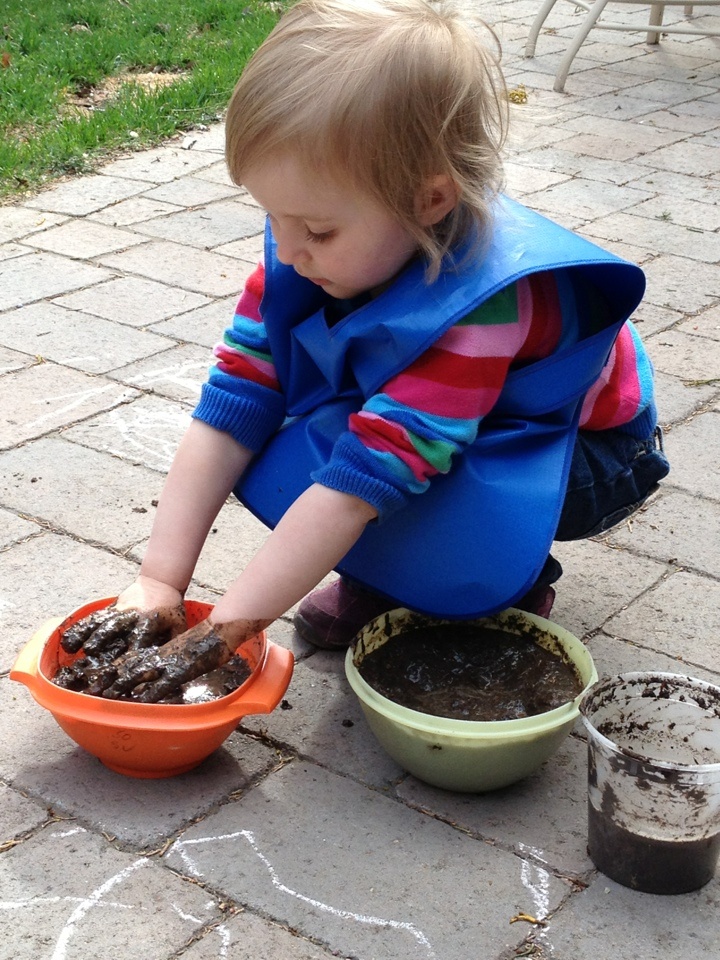
Spending time in nature and digging and playing in the dirt or mud are sensorial experiences that children delight in. Do you remember the wonderful feeling of mud squishing between your toes? Or recall the joy of discovering how a steady stream of water can erode a “mountain” of dirt into nothing at all?

I used to love to make mud pies as a child. I would mix the dirt and water in my own special concoction adding just the right amount of each, a sprinkle of grass, a few clovers, and then I’d mix it all up with a twig and serve up my creations with the pride of a master baker.

Who knew I was improving my immune system, developing a healthy heart, and decreasing my chances of depression? I just knew it was fun!

Last week my mom introduced my daughter to the joys of making her first mud pies. She was slow to warm up, unsure about getting quite that dirty, but I’m betting that by the end of the summer we’ll have some shots of her covered head to toe. And who knows, maybe I’ll join her!

I mean, I don’t have to go to some fancy resort and shell out of bunch of money to take a mud-bath, I can do that in my own back yard! So, yes, encourage your kids to put on some old clothes, and play in the mud, and if you’re feeling adventurous, join in the fun!

Have a wonderfully dirty week, Shelly

Photo by Christee Cook

My Screen-Free Airplane Adventure (with my 21 month old Daughter)

I took my very first solo airplane ride with my daughter last week and at first I was not sure how it would go. As I began to pack, I realized that I was really nervous about being stuck on an airplane alone with a toddler and for a couple of days I considered nixing my previous commitment to screen free living for my little one. I thought it might be easier to manage the trip if I brought along my husband’s iPad and chocked it full of children’s books and fun drawing apps.

But after some consideration, I decided that I just didn’t feel good about introducing my daughter to the iPad because I was scared she wouldn’t be able to entertain herself on the airplane. Instead, I came up with a solid plan to entertain and engage her with books, rhymes, toys, finger puppets, a small doll, crayons, and stickers. And it worked!

The photo at the top is only part of my airplane kit, but as you can see it contains some small animals (my daughter LOVES her toy animals), some finger puppets (yes I did use funny voices), a pad of paper, and some stickers all in a beautiful box. I took her interests into consideration when I created the kit. So if you were to do something similar, you might include toy cars, tractors, or dinosaurs. Or you’d add books about insects, birds, a small music box or whatever else interests your child. I included a list of our favorite rhymes, songs, and the story books that I have memorized due to sheer repetition. That list definitely came in handy.

We also packed a very first chapter book, “Charlotte’s Web” because I thought J was ready to listen and talk about the characters. And I had a book of Shel Silverstein’s poetry, a current favorite bedtime book. I took a couple of board books with lots of animal photographs and vocabulary to learn as well.

Essentially, I figured out what would engage us BOTH in long hours of conversation and exploration and I packed it all into our carry-on. The highlight of the trip for me was when I set her up with her toy animals and a couple of board books, strapped her into the unoccupied seat next to me, and then sat back and actually took a nap! She entertained herself for about thirty minutes, always keeping one hand on my arm to check in, and then she fell asleep too. I was shocked.

We used different items and various strategies to ensure that the entire trip was enjoyable. And if you’re thinking that this only works on a short flight, let me tell you, we missed our first connection due to weather conditions and ended up on a five airport, 20 hour long, overnight airplane adventure. She didn’t shed a tear the entire time.

I certainly can’t take all the credit for our success. I will be the first to admit that my daughter is exceptionally amiable and easy going, but I do think that we avoided a lot of potential upset when we came utterly prepared to entertain ourselves for hours and hours. Oh, and I also brought a BUNCH of yummy snacks.

So if you’re dreading air travel with a little one, let me reassure you, you CAN have a nice easy flight (or four) by engaging your child in his interests and providing opportunities for exploration and play.  One more highlight: on the flight home she was playing with her tiny baby doll while I was gazing out the window and I heard her pretending that her doll was at the park going down the slide and riding on the swings. I love her imagination!

Have you had a successful flight with a young person? What were the keys to your easy and fun air travel? Please share your story with us in the comments below.

And have a lovely week, Shelly

Playing with power

Well, it has happened.  My sweet baby is already becoming a willful toddler.  The past week or so has been filled with frustrating moments for her and for anyone near her.  She has begun to whine.  She is clinging to us like she thinks we’ll disappear if we’re out of her sight.  And of course, she’s also starting to walk.

Learning to walk and talk are HUGE developmental milestones for a baby and with the new development comes an equally big emotional response.  Tears and frustration abound as we humans learn new skills and reach new levels of development.  And it’s not just babies who experience the emotional ride of learning new skills.  Children and adults of all ages have the same big feelings.  When we reach a goal, there’s often a big emotional high and an accompanying let down.

So, what do we do with those feelings of sadness and anger that go along with new accomplishments?  We can try to ignore them or shove them aside, but that sure hasn’t been working at our house.  I’d rather embrace the feelings and provide a safe space for my daughter to fully express all that she’s going through.

Amazingly, just last week, my little one learned how to roar like a lion and wow, it’s a really ferocious roar!  So my mom and I began to play a game with her where we pretend to be frightened by her roar.  She LOVES it!  It’s really one of the first times I’ve seen her expressing and enjoying her power, she completely lights up.  She roars again and again while we cower in mock fear.  “Oh no!  Don’t eat me!  I’m so scared,” can be heard often at our house these days.  Here’s a short video of the game:

Then last night it was bedtime.  And you guessed it, she didn’t want to go to bed.  I could tell she was getting agitated and she started to test my husband by hitting him.  She knows that hitting people isn’t allowed, but she wasn’t sure how else to express the anger and frustration bubbling up inside her.

So I redirected her hitting to the stuffed animals on her bed.  Before we knew it, my husband, daughter, and I were all throwing and hitting and jumping on the stuffed animals yelling, “Take that!” and “Aaarrgghh!”  We all had a blast and each of us got an opportunity to express any unexpressed anger or frustration.  I can’t even tell you how satisfying it was to slam that pink elephant into the wall.  It was truly liberating.  The best part was that after the anger release, she was tired and ready to wind down to sleep.

So the next time anyone at your house is whining or getting agitated, try playing a power game.  Sometimes, just having an appropriate outlet for anger, frustration, or powerlessness is all a child really needs.  And when offered a healthy way to release those feelings, kids can easily return to their usual kind and cooperative selves.

Wish me luck with the rest of toddler-hood, I have a feeling I’m going to need it!

Have a great week, Shelly

Why rough housing is good for kids

I get a lot of questions from concerned parents about rough housing, wrestling, and other physical play. Dads want to know if it’s OK to wrestle with their kids, and moms are concerned that somebody will inevitably get hurt. Often it seems that physical play of this sort does end with the younger or smaller child in tears. But as I was doing research for my thesis in 2007 I ran across some studies that changed my mind about so called “rough housing.”

One study in particular stands out in my mind. It was conducted on a playground where researchers observed boys playing a tackling game. Researchers thought that they would find the game to be violent and detrimental to kids, but they actually found just the opposite. They observed that in playing this seemingly violent game, rarely did anyone get hurt, and when someone did get hurt, the other boys reacted with caring and compassion toward their fallen playmate.

And, after failing to find what they were looking for, the researchers changed their tack and began to look for behaviors that showed kindness and caring, such as a pat on the back, a hug, or helping one another get up. They quickly realized that the vast majority of the interactions between the kids on the playground were those kind and caring gestures!

In fact, they further realized that it was because of the seemingly violent nature of the tackling game that kids were given more opportunities to offer a helping hand or a hug than they would have otherwise. So that’s when I realized, that with some clear ground rules, wrestling between kids or between kids and adults could actually be a really joyful and beneficial activity for everyone involved.

So the next time your child runs to you crying, “My brother hurt me!” you can see it as an opportunity to nurture and comfort your child (which builds your connection) AND as an opportunity to show an older child how to take even better care of his younger sibling (which will build their connection).

Now, I’m not recommending that you force your older child to offer disingenuous nurturing, rather, that you model for your children how to care for one another. I also think it’s useful to keep in mind that there have likely been lots of other moments when the older sibling did take care of the younger one, that you might not have seen. Of course, the opposite can also be true.

So, if you’re not sure what’s really going on between your kids, take some time to observe them together and keep a tally for yourself. How many times did they touch or hug in a loving way? How many times did they touch in a hurtful way? What was your favorite moment? Why? What kinds of things did they say to each other? Ideally, you would tuck yourself away in a corner and seem to ignore them, so that they can play normally, forgetting that you’re even in the room.

But do be careful not to allow your preconceived notions or biases to show up in your observations. An observation should be completely neutral and without judgment, such as “Carl jumped on the bed and Henrietta fell off,” rather than “Carl viciously knocked Henrietta off the bed.”

I mentioned ground rules earlier and here are the ones I like for wrestling and rough housing at my house:

1) We stop if someone gets hurt and help them

2) We stop when someone says stop

3) We only use our bodies and pillows (no hard objects)

4) We stay on the carpet or bed

I’m so curious, have you found rough housing to be a connecting activity at your house? What are your ground rules? Please share your wisdom with us!

And have a wonderful week, Shelly

Spinning and swinging for fun, focus, and emotion regulation

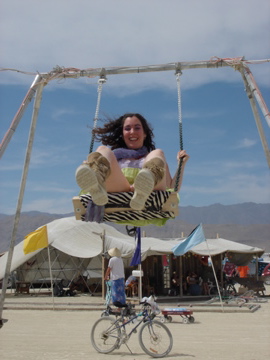
The vestibular system is responsible for balance, focus, and even plays a role in emotion regulation. But the best way to activate the vestibular system is by moving through space. So, if your child is having trouble with focus or emotion regulation, try encouraging movements like spinning and swinging and you’ll notice a huge change.

At Montessori school, we used the swings to help kids focus at least several times a week. I even activate my own vestibular system by doing somersaults whenever I’m feeling socially anxious. (So if we’re at a party together and I sneak into a back hallway for a moment, you know what I’m up to.) The thing is, it really works! After a few forward rolls, I feel so much happier and better able to engage and be social. If you don’t believe me, I challenge you to try it for yourself.

But I’m not writing this to help adults with their social anxiety, rather, I want young people who get labeled as “out of control” or informally called “adhd” to have solutions to anxiety, aggressiveness, or lack of focus that are easy, fun, and free of negative side effects. So, the next time you see your kids spinning in circles, remember that they’re self-regulating and it’s really good for their brains. Plus, it’s just fun and it feels good to spin around in circles!

For months now my daughter has enjoyed shaking her head back and forth. She’ll shake her head and then look up and smile. I usually join her just because it’s fun, but now I’m remembering that shaking our heads or moving our heads through space in other ways is actually crucial to brain health and wellbeing. The vestibular system needs input!

And, now that we humans spend less time running through the forest and more time sitting in front of screens, it’s even more important that we consciously choose to activate those systems.

So, your homework this week is to dance, wiggle, spin, jump, cartwheel, and swing with your kids. It’s good for everybody’s brain and it’s a great strategy to teach your child for times when he’s feeling worried, bored, or disconnected.

Have a fabulous week! Warmly, Shelly