
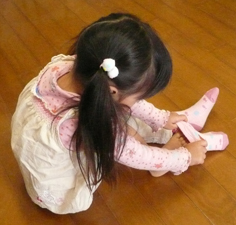
How to foster an emerging sense of order

Between 2 and 4 years old most young people begin to develop their sense of order.  This is the time when your child will become exasperated if you say the wrong word during story time or if you move her artwork or put away his toy before he was finished playing with it.  It can be a difficult time for parents and caregivers alike, because in the past your little one didn’t even notice when you put away his toys.  Now everything starts to become a negotiation because along with a sense of order, a stronger will and resulting tantrums also mark this stage of development.

This sensitive period for order can be challenging, but there’s no fighting against human development, and if you think about it, you wouldn’t want to anyway.  This is actually the perfect time to teach your child how to put away toys, straighten her room, and help out in the kitchen.  But in order to capitalize on your child’s innate desire to learn and this sensitive period for order heed this advice:  Attention to detail is the key to getting the most cooperation from your child during this time.

Let me illustrate further; Paying attention to minute details and showing your child all the tiny steps involved in tidying, cleaning, and putting things away create more interest and better results.  For instance, if you would like to teach your three year old to fold and put away his socks follow these steps slowly, carefully, and methodically (and wait until you have your child’s attention before moving on to the next step):

1)     Take newly dried clothes out of the dryer while they’re still warm

2)    Put them in a pile on the bed and invite your child to feel the warmth and play in the pile a little bit.

3)    Ask your child if he would like to play a sock folding game.  If yes, continue, if no, try another time.

4)   Ask your child to help you find two matching socks. Continue reading “How to foster an emerging sense of order”
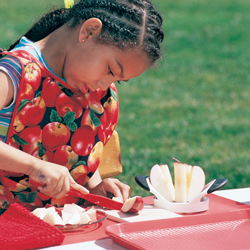
Autonomy is the holy grail of childhood

In my work with young people there are some needs that come up again and again.  The need for play is a great example.  Kids need lots and lots more play than we need and they let us know about their need in ways that are sometimes difficult for us.

But the unmet need that I notice most in young children is the need for autonomy.  Children desperately need to be able to do things on their own and to choose their own path and luckily for you, there are simple things you can do around the house to support your child’s autonomy.

First, take a tour through your home in your mind.  Starting at the front door, do kids have a place to put their coats and shoes when they get home?  Is the place for coats and shoes easily accessible?  For children under five years (and for older children and even adults) the easiest place to put a coat is on a hook near the front (or back) door.  And to put shoes on and take them off, a child-sized bench to sit on is quite useful.

As you move through your home in your mind, consider whether your child has access to the things she needs.  Can she reach toys and books in the living room?  Art supplies, dishes, water and a snack in the kitchen?  Is there a stool in the bathroom that makes using the toilet and washing hands easy?  Can he reach the towel to dry his hands?

Each room of your home should have an activity for your child available in case he wants to be in the same room with you, and in case he doesn’t!  Continue reading “Autonomy is the holy grail of childhood”

Holiday family time

Ahh, the joys of the holidays, we get to travel far distances and celebrate with people we may or may not like very much, all in the name of family togetherness.  Luckily for me, I adore pretty much everyone in my family, but I know that’s not the case for everyone.  And even though I love my family, the stresses of traveling with a baby are not something I’m looking forward to.

I’ve heard from my clients that the holidays are often more stressful than fun and tend to disrupt children’s routines and rhythms, making it difficult to get back into the groove once they return home.  I’m not sure what there is to do about that except to try your best to stick to the routine as much as possible even when you’re in a different time zone.

I do, however, have some great tips for how to handle potential conflicts that may arise after everyone has a few drinks under their belts, and how to deal with the “suggestions” you’ll inevitably encounter as your family members observe your parenting style.

For starters, get clear about why you’re doing the things you’re doing BEFORE aunt Margie tells you about how when she was raising her kids she swatted them with switches and they never “back talked” again.  Here are some ways to maintain your own parenting style and share it with your family compassionately. Continue reading “Holiday family time”

Three ways to stop yelling and still be heard

Although we’re all aware, caring, conscious parents, you know as well as I do that there are times when we lose control and we find ourselves saying the very words we swore we’d never say to our kids. I’m sure there have even been times when you *gasp* yelled at your kids. So, what can you do instead of yelling when you want to be heard and your little ones seem completely oblivious to your existence? I’ve got three great strategies, new things you can do in moments when you’re about to yell or scream. So, try these and let me know how it goes!

Strategy #1 Whisper

I know it’s counter-intuitive, but it’s also like using reverse psychology. When you walk up and whisper in your child’s ear, they will be compelled to listen and become quiet themselves (so they can hear you). I’ve been shocked by how well this has worked in the classroom and in a house full of kids. I think it’s because Continue reading “Three ways to stop yelling and still be heard”

The simpler the better

Hey Everybody, I’m back!  My beautiful daughter is nearly 2 months old and I’m excited to be back in touch with you all.Before I go on, a special thanks to all my guest bloggers. You all really helped me out and provided great content for our awakeparent
community!

OK, so you know the principle of Occam’s razor?  It’s the one that states that the simplest explanation is usually the correct one.  Well, so far, it’s been showing up in my world as a new parent.  Here are some examples:  1) Which is simpler, that my husband purposely hid my fork from me or that I inadvertently tossed it into the sink and forgot about it? 2) Which is simpler, using a host of stain fighting concoctions to get the poop stains out of my cloth diapers or just putting them out in the sun for an hour? 3) Which is simpler, applying lots of special creams to my baby’s butt to get rid of diaper rash or just letting her little toosh get some air a few times a day?

I’m finding it absolutely amazing how time and again, the simpler solution is the better one!  It reminds me of a book I read years ago called “The Simple Living Guide” that offered lots of simple, easy solutions to all aspects of our ever more complicated lives.  If I recall correctly the author even wrote about things like getting rid of stuff so that you’d have less to organize and keep track of.

I love the principle of simplifying on many levels.  Continue reading “The simpler the better”