

Creating the emotional state you want, it’s easier than you might think!

eva_summersaultToday I want to share something I learned from NLP (otherwise known as neuro-linguistic programming) called a “state change”.  We’re always in some sort of emotional state, whether happy, sad, excited, or frustrated.  And often it feels like we’re at the whim of our emotions.  When I’m frustrated it seems like there is no way to transform the frustration into something else.  But there is!  We can consciously create a “state change” in ourselves and often in others, pretty much any time we want!

Sounds too good to be true doesn’t it?  Well, I assure you, I’ve used this technique countless times with kids and with myself and it really works!  But, how does it work?  Well, here’s the thing, the body and the emotions are directly linked to each other.  When we feel sad, we look down, hunch our shoulders, pout and stay still.  On the other hand, when we feel happy and excited, we throw our shoulders back, look up, smile and move our bodies!

The trick is realizing that the conversation between the body and the emotions is a two way street.  Not only does our body reflect how we’re feeling, but our feelings reflect how we’re holding our bodies!

Try this the next time you’re feeling down.  Find a brightly lit room, look up at the ceiling, smile your biggest smile and think about something you love.  Now how do you feel?  It’s almost impossible to continue feeling sad when your shoulders are back, you’re looking up, smiling and thinking of something you love or enjoy!  You can try the opposite too (although it’s less fun).

Sometime when you’re feeling great, try hunching your shoulders, looking down at the ground, and thinking about something really sad.  You’ll almost immediately start to feel sadness.

So, how can you use this two way street to your advantage?  You can actually tell your emotions what to feel by holding your body in a certain way!  Continue reading “Creating the emotional state you want, it’s easier than you might think!”

Free online parenting retreat!

Numbers 2010 on beachParenting is a wonderful, but challenging, journey. No instruction manuals, no definitive “right” or “wrong” methods. And, of course, each child is different!

But for one special weekend (May 25-27) you can give yourself a break… while getting your parenting questions answered, brainstorming solutions and learning tips and techniques that work for today’s kids – toddlers to teens.

You can access all of the live workshops at this online parenting retreat at no charge! Click here to view more details

You will be able to participate online in over twenty interactive workshops given by professional parenting coaches, educators, and counselors. And if you have to miss any sessions, we’ve thought of that too…

…When you purchase a ticket, you’ll get audio recordings of *every single session*!

(There’s even a Spa Products giveaway for 35 lucky registrants – just so it will really feel like a weekend conference “getaway”.)

Tickets are just $77 from now until May 22nd for the early-bird special. Then the price goes back to $97.  AFTER the retreat, the entire package will be available for purchase for $197, which is still a TREMENDOUS BARGAIN for 35 quality workshops and bonuses!!!

And remember, you can attend the live workshops for FREE.  You only pay if you want recordings of the sessions.

What sort of parenting issues will you be able to address?  Top parenting experts – each of whom has invested years of dedicated study in the field – will be there to share their wisdom about:

*Raising a confident and happy child able to be resilient to life’s challenges.

*Coping positively but effectively with disrespectful behavior and sassy attitudes.

*How to set your child up to make wise decisions and avoid dangerous behaviors.

*How to balance work and family – while still keeping your sanity!

*How to deal with meltdowns and tantrums–at any age—with me, Shelly Phillips!

I sure hope you’ll join me on May 25th at 7pm Pacific time for my “How to deal with meltdowns and tantrums at any age” seminar.

Warm hugs, Shelly

What to do about potty talk

kids_potty_mouth_pm-thumb-270x270-1Isn’t it amazing what kids find funny?  I’ve been surprised more than once by what seems hilarious to a 2, 4 or 6 year old.  And then I remember, their sense of humor is just developing.  Kids this age have a challenging time understanding word play and innuendo, but they do know that burps, farts, and poop are some of the funniest things around.

I’m guessing you’ve especially had an opportunity to witness this phenomena if you have a little boy but some little girls love potty talk too.  Suddenly “poopy butt” or “potty head” is their new favorite nickname for everyone.

So, what to do?  Well, first of all, recognizing that this is a normal stage of development can help you breathe deeply and relax a little when your child says “penis” for the tenth time that day or calls the lady checking you out at the grocery store a “fart face”.  Patience is a huge key to allowing this stage to pass, but patience alone will probably not create the kind of verbal environment you’re wanting.

So, you’ll have to create boundaries, letting your child know what works for you and what doesn’t.  I invite you to give a little here, and recognize that using potty talk is a way that your child is experiencing joy, laughter, and humor.  But clearly it’s not appropriate to call the teacher names or to shout the names of certain body parts across the store.  So the first step is to decide where your boundary is.  And that can vary greatly depending on your own preferences. Continue reading “What to do about potty talk”

An easy game for busy times: The “find it” game

green-kids-treasure-hunt-lgThe “find it” game is a fun game for times when you don’t have a lot of attention to give but you want to help stimulate your child’s mind and have fun together even while you’re busy at other tasks.
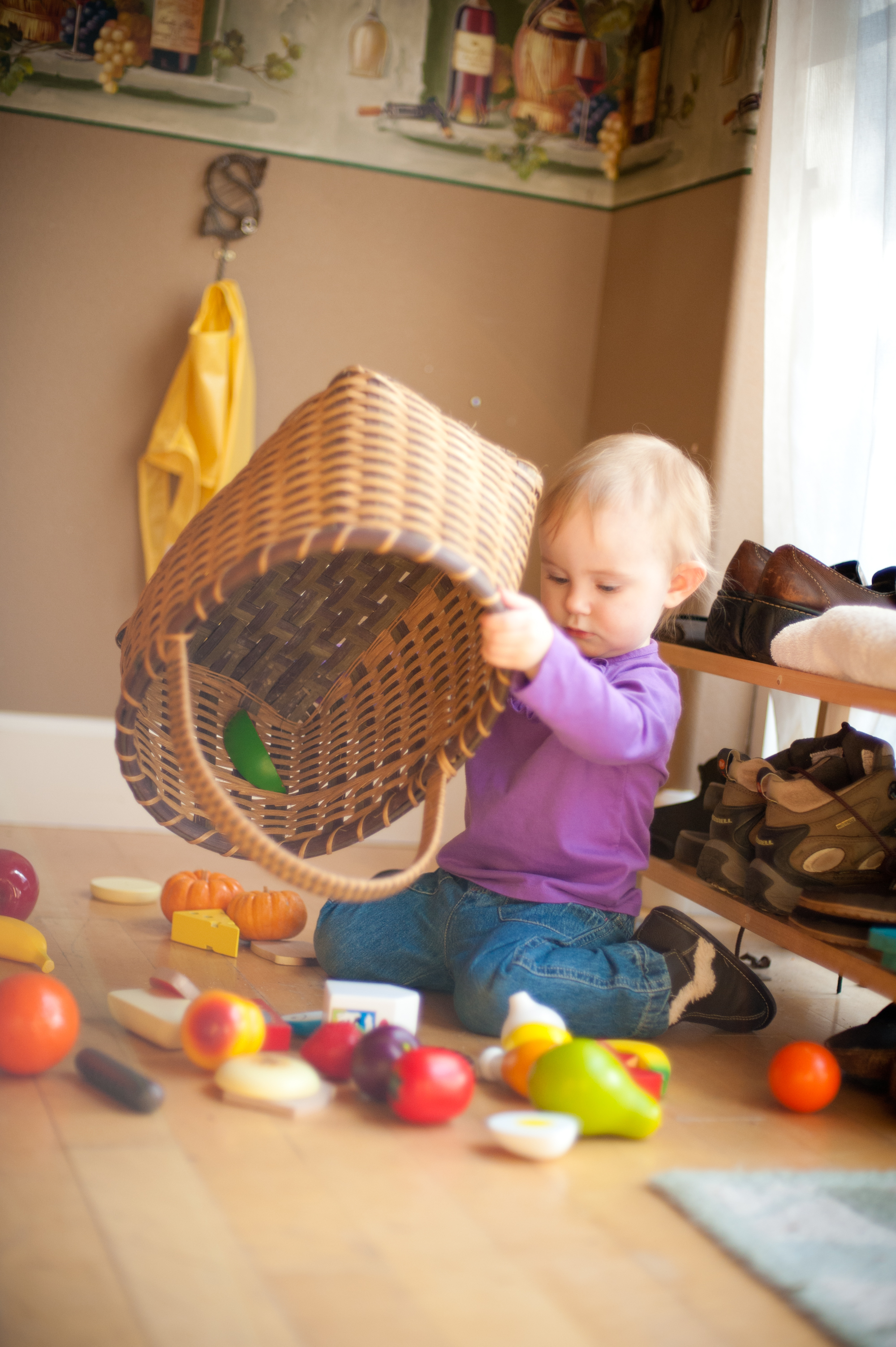
This game can be modified for ages 1-7.  For the youngest kids you can ask your child to find something familiar like his favorite stuffed animal or blanket.  Then, you can ask your child to put it in an unusual place (like in the dry bathtub) and then go find it again.  The ability to remember where something is and go retrieve it even when it’s out of sight is a useful skill for young children as it requires memory and visualization.

As your child grows older and needs a more complex “find it” game, you can ask her to find a blue crayon, a red triangle, or a specific item from a specific drawer.

So let’s say you’re busy cooking and your child seems bored.  You can offer, “Hey, do you want to play the ‘find it’ game?”  You’ll usually hear an enthusiastic yes from your child.  “Great!  Can you go into the bathroom and look in the far right drawer and find me a brown hair tie?”  When they’ve brought it, “Thanks!  Now let’s see, can you find your baby brother’s favorite book?  The one about the white mitten?” Continue reading “An easy game for busy times: The “find it” game”

Seek first to understand…

In his Seven Habits of Highly Effective People, Stephen Covey enjoins us to “Seek first to understand, then to be understood.”

As hard as this may be to remember to do with other adults sometimes, I find it even harder to remember to do with my son.

Recently I got my son and his stepbrother reading and math workbooks based on movie characters. My son got a Cars (as in the Disney movie) workbook for Chanukah, while his stepbrother got a Spiderman workbook. My son wailed and hollered for days…”It’s not fair! It’s not fair! Why did you give him that?”

I explained that I knew Canaan (my son, and that’s his new chosen spelling of his name) liked Cars, so I got him that, and I knew Taebin (his stepbrother) liked Spiderman so I got him that. Completely logical.  Meanwhile I was kicking myself for not remembering to get them identical gifts.

Canaan’s dad explained to him that if he kept reacting like this, people wouldn’t feel like giving him gifts anymore. Turning on my best earth mother tone, I imparted a deeply meaningful spiritual lesson about how gifts are expressions of the heart, and the giver wants joy and gratitude in response, and how the gesture of giving the gift is an act of love, far beyond the gift itself.

We also reminded him to focus on himself, and not pay so much attention to what other kids were getting.

Well, sure.

And…blah, blah, blah.

What does any of this mean to a six-year-old with a bruised heart?

Maybe something sunk in. I hope it did.

But what dawned on me was that I had completely skipped over the step of seeking first to understand him. And in so doing, missed the chance to really connect with him, build trust, and show him I was on his side. And how much more valuable would that be than trying to “convince” him of something when he plainly knows otherwise?

I stopped mid-lecture.

“Are you feeling really sad, because when you saw Taebin’s gift you wanted his more than yours?”

Immediately his energy relaxed.

“Yyyeeeeahhhh….”

Of course it did–I was showing him that I was with him, not against him.

So I continued.

“And you really wish you had that present, so you could feel like things were equal?”

Tiny whimper.

“Uh-huh.”

Oh, my sweet little puffin.

I felt myself soften, too.

I noticed that I can feel afraid, sometimes, when I take this approach, that I’m somehow reinforcing “irrational behavior,” or teaching him that it’s “Ok to be upset about little stuff.”  I’m also just wanting peace, and wanting his tirade to end, which fuels my strategy of explaining why it “should” end.

I need to remind myself that empathizing with him doesn’t mean I’m agreeing with his story–it just means I’m taking a moment to seek first to understand, before trying to get understood. This works pretty well with adults. How much more mileage can we get from this technique with young people, who don’t even have the advanced brain development most adults do? But boy, do they know when someone is genuinely trying to understand them.

Please tell me your experience–what happens when you seek first to understand (and check out with the other person whether you got it right), before seeking to be understood?

Oh, and happy Chanukah!