
The beautiful urge to bite and what to do about it

Young people are discovering their world and constantly coming up with strategies to meet their needs.  Sometimes these strategies cause pain and upset in others and are experienced as destructive.

The most common examples of destructive behaviors in 1-5 year olds are hitting and biting.  Older kids often use their words to destructive means.  And teenagers do all sorts of behaviors that we adults see as destructive and dangerous.  But what if we were able to see the beautiful needs behind these behaviors and redirect kids in a way that helps everyone experience more peace and joy?

Redirection is a wonderful tool that will help you help your child.  When we can offer another option that’s less destructive, kids will often gladly take our suggestions.  After all, they’re usually not trying to hurt others, they’re just trying to meet their own needs.

When I was a nanny one of my charges began to bite his brother, other kids at the park, and even me and his mom.  Ouch!  I’ve heard all sorts of stories about what to do with a kid who’s biting from ignore it to bite him back.  But I knew that biting a baby or young child was not going to work for me.  I would certainly feel sad and guilty if I were to retaliate against such a young child (or any child for that matter).  And ignoring a destructive behavior can just help it grow and become ingrained.  So we tried another strategy­–redirection.

First, we began to watch him closely and after some observation we discovered that there was a look in his eye just before he tried to bite.  Next, we tried to understand what need he was trying to meet and we determined that when he needed space, he bit.  He would usually try to bite in a situation when he was in a confined space, had another child touching his body, or when another child took the toy he was playing with.

So for starters, we tried to anticipate any situations that were likely to result in his desire to bite and diffuse the situation before he even got the idea.  But we weren’t perfect, and sometimes he still got the look in his eye, opened his mouth, and tried to bite someone.  We acted swiftly, removed him from the person he was about to bite and REDIRECTED his aggression toward his blanket.  “It’s not OK to bite people, but if you need to bite, you can bite your blanket.”  After a few weeks, “John” began to go and get his blanket whenever he had the urge to bite!

If you think about it, the urge to bite has helped us out immensely when it comes to eating.  If we didn’t have a need to bite, we might never have discovered some of the delicious foods we eat today.  So, ultimately, biting is a beautiful need, it just sometimes gets generalized to people and things that aren’t safe for biting.

A friend recently shared that her young son had begun to bite his bed frame and was damaging his bed and eating wood!  She decided to redirect her son’s behavior so they found a heavy plastic fork and deemed it his “special biting fork”.  Now when he has the urge to bite he asks his mom for his special biting fork, then he gnaws on it for a few minutes and hands it back to mom.  I was talking to his mom on the phone the other day when he said, “Mom, can I please have my special biting fork?” and I found myself grinning from ear to ear.  I’m so happy that he gets to bite something that’s safe for him!

There are lots of other behaviors that can be redirected into more constructive choices for kids.  What have you tried?  Which redirections have worked for you?  I’d love to hear about your experiences with redirection.  Thanks for being here!

Rewind! A simple trick that really works.

Sometimes the best and simplest solutions are the hardest to remember. I’m not sure why that is. Back in the days when Shelly and I lived in the same city and taught classes “real-time,” one of the things we brought up frequently was that in real life, you don’t really get “rewinds,” where you can go back and start over. So we’d replay challenging situations and get to try out new behaviors so we could become comfortable with them.

However, you *can* start over in real life. Well, not really, in the sense that the past is still there. But you can “rewind,” if both people agree.

The other day, I talked to my girlfriend in a way neither of us really liked. It took us in an uncomfortable direction. On a lark, I said, “Let’s start over.” All four of our shoulders fell several inches in relief.

And you know what? The new beginning was just as good as if the old beginning had never happened.  Why is that?

I think it’s because, most of the time, when we head down a path that feels like it just isn’t working, everyone involved can feel trapped. So starting over gives the opportunity to pick a different beginning point, which most people want anyway if where they are isn’t working.

This trick can work with grownups, kids, and everyone in between. You can offer it to young people as a way to have a “second chance,” in a warm and playful way. Not as if they were somehow bad or wrong, but as an offering of another option. “Ooh, that didn’t work for me so well–would you like to start over?”

When we feel scared, hurt, angry, or a whole host of other emotions, we can default into  ways of being that don’t help connect or get us where we want to go.  Try playing with this technique of starting over, and see if you can’t create more beautiful pathways–let us know how it goes!

Warmly,

Jill

Simple changes at home can help kids feel comfortable and capable

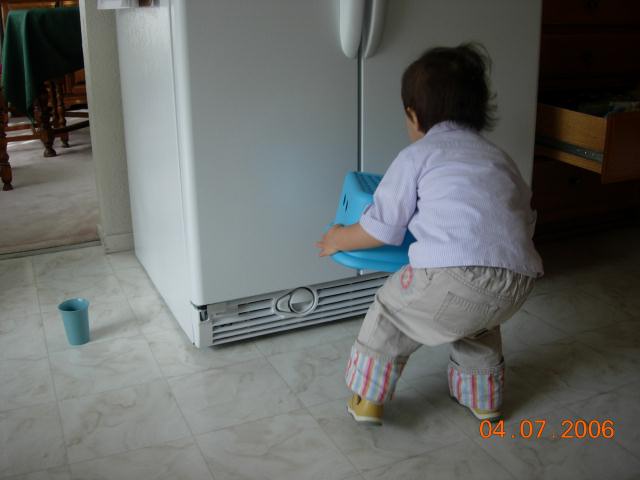
DSCN0589When I worked in Montessori schools I was consistently amazed at how happy, engaged, and capable the kids in my class were.  This got me thinking, “If kids can be this self-sufficient and joyful in a classroom, then why not at home too?!”  I’ve noticed that young people often feel frustration at living in a an adult-centered world. I can remember feeling irritated about not being able to see over the counter, or out the car window (before the advent of booster seats).

Although young people make up a significant portion of our population, they don’t pay the bills, so they usually aren’t catered to in the way that adults are. Most furniture is not built to accommodate them. There are often no stools provided where needed, especially in public.

Even going to the bathroom in a public restroom and washing one’s hands can be quite difficult for a person with a small body. Doors are large and too heavy; tools are too big for their hands… I think you get the idea.DSCN0590

So if there’s a place where a child can find solace from these frustrations, I hope it will be their home.  I would be inspired to live in a world where a child’s home is a place where she can reach the counter top, make herself a snack, and take care of her personal hygiene easily. I’ve found that when young people are given the tools they need to be able to have these freedoms, they are more peaceful and often much more responsible. Trusting young people to care for themselves and giving them the necessary tools to do so, fosters a sense of self-care, self approval and healthy pride.


DSCN0591Consider the daily activities of the child in your home. What does he do and what would make his tasks easy to accomplish without asking for adult intervention? Is there a convenient place for him to hang his coat when he enters his home? (Tip: for very young children, a low hook is the easiest place for a jacket) Can he reach the sink easily for hand washing? Are there art activities, games, puzzles and books that are within easy reach?  Does your child have comfortable furniture that fits his body?

Ask your kids what changes they’d like to see in their home environment. And consider what changes would ultimately make things easier for all family members. For instance, if children’s dishes are where they can reach them and they know where the carrot sticks are and that carrots are an acceptable snack, they can simply let you know what they’re doing (or not, depending on your house rules),  without needing you to stop what you’re doing and fix them a snack. Also, consider asking older children to help younger children. Requesting the help of your older child (without demanding) can foster teamwork and interdependence between siblings.

Ultimately, your children want to feel capable and supported in their home, and although that might require some rearranging and consideration, it’s not much work to provide possibilities for autonomy and it’s almost no work for you once they know how to care for themselves! So, take a look around your home this week to be sure that everyone in your family has access to:

Water (for drinking and washing)DSCN0600
Food
Clean clothing
Warm clothing
Books/toys/art supplies
Towels and cleaning supplies
Art at eye level
Full-length mirror in bedroom
Things to nurture like a plant or a pet

So, I hope you’ll use this list as a guide, and talk with your child about what sort of changes would make life at home easier, more fun, and more equitable.  When we honor children by taking the time and making the effort to accommodate their needs, they feel treasured in ways they can’t even express.  But I’m sure you’ll notice the difference!  I’d love to hear about how simple changes around the house have made a difference in your kids lives.  Please leave us a comment below.

“Have to?” Are you sure about that?

I’m gearing up for a five-day retreat in which I’ll study Nonviolent Communication Mediation intensively. As many of you know, I work as a mediator and Shelly and I use the insights of Nonviolent Communication, based on the work of Marshall Rosenberg, in our work here at Awake Parent.

One of my favorite insights, or, “reframes,” as my girlfriend likes to call it, is taking the phrase “I have to…” and rephrasing it as, “I choose to…because I want…” So, for example, “I have to go to this stupid job I hate,” might become something like, “I choose to keep this job because the salary affords me things I want and need, like health insurance, and the peace of mind that comes with knowing I have reliable income.” Continue reading ““Have to?” Are you sure about that?”

One simple trick for hard times: Imagine how you want it to go

It’s finally hitting my son—he has two homes now. He’s struggling to make sense of it, and sometimes lashing out at me. I mean really lashing out—hitting, telling me he doesn’t live with me any more, and that I’m not part of his family. I’ve been thrown for more loops than I can count in a very short period of time. And it’s always like a surprise kick in the gut.

I realized I was kind of going victim about it all. I was seeing these scenario’s as something that was “happening to” me—I was not helping create them, but just reacting to them—in very knee-jerk, disempowered ways: impotent rage, fighting him in petty power struggles, taking it personally, and giving up and getting depressed.

Finally it dawned on me: I could create exactly the scenario I wanted. Continue reading “One simple trick for hard times: Imagine how you want it to go”