Terrified of the Terrible Twos? How About Terrific Twos Instead!

Yes, it is true that two-year-old children don’t have much impulse control or emotion regulation skills and that coupled with their very strong preferences has given them a bad reputation as irrational and explosive. I’ve been told all sorts of things about “the terrible twos,” especially when I was a nanny and again as I prepared for motherhood. But it really doesn’t have to be this way. Tantrums and other toddler behaviors that are difficult for us are actually just a signal that a child’s needs aren’t fully being met. Luckily, we CAN meet those needs and enjoy far less of those pesky behaviors.

A couple of years ago I saw an amazing documentary film called, “Edison’s Day” which is about a 20 month old boy whose parents are both Montessori trained. Their whole home is set up to accommodate the budding independence of toddlerhood.  And their son Emerson is clearly thriving as he’s included in meaningful work, helpful tasks, and independent activities throughout his day. If you want to be completely inspired by what a toddler can accomplish if given the opportunity, definitely watch “Edison’s Day.”

I’ve done my best to set up my home in a similar way and have always encouraged my daughter Julia to develop independence as well as nurturing her ongoing cooperation in every possible moment.

And with a few adjustments to your home environment, the way you handle transitions, and your daily routines, you can have terrific twos just like Julia and Edison have! Here are some tips to get you started:

1)   Track your child’s ability to communicate and offer help.

Sign language, guessing what he wants and verbalizing for your child, and helping a child to simplify a sentence can all support toddlers in gaining the confidence to communicate their needs. “You want the cup? Can you sign ‘please’? OK!”

2)   Set up a leaving home and arriving back at home routine

complete with low hooks, a bin or basket for shoes, and a playful but consistent attitude. “We put our shoes away when we come inside.”

3)   Warn toddlers of an impending transition with plenty of time for them to get on board.

“We need to go to the grocery store. Would you like to go now or in 5 minutes? Is there anything you’d like to bring with you?”

4)   Empower your child with the skills and knowledge of the daily routine, self-care practices, and household tasks.

Toddlers are FAR more capable than we might think, so invite your child to try new things and try not to do things for them if they’re capable and willing to do it themselves.

5)   Establish a few very clear rules, post them publicly, and ask everyone in your child’s life to help you maintain those boundaries.

Also, offer an acceptable alternative if your child breaks a rule. “It’s not OK to throw books, but here’s a ball you can throw instead!”

6)   Establish a consistent daily routine and ask your child to anticipate what happens next.

“Do you remember what we do after we take off our shoes and coat?…That’s right! We go to the bathroom.”

So, why do these things make such a huge difference in the life of a two year old? For young people, routines create security. So the more predictable the daily routine is, the more likely your two year old will know what to expect and feel comfortable and prepared for what’s next.

And then there’s their budding independence. The “I do it,” stage. The more we can embrace and nurture a toddler’s autonomy, the happier and more relaxed they will be. That’s because a toddler’s main goal in life is to grow up and become a capable adult. They want to be just like us, so let’s help them learn how!

Have a fantastic week, Shelly
Do You Recognize the 7 Warning Signs of a Toddler About to Hit or Bite?

It seems to come out of nowhere. One second your toddler is playing peacefully near a friend, and the next moment the other child is running to you screaming, “He bit me!” or “She hit me!” You feel embarrassed, confused, and unsure how to proceed. Meanwhile the other child’s mom is staring at you like, “Aren’t you going to DO something about this?!”

You’re sure your friend or family member is expecting you to put your child in time out, but you’ve heard that punishment undermines your connection with your child, so what to do?

Obviously you need to address this with your child, however, a child who just hit or bit is clearly not in a learning mindset. Instead, your sweet child has stress hormones coursing through her system and is in fight, flight, or freeze mode.

Start by going over to your child, hug or hold her, make eye contact and use a simple phrase like, “Hitting people is not OK.” After that, you may want to empathize, “Were you scared your friend was about to take your toy away?”

Remember, a child who’s acting out is using her best strategy to communicate her needs. She’s not trying to hurt others or annoy you. She simply doesn’t know how else to protect her personal space or express her upset.

The good news is, kids can learn these skills quickly if you’re willing to give it some effort. The key to helping a child learn a new coping strategy is to catch the child BEFORE he employs the strategy you don’t like and then offer a suggestion in the moment when you can see he’s about to hit, bite, scratch, kick or whatever else your child does to protect himself.

So, if you have a child who resorts to hitting or biting, get ready to supervise closely for the next few weeks. Trust me, this intense supervision definitely pays off. You can rest assured that if you’re consistently there to stop your child from doing the unwanted behavior and you also offer an acceptable alternative, you’ll eradicate these behaviors in a few short weeks.

But how do you know when a child’s about to bite or hit?

Here are the 7 warning signs to look for:

1)   There’s no adult supervision or adults are involved in a conversation.

2)   Your child is tired, hungry, and/or irritable.

3)   Your child is frowning or looks unhappy whenever a friend comes near.

4)   Your child is acting possessive of a particular toy or item.

5)   You hear your child try to say “No,” raise his voice or begin to yell.

6)   Your child is clinging to you and/or whining.

7)   You see your child begin to act aggressively, with little body checks, shoves, or other physical acts.

While each child is different and has her own unique warning signs, you’ll find that once you’re looking for signs and signals that your child is about to hit or bite, you’ll begin to notice his particular way of ramping up his upset.

But if we can intervene before kids act out, we’re not just stopping them from a destructive and hurtful behavior, we’re also helping them learn to regulate their emotions and use more effective strategies for calming themselves down and establishing healthy boundaries with their friends.

And once your child feels comfortable setting clear boundaries, she’ll be much more likely to relax and enjoy her time with friends. When you feel confident that your child has the skills to use his words or other strategies, you can relax your supervision a bit. But you may want to remind everyone of the ground rules, before you leave the room.

Have a great week! Warmly, Shelly

My Top 10 Most Popular Posts of 2012

In the past I used to write whatever I wanted on this blog and I still do that to a large extent. But this year I had a shift. I realized that I want this blog, this website, and my business to be more about what YOU want and less about what just happens to strike my fancy when I sit down to write my posts. In order to better analyze what you like, I decided to take a look at the best performing posts from 2012 and use them to direct my future efforts.

And wow, I am shocked at how much time it has taken me to figure out what my top ten posts of last year were. First I had to decide on an accurate measure. Should I use traffic, views, tweets, or Facebook shares? After much research and analysis, I’ve decided to base my most popular posts on Facebook shares, since that’s how most of you let me know you’ve enjoyed my post. And so, without further ado, here are the top ten most popular posts of 2012! Oh, and I’ll share them in reverse order for a bit of dramatic flair 😉

#10 Forced Apologies Undermine Conflict Resolution Skills


#9 Three Simple Activities Children Absolutely Love


#8 Our New Favorite Geography Game


#7 Seven Strategies to Transform Challenging Moments


#6 How to Teach Toddlers to Share


#5 Circumcision is Genital Mutilation


#4 The Santa Conversation


#3 Don’t Say That Do Say This: 20 Things Not To Say To Your Child (And What To Say Instead)


#2 “Back Off!” Empowering Young People to Claim their Personal Space


and drum roll please…the number one most popular article from 2012 was…


#1 Why My Child’s Sleep Rules My Life and I Wouldn’t Have it Any Other Way


Thank you so much for being here with me in 2012 and for sticking with me in 2013. I’ve got an exciting new eCourse in the works due to open in the spring. As usual you can expect weekly posts on whatever seems most relevant to the conscious parenting conversation. And please contact me if you have any questions, want to connect with me more, or have suggestions about what else you’d like to see me write about here at Awake Parent!

Have a wonderful week, Shelly


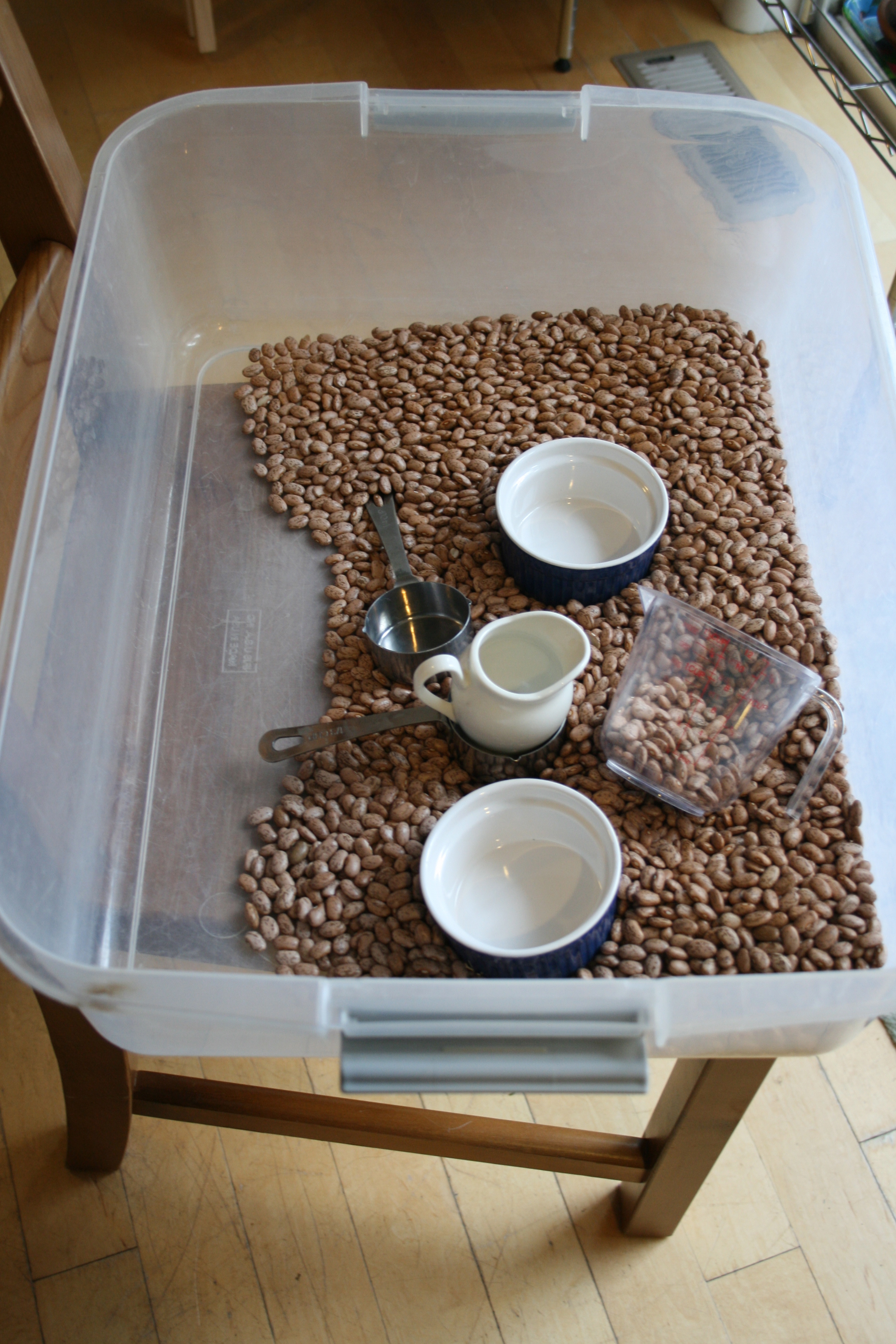
Winter Fun: Bean Bin!

IMG_5298Our Simple Inexpensive Bean Bin

1) Shallow plastic bin with lid

2) Lots of dried beans

3) Cups, pitchers, scoops, and bowls

4) Set it up on a chair

5) Put it away and take it out when you need some uninterrupted time in the kitchen.

The Top Ten Things I’ve Learned About Getting Organized

I used to resist organizing. I’d put it off until my drawers were overflowing and my closets bulged. But at some point, often at the worst possible moment, I’d be forced to handle the clutter that had built up beyond recognition.

I’ve turned a corner in this regard. I actually enjoy organizing and re-organizing now! And having a few days “off work” seemed like a great opportunity to re-organize some areas of my home that had been neglected of late.

So, the pantry got an overhaul last weekend and so did a strangely shaped cabinet in my kitchen. Now both are more usable, more pleasing to look at, I know what I have and I’ve gotten rid of the stuff I was keeping but no longer needed. It’s amazing how much space can be taken up by things that we rarely use, but that we still think we need to keep around. For me, a huge part of organizing is letting go of the things I think I need, but don’t actually use.

Whew! I’m so glad I tackled that pantry (thanks to my wonderful husband for the inspiration). What a nice feeling to start the New Year with! Next up, my office! Ha! That’s a joke, I’ve been working on organizing my office for at least a year. And, yes it’s far better than it has been in the past. Maybe I should add an organized office to my 2013 vision!

Do you enjoy organizing? Or do you experience it as a constant battle? Do you dread doing it with the kids around? Or is it fun to include them in the process?

I used to do all my re-organizing when my daughter was asleep because I was afraid she would take things from various piles, carry them around the house, or just need my attention while I was in the midst of my project. I still tend to do more organizing when she’s otherwise occupied, but now I’m no longer afraid of what will happen if she’s around while I’m moving things around.

I figure it’s probably good for her to see behind the curtain a little bit and start to understand that there are things that need consistent revisiting in order to keep our home tidy and accessible.

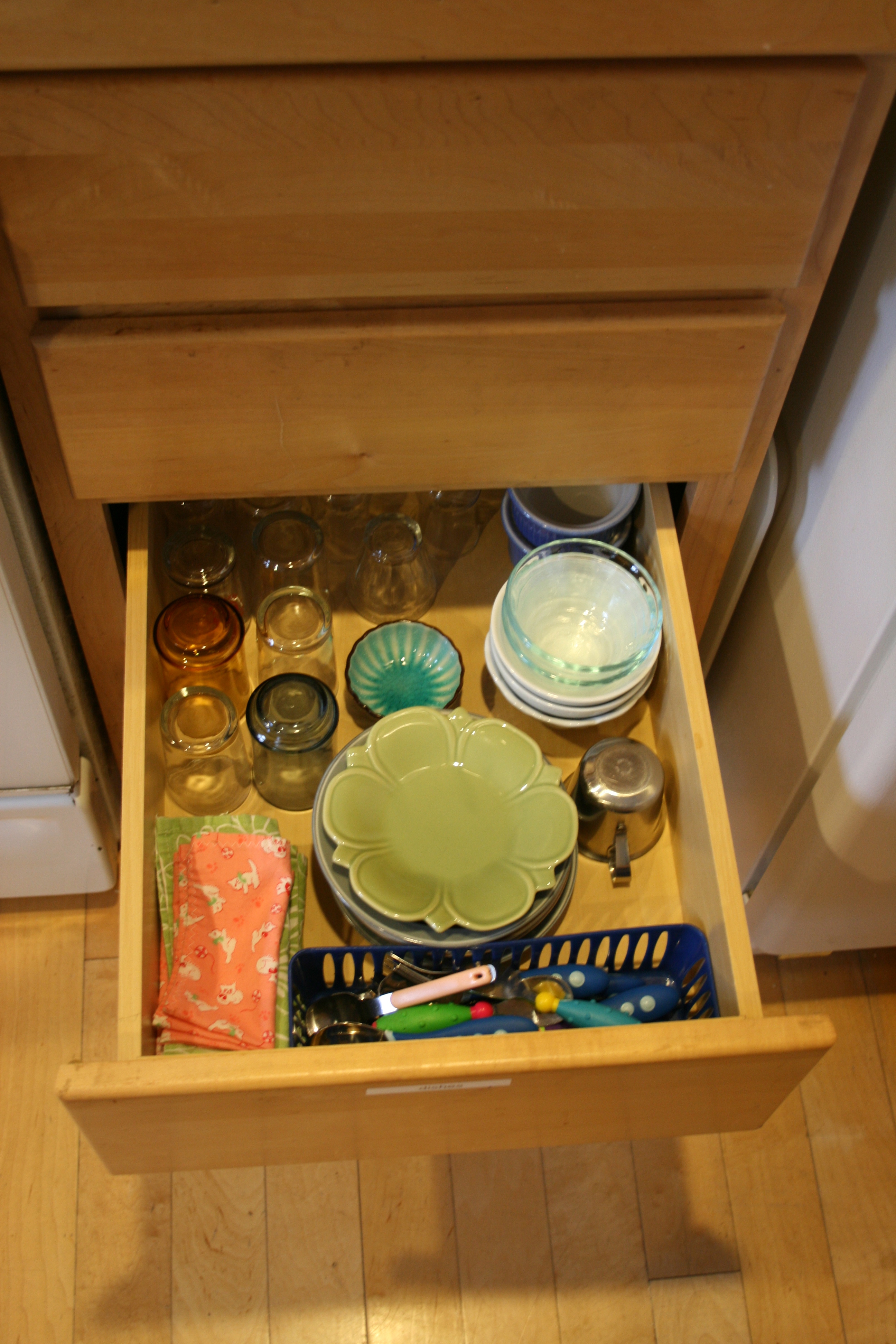
At almost two and a half, Julia is now responsible for putting her clean breakable dishes into her kitchen drawer after they come out of the dishwasher. She does this task with gusto each and every time I ask, but it’s only possible because we’ve kept her drawer well organized and it’s not overstuffed with items that are rarely used.

Here’s what I’ve learned about staying on top of organization lately.

1)   It’s never ending.

2)   I need empty bins, baskets and buckets to dump things into at the beginning of any reorganization attempt.

3)   I need bins, baskets, and buckets to hold ongoing in-process items like “giveaway” “to be filed” and “to be fixed.”

4)   I MUST have systems for dealing with things like junk mail, personal items, things that are broken and need fixing etc.

5)   It’s never ending.

6)   A place for everything and everything in its place is a fantasy right now (albeit one of my favorites), but I will achieve it. I WILL ACHIEVE IT.

7)   Keeping things from coming INTO my house is probably even more important than having a system for dealing with things once they’re here.

8)   Asking my daughter, husband, mom, and whoever else is willing to HELP me is crucial. I don’t have to do it all myself.

9)   It’s my job to set the expectations and to let my family members know when it’s time to straighten up (without throwing a fit by huffing around the house complaining about what a pit it is).

10)   It’s never ending, so I might as well enjoy the process.

I recently read “Getting Things Done” by David Allen and I realized that there are all sorts of ways that I’ve been undermining my own efforts to organize. Now I’ve got a clear plan and I’m chipping away at my bad habits bit by bit.

Do you know what’s keeping you from having the tidy and organized home you dream about? Or are things just fine as they are? I would love to hear about your own journey of staying organized at home. Please share a story or comment below!

And have a fabulous day, Shelly