4 Secrets to Mindful Giving During the Holidays

Guest Post by Megan deBoer

As parents, we are often filled with conflicting desires during the holidays: we want to satisfy our children’s wishes, we want to make the holiday magical, we want to create our own family traditions all without causing financial stress and unwelcome credit card bills.  And so we try to plan…

Yet despite our best planning, there can come a moment during the whirlwind and heightened emotions of the holiday season when we find ourselves making impulsive, reactive, and unconscious spending choices.  We can be swept up in the mood, the beautiful display, the “deal!” and the hectic pace of it all.  It is easy to loose our bearings.

I have found that in moments like these I need some grounding.

To ensure that you are making mindful choices, run the following assessment when considering the purchase of a gift.  If the questions cannot be answered on the spot, it is important to pause, put the item on hold, possibly leave the store, and give yourself the time – and space – to come to a decision that feels right.  You haven’t said no yet, you are simply exploring a new process of mindful spending!

Assessing a mindful GIFT

GENEROUS–

Is this gift Generous in spirit?  Thoughtful giving is a true art.  The amount spent does not reflect your generosity by itself.  Young children are easily delighted with something that engages their imagination.   Our adult value scale does not apply.

INTENTION–

What is my Intention in giving this gift?

  • Is this something I always wanted as a child but never received?
  • Am I worried that if my child doesn’t receive X that they could experience disappointment?  Is that uncomfortable for me to imagine?  Will I experience disappointment if I cannot give this to my child?
  • Is it uncomfortable for me to compare my gift to what others will be giving?  To what their friends will receive?  To what I have given in the past?
  • Am I afraid that what I have already gotten won’t be ‘enough’?
  • Will this gift satisfy a long awaited wish for my child?
  • Will this gift inspire my child – who they are right now – and add joy to their life?

FAIR –

Is the cost of this gift Fair to our family’s resources?  Does it fit into my spending plan?  If not, is there a creative way that I can give this gift (or an alternate) responsibly?

TIME —

Will my child have the necessary Time – and space – to enjoy this gift?  Our children are given gifts from many family members – for birthdays and holidays.   It can be overwhelming for them to receive more gifts than they can actually enjoy in their available time.

We can justify most spending – especially to our children – if we craft the right story to tell ourselves.  But giving mindfully means we give generously, with clear intention, in a way that is fair to our resources, and honors the time and space our children must have in order to receive and enjoy the gift.

Our gifts have the amazing ability to become a symbol of our love in tangible form. Sometimes they feed our souls and sometimes our bodies, like the Manly Man edible arrangements a friend of mine received last year. Our gifts can also hold unintended and unconscious messages.  Our unconscious spending does not serve us, or our children, in the way we may hope.

This season, give mindfully and trust that your love is the purest gift – in tangible or intangible form.  Exaggerate the magic, the mystery, and the endurance of love in your celebrations.  Share your own joy abundantly with your children and spouses in the traditions that give meaning to you – this is a gift that your children will pass to your grandchildren, and all the children who will come after them.

May you have a joyous holiday season, mindfully celebrating and sharing all the joy you have in your life!

Megan deBoer is a certified Financial Recovery? Counselor, and mother of two rapidly growing girls.  She supports couples and individuals across the country as they craft a healthy relationship with their money.  Visit TendedWealth.com to find out more.
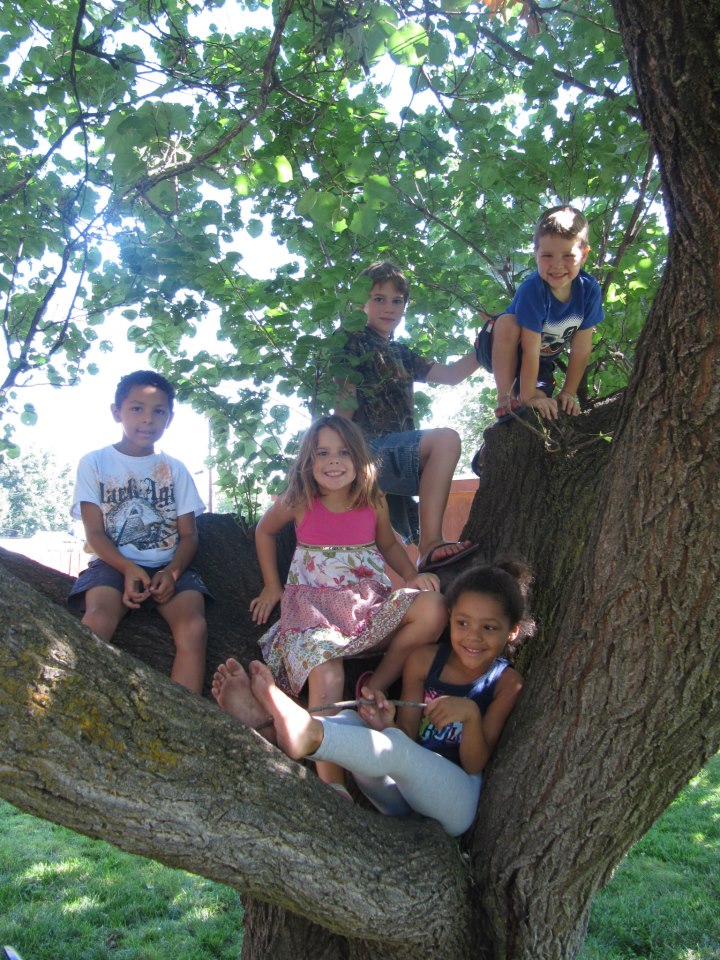
5 Reasons to Encourage Your Kid to Climb a Tree

There are lots of reasons to encourage kids to climb trees, but many of them can begin to seem unimportant when faced with the possibility of our beloved child falling out of one. Besides the fact that kids just love it, here are my top five reasons, backed by science, to support tree climbing despite its inherent risks.

1)   Being Outside Reduces Stress

Many studies over the past 20 years have shown that spending time in nature reduces cortisol levels, lowers blood pressure, increases resilience, and supports cognitive function. And climbing trees is a great way to help kids engage in an outside activity that is fun and challenging.

By encouraging this type of outdoor play and discovery, you’re putting your child into an environment that she has evolved to enjoy and appreciate.

2)   Connecting With Nature Is Good For Us and the Planet

Helping your child develop a personal relationship with nature has lots of benefits both to your child and to the environment. We humans are funny. When we care about something deeply, we’ll work incredibly hard to preserve it. So, by helping your child connect with nature, he is better off because of all of the benefits mentioned above and the environment is better off because your child will work hard to preserve the nature he loves so dearly.

Working with children showed me that when kids understand the direct implications of their impact on the environment, they’re motivated to reduce their carbon footprint and are easily able to change their habits to live in more harmony with nature. For instance, after learning about landfills, many children become recycling activists in their homes and schools. And after a trip to a local water treatment facility where we got to engage in hands on demonstrations, I saw a marked improvement in water conservation efforts and interest in overall watershed health.

3)   Climbing Trees is Good for Physical Development

As I began to write this article I spoke to a local 7 year-old boy. I asked him, “what’s your favorite thing about climbing trees?” and he responded immediately, “Climbing!” Kids love the challenge of deciding where to put their feet and hands, and the exhilaration of getting high up into a tree. There’s a physical challenge and a huge sense of accomplishment that goes along with tree climbing. I wish more kids were encouraged to climb trees.

Developing hand/eye coordination, muscle strength, and the ability to assess their own safety are all skills that benefit kids. And they’re the same skills that are often found lacking in today’s screen focused world.

4)   Taking Risks Helps Kids Learn Their Strengths and Limitations

By challenging themselves physically, kids learn their strengths and limitations quickly. They know when it’s easy, when it’s hard, and when they start to feel unsafe. It’s important for children to have the experience of pushing themselves and knowing when to step back and play it safe. You may be surprised to find that children have quite a strong sense of self-preservation when they’re allowed to exercise it.

Yes, this does require us to step back, stop saying, “be careful!” and allow our kids to explore without us hovering and monitoring their every move. I know it can be difficult, and if you really have a tough time with it, I’d recommend sending the kids out with their dad (or other masculine role model). I’ve found that in general dads are much better at letting kids take physical risks than moms are. As much as super child safe playground like those made by sites like https://www.softsurfaces.co.uk/ are good for the really little ones, there comes a time where the little ones need to grow up and learn to make mistakes and scrape their elbows and knees a little.

Even so, it’s still important to develop this ability for yourself, mom. Eventually we’re going to have teenagers on our hands and if we don’t allow our kids to take calculated risks now, they won’t be prepared for the life and death decisions they’ll be required to make once drinking and driving enter into the picture.

5)   Spending Time in Nature Encourages Scientific Discovery

Are your kids curious about birds, bees, squirrels, and raccoons? Spending time outside climbing trees is a wonderful way to encourage scientific interests. Maybe they’ll discover a next and get to watch baby birds being fed by their parents. Or perhaps they’ll discover a new species of beetle, never before catalogued.

By encouraging kids to climb trees, you’re really encouraging them to explore the natural world in all it’s glory. How does a plant grow? Where does a tree get its nutrients? What does decomposition look like? And what happens if a bird’s nest is disturbed?

Children are natural scientists and will create experiments, hypotheses, and conclusions about everything in life. Why not encourage them to conduct some of their research in the canopy?

So, let’s all go out and climb a tree! And let’s make sure our kids get the opportunity to spend time outdoors, climbing trees, playing, making up songs and stories, coming up with wild theories, and just forging a relationship with this wonderful, wild, beautiful world we live in.

Have a great week, Shelly

7 Secrets to Getting Kids to Clean Up Joyfully

Getting kids to clean up after themselves can be quite a battle. They’re really good at making messes, but when we ask them to clean up, they look at us like we’ve just spoken Swahili. Trust me, they’re not trying to be annoying. They really are confused about how to go about it and they definitely don’t like to be told what to do or forced to do something that’s no fun.

So how can you help your child learn to pick up her toys or put his clothes in the hamper? I’ve got 7 secrets to getting kids to clean up that will completely change the dynamics and turn clean up into a fun time to be had by all.

But there is a catch. Secret #1 was one of the most challenging transformations I’ve ever experienced. You’re ahead of the game if this one is easy for you…

1)  Clean up joyfully yourself

Enjoying cleaning tasks has not been easy for me, but when I realized that I was grumbling every time I had to vacuum, hated to sweep, and despised dusting, I knew that something needed to change.

First of all, I was making myself miserable over tasks that would need to be done and revisited every week for the rest of my life. And secondly, how could I expect my child to clean up joyfully if I couldn’t do that myself?

So, I read, “Peace is Every Step” by Thich Nhat Hanh and I decided to see cleaning tasks as a sort of daily meditation. I was determined to enjoy myself. And now I do genuinely enjoy cleaning. Some days are easier than others, but if you struggle with this, take it from me, you CAN change your mindset about cleaning. And once you do, getting your kids to join you will be much easier.

2)  Invite, don’t force

Nobody likes to be forced to do anything. And the sooner we recognize that children are exactly the same as adults in this regard, the sooner we’ll come up with more effective strategies to help kids want to clean up.

Imagine you’re over at a friends house and she hands you a towel and says, “You used the dishes, so now you have to dry the dishes.” Not very compelling is it?

But what if your friend said, “Would you please help me dry these dishes? I really like to get them put away right after the meal whenever possible. Do you mind?” Now you’re jumping up and pitching in, right? It pretty much always feels better to be asked and invited than to be told and forced. Want them to put their dirty clothes in the hamper? Try asking nicely! You’ll be shocked at how cooperative your kids can be when they’re invited to step up.

3)  A place for everything and everything in it’s placeMontessori shelves

I know, I know, it’s a total cliché. But the thing is, this really works well for kids. When a child knows exactly where to put the puzzle, it’s far more likely to make it back to the shelf.

In fact, for kids, I find that shelves work really well. Arranging their toys and activities so that they can be easily seen, accessed, and then put away can drastically increase the harmony in your home. Here’s a photo of our “work shelves” and bookshelf where Julia can find a wide variety of books and activities and put them away independently. And since we’ve been working on this skill since she could walk, it’s just second nature to her now to put things back when she’s finished with them.


IMG_4093


4)  Create a consistent routine with clearly defined steps

So how did we make it second nature? We were consistent. We have a rule that we only get out one or two things at a time and we clean those up before we choose new work. At two and a half, my daughter still needs some reminders, but it’s not a power struggle, I simply remind her that she has work out and tell her that I’ll hold on to the new activity while she cleans up the old one.

And since she knows exactly where her work belongs, she’s empowered to clean up quickly and get to the next item she’d like to explore.

But what if you haven’t established such a strict rule about how many items can be out at a time? Then you need to create a clear step by step guide for your child about exactly how to clean up a big mess.

For example, if you tell a child to “clean your room,” you get that blank stare. But if you say, “Here’s a basket, first pick up everything off the floor and either put it away or put it into this basket. Next find a place for each item in the basket. After that, make the bed. Don’t know how to make the bed? I’ll show you and we can do it together. Next, use this duster to clean the dust off of your dresser and nightstand. Last, use the carpet sweeper or vacuum to clean the floor. And then you’re done!”

After a few times of going through this routine with your child, he’ll remember the steps and won’t need as much help or supervision.

5)  Make it a game

Whenever I encounter my own resistance to cleaning, I try to make it more fun by putting on some music I enjoy. This works with kids too, you can have a cleaning dance party. But sometimes even a simple game like counting the items as you put them into a basket can be enough to encourage a young child to pitch in.

If simple counting isn’t working anymore, try a more complex game like, I Spy or wind up your little cleaning robot. The more creative you can be with this the better. Because children love to play, so when cleaning up is clearly the most fun to be had, they’ll definitely want to join you.

Another great strategt is to simply hand them an item and “forget” where it goes. Kids love to remind you of things you’ve forgotten and once the item is in their hands, it’s much easier for them to realize what to do next.

6)  Be a leader

If your child just doesn’t seem to want to help out, then it’s your job to model joyful cleaning, enjoy yourself immensely and continue to invite them to play with you in creative ways. This only works if you actually enjoy cleaning, but if you can get there, then you can get the ball rolling, sit back and watch the magic happen.

Afterward, be sure to admire your work with your kids. “Wow, the living room looks so tidy! Thank you so much for all your hard work.”

And if they missed a spot when they were dusting, don’t get overly critical, that will just diminish their enthusiasm the next time. You can point out ways to improve if you’re feeling happy and enjoying yourself, but if you’re feeling even slightly annoyed by your child’s inability to be precise during cleaning tasks, keep your mouth shut and fix the problem yourself when they’re out of the room.

Remember, the most important part is that they enjoy themselves and that they’re willing to help out.

7)  Provide them with tools that fit their bodies

Kids love to be just like adults and when we offer them cleaning tools that fit their small bodies, they rejoice in their ability to contribute to the household. A small broom, dustpan, mop, and duster are a good place to start. Access to rags, towels, a trashcan they can use, and a demonstration of how to do each task (as well as clear boundaries for how we don’t use these items) can invite even the most hesitant beginner cleaner to jump in and give it a try.

IMG_5562

Good luck and I can’t wait to hear how it goes!

Please leave me a comment below.

And have a wonderful day, Shelly

I Trust You

I’ve been working on my new eCourse that will be available this spring and so I’ve been thinking a lot about my parenting values, my priorities, and the ultimate messages I want my daughter to receive both verbally and non-verbally through my parenting.

Of course I want her to know she’s loved and cherished and that she can do anything she puts her mind to. I want her to know she’s valuable and capable and that her opinion matters. And as I pondered these things there was one message that kept showing up.

I trust you.

I want my child to know that not only is she wise and capable, but that I actually recognize that she knows what she’s doing. Yes, she’s just two and a half years old, and I want her to know that I trust her to make wise decisions and to take care of herself, and that I support her in taking appropriate risks and reaping their rewards. I want her to know that it’s OK if she falls on her face, we all do that sometimes, and we learn and grow as a result.

I want her to trust herself.

So the other day when she was sorting the silverware, a task she joyfully takes on almost every time I ask, I cringed when she kept asking me to confirm whether the spoon was large or small or whether the fork was in the right spot. “I trust you.” I responded. “You can decide if it’s large or small. Just put it where YOU think it should go.” She happily resumed her task, finished up and went into the other room to do something else.

But later, I worried about her need for reassurance and her fear of making a mistake. I wondered if she’s getting too much feedback from adults about how “right” or “wrong” she is. I fretted that perhaps because I’ve taught her the difference between a sphere and an ellipsoid, I may have inadvertently taken away her ability to discover those things for herself.

Later, after all the worry had dissipated, I just knew on a deeper level how dedicated I am to trusting my child and how committed I am to nurturing self-trust in her. I remembered all the times I’ve refused to offer her an evaluation and asked her to tell me what she thinks instead. I recalled a few times when she’s asked me a question and I’ve simply responded, “You know.”

I remembered a time at the playground when she refused to climb up, worried she might fall. And then a subsequent trip when she tried to climb up and did fall (even though I was spotting her). She cried, got back up and tried again, finally succeeding. I remembered the look on her face. It looked like the success was even sweeter after her previous failure.

I know that’s often the case for me. Overcoming fear and putting in effort gives me a greater sense of purpose. And maybe that’s what they’re meant to do. It’s the things I’m not willing to try, because I’m afraid of failure that most plague me. It’s the times I notice that I’m playing it safe that disappoint me. Because I think we’re all bound for greatness, except when we get in our own way or we’re too afraid to step up.

So I want my daughter to trust her instincts and go for what she wants, recognizing a potential failure as just another stepping-stone to success. Because after all, as long as we persevere, that’s really all failures ever are.

And when she has a question, I want her to look within and know that she’ll always find what she needs there. Sure, she can look something up or ask a teacher. But ultimately, I want her to know that HER truth is what matters most. I want her to know that no matter what others might say, she can trust her inner knowing.

In fact, I want that for everyone! So this week, let’s all trust ourselves more and let’s remind our children that they’re trustworthy. Let’s also take a look at our words and our actions to make sure that we’re sending the message loud and clear that we trust our children. And if there are things that you’re doing that seem to fly in the face of that message, look within and decide for yourself whether you still need to do those things. Maybe there’s a way that you can trust and let go even more than you are already. Or maybe not. Either way, I trust you.

Have a wonderful week, Shelly