
The Secret to Improving Your Child’s Attention Span

The way to help children improve their attention span is counter-intuitive. You might think that giving children tasks that require their continued attention would help. Or maybe challenging them to accomplish long and complex sequences will help memory and cognition, improving attention span. But the current research is showing something counter to what we might think.

In fact, research shows that allowing kids to have unstructured playtime can actually improve their ability to focus on a task. In the book “Nurture Shock” by Po Bronson I learned about a kindergarten program which encourages children to choose a character to play in an imaginary play scenario that lasts for several hours. Researchers found that the children who were able to remain in character did better on later academic tests than children who were taught their letters and numbers instead of engaging in imaginary play.

The real take away here is that imaginary play and unstructured playtime are tools that children use to learn real life skills that will benefit them forever. It might seem like “child’s play” to us, but to them, this type of play involves acting out potential scenarios, doing scientific experiments, and using critical thinking skills.

So what’s the secret to improving your child’s attention span?

Offering them big chunks of unstructured time to explore their own interests and engage in imaginary play.

Our daughter Julia wakes up at about 6:30am every day of the week and lately I’ve been helping her get to the bathroom and then climbing back into bed with my husband on the weekends. For several weekends in a row Julia has happily played by herself and allowed us to sleep in.

One morning she found the box of stickers and this is what she did:

The Secret to Improving Your Child's Attention Span

DSCN2130


I was impressed and here’s why. Not only did she use her fine motor skills to get each of the tiny stickers off of the sticker paper and on to her robe independently. She focused on this task for well over an hour without interruption. She put over a hundred stickers on her robe one by one. And she’s not yet three years old. I think we’re on our way to a very well developed attention span!

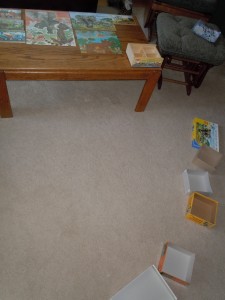
The following weekend she impressed me even more. Here’s what she did while we slept:

 

DSCN2141

DSCN2140

I love the way that she displayed her finished puzzles and the fact that she also lined the boxes up on the floor was interesting too. And just for the record, this is four 12 piece puzzles, two 24 piece puzzles and a 35 piece puzzle. And she didn’t wake us up for help even once.

So what does your child like to do when given uninterrupted alone time?

When Julia was smaller she would spend up to an hour looking at books in her bedroom. Sure there was a huge pile of books on the floor afterward, but she had entertained herself for an hour…with books! And we did work on putting them away together, so now, she happily puts away most anything she plays with.

Just a quick disclaimer here, safety is very important any time you’re allowing young children to have time alone without direct supervision.

Please make sure that the environment is free of hazards whenever you leave your child alone.

There’s one more secret to helping your child expand his attention span, remembering not to interrupt his work. Again, while it might just seem like meaningless play to us, children are engaged in the work of becoming the adults they hope to be. When we remember to respect their time and attention by refusing to interrupt when they’re engaged or by simply waiting for them to approach us, we’re helping them learn more independence and encouraging their natural urge to go deeply into the subject at hand.

If every time a child becomes engrossed in something he gets interrupted and asked to do something else instead, he’s not as likely to develop a deep and long lasting desire to dive in to his own interests. Instead, he may become overly attuned to the needs and desires of the people around him, believing that it’s more important to do what others require of us than it is to develop our own driving interests.

Oh, one more thing I forgot to mention, screen time does NOT count as independent play. In fact, excessive screen time has been linked to shorter attention spans and an inability to focus on real world tasks. So, if you’re in the habit of using the screen to get some time to yourself, I hope you’ll consider some other options.

So this week your challenge, if you choose to accept it, is to allow your kids to have some extra alone time, unstructured playtime, and wide swaths of time when they’re not interrupted. You might be as surprised by the results as I was when I woke up to that table full of puzzles.

Have a great week, Shelly
Your Work/My Work

In the Montessori classrooms I’ve worked in, there are usually twenty-four children between three and six years old and just two adults. Each child has free choice of hundreds of possible activities in the classroom, and in order to maintain peace and order, we HAVE to create some rules and boundaries.

One of the rules is that we respect one another’s work. We don’t touch each other’s work, we don’t walk on someone else’s work rug, and we don’t clean up after each other. Each person is responsible for getting out, completing, and putting away their own work.

Several months ago I taught a class to parents of Montessori students and when I described the reverence and care we have for our work, a mother perked up. “Oh!” she said, “So THAT’S why my son gets so upset when I clean up his toys, he’s always complaining that I’m not respecting his work, but I didn’t understand why until now!”

I believe strongly in Montessori philosophies and use many of them as guidelines in my home with my daughter and now that she’s approaching two years old I’m beginning to understand what a huge difference this has made in the peace and order of our home.

First, I do my best to respect her work and often ask her to clean up after herself, before offering any help. So when she leaves something out, she can reasonably expect it to be there when she gets back. This provides stability in her mind and encourages her sense of order. She knows where she can find her things and she knows that there is no magical clean up fairy.

As an aside, I actually did think that something like a clean-up fairy existed when I was a young child. I had no concept of my preschool teachers staying after school to clean up, or of my mom and dad picking up after I was in bed. I just thought things magically reappeared in their original locations!

Of course, I’m happy to help my daughter clean up if she needs support, but I don’t make a habit of going around behind her and cleaning up after her.  As a result, I overheard her with her books yesterday. She was looking at the pages and talking about the content of the book and when she got to the end of the book she said, “Back” and put the book back on the shelf!

But here’s the real kicker. I also ask her to respect MY work. That means that she understands that my work is important and I’m committed to its completion. So when my daughter asks me to play with her I will often respond with, “Sure! I would love to play farm with you, but I’d like to finish my dishes work first, so you can go get started without me, or you can watch me finish my work, and then I’ll join you!”

One of the things I love about this is that she’s learning that life is filled with “work” that people enjoy and want to complete before moving on to new tasks. This promotes the concept of follow through while it also helps her to delay gratification while she waits for me to join her in her chosen activity.

I know without a shadow of a doubt that my daughter understands that her wellbeing is my top priority. And, I also want her to know that my own wellbeing is hugely important to me as well. The order of my environment helps me to feel peaceful and relaxed so that when I do sit down to play with her I can completely focus on her, rather than constantly thinking about my enormous to do list and only giving her my partial attention.

I’m sure I’ll write another post about organization and it’s psychological impact on us, but for now I’ll just say, it’s OK to let your child know that you have work to do when you’re at home. If we model respect for their work, they’re bound to learn to respect ours too. And when we honor and respect one another’s work, peace and love have plenty of room to thrive.

So, how do you balance playtime with work time at your house? I would love to learn some of your secrets to success in this area! Please share a comment below.

And have a fantastic week, Shelly

A new take on discipline

What do you think of when you hear the word “discipline”?  When most people think about parenting and discipline they probably think of punitive discipline like time out, yelling, spanking, or taking away privileges.

I don’t want my daughter to be afraid of me or of the punishment I might hand down.  So I’ve chosen the most peaceful parenting I can possibly muster.  But if punitive discipline is out, does that mean I’m a total softie and my kids walk all over me?  Definitely not.

In fact, setting clear and consistent boundaries is one of the best ways to help your child feel secure.  In the Montessori schools in which I worked, we practiced a logical or natural consequences approach to setting boundaries with kids.  And it really worked!  Children understood why we did things a certain way and they were usually happy to cooperate.

Somehow setting boundaries was easier when it was my job to be completely respectful of the child.  Now that I think about it, it was much easier not to swear when I was a preschool teacher and my job was on the line.   But now that I’m a parent, I slip up sometimes.  It’s a much different challenge to be respectful of a child 24 hours a day than it is for six or eight hours a day five times a week.

Today I’d like to explore a different kind of discipline, the kind of discipline that allows us to complete a difficult task or to master a new skill.  Lately I’ve been thinking that by developing interests and practicing one or several disciplines myself as well as encouraging my child to do the same, the need for any other kind of discipline could simply melt away.  Maybe I’m crazy and my daughter just hasn’t hit her “difficult” period yet, but this sure seems to be working for us so far.

By encouraging her to develop her own interests and explore them independently, my relationship with my daughter becomes more about facilitating and supporting her desires, rather than circumventing them or redirecting her.  Oh, trust me, there are plenty of opportunities to redirect her.  But the more I’m able to just go with her flow and allow her to explore what she’s interested in, the more confident she becomes and the more she enjoys learning.

We’re setting up a positive loop.  She seeks out something interesting and explores it, she enjoys what she learns and then she seeks out something new and interesting again.  And we’re also building our connection because she understands that I deeply care about her and want her to explore her interests and fulfill her purpose in life.  So really, she’s developing self-discipline!

That way, in the times when I do need to set a firm boundary for safety or for some other reason, she knows that I’m not just trying to punish her.  I’m actually making choices based on what will give her the most freedom she can safely have.

So what do you think?  Can we reduce the need for “discipline” by supporting our children to develop their interests and practice self-discipline?  I would love to hear your take on my idea.  Please leave me a comment!

And have a fantastic week, Shelly

Delay of gratification is a crucial skill

Photo by Suzette Hibble

Teaching your child to delay gratification can help him in all sorts of ways.  He will learn self-control and willpower.  He will also reduce his impulsivity and increase in academic performance.  But delaying gratification does not come easily and often won’t develop naturally, unless parents and caregivers help children learn this important skill.

Luckily, you can start to teach these skills at any age with simple games that don’t take much time.  Start by offering your child a toy you know she wants but at the last second pull it back saying, “Ut oh, wait just a moment.  Wait…wait…great job waiting!” and then hand your child the toy.  At first just ask your infant or toddler to wait a few seconds.  Then as your child becomes better and better at waiting for the object of her desire, begin to lengthen the time required.

This works best if you’re both in a good mood and you’re playful in your removal of the object.  Children always learn best when they’re enjoying life.  But if your child reacts negatively to your attempts to play a waiting game, just ignore any outburst, give the toy back after the allotted time and try again later.

It won’t do much good to tell your child when they didn’t wait well, but when they do, be sure to give him some positive feedback using effort and/or behavior based praise.  “Great waiting!”  “Good job!” And “Wow, I could see how much you wanted that, but you waited anyway!  Nice!” are all great ways to reinforce delay of gratification.

Do your best to stay away from character based praise though.   “Good boy!” or “You’re so smart!” can actually make some kids more self-conscious and fearful, rather than helping them feel good about their accomplishments.  For more information on effort based praise see my earlier article “The dangers of praise.”

Impulsivity is a defining characteristic of young children, so don’t expect too much too fast.  But if you play waiting games a few times a day, every day, you can expect your child’s capacity for waiting to grow over time.  And that’s good news, because in the short term, you’ll have a more patient and considerate child.

And in the long term, delay of gratification has been linked to better studying behaviors and might even be linked to reduced drug use in teens and young adults. If you caught my blog about a conscious relationship to money, you know that delay of gratification is also a great asset in terms of financial planning, saving, and living within your means.

Right now I’m wishing that I had learned much earlier to delay gratification, but we all have to start somewhere, and I’m a firm believer that it’s never too late to learn a new skill.  So, as I teach my daughter to wait, I’ll also be practicing delaying my own gratification and we’ll both enjoy the benefits of increased willpower and reduced impulsivity.

What have your experiences with impulsivity and self-control been?  I would love to know what you think about this topic.  Please leave me a comment!

Have a wonderful week, Shelly