Taking a Tantrum as a Compliment?

OK, I know it sounds strange, but when my daughter has a meltdown I really do take it as a compliment. Her tears and upset are so rare, partly because she’s just an easy-going person and partly because she trusts all her caretakers to listen to her and work to help her meet her needs. But there are times when she’s just too tired, or too hungry to stave off the tears and then she cries, throws herself down, throws whatever is within her reach, and pushes large objects around.

After we returned from a recent trip to visit my family, Julia was just a bit unglued and prone to crying and tantrums for a couple of days while she readjusted to being home. At first I was annoyed. I kept thinking, “Why is she acting like this? Why can’t she just listen? What can I do to get her to stop?” But every time I approached her with that attitude, the tantrums just increased in severity.

And then I remembered something I had learned years ago from Hand in Hand Parenting. When a child has a meltdown with me, it’s actually a compliment. It means that the child trusts me enough to be at her worst. It means that she doesn’t feel she has to act a certain way in order to be loved. She knows that she is unconditionally loved and so she can release her feelings safely!

After I remembered to take her tantrums as a compliment everything changed. I would breathe, relax and sit down on the floor near my daughter. Although I was prepared to listen to her feelings for as long as she needed, her crying and upset usually didn’t last very long. And it wasn’t as loud. She also stopped throwing and pushing things. Instead, she would often just come over to me for a hug or sit in my lap. “I hear you.” I would say. “You’re really upset about that and you’re wishing things were different, huh? Well, you can tell me all about it and I will sit here and listen to you.” Usually after a few words, some grunting or a few more minutes of crying, she was finished and ready to play happily again.

I am constantly surprised by how quickly children are able to switch gears from upset to joy (and back again). It’s really quite remarkable how completely they are able to let go into their current emotional state. I sometimes long for that freedom of emotional expression.

Now I’m not saying that your child will react in exactly the same way my daughter does. But I’m certain that my own ability to relax and enjoy her even as she is about to completely freak out helps her process her emotions more efficiently. She knows she has my attention and love, so she doesn’t need to escalate her efforts to be heard and understood.

Have you found this to be true at your house? Do tantrums decrease in frequency and severity when you’re able to calmly listen and reflect your child’s feelings back? Or is there something that keeps you from being able to do that? I would love to hear about your successes and challenges with handling tantrums. Please tell me all about it!

And have a fantastic week, Shelly
Tender Transitions

In life there are big transitions, little transitions and everything in between but there’s one thing you can be sure of, there WILL be transitions. Shifting from one thing to the next is challenging for children and adults alike, especially when the transition wasn’t their idea.

I’m in the midst of a big transition right now. We are so fortunate to have my husband’s parents living here full time and being active participants in caring for our daughter. And if you’re thinking we’re the luckiest people ever, then get ready for more, because we ALSO have my mom and step dad here for six months of the year! It is SO incredibly helpful to have so many people adoring and caring for Julia, but there’s a dark side to this beautiful gift too. My parents leave and are gone for six months of the year.

My mom and Jim just left to head back to Illinois a couple of weeks ago and the transition has been really challenging for me. I miss them. Julia misses them. And I’ve had to completely rearrange my working schedule to accommodate the change. It totally sucks.

But is also great. I’m getting more time with my daughter, which is awesome. And I’m forced to really prioritize my work and only engage in the activities that really matter to me. But it’s also still really hard.

Transitions are especially difficult for me, maybe because I’ve had so many of them in my life. After my parents divorced when I was 5, they shared custody and, without going into too many details, for much of my life I split my time between my mom’s house and my dad’s. It was great to be able to have real relationships with everyone involved, but it was hard on me too.

Every two weeks I packed up my bags and moved to a different house with different people, different rules, different expectations, and even different foods. And, everybody was always so excited to see me that I don’t think I really took the time to mourn the loss of the other family before I was thrust into the next one. Luckily for my parents, I didn’t act out. Instead, I stuffed my emotions and tried to pretend that everything was OK. But sometimes it wasn’t.

So that’s what I mean when I say “big transitions.” Learning to let go of my family for two weeks or six months, mourning the loss of a home, job, or loved one, moving away from friends. But there are also all sorts of little transitions and these can be challenging too.

So if you’re wondering why your young child throws a tantrum at the front door and refuses to put on his coat and shoes, consider the possibility that transitions are just hard. Saying goodbye to his toys, home, book, or plan for the day can be really challenging for a kid.

Here’s what I’d recommend if you’re having difficulty with transitions at your house. Be tender about them. Remember that they can be hard. And most of all, TALK ABOUT TRANSITIONS BEFORE, DURING AND AFTER THEY HAPPEN. I wish I had been better about this with my parents leaving town. I’m doing OK talking about it now, but I wish we had thought more and talked more about how our lives were about to change, before it happened. I’m a planner, and when transitions catch me off guard, I find them MUCH more challenging to deal with.

Perhaps your little one feels the same way. It might feel silly to talk to your infant or young child about a big or small transition, but in my experience, a short, matter-of-fact discussion about what’s about to happen can mean the difference between a screaming, kicking freaked out kid and a calm, relaxed, collected child.

When it comes to some of life’s big transitions like the loss of a pet or the death of a loved one, we don’t always get the opportunity to talk about things ahead of time. In that case, be sure to discuss things as they arise so that you and your child can integrate what’s happening as much as possible.

When you’re about to head out the door to go to the store, and you actually CAN give a child a heads up, so please do. They will appreciate it. And you might find that this one simple act of kindness and respect toward your children reaps you more benefits than you could have imagined. I would love to hear all about it. Please share your story with us!

And may your transitions be easy and tender this week, Shelly

Video: Reduce Tantrums With This Tip

Here’s one last video with content from my new eBook “Cracking the Kid Code: Discovering the secret to having a happy child, family and home.”  This time I wanted to share one of the most important pieces of information that parents often forget.  That children really do want to do it themselves!

What are your children excited about doing all by themselves right now?  Tell me now!

It’s OK to cry

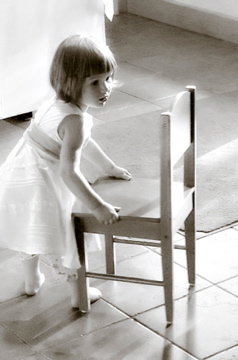
“Dagny III” by Christee Cook

Have you ever noticed that when a child cries, often the first things out of our mouths are things like, “You’re OK” (minimizing their experience) or “Oh no! Don’t cry!” (asking them to deny their experience) or even, “What’s wrong?!” (asking them to think about and describe the upsetting event).

None of these acknowledge the child’s feelings or provide an open, loving environment in which a child can fully feel and express his emotions. I know, it’s an unconscious reaction we have all had at one time or another, but this week it’s time to shine the light of awareness on the way we speak to an upset child.

So, if we could choose exactly how to respond, how would we? We might say something like, “I see you’re upset, do you need a hug?” or “Wow, that was really scary, wasn’t it?” or one of my personal favorites, “It’s OK to cry.”  We might even choose just to sit with them and witness their emotional expression.

I especially wish more boys were told that it’s OK to cry, because after all, it really is OK! In fact, people who are in touch with and at peace with their emotions will fare better in life than those who deny or stuff their emotions.

Studies have shown that holding in emotions like anger, frustration, and resentment, can have long term negative effects on heart health. So, by encouraging kids to acknowledge and express their emotions, we’re helping to ensure a long and healthy life for them both physically and emotionally.

On the other hand, it can be uncomfortable for us to listen to a child who’s crying, wailing, or raging. But I think that’s because we all have our own withheld emotions that we’re fighting to keep hidden. If we felt free to express our emotions as they came up in the moment, we might not feel quite so uncomfortable when our children cry or scream. I’ve certainly found this to be the case in my own life.

For a long time I was uncomfortable with sadness. I didn’t acknowledge my own, and I definitely didn’t want to be around others who were upset. I did everything I could to soothe, redirect, or even ignore any sadness that I came into contact with. And then something shifted for me.

I was hanging out with some close friends of mine, and one of our friends just started to cry. I was a little bit uncomfortable, but I was more fascinated with how unashamed she seemed about her sadness. Pretty soon the crying turned into wailing and I realized that except in movies, I had never actually seen anyone wail! I was moved to tears myself and I came away from the experience realizing that expressing sadness could be deeply moving and beautiful.

I’ll never forget how my friend looked afterward. She was so open, beautiful, free, and light. I had never seen her look so gorgeous and so at peace. So I decided that sadness wasn’t actually something to be avoided at all costs. I realized that in fact, crying could be a relief and a release. And I began to allow my own tears to flow more freely.

I like to imagine my emotions like a big pipeline. When I was holding them in, my pipe was clogged and just a trickle of emotions was getting through. But after practicing to express and celebrate my emotions as they arise, I’ve opened up my pipeline and now all my emotions can travel through it with ease. Now I feel everything with more intensity and I love it!

I am able to cry in an instant, if I’m moved to, but I can also laugh more authentically and have even experienced tears of joy (which I used to think was a bunch of hooey).

Wouldn’t it be amazing if our children never had to go through the process of suppressing their emotions and then rediscovering them? What if they could feel and express their feelings without interruption for their entire lives?  I sure hope for that for my daughter.

So this week, pay special attention to how you automatically respond when a child is upset. Then make a conscious choice about how you WANT to respond and practice it. I would love to hear your thoughts and experiences, so please leave me a comment below.

Have a wonderful week, Shelly

P.S. If this topic is dear to your heart, check out my audio program Perspectives on Feelings for a more in depth discussion of holding space for big emotions.

Preventing toddler tantrums

When a toddler wants something, it’s crystal clear.  They yell, scream, fuss, throw their bodies around, grab, and then when they get the object of their desire, it’s as if none of that just happened.  They’re instantly content, but you know it’s temporary.  Soon, they’ll want something else, and eventually it will be something that you can’t give them.

So what’s the best way to handle a toddler’s tantrums?  One of my favorite tools for helping to calm infants is “The Happiest Baby on the Block” DVD by Dr. Harvey Karp.  There’s a book by the same title as well.  And apparently Dr. Karp had lots of parents asking him about how to handle toddler tantrums too, so he wrote a companion book and created another DVD called “The Happiest Toddler on the Block.”  It’s great stuff.

But just in case you don’t have time to read the book and watch the DVD yourself, I’ll give you an overview of his tips and techniques to reduce the frequency, length, and intensity of tantrums.

The first concept he introduces is the idea that toddlers are like little cave-people.  I really like this idea because it helps us understand who we’re really dealing with.  Toddlers are opinionated and very clear about their desires, but their command of language is still quite limited, especially when they’re upset.  They do a lot of gesturing, grunting, and making noises to get their point across, just like a Neanderthal might have.   In general they’re uncivilized, and that’s part of their appeal.  They are not little adults, they’re beings all their own.

That’s why reasoning with toddlers rarely works well.  They don’t understand your long, complex sentences and three syllable words, at least not while they’re freaking out.  So, seeing your little one as a mini cave-man, can help you figure out why the next tip is so important.

Learning to speak “toddler-ese” is the best way to help your little one know that you understand what she’s going through.  And as I’ve said many times before, empathy is often the best way to handle most tantrums.  When children feel heard and understood, they relax and become more cooperative.  So how can we help toddlers feel heard and understood?  We have to learn to speak their language.

Dr. Karp says that the most important elements to “toddler-ese” are matching intensity, keeping our phrases short, and using lots of repetition.  Listen to your toddler when she’s trying to express a desire and you’re likely to see her pointing, grunting, “Uh, uh, uh!” and repeating what she wants “Up!  Up!  Up, Mama!”

So, let’s say you’re not able to pick your sweet toddler up because your arms are full of groceries.  But you’re feeling worried, because you can see a tantrum about to come on.  Rather than ignoring or reasoning, try saying something like, “Riley!  You want up, up up!  You want mama to pick you up, up up!”  Be sure to match your child’s level of intensity.  Then, watch your child as you empathize with her in her language.   You’re likely to see her relax and become fascinated with you.  At that point, you can explain the predicament, “Honey, I want to pick you up, but my arms are full of groceries, can you wait one minute please?”

There are lots of other great tips and tricks in Karp’s books and DVDs but these are the ones that jumped out the most and that I thought would be most helpful to share.  I hope you’ll have a wonderful week and as always, I would love to hear about your own experiences with these ideas.

Warm hugs, Shelly