Kids always have a positive intention

I know it sounds like an outrageous claim, but the truth is that kids always have a positive intention behind EVERY action.  Even when he’s smearing peanut butter all over your computer keyboard, or convincing his little sister to eat dog food he has a positive intention.  And when she’s cutting her hair, coloring on the walls with crayons, or purposely waking up the baby, even then, she has a positive intention.

Kids, just like the rest of us, are just trying to get their needs met.  They may not always have the most effective strategies for getting what they want, but they’re always doing their best and responding to the world around them.


When we can assume a positive intention and even try to discover what that intention might be, suddenly we can move from feeling angry and exasperated, “Why in the WORLD would she DO that?!” to a state of compassion and understanding.  “Oh, I see, she was needing some excitement and stimulation, so she woke up the baby to play with him.”

When we’re aware of the underlying needs behind our children’s seemingly bizarre behavior, we can start to empathize with them and teach them better strategies that will actually get them what they want.  But first we have to learn to breathe and take a moment BEFORE we react.

Right now, imagine the most frustrating thing your child has done in the past week or so.  Remember how you responded.  Now, consider, what might be the positive intention behind your child’s actions?  Imagine yourself in a similar situation in the future.  Is there a way you could have responded that would have created more connection and understanding between you and your child?

Let’s try the “Assume a positive intention” technique:

You see your child doing something that makes your heart race and your mind jump to all sorts of troubling conclusions.  You decide to implement assuming a positive intention behind all actions.  First you breathe, then you think, “What could the positive intention behind this action be?,” then you come up with some idea, you check in with your child, “Sweetie, were you really wanting to see what why I won’t let you have food near the computer?  Are you needing some more information and understanding about that?  Were you enjoying the feeling of the peanut butter on your hands?”

Your child feels heard, understood, and maybe a little bit confused about why you’re not screaming at the top of your lungs yet.  Now’s your chance to calmly let your child know how you feel about the strategy he’s chosen.  Be sure to use the words “I feel” and then an actual emotion.  “I feel worried when I see my computer caked with peanut butter, I’m not sure it will work any more and computers cost a lot of money, so now I might not have a computer any more.  I feel sad about that.”

And finally, assuming you’ve kept your cool, your child should be ready for some learning!  So now you get to share a new strategy for next time.  “What could you do next time instead of putting peanut butter on my computer?  Could you ask me about why I don’t allow food near it?  Could you ask me for a cracker to smear peanut butter on?  What do you think?”

I would love to hear your stories about the wild things your kids have done, how you’ve handled it, and what you think about the idea of assuming a positive intention as a way to practice understanding and compassion with children.  Please leave me a comment!  Hugs, Shelly

The joys and challenges of spending the holidays with family

Happy holidays everybody!  I hope you’re having a lovely time together as a family and I know that when we get extra time together with our immediate families and especially when we spend time with extended family, tensions can run high.  I’m sure you know what I’m talking about.

Almost inevitably when we celebrate with our families, there’s someone whose beliefs are different from our own, or there’s a sibling or parent who treats us in just the same way they treated us when we were five or who treats our children in ways we don’t enjoy.  The holidays can be a time of joy and celebration, and a time that warrants a lot of introspection, conflict resolution skills, and mediation between family members.

Although we all might intend to have a nice Christmas dinner or a beautiful Solstice celebration or (insert your holiday here), there are times when feelings get hurt, alcohol helps remove inhibitions, and we can suddenly find ourselves or other family members in the midst of conflict.  So what can we do when our lovely celebration is about to deteriorate into chaos?  Continue reading “The joys and challenges of spending the holidays with family”

The beautiful urge to bite and what to do about it

Young people are discovering their world and constantly coming up with strategies to meet their needs.  Sometimes these strategies cause pain and upset in others and are experienced as destructive.

The most common examples of destructive behaviors in 1-5 year olds are hitting and biting.  Older kids often use their words to destructive means.  And teenagers do all sorts of behaviors that we adults see as destructive and dangerous.  But what if we were able to see the beautiful needs behind these behaviors and redirect kids in a way that helps everyone experience more peace and joy?

Redirection is a wonderful tool that will help you help your child.  When we can offer another option that’s less destructive, kids will often gladly take our suggestions.  After all, they’re usually not trying to hurt others, they’re just trying to meet their own needs.

When I was a nanny one of my charges began to bite his brother, other kids at the park, and even me and his mom.  Ouch!  I’ve heard all sorts of stories about what to do with a kid who’s biting from ignore it to bite him back.  But I knew that biting a baby or young child was not going to work for me.  I would certainly feel sad and guilty if I were to retaliate against such a young child (or any child for that matter).  And ignoring a destructive behavior can just help it grow and become ingrained.  So we tried another strategy­–redirection.

First, we began to watch him closely and after some observation we discovered that there was a look in his eye just before he tried to bite.  Next, we tried to understand what need he was trying to meet and we determined that when he needed space, he bit.  He would usually try to bite in a situation when he was in a confined space, had another child touching his body, or when another child took the toy he was playing with.

So for starters, we tried to anticipate any situations that were likely to result in his desire to bite and diffuse the situation before he even got the idea.  But we weren’t perfect, and sometimes he still got the look in his eye, opened his mouth, and tried to bite someone.  We acted swiftly, removed him from the person he was about to bite and REDIRECTED his aggression toward his blanket.  “It’s not OK to bite people, but if you need to bite, you can bite your blanket.”  After a few weeks, “John” began to go and get his blanket whenever he had the urge to bite!

If you think about it, the urge to bite has helped us out immensely when it comes to eating.  If we didn’t have a need to bite, we might never have discovered some of the delicious foods we eat today.  So, ultimately, biting is a beautiful need, it just sometimes gets generalized to people and things that aren’t safe for biting.

A friend recently shared that her young son had begun to bite his bed frame and was damaging his bed and eating wood!  She decided to redirect her son’s behavior so they found a heavy plastic fork and deemed it his “special biting fork”.  Now when he has the urge to bite he asks his mom for his special biting fork, then he gnaws on it for a few minutes and hands it back to mom.  I was talking to his mom on the phone the other day when he said, “Mom, can I please have my special biting fork?” and I found myself grinning from ear to ear.  I’m so happy that he gets to bite something that’s safe for him!

There are lots of other behaviors that can be redirected into more constructive choices for kids.  What have you tried?  Which redirections have worked for you?  I’d love to hear about your experiences with redirection.  Thanks for being here!

Simple changes at home can help kids feel comfortable and capable

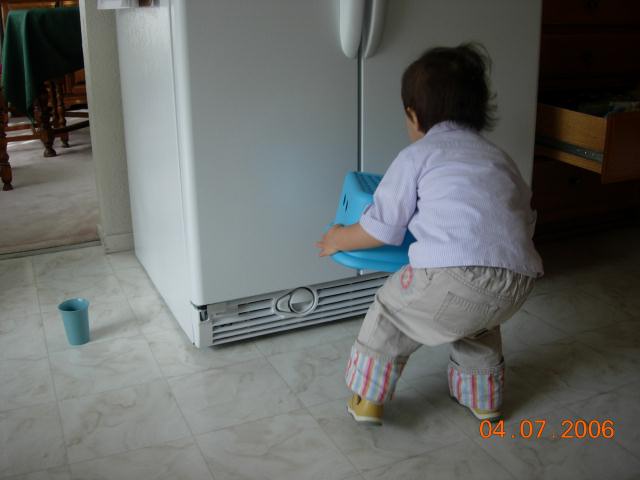
DSCN0589When I worked in Montessori schools I was consistently amazed at how happy, engaged, and capable the kids in my class were.  This got me thinking, “If kids can be this self-sufficient and joyful in a classroom, then why not at home too?!”  I’ve noticed that young people often feel frustration at living in a an adult-centered world. I can remember feeling irritated about not being able to see over the counter, or out the car window (before the advent of booster seats).

Although young people make up a significant portion of our population, they don’t pay the bills, so they usually aren’t catered to in the way that adults are. Most furniture is not built to accommodate them. There are often no stools provided where needed, especially in public.

Even going to the bathroom in a public restroom and washing one’s hands can be quite difficult for a person with a small body. Doors are large and too heavy; tools are too big for their hands… I think you get the idea.DSCN0590

So if there’s a place where a child can find solace from these frustrations, I hope it will be their home.  I would be inspired to live in a world where a child’s home is a place where she can reach the counter top, make herself a snack, and take care of her personal hygiene easily. I’ve found that when young people are given the tools they need to be able to have these freedoms, they are more peaceful and often much more responsible. Trusting young people to care for themselves and giving them the necessary tools to do so, fosters a sense of self-care, self approval and healthy pride.


DSCN0591Consider the daily activities of the child in your home. What does he do and what would make his tasks easy to accomplish without asking for adult intervention? Is there a convenient place for him to hang his coat when he enters his home? (Tip: for very young children, a low hook is the easiest place for a jacket) Can he reach the sink easily for hand washing? Are there art activities, games, puzzles and books that are within easy reach?  Does your child have comfortable furniture that fits his body?

Ask your kids what changes they’d like to see in their home environment. And consider what changes would ultimately make things easier for all family members. For instance, if children’s dishes are where they can reach them and they know where the carrot sticks are and that carrots are an acceptable snack, they can simply let you know what they’re doing (or not, depending on your house rules),  without needing you to stop what you’re doing and fix them a snack. Also, consider asking older children to help younger children. Requesting the help of your older child (without demanding) can foster teamwork and interdependence between siblings.

Ultimately, your children want to feel capable and supported in their home, and although that might require some rearranging and consideration, it’s not much work to provide possibilities for autonomy and it’s almost no work for you once they know how to care for themselves! So, take a look around your home this week to be sure that everyone in your family has access to:

Water (for drinking and washing)DSCN0600
Food
Clean clothing
Warm clothing
Books/toys/art supplies
Towels and cleaning supplies
Art at eye level
Full-length mirror in bedroom
Things to nurture like a plant or a pet

So, I hope you’ll use this list as a guide, and talk with your child about what sort of changes would make life at home easier, more fun, and more equitable.  When we honor children by taking the time and making the effort to accommodate their needs, they feel treasured in ways they can’t even express.  But I’m sure you’ll notice the difference!  I’d love to hear about how simple changes around the house have made a difference in your kids lives.  Please leave us a comment below.

The art of conscious ignoring

Photo by Juliet Cook

I’ve talked a lot here about giving kids attention but I haven’t yet shared about the art of  conscious ignoring.  Well, I really do think there’s a time and place for everything and ignoring your kids can sometimes be the best choice in a given moment.

For instance, if you’re about to escalate a conflict, yell at them, curse, or otherwise treat them in ways you don’t want to, try ignoring instead.  By ignoring their behavior, you’re sending the message, I don’t like what you’re doing and you won’t get my attention by behaving in that way.

Often whether they know it or not, what kids are most wanting when they act in the most extreme ways, is your attention.  So, by removing your attention in the moments when you know you can’t respond responsibly, or in the times when you feel that giving them negative attention will just fuel the fire, you can actually create more calm and promote better behavior from your kids.

Obviously this is not a strategy to use very often, and if your tendency is to withhold your attention, watch out.  What I’m talking about here is making a conscious choice to ignore, as the best choice among others in your repertoire; not getting in the habit of automatically taking away your attention to coerce kids to behave in ways we want them to.   My point is that we all have times when if we had just been able to turn away rather than engage in an old unhealthy pattern, things would have turned out better. Continue reading “The art of conscious ignoring”