
Simple changes at home can help kids feel comfortable and capable

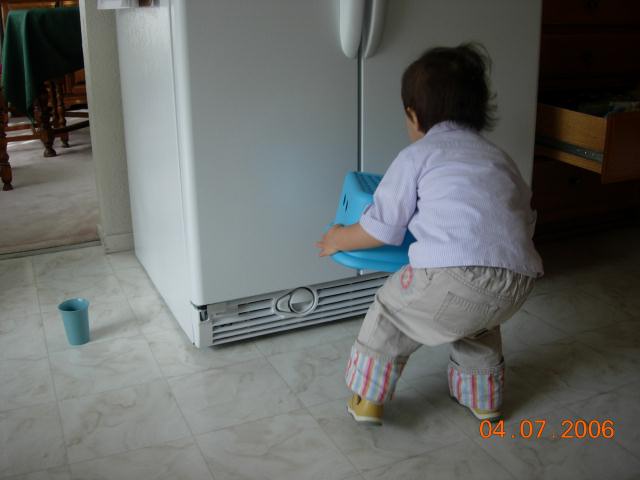
DSCN0589When I worked in Montessori schools I was consistently amazed at how happy, engaged, and capable the kids in my class were.  This got me thinking, “If kids can be this self-sufficient and joyful in a classroom, then why not at home too?!”  I’ve noticed that young people often feel frustration at living in a an adult-centered world. I can remember feeling irritated about not being able to see over the counter, or out the car window (before the advent of booster seats).

Although young people make up a significant portion of our population, they don’t pay the bills, so they usually aren’t catered to in the way that adults are. Most furniture is not built to accommodate them. There are often no stools provided where needed, especially in public.

Even going to the bathroom in a public restroom and washing one’s hands can be quite difficult for a person with a small body. Doors are large and too heavy; tools are too big for their hands… I think you get the idea.DSCN0590

So if there’s a place where a child can find solace from these frustrations, I hope it will be their home.  I would be inspired to live in a world where a child’s home is a place where she can reach the counter top, make herself a snack, and take care of her personal hygiene easily. I’ve found that when young people are given the tools they need to be able to have these freedoms, they are more peaceful and often much more responsible. Trusting young people to care for themselves and giving them the necessary tools to do so, fosters a sense of self-care, self approval and healthy pride.


DSCN0591Consider the daily activities of the child in your home. What does he do and what would make his tasks easy to accomplish without asking for adult intervention? Is there a convenient place for him to hang his coat when he enters his home? (Tip: for very young children, a low hook is the easiest place for a jacket) Can he reach the sink easily for hand washing? Are there art activities, games, puzzles and books that are within easy reach?  Does your child have comfortable furniture that fits his body?

Ask your kids what changes they’d like to see in their home environment. And consider what changes would ultimately make things easier for all family members. For instance, if children’s dishes are where they can reach them and they know where the carrot sticks are and that carrots are an acceptable snack, they can simply let you know what they’re doing (or not, depending on your house rules),  without needing you to stop what you’re doing and fix them a snack. Also, consider asking older children to help younger children. Requesting the help of your older child (without demanding) can foster teamwork and interdependence between siblings.

Ultimately, your children want to feel capable and supported in their home, and although that might require some rearranging and consideration, it’s not much work to provide possibilities for autonomy and it’s almost no work for you once they know how to care for themselves! So, take a look around your home this week to be sure that everyone in your family has access to:

Water (for drinking and washing)DSCN0600
Food
Clean clothing
Warm clothing
Books/toys/art supplies
Towels and cleaning supplies
Art at eye level
Full-length mirror in bedroom
Things to nurture like a plant or a pet

So, I hope you’ll use this list as a guide, and talk with your child about what sort of changes would make life at home easier, more fun, and more equitable.  When we honor children by taking the time and making the effort to accommodate their needs, they feel treasured in ways they can’t even express.  But I’m sure you’ll notice the difference!  I’d love to hear about how simple changes around the house have made a difference in your kids lives.  Please leave us a comment below.

Free audio Tele-seminar with Shelly and Shera

Did you hear about my tele-seminar with Shera Davis on September
2nd?  It was so much fun and we got to answer some specific
questions from parents like you about how to handle tantrums
lovingly.  Shera’s insights and suggestions were fantastic!

Because I appreciate you and enjoy having you as a member of Awake
Parent Perspectives I’d like to offer you free access to the
recording of the tele-seminar.  Take some time out today to listen
and discover:

-The two biggest unmet needs your child desperately starves for
-A lesson Mary Poppins would be proud of — and how you can use it
-How you can prevent melt-downs before they happen. (It takes only
five minutes a day
-Three strategies for handling the non-stop “why” questions – get
the relief you need
-The most powerful way of showing your child you love them
unconditionally – an invaluable bonding experience
-What’s really ticking you off in heated situations? Use the
H.A.L.T. formula to find out.

Check out the recording of the tele-seminar here:
Listen here

To download a copy, right-click and choose ‘save as’:
Shera & Shelly Tele-seminar

And if you want even more in-depth information on these topics
including support materials that will help you integrate these new
tools into your life, check out the Perspectives on Feelings Audio
Program
.  It comes with a workbook, transcript, and an 11 week
email course that will walk you through the exercises and help you
relate to your child’s big feelings in a whole new way.

Thanks for being with us!  Warmly, Shelly

How to handle tantrums lovingly

Confused about how to deal with tantrums? I sure was. I couldn’t figure out why my students or charges would just flip out over seemingly trivial things like the color of their socks. There were times when I changed the color of a child’s cup so many times I had a huge pile of dishes by the end of lunch. Sometimes I felt like I was dealing with a crazy person.

I KNOW you’ve experienced this. One minute, things are fine and the next, your child is screaming, throwing herself on the floor and crying so hard she can hardly even catch her breath to tell you what happened. Then, when you finally discover what set her off, you’re left wondering how that could possibly matter enough to create such a huge reaction.

As a parent or caregiver experiencing a child’s tantrum, we can feel confused, powerless, and overwhelmed. I’ve often thought, “Oh no! What went wrong? And how can I get her to stop?”

But after experiencing more and more tantrums, I began to discover that getting kids to stop isn’t always the most connecting thing we can do. Not only that, but when kids freak out, it’s not necessarily a bad thing. Continue reading “How to handle tantrums lovingly”

How to be in charge and stay connected

As part of launching our Perspectives on Feelings audio program, Shelly and I asked for your questions related to feelings, so we could get a discussion going around the topic. You might have seen our video blogs the last few weeks.

I’m giving the camera a rest and going back to the old familiar keyboard this week. One of you asked, “My son’s a wiggler. Sometimes I need to use force to put him in diapers, into a car seat, or other places. What do you recommend?”

Here are some things to keep in mind:

As the parent, you are in charge. As much as we try to create opportunities for autonomy, ultimately, you need to get the family from Point A to Point B. Your child relies on knowing this, and even if they fight you, they get a sense of comfort from you knowing that you’re in charge—this is probably even part of why it seems they’re testing you—to find out if they’re really in a stable container.

There are many ways to be in charge.  What happens before, during and after you exert force to make something happen, makes all the difference in how your child experiences it, and how your connection is impacted.

Before:
If you can think of it and remember to do so, giving your child two or three heads-ups before something happens will help them shift internally to prepare for it, so it’s not as much of a surprise. For example, “In five minutes, we’re going to get in the car to go to Grandpa’s, and I’m going to need to put you in the carseat.”

If you encounter resistance when it’s time to make the transition, here’s one trick that even works with my especially willful child:

“Do you want to go now, or in two minutes?”
(They’ll probably answer “in two minutes!”)
“Okay, we agree–yay! I’ll be back in two minutes to collect you”

This gives them a measure of autonomy. Remember, when they fight you, it’s not you they’re fighting—they’re fighting for their sense of autonomy, and to test the boundaries. It’s through this back-and-forth that they develop a feeling for who they are, and a sense of self-confidence. The more you can weave contained opportunities for autonomy into your everyday activities, the more cooperation you’ll get, because your child will pick up on your respect of him, and respond accordingly.

Okay, but what about when they’re all out, full-on fighting you? And you need to get out the door? Here are some more ideas:

During:

Here’s how to make the most of a situation where you need to exercise your will over theirs:

1)      Give the heads-ups, as above.

2)      Say what you need, what exactly what you’re going to do, and offer one last out: “I really need to get out the door because…I’m going to give you until three to come with me, then I’m going to pick you up and take you.

3)      DO IT LOVINGLY!!!  This is the most important. I understand you might feel frustrated and powerless—I often do! And we’ll address expressing your own big feelings to your kids soon. There are times when you might need to sound authoritative to get a response—just try to remember the love if you can.

4)       As you begin to interact, however, pay attention to your tone. There’s a huge difference between, Get in this car or I’ll haul you away with a crane! And Okay, sweetie, here we go, up, up and away, my little airplane! With the latter, you might even get a giggle.

After

Once you’ve decided on a course of action and enforced it, your child may have a lot of feelings: frustration, fear, anger, relief. If you can at least acknowledge and reflect back those feelings, you’ll add to the trust and connection between you.

Here’s the secret: You can listen to your child’s feelings without giving in. Conversely, you can be in charge and set the limits you feel comfortable setting, and still lovingly allow your child to have their feelings about how things are.


Let us know how it goes!
Warmly,


Jill

Listen to your body

I’ve been wanting to be a mom for as long as I can remember. And I’ve prepared in all sorts of ways for my future children. After I graduated from college I realized that I wasn’t very patient, so I went to work at a preschool (yeah, I love a challenge). I knew that 3 year olds were difficult for me to be with, so I headed straight for the 3-4yo classroom to practice patience and learn how little people learn best. More recently I was a nanny for several amazing boys, practicing newborn care, learning to handle sibling rivalry, and generally practicing for motherhood.

But now that the time for motherhood is getting closer, I’m getting a whole new education. I’m learning about my body. I had no idea how much I didn’t know about my own body, its cycles, its hormones, its fluids. I’m realizing now that my body is constantly speaking to me about all sorts of things all the time.

I’ve started reading “Taking Charge of Your Fertility” by Toni Weschler and this book is like the bible of the female body. Did you know that just by charting your waking basal body temperature you can know almost immediately if you’re pregnant? I mean, WELL before you miss a period. You can also know when you’ve ovulated, when you’re experiencing menopause, and how long your actual cycle is (instead of assuming it’s the average 28 days).

All this knowledge can really inform and educate us, and I can’t believe that it took me so long to discover it! It leaves me wondering, what else have I been missing out on? I’ve been so focused on child development, conscious parenting, and personal growth, that I’ve forgotten about my own body!

Sound familiar? Are you so wrapped up in the lives of your kids, your husband, and your best friend that you’ve forgotten something as simple as connecting with yourself and your own body? Well, I’m here to remind you to take a moment and check in. Maybe that looks like recording your basal body temperature and the position of your cervix, or maybe it’s just getting back to that yoga class. It could be as simple as taking the time to prepare yourself a healthy and delicious snack, instead of eating the leftover cookies in the bottom of the diaper bag.

I’m better about tuning in to my body than I used to be. When I was a preschool teacher I was constantly fighting off a cold or flu of some kind. I felt pressured to go to work even when I wasn’t feeling well because the administrators always had a hard time finding a sub. So, I would push myself and push myself until I collapsed. I was usually out for several days at that point.

Now that I’m self-employed, I’ve learned to listen to my body more. When I feel my immune system kicking in trying to fight something off, I take a break, I rest and pretty soon I feel better. I haven’t had a full-blown cold or flu in several years now. And I owe it all to listening to my body.

The same goes for injuries. I used to injure my shoulder or back or neck at least once a month because I thought I could lift more than I could safely, or I thought I “should” be able to carry the groceries all in one load. I was in too much of a hurry to listen. But then I’d pay the price. I’d be laid up for days, unable to use my arm or popping pain pills. Now I check in with my body every time I’m about to lift something heavy. “Is this OK?” I’ll ask. Don’t laugh, I actually have this conversation inside myself and sometimes my body says, “Stop! Don’t do that, find another way.” And again, with the guidance of my intelligent body, I haven’t felt the need to take any pain medication stronger than ibuprofen in over six years.

Now, I’m not saying that pain medication doesn’t have its place. You might hear your body say, “please give me some relief!” My point is not whether to take medication or not, it’s just to listen to the innate wisdom of your amazing body. By doing this, we also model this kind of awareness for our children. We can ask the same questions of them, and really listen and tune in. (More on that in another blog!)

So, take some time today and everyday to check in with your body. Remember, it’s trying to tell you something right this very minute, but we have to take the time to listen. I’d love to hear about your own experiences of tuning in to your body. What works? What hasn’t worked? And why do you think it’s important to take time to check in?

Sending big hugs, Shelly