Fostering Gratitude

My daughter’s favorite phrase lately seems to be, “I want I want I want…” and then she fills in the blank with whatever she happens to want in that particular moment. We’ve been working on asking nicely, which she does beautifully when prompted. And, with Thanksgiving approaching I’ve been thinking about the relationship between desire and gratitude.

In my experience, desire is somewhat uncomfortable and exciting and if my desire goes unfulfilled it can reach a point of frenzy. Gratitude on the other hand is calming, heart centered, and incredibly fulfilling in and of itself.

So, when I find myself stuck in a cycle of desire, I can often find a peaceful way out by consciously practicing gratitude. And I deeply want Julia to develop this useful skill.

For the next couple of weeks when she starts in with her refrain, “I want I want I want…” I think I’ll respond by sharing something I’m grateful for, instead of prompting her to ask nicely. “I’m so grateful we get to spend this time together!” or “I’m glad we have lovely healthy food to eat.” And then I’ll ask, “What are you grateful for?”

Sure, we’ll practice this on Thanksgiving, but why not start early and continue through the end of the month? In fact, why take a break from gratitude at all?

There are bunches of studies from positive psychology and happiness research that show that gratitude increases quality of life. Here’s a list of some peer reviewed studies from 2006-2011 if you’re interested in learning more about the current research.

The point is that gratitude and appreciation are emotions that benefit us and the people around us. And what’s the best way to teach this wonderful skill to our children? Why, to practice it regularly ourselves, of course!

How do you practice gratitude on a daily and weekly basis? Do you have rituals around food, like saying grace? Do you recount favorite moments of each day at bedtime? Do you have family meeting where each person gets a chance to appreciate the other members of the family?

If none of these sound familiar, maybe it’s time to implement a gratitude practice into your life! Even something as simple as keeping a gratitude journal that you write in daily can improve your happiness and wellbeing. And even if you don’t formally adopt a practice WITH the kids, your own daily practice will still positively impact your family.

The holidays are a wonderful time to practice being grateful for what we have, and they’re also a good time to give to others. Sometimes I find that it’s easier to be grateful for the abundance in my life when I spend time with people who are less fortunate. It’s very easy to take things for granted when everyone around us has things like hot running water and cars to drive.

But when we volunteer at a local soup kitchen, it feels really good to give back AND it reminds us how fortunate we are. Really, having hot running water and a roof over our heads is quite a miracle.

So, what are you most grateful for today? And how might you implement a gratitude practice with your kids? Or do you already have one that you’d like to share? I love hearing from you!

Have a wonderful week, Shelly
“I don’t need you anymore.”

Last week I was absentmindedly helping Julia put on her shoes when she pushed my hand away and said, “I don’t need you anymore.” Initially I was shocked (she’s 2!), and then I felt hurt. Then I understood that she didn’t mean that she will never need me for anything ever again.

Afterward I thought about how silly it is that such a small sentence could send me into an emotional tailspin, especially when it came out of the mouth of a two year old. I mean, I’m supposed to be the adult and she’s the child!

But that’s parenthood, right? Maintaining composure with friends, colleagues, co-workers and other family members is a breeze compared to keeping our center when our beloved child says something unexpectedly hurtful. We know they don’t INTEND to be hurtful, and even if they do, it’s just their way of exploring boundaries and understanding emotional experiences.

I know that by maintaining composure and sharing my innermost thoughts and feelings from a grounded place, I can help my daughter develop empathy and become more emotionally intelligent.

But it hurts like hell to have your child say something like, “I hate you,” or “Go away, don’t touch me!” So how can we maintain calm composure when our children are spewing their most powerful poison at us?

First we have to remember that they are children. That doesn’t mean that their words are meaningless or that we shouldn’t take them seriously. It means that they aren’t fully aware of the effect their words can have yet and they’re still exploring concepts of power, empathy, and their impact on others.

The problem with breaking down in the face of our children’s attempts to explore their power is that it can actually be scary for them to realize that they can cause emotional upset in us. What children most want is a strong and compassionate parent who can hear the message underneath their hurtful words.

So, next we could translate their words into the underlying feelings and needs they’re trying to express. For instance, when Julia said, “I don’t need you anymore.” I could have thought, “Oh, she’s feeling frustrated because she needs autonomy and accomplishment.” What a difference a little bit of interpretation can make!

Or if a child is saying, “I hate you! Go away!” they may need reassurance that we love them no matter what. They could also need some space, but many times when children push us away with their irritating, or hurtful behavior it’s precisely because they’re testing our resolve to stay and love them no matter what they say or do. If I were able to stay composed in this scenario I might say something like, “I hear you. It sounds like you’re feeling angry, and that’s OK. I love you no matter what and I’m going to stay right here in case you need a hug.”

On the other hand, if I sense that a child really does just want some alone time, I’m happy to offer that too. It’s really just a matter of interpreting what we think the underlying feelings and needs probably are in this particular instance.

Think back to a time in the past few weeks when you’ve lost your cool with your kiddos. Can you identify their underlying feelings and needs? Can you identify your own? How might you have handled the situation differently if you were able to maintain relaxed composure?

I do think it’s important to process emotional content after the heat of the emotion has passed. During an upset, no one is able to learn from the experience. But afterward, by playing games, getting curious, and doing some role-play, we can often turn the most upsetting experiences into opportunities to learn and grow.

I would love to hear about your own moments of emotional turmoil when something unexpected comes out of your child’s mouth. Please share your story with us by leaving a comment below!

And have a lovely week, Shelly

A Healthy Halloween? Why We Won’t Be Trick-Or-Treating This Year

Photo by James Cook

Have you heard about any of the new studies out lately showing the deleterious effects of sugar on our bodies? They are seriously chilling. Sugar has been linked to heart disease, obesity, diabetes, and even cancer. Whoa.

Here’s an article in the New York Times called “Is Sugar Toxic?

And this article from Time magazine “Too Much Sugar Increases Heart Risks” is also informative.

Not to mention the problems with sugar and teeth, if nothing else we are sure that sugar causes cavities and according to LA Dental Town dental health has profound impacts on your health overall as well. So with all this new information about the negative effects of sugar on our bodies, I’ve been strategizing about how we can have a fun and healthy Halloween, WITHOUT binging on sugar.

When I was a kid I loved trick or treating, but there were all those scares about razors in baked goods and whatnot and the recommendation was not to eat anything that wasn’t in it’s sealed individual package. Then again, I have some vivid memories of bobbing for apples and having Halloween parades at school, so maybe this holiday doesn’t actually have to be centered around snack sized sugar bombs.

As I was pondering what to do about Halloween and how to keep our celebrations healthy, Julia asked to have a party. “That’s it!” I thought to myself. The perfect way to keep sugar out of our Halloween celebrations is to provide healthy alternatives and our very own Halloween party.

We can dress up in costumes, carve or paint pumpkins, roast pumpkin seeds, bob for apples, listen to creepy music, make our own masks, and serve savory delights with a Halloween theme. “Pumpkin Soup” by Helen Cooper has been a popular book at our house lately, so perhaps we’ll make some!

OK, the truth is, this party won’t be happening this year, but I’m excited about hosting it next year for all the families we love and who are also conscious of healthy living. For this year we can definitely avoid trick-or-treating, since Julia doesn’t know what it is yet.

But for those of you whose children already know about and are looking forward to trick-or-treating this year, you might want to try participating in a dentist office candy buyback. Here in Bend, OR there are some dentists that will pay kids $1 per pound of Halloween candy that they then send to troops overseas.

I’m not sure how I feel about passing the health detriments of candy on to our service men and women abroad, but I’m guessing they will at least enjoy the treats. And any amount of pleasure we can offer them is so little in exchange for the services they provide.

Alternatively, my friend has struck a deal with her son that he may choose 5 pieces of candy to keep and eat and if he hands over the rest, she will buy him a toy in exchange. Apparently her son didn’t go for it last year, but this year he’s ready to trade in his candy for Legos! Sounds like a win-win to me!

I’m curious, how do you handle Halloween at your house? Do your kids participate in trick-or-treating? Is it horribly mean of me to try to shelter my daughter from it for as long as possible? Am I making a big deal out of nothing, or do you agree that sugar consumption is something we should be taking a good hard look at in ourselves AND in our children?

I always love it when you share your thoughts, so please leave a comment.

And have a Happy Halloween!

Warm hugs, Shelly

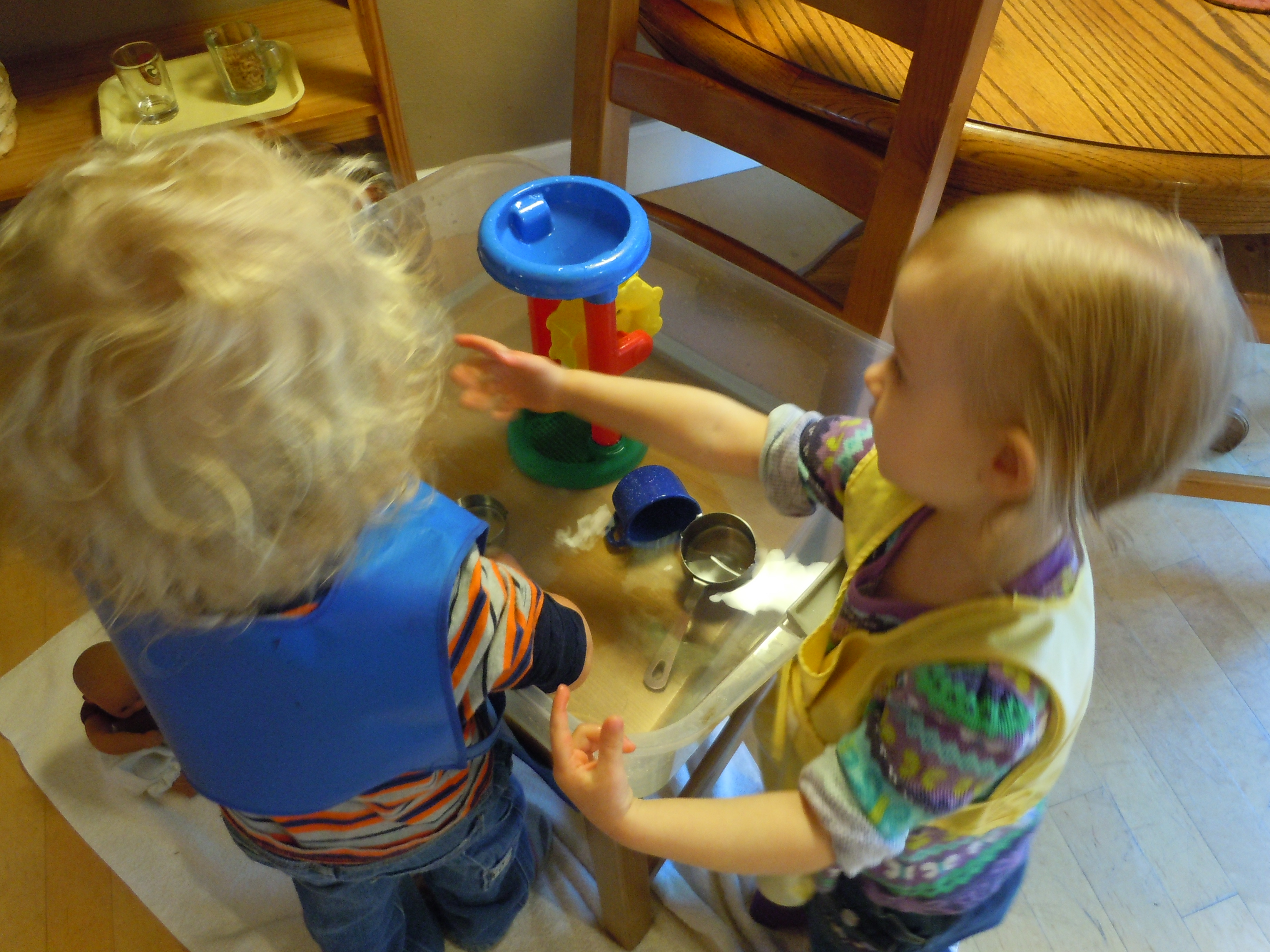
Our Inexpensive Home Made Water Table

1) Put a towel underneath to catch any drips

2) Put on smocks

3) Get a shallow plastic bin

4) Fill with a few inches of water

5) Put it on a chair or low table that is easy to reach

6) Add measuring cups, spoons, funnels etc.

7) Remind children to keep the water inside the water table

8) Enjoy!