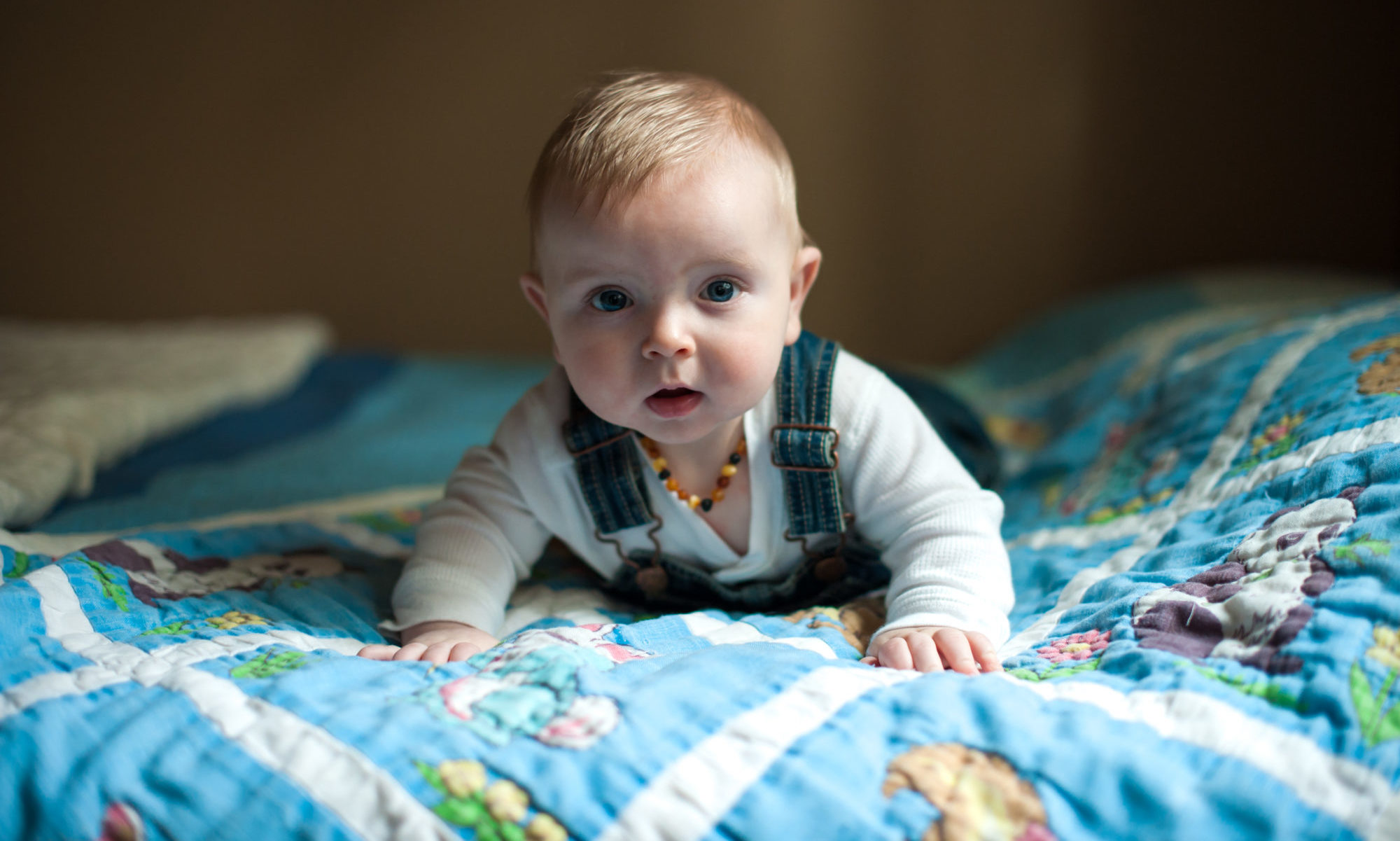
Am I a breastfeeding activist?

I’m not sure exactly what’s going on here, but every time I breastfeed my 16 month old in public I feel like some kind of breastfeeding activist. I think it’s because I so rarely (almost never) see other moms out doing the same thing. I almost always get someone’s attention when I plop down on a park bench or on a chair in a local store and nurse.

Just the other day I was shopping with my daughter when she asked for “milk please.” I didn’t hesitate to find the nearest chair and claim is as ours for the moment. The other people in the store seemed uncomfortable and avoided us, but that was fine with me. I don’t need privacy to nurse, but I also don’t mind it.

Although the benefits of breast milk are well documented and more and more moms are attempting to breastfeed, it’s not always as easy as we might think it should be and there’s still all kinds of pressure to wean at a young age. “If they can ask for it, they’re too old for it,” is still the prevailing wisdom.

But from the research I’ve done, it looks like nursing for two or even three years is not only acceptable, but is preferable to weaning in the first year. Now I know I might upset some people by declaring my position on breastfeeding, but so be it. I am definitely nursing for a full two years and planning a gentle (hopefully child led) weaning experience for us. Does that make me some kind of breastfeeding activist?

I sure hope not! I hope that more and more moms are choosing to nurse for at least two years; I just haven’t seen them out and about lately. Now I do realize and want to acknowledge that there are some legitimate medical reasons why some moms can’t breastfeed. And sometimes the milk just never comes in. But I also had my fair share of challenges with nursing and never once considered calling it quits. And thank goodness! My nursing relationship with my daughter is better now than it’s ever been before!

I love it when she asks for milk and how sometimes if I don’t respond quickly enough she’ll begin to chant, “Milk, milk, milky, milk,” until I’m ready. When we began our nursing relationship it was difficult. I didn’t get my milk in until day 9, so we had to supplement with donated breast milk for about two weeks. That little tube and syringe were a huge pain. I also had excruciating pain, and used a nipple shield, which we later had to wean from.

Can you picture me with a newborn, a nipple shield, and a syringe full of someone else’s milk trying with all my might to snake that little tube into my daughter’s mouth? I needed about eight arms! And even after months of breastfeeding I was still in pain until I wrote a blog about it and realized that I was having vasospasms in my nipples. OUCH!

But after I realized what was wrong (after NINE months of unexplained nursing pain) I began to treat myself by eating red pepper and cinnamon and taking some herbs prescribed by my acupuncturist. And by staying extra warm during nursing. It worked! Now I can breastfeed pain free!

I guess the reason I’m sharing all of this is because I think my determination to continue to breastfeed has made a HUGE difference in my life. Sure, I had more pain than I would have liked, but I also got to create a bond with my daughter that is absolutely priceless. And now I know that when I’m determined to do something important for my daughter, I can overcome some pretty big challenges to get there.

What are your thoughts or feelings about extended breastfeeding? Would you think I was an activist if you saw me on a park bench nursing my two year old?

I have a confession to make…

I have a confession to make. So first let me set the scene, I’m with my 16 mo. old daughter and she reaches for something. Now I have to quickly decide whether it’s safe for her to have. If it’s not, I feel pretty justified in wrenching it forcefully from her grip. Scissors, sharp knives, push pins, and electrical cords are all things in that category for me.

But then there are other times when I simply don’t WANT her to have the object of her desire. The truth is, sometimes I grab stuff away from her. Wow, I feel so vulnerable sharing that. And I feel awful afterward, especially if she’s left upset and crying. So I’m declaring right this moment that I’m committed to stopping this behavior. I will no longer grab things from my daughter (unless they’re truly dangerous items).

You might wonder what alerted me to the behavior in the fist place. Well, let me tell you. A couple of weeks ago my wonderful mother-in-law (who takes care of my daughter two days a week) came home from the library with a story about how my daughter had walked right up to another child and grabbed the book she was holding away from her. I’m sure it was an awkward moment for all involved and I was reminded of this blog post by Leslie that really inspired me (funny that her story happened at the library too).

After I heard about the “incident” at the library, I began to get curious about where my daughter had learned to grab and more importantly, why I hadn’t been teaching her how to ask nicely when she wanted something from someone else. And in the midst of my inquiry, I realized, I’ve been modeling the very thing she did. Whoa.

So, now that I’ve noticed the behavior that isn’t working for us and I’ve declared my new commitment to honor my daughter more fully, I have to come up with some strategies to help me keep my commitment. The first one is to plan ahead and keep items I don’t want her to have out of her reach entirely. So I’ll go through a few problem areas (like next to the diaper changing station) and reorganize, placing baby unfriendly items away in cabinets or boxes that close.

But I also need a strategy for the times when she does get something that I don’t want her to have. In those moments, I’ll take a deep breath and remember my commitment and then I’ll ask her for the item. If she refuses, I’ll ask her for “my turn”, or I’ll follow her around until she loses interest and then remove the item to a cabinet or drawer.

OK, so now I have my new commitment and my new strategies. I think I’m all set!

The only thing left is to process the feelings I have about how I’ve behaved in the past. I feel guilty about having ripped things away from my daughter in the past. I feel ashamed of my behavior and I’m judging myself as “immature.” And…my deepest truth is that I really was doing the best I could in the moment. It’s just that my best is constantly changing and grabbing things away from a young child no longer makes the cut.

Now I don’t expect my toddler to stop grabbing simply because I’ve stopped, but since we’ve also started talking about taking turns, I’ve noticed a big change already. After just a week or so of discussion, she now walks up to me, puts out her little hand and says “Turn?” My heart melts every single time.

Is this something that you struggle with too? If so, please leave me a comment. I’m out on a little bit of a limb here, and I would love to know that there are other people out here with me! Or maybe your challenge is slightly different, but I would still love to hear about it. We can support one another in making a change!

Sending you all warm hugs, Shelly

Educational programming increases violent behavior!

Another shocker from “Nurture Shock,” preschoolers who watched educational programming increased in violent behavior almost as much as kids who watched violent programs did. Researchers were stunned when their data revealed that educational shows significantly increased relational violence in preschool aged kids. That means that the more educational television a child watched, the more likely they were to withdraw their friendship, tell others “You can’t play with me,” and lie about their friends. Kids were more bossy, controlling and manipulative, the more educational programming they watched!

Upon further investigation it was discovered that children’s programming is full of examples of relational violence, and often most of the program was about setting up a conflict and the resolution only happened for a few minutes at the end of the show. Unfortunately for preschoolers, they aren’t developmentally able to follow the story line very well, so they end up learning from everything they see, rather than learning the moral of the story. Oops!

OK, so here’s where I come down hard on all television and tell you that young people are infinitely better served by playing games, reading books, contributing to the household, and engaging in pretend play. But you already know all that, and it’s still challenging to keep the TV off. So here’s another take. If you feel you must allow your preschooler to watch TV, try watching along with them and talking about what’s happening.

Children learn best from real live human beings who engage in a dialogue with them. So, your little one is much more likely to understand the moral, if you talk about it together. You can mute the commercials and use the time to process what’s happening in the show. Probing questions like, “How do you think Arthur felt when his friend didn’t want to play with him?” or “What can Word Girl do to help her friends?” can help your child clarify and understand the story line.

I know this doesn’t solve the problem of the most common use of television, to get a few minutes away from the kids to do an adult task, but I have lots of articles and information about how to help your child engage in independent activities. So if you need a few minutes to yourself, I recommend setting them up with an engaging task, rather than plopping them in front of the tube.

So far, my daughter has seen about 10 minutes of television in her whole 16 months of life, so I think it’s pretty clear where I stand on this issue. But I can imagine that as she gets older we will allow her to watch some nature shows and an occasional movie. But you’d better believe, I’ll be right there by her side, describing, sharing, showing, and educating her about the emotional content of the programs she watches. After all, I can’t think of much that’s more important to me than her emotional education. And since I also have a strong personal commitment to compassionate communication, I want my daughter to have the information and tools she needs to empathize and connect, rather than to hurt and tear down others.

If I really start to think big, I’d like a complete overhaul of children’s programming so that it promotes compassion and emphasizes the resolution of the conflict, rather than the creation of it. Who’s with me?

Please leave me a comment and share this with your friends. And have an awesome day, Shelly

News flash: It’s OK to fight in front of the kids (as long as you also do this)

Did you know it could actually be beneficial to kids to see their parents fight? Well, it’s not actually the fighting itself that is beneficial, but if children witness their parents having an argument and then resolving the conflict, they are just as happy as they would be watching their parents have a friendly discussion!

I know, I’m just as shocked as you are. I bought into all that stuff about not letting the kids see you fight, just like everyone else. But the problem with taking your argument into the other room is that children are left knowing their parents are upset, but they have no idea how the situation was resolved. On the other hand, if they can witness the conflict AND it’s resolution, children are learning how to resolve conflicts, which is a pretty important skill for everyone.

Now I don’t mean to suggest that it’s good for kids to watch a conflict go unresolved. Children derive their sense of emotional security from the relationship between their parents (or the relationships between their primary caregivers). In fact, in “Nurture Shock” by Po Bronson, I read of a study by Dr. E. Mark Cummings from Notre Dame, in which he showed that the quality of the parents’ relationship had even MORE of an impact on the child than the direct relationship between parent and child! So when there’s tension in the air, you can be assured, they feel it. And it bothers them. And it isn’t good for them.

But the truth of the matter is that married couples typically have anywhere between 2 and 8 conflicts every single day. Granted, some of them are large and some are small, but clearly, kids are being exposed to these conflicts even with our best efforts to shield them from our arguments.

Instead of wasting precious energy keeping our kids away from our conflicts, let’s learn to consistently resolve them peacefully, so that our children can learn much needed conflict resolution skills and we can relax and live our lives WITH our kids, rather than attempting to hide our arguments from them. Studies are showing that arguments can actually get quite heated, and as long as they are resolved, children are happy, calm, and well adjusted.

So, how are your conflict resolution skills? A little rusty perhaps? If so, I highly recommend “Nonviolent Communication” by Marshall Rosenberg. The NVC skill set has completely changed my experience of conflict.

I used to be terrified of upsetting anyone and walked on eggshells around my more firey and expressive friends and family members, but now I see a conflict as an opportunity to get closer to my loved ones. By checking in about what has upset someone, I get to know them even better than I did before!

As with any technique or model, even NVC can be used violently, so if you do learn and practice it, be sure to check in with yourself about what your intentions are in every interaction. But if you genuinely want to reconnect after an argument, NVC is one of my favorite tools.

The one other thing that has made the biggest difference for me in my ability to reconnect and resolve conflict is willingness to be vulnerable and share what’s on my heart. I think any two people can reconnect if they’re willing to feel their hearts and share what’s happening for them in a responsible way (read no blaming or shaming).

So, have you had any big (or small) arguments lately and then resolved them in front of your kids? If so, I would love to hear all about it! Please leave me a comment.

And have a Happy Thanksgiving! Warm hugs, Shelly

Whispering Magic

Thinking back to all the times when I was in a classroom or a house full of kids who were all running around and screaming their little heads off I suddenly remembered the one thing that turned yelling into quiet voices. I whispered.

Now you might think that whispering in a room full of screaming kids wouldn’t have much impact, but I’ve found that screaming is the thing that makes the least impact. The kids just thought I was playing along with their game and continued to scream unless I really lost it, which I later felt bad about.

Instead, I did the opposite and got an almost immediate response. First I thought of a secret to tell. Then I went over to the loudest child and tapped her on the shoulder cupping my hands around my mouth as if I were about to whisper. Then I whispered the secret to her. Usually my secret had something to do with a delicious snack waiting for them in the other room or a really fun game or activity I had planned, but inevitably, the whisper was the thing that made the biggest difference.

My daughter has stopped nursing herself to sleep when she’s going to bed at night and instead prefers to cuddle to sleep. But if she’s really squirming and unsettled I simply begin to whisper a story to her and she’s often asleep within minutes. Sometimes she’ll whisper parts of the story back to me, but she ALWAYS stills her body and listens intently. It really doesn’t matter what the story is about, it can even be gibberish, the important thing is that the message I’m sending with my whispering is that it’s time to relax and rest now. And the message comes across loud and clear…or quiet and clear in this case. ?

I’ve even used whispering to stop a child from screeching wildly when she didn’t get what she wanted. Sure there are times when it’s important to allow a child to fully express her upset, but this particular child was using the screeching as a way to get my attention. So I gave her my attention, but I changed the rules of the game. Whenever she screeched, I would walk up to her, whisper in her ear, and then if the screeching continued, I would walk away. She almost always followed behind me whispering about the topic of choice. Because it wasn’t screaming that she most needed in that moment, it was my full attention.

I know it can be difficult to remember this when you’re in a room full of people who are yelling to be heard, but sometimes going against the grain and doing the opposite of what the crowd is doing is the perfect way to shift the dynamic.

My husband and I even use this technique when we’re dining in a very loud restaurant. If I can’t hear him, I just slide into the booth on his side of the table and we snuggle up and talk quietly to one another. Often, the noise level in the whole restaurant will go down. I’m not really sure why it works, but I’m sure glad it does!

So the next time you’re in a room full of loudness, try whispering and see what happens. I would love to hear how it goes. Please share your story with me in the comment box below.

And have a fantastic week, Shelly