Stimulating young minds

Learning doesn’t just happen at school. You can stimulate your child’s mind at home with these simple activities:

Sometimes when kids seem to need a lot of extra attention, are bugging you constantly to watch TV and movies, or are generally in your face 24/7, they might actually be asking for more intellectual stimulation.   When kids get bored, they turn to you for help, but they might not know exactly what they’re wanting.

If you think this might be what’s happening in your household, I’ll give you some ideas and examples of simple things you can do to stimulate your child’s mind, support more independence, and encourage self-directed activities.

First, consider your child’s favorite things.  Does she love dinosaurs, dolls, horses, or art?  Does he enjoy cooking or playing in the sandbox?  These preferences can inform which kinds of activities your child will enjoy right now.  Let’s say she’s into dinosaurs.  She loves to play with her dinosaurs and sometimes corrects you when you call them by the wrong name.

So, how can you create an engaging, self-directed activity that will build on your child’s knowledge and encourage her to learn even more about dinosaurs?

If you have a book in which dinosaurs are classified into carnivores and herbivores, you can create a fun activity that she can do on her own.  If you combine her basket of dinosaurs and the book about carnivores/herbivores, add a green piece of construction paper on which you will write “Herbivores” and a red piece of paper on which you will write, “Carnivores” you have a fun game!  Just show her how to set out each piece of paper, choose a dinosaur from the basket, look in the book to check whether this dinosaur is a carnivore or a herbivore, put the dinosaur on the appropriate piece of paper and then choose another dinosaur!

When she has classified all of her dinosaurs she can come get you and you can discuss her reasoning.  Be careful not to correct your child’s work at this point.  The idea is to encourage self directed activity that is intellectually stimulating and if she thinks she’s going to get a “bad grade” at the end, there’s no motivation to do the activity again.  However, if you sit with her and ask questions like, “Wow, I’m confused, I thought a stegosaurus was a carnivore, how did you know it’s an herbivore?” then she gets to teach you, and teaching is an even more stimulating way to learn something.

Another idea for a pre-reader is to make small paper signs that say things like door, mop, sink, book, ball, table.  Put tape on the back of each and then invite your child to find the items and tape the signs on.  Pretty soon, your child will begin to recognize words even before he’s able to read!

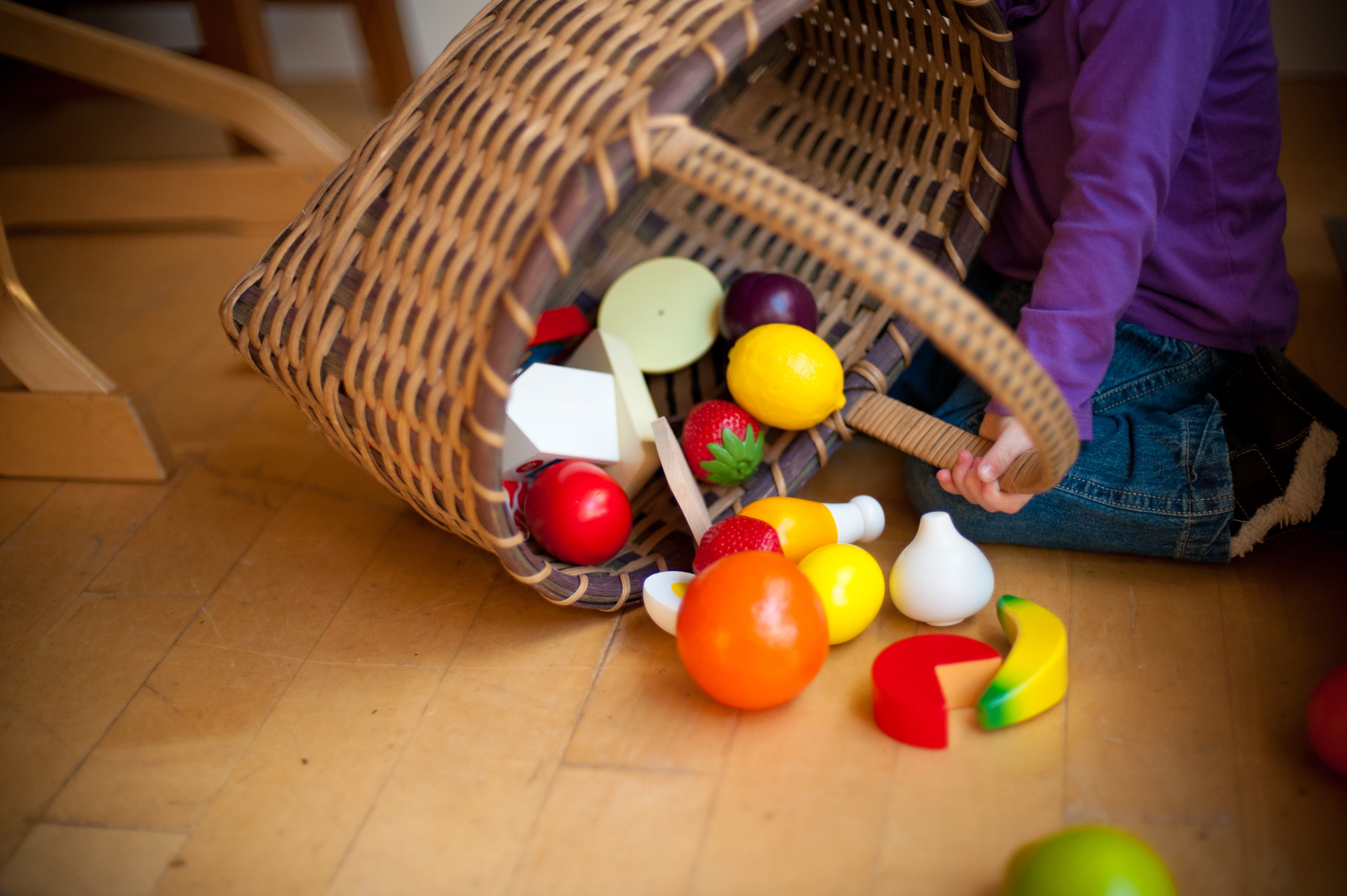
You can also adapt this activity by using a basket of miniature items and laminated cards with words on them for beginner readers.  Easy words like dog, cat, and hat can be matched up with a tiny toy dog, cat, or hat.  Kids love these types of matching games and they learn while they play!

To make this game easier for a child who’s not reading yet, create sets of cards.  First, create two matching cards each with a sticker, picture or drawing of a cat and write the word cat below.  Now cut the word off of the second set of cards.  Now you have three sets of cards- a control set with pictures and words, a set with pictures only and a set with words.  Show your child how to match up the control set with the other sets.  Again, remember, it’s not important that they get it right, it’s just important that they’re engaged and having fun with it!  I find that it helps to do this activity at a table or on a small rug on the floor so that their workspace is contained.

I hope that some of these ideas have sparked your creativity and your desire to stimulate your child’s mind.  Please write to me with your thoughts, other ideas, questions, and stories about how these activities work for you!

Big hugs, Shelly

The taking-it-personally vortex

One of my biggest challenges as a parent is trying to find ways not to take it personally when my child blames me for his unhappiness. Sometimes, it’s easier than others. For example, when I  hear, “You’re so mean!”, it’s easy for me me to remember that this is all part of the parenting mix. It’s harder when he does things like vigorously reject my home-cooked food.

I don’t know whether “You’re so mean” rolls off my back because I’ve heard it so many times lately (whenever my son doesn’t get what he wants), and thus am getting used to it but somehow, I’ve been able lately to keep a calm heart in the face of “You’re so mean”,  and offer up empathy guesses into feelings and needs:

“Ah–are you saying you’re angry because you’re not getting what you want?”

“Yeeahhhh.”

Whew. That I can hang with! And it also helps take the edge off his upset. In fact, whenever I can remember to tune in deeply to my son, and help him feel heard and understood, his anger dissipates, and least a bit.

I think if I could remember each and every time I hear something personal, to tune into the feelings and needs underneath, I’d probably be a lot more peaceful.

As it is, what comes up for me sometimes is, well, taking it personally. And then fighting accordingly. This is especially easy to do when I get called a name. For a period of weeks, when my son was unhappy, he’d shout, “Stink!”, which I think was meant to be a noun, as in, You are a “stink,” an unpleasantly-scented thing…like a piece of poop for example.

Continue reading “The taking-it-personally vortex”

Kids always have a positive intention

I know it sounds like an outrageous claim, but the truth is that kids always have a positive intention behind EVERY action.  Even when he’s smearing peanut butter all over your computer keyboard, or convincing his little sister to eat dog food he has a positive intention.  And when she’s cutting her hair, coloring on the walls with crayons, or purposely waking up the baby, even then, she has a positive intention.

Kids, just like the rest of us, are just trying to get their needs met.  They may not always have the most effective strategies for getting what they want, but they’re always doing their best and responding to the world around them.

When we can assume a positive intention and even try to discover what that intention might be, suddenly we can move from feeling angry and exasperated, “Why in the WORLD would she DO that?!” to a state of compassion and understanding.  “Oh, I see, she was needing some excitement and stimulation, so she woke up the baby to play with him.”

When we’re aware of the underlying needs behind our children’s seemingly bizarre behavior, we can start to empathize with them and teach them better strategies that will actually get them what they want.  But first we have to learn to breathe and take a moment BEFORE we react.

Right now, imagine the most frustrating thing your child has done in the past week or so.  Remember how you responded.  Now, consider, what might be the positive intention behind your child’s actions?  Imagine yourself in a similar situation in the future.  Is there a way you could have responded that would have created more connection and understanding between you and your child?

Let’s try the “Assume a positive intention” technique:

You see your child doing something that makes your heart race and your mind jump to all sorts of troubling conclusions.  You decide to implement assuming a positive intention behind all actions.  First you breathe, then you think, “What could the positive intention behind this action be?,” then you come up with some idea, you check in with your child, “Sweetie, were you really wanting to see what why I won’t let you have food near the computer?  Are you needing some more information and understanding about that?  Were you enjoying the feeling of the peanut butter on your hands?”

Your child feels heard, understood, and maybe a little bit confused about why you’re not screaming at the top of your lungs yet.  Now’s your chance to calmly let your child know how you feel about the strategy he’s chosen.  Be sure to use the words “I feel” and then an actual emotion.  “I feel worried when I see my computer caked with peanut butter, I’m not sure it will work any more and computers cost a lot of money, so now I might not have a computer any more.  I feel sad about that.”

And finally, assuming you’ve kept your cool, your child should be ready for some learning!  So now you get to share a new strategy for next time.  “What could you do next time instead of putting peanut butter on my computer?  Could you ask me about why I don’t allow food near it?  Could you ask me for a cracker to smear peanut butter on?  What do you think?”

I would love to hear your stories about the wild things your kids have done, how you’ve handled it, and what you think about the idea of assuming a positive intention as a way to practice understanding and compassion with children.  Please leave me a comment!  Hugs, Shelly

What Do You Really Need in The New Year?

Happy Gregorian New Year! Whatever calendar we may observe as part of our many traditions, the popularity and ubiquity of the Gregorian New Year offers us a time to reflect, regroup and realign with what we want most.

This past October, as part of my year-long program studying Nonviolent Communication  (NVC) mediation, I went on one of three retreats. I got to deepen my NVC skills, learn new ways of approaching mediation, and make many wonderful connections with other mediators.

One powerful demonstration stood out in my mind.  John Kinyon, one of my mentors, stood with one foot in front of the other. He said he was about to recall something he was upset or angry about, and to think of it in “jackal” or judgmental terms, such as “that person’s a jerk,” (or bad, or wrong or similar). He did so, and asked a volunteer to attempt to push him off balance. John got knocked over quite easily.

Then, he stopped and asked himself what he was needing. For example, peace, support, or respect. He allowed himself to “drop down into,” or really feel the awareness of that need, beneath the judgment. The volunteer attempted once again to knock John off balance and was not able to do so. We got together into pairs and tried the exercise–it worked! When I dropped down into my need beneath my judgment, I felt calm, solid, and grounded, and in fact was not pushed over.

What does any of this have to do with the Gregorian New Year?

Continue reading “What Do You Really Need in The New Year?”

The joys and challenges of spending the holidays with family

Happy holidays everybody!  I hope you’re having a lovely time together as a family and I know that when we get extra time together with our immediate families and especially when we spend time with extended family, tensions can run high.  I’m sure you know what I’m talking about.

Almost inevitably when we celebrate with our families, there’s someone whose beliefs are different from our own, or there’s a sibling or parent who treats us in just the same way they treated us when we were five or who treats our children in ways we don’t enjoy.  The holidays can be a time of joy and celebration, and a time that warrants a lot of introspection, conflict resolution skills, and mediation between family members.

Although we all might intend to have a nice Christmas dinner or a beautiful Solstice celebration or (insert your holiday here), there are times when feelings get hurt, alcohol helps remove inhibitions, and we can suddenly find ourselves or other family members in the midst of conflict.  So what can we do when our lovely celebration is about to deteriorate into chaos?  Continue reading “The joys and challenges of spending the holidays with family”