
In his Seven Habits of Highly Effective People, Stephen Covey enjoins us to “Seek first to understand, then to be understood.”
As hard as this may be to remember to do with other adults sometimes, I find it even harder to remember to do with my son.
Recently I got my son and his stepbrother reading and math workbooks based on movie characters. My son got a Cars (as in the Disney movie) workbook for Chanukah, while his stepbrother got a Spiderman workbook. My son wailed and hollered for days…”It’s not fair! It’s not fair! Why did you give him that?”
I explained that I knew Canaan (my son, and that’s his new chosen spelling of his name) liked Cars, so I got him that, and I knew Taebin (his stepbrother) liked Spiderman so I got him that. Completely logical. Meanwhile I was kicking myself for not remembering to get them identical gifts.
Canaan’s dad explained to him that if he kept reacting like this, people wouldn’t feel like giving him gifts anymore. Turning on my best earth mother tone, I imparted a deeply meaningful spiritual lesson about how gifts are expressions of the heart, and the giver wants joy and gratitude in response, and how the gesture of giving the gift is an act of love, far beyond the gift itself.
We also reminded him to focus on himself, and not pay so much attention to what other kids were getting.
Well, sure.
And…blah, blah, blah.
What does any of this mean to a six-year-old with a bruised heart?
Maybe something sunk in. I hope it did.
But what dawned on me was that I had completely skipped over the step of seeking first to understand him. And in so doing, missed the chance to really connect with him, build trust, and show him I was on his side. And how much more valuable would that be than trying to “convince” him of something when he plainly knows otherwise?
I stopped mid-lecture.
“Are you feeling really sad, because when you saw Taebin’s gift you wanted his more than yours?”
Immediately his energy relaxed.
“Yyyeeeeahhhh….”
Of course it did–I was showing him that I was with him, not against him.
So I continued.
“And you really wish you had that present, so you could feel like things were equal?”
Tiny whimper.
“Uh-huh.”
Oh, my sweet little puffin.
I felt myself soften, too.
I noticed that I can feel afraid, sometimes, when I take this approach, that I’m somehow reinforcing “irrational behavior,” or teaching him that it’s “Ok to be upset about little stuff.” I’m also just wanting peace, and wanting his tirade to end, which fuels my strategy of explaining why it “should” end.
I need to remind myself that empathizing with him doesn’t mean I’m agreeing with his story–it just means I’m taking a moment to seek first to understand, before trying to get understood. This works pretty well with adults. How much more mileage can we get from this technique with young people, who don’t even have the advanced brain development most adults do? But boy, do they know when someone is genuinely trying to understand them.
Please tell me your experience–what happens when you seek first to understand (and check out with the other person whether you got it right), before seeking to be understood?
Oh, and happy Chanukah!


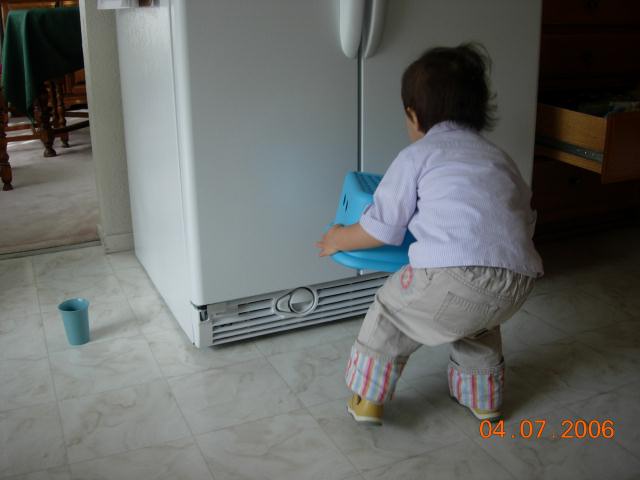
 When I worked in Montessori schools I was consistently amazed at how happy, engaged, and capable the kids in my class were. This got me thinking, “If kids can be this self-sufficient and joyful in a classroom, then why not at home too?!” I’ve noticed that young people often feel frustration at living in a an adult-centered world. I can remember feeling irritated about not being able to see over the counter, or out the car window (before the advent of booster seats).
 Consider the daily activities of the child in your home. What does he do and what would make his tasks easy to accomplish without asking for adult intervention? Is there a convenient place for him to hang his coat when he enters his home? (Tip: for very young children, a low hook is the easiest place for a jacket) Can he reach the sink easily for hand washing? Are there art activities, games, puzzles and books that are within easy reach? Does your child have comfortable furniture that fits his body?