12 Easy Ways to Help Kids Unplug

I’ve been reading Dr. Laura Markham’s book, “Peaceful Parent, Happy Kids” and this week as I read about helping children cooperate, one of her suggestions really stood out. Dr. Laura recommended that if you’re not getting enough connection and cooperation, you might want to try unplugging.

This is not just some thought, idea, or wild theory about how to reconnect with your kids and support their healthy development. The American Academy of Pediatrics recommends no screen time for children under 2 and limited screen time for kids over two. Their website claims that the average amount of screen time for today’s children is a whopping 7 HOURS per DAY. Whoa. That’s more than half of a typical child’s waking hours in a day!

There is an increasing body of research that shows that excessive screen time can lead to attention problems, social delays, and an increase in violent behavior. But I’d argue that even much smaller amounts of screen time deprives kids of what they most need, our attention.

Interaction with a live human being is clearly what human babies and young children need more than anything else. In fact, babies deprived of human contact die, even if they’re provided with adequate food, clothing, and shelter. Freedom to explore their world in a physical and sensory way is also crucial to healthy development. So, how can we help kids avoid media when screens are so prevalent and so unbelievably addictive?

If you don’t think that screen time is addictive, just try to go a whole day with your smart phone turned off. I bet you’ll reach for it at least 20 times. We check Facebook, phone messages, texts, emails, watch videos and that’s even before the television, movies, or cable comes on. Today’s society is deluged with screens and young children are not immune to the draw.

Lately, almost every morning, my daughter asks her Dad in a super sweet voice, “I was wondering if we could watch videos on the iPad?” This is an activity that they enjoy together, recording and then watching themselves on video. But it’s clearly becoming her go-to activity with Daddy.

Is your child in a similar media rut? Perhaps they’re asking for movies or television on a daily basis, or maybe they want to play computer games. I’m not saying that these activities are bad for kids altogether, but I do think that they should be kept in the “occasional” category, rather than as staples of our daily life.

So how can we help our kids break the habit? Often it’s as simple as offering an alternative and helping them engage in something different long enough to forget about their desire for screen time. Here are 12 ideas to get you started:

1) Model what you want—

If you want them to stay off of media, then you have to do it too. Show them how to live a life of personal real-life connections, instead of web connections.

2) Schedule play dates—

Building in person social connections is hugely important for kids of all ages. Establish a “no screens during play-dates” rule and help the kids come up with ideas for how else they can spend their time together.

3) Offer books, games, puzzles, and other diversions—

And participate WITH your kids if they’re not engaging in these right away. Once they’re absorbed, you’re welcome to return to your own activity.

4) Do an art project—

You could go on a nature hike and collect interesting items, then bring them home and create a collage. Or just bring out the paint! Ask the kids to agree to help clean up the mess too, the clean up might be half the fun!

5) Rough and tumble play—

Physical play is a great way to reconnect and to get out the day’s frustrations in the form of laughter. Remember to let your child be the more powerful one for the most giggles.

6) Gardening—

Getting out into nature, even if it’s just the back yard can be rejuvenating for kids and adults alike. Spend some time outdoors every day. And better yet, plant a food producing plant and enjoy the moments of discovery when flower turns to fruit. Harvesting and eating food they’ve grown themselves is a great way for kids to learn about food production and the life cycle of a plant.

7) Make up a silly song—

Stimulate your child’s creativity by using a familiar tune and making up new silly, rhyming lyrics.

8) Play a brain teasing game—

Riddles, mental puzzles, alliteration games and mysteries are really good for brain plasticity and developing problem solving skills.

9) Read aloud—

No matter how old your kids are, reading aloud can be a wonderful family activity. If you start a chapter book today, I guarantee that in a week or so, your kids will be begging for the daily chapter.

10) Exercise—

Riding bikes, canoeing, running, playing sports, swimming, and skiing can be excellent family activities that will get the whole family outside and physically active. Instilling the habit to move while kids are young can translate to a healthier lifestyle for decades to come.

11) Puppetry and theater—

Do you have a child who seems to need endless attention from you? Set him up with some puppets or assign him the task of writing a play to perform for you and you’ll be amazed at the creative results. Provide costumes, or the means to make their own to add even more depth to the performance. This is a fantastic play date activity.

12) Science experiments—

Head over to your local library and check out a book on science experiments for kids. Look through it yourself and copy a few items that you’d be willing to supervise or that don’t need much adult intervention. Help your kids collect the materials and watch their minds expand as they learn about mass, volume, weather, chemistry and more!

So, hopefully after reading through these initial ideas, you’re brimming with even more ideas of your own! Isn’t it amazing how creative we can be when we take screen time off the table? Hopefully you’re already doing a bunch of these, and if not, I hope you’ll try some. Then, leave a comment to let me know how it’s going. If you’re not feeling more free from technology and MUCH more connected with your kids after these, I’ll be shocked. But even if these particular ideas don’t work for you and your family, I bet you can come up with a few activities that will work great and will keep you all connected to each other, instead of to your various devices.

Have a fabulous week! Warm hugs, Shelly

You Don’t Have to Work So Hard to Entertain Your Baby

Well, the secret’s out. We’re expecting! And as I contemplate the inevitable chaos of introducing an infant into all of our lives there’s one idea that brings me a huge amount of peace and calm. It’s the notion that babies can actually entertain themselves.

I was first introduced to this idea by Janet Lansbury and if you want to explore this further, I highly recommend her website janetlansbury.com It’s filled with information about how to be respectful to even the youngest infants and some of the underlying messages I’ve gotten from her work with babies are:

1)   You don’t have to be Super-Mom, you’re already a super mom.

2)   You don’t need to hold your baby for every second of the day to foster proper bonding and development.

3)   Ultimately, even newborn babies are really good at meeting their own needs for learning and entertainment, when given the opportunity for independent play.

Sometimes these ideas seem to fly in the face of all of the attachment parenting information out there, but I don’t think the ideas are really at odds at all. In fact, I think that when we provide the nurturing and responsive environment for our children that we naturally want to give them, they respond by needing less reassurance and wanting more independence.

This is certainly what I’ve seen with my first daughter. As soon as she feels safe and comfortable, she’s ready to take on a new task or skill and she almost always wants to do it herself.

Even as a tiny infant, when she was fed, rested, and we were fighting a diaper rash, we’d leave her strapped to her changing table with a pre-fold underneath her just in case, put on some music and she would stay there happily for up to half an hour!

Other times I’d simply lay her down on a soft blanket on the floor, offer her one or two toys to explore and leave the room. And again, as long as her physical needs were met, she would rarely call out for me. So I got to fold laundry, cook dinner, or do whatever else I’d been neglecting for up to half an hour before she needed another diaper change or to nurse or some help falling asleep.

So if you’re a first time mom and are worried about how you’ll keep your baby entertained, or if you have other kids and you’re pretty sure the new baby won’t get the same kind of undivided attention that your first baby got, fear not. You can relax and trust your baby to learn and grow perfectly, even without your constant attention.

There are a few keys to encouraging this kind of independent play in infants (and toddlers for that matter) Here’s a quick check list:

1) Safety first—Make sure the space is safe from anything that could harm your baby, even if they move farther than you expect (because they probably will!). Check for long cords, electrical outlets, furniture that’s unstable (it’s best to attach bookcases to the wall), fluffy bedding, choking hazards etc.

2) Less is more—Young babies really don’t need 12 toys that blink and play music. A simple ball, a cloth or wooden teether, or even a kitchen utensil may be enough stimulation for a young developing brain. Some babies don’t even need a toy, they can be content just learning to move their bodies and looking around at the things in the room or in my daughter’s case, listening to music.

3) Give them space and time—If you’re not accustomed to leaving your baby alone, this one can be challenging. It’s an exercise in trust and an opportunity for self care.  But remember, offering your baby this time is helping him develop a longer attention span, reminding him that he’s safe, even when he’s left alone, and laying a strong foundation of self-reliance.

4) Be within earshot and available—Infants need to know that we’re there and available when they need us, so be sure you’re within earshot and available to respond quickly either verbally or physically if your baby cries out. When we respond quickly to their needs, babies relax and are able to feel safe even when we’re out of the room. But if we fail to respond when they need our help, we’re breaking a fragile trust and infants will easily learn to object to our being out of sight in order to be sure we’ll be there when they need us.

Just to be clear, I’m not suggesting that you leave your newborn alone for hours at a time or even for several hours a day, but the idea that we must be interacting with our babies 24/7 is just an impossible dream that undermines our own sanity.

Yes, it’s incredibly important to make eye contact, smile, talk to, hold, and sing to your baby. And I already know you’re doing those things. This is just a reminder that there’s absolutely no reason why you can’t take a shower, read a novel, or talk on the phone with a friend, even when you have an infant in the house.

And when we give our babies time alone, we’re not just taking care of ourselves by giving ourselves a much needed break, we’re also helping them develop crucial skills and allowing them to learn and grow at their own pace.

I’m curious, do you give your baby alone time? Or does this idea seem foreign? I would love to hear about your experiences. Please share your story with the rest of us!

And have a lovely week, Shelly

DIY Montessori Counting Activity

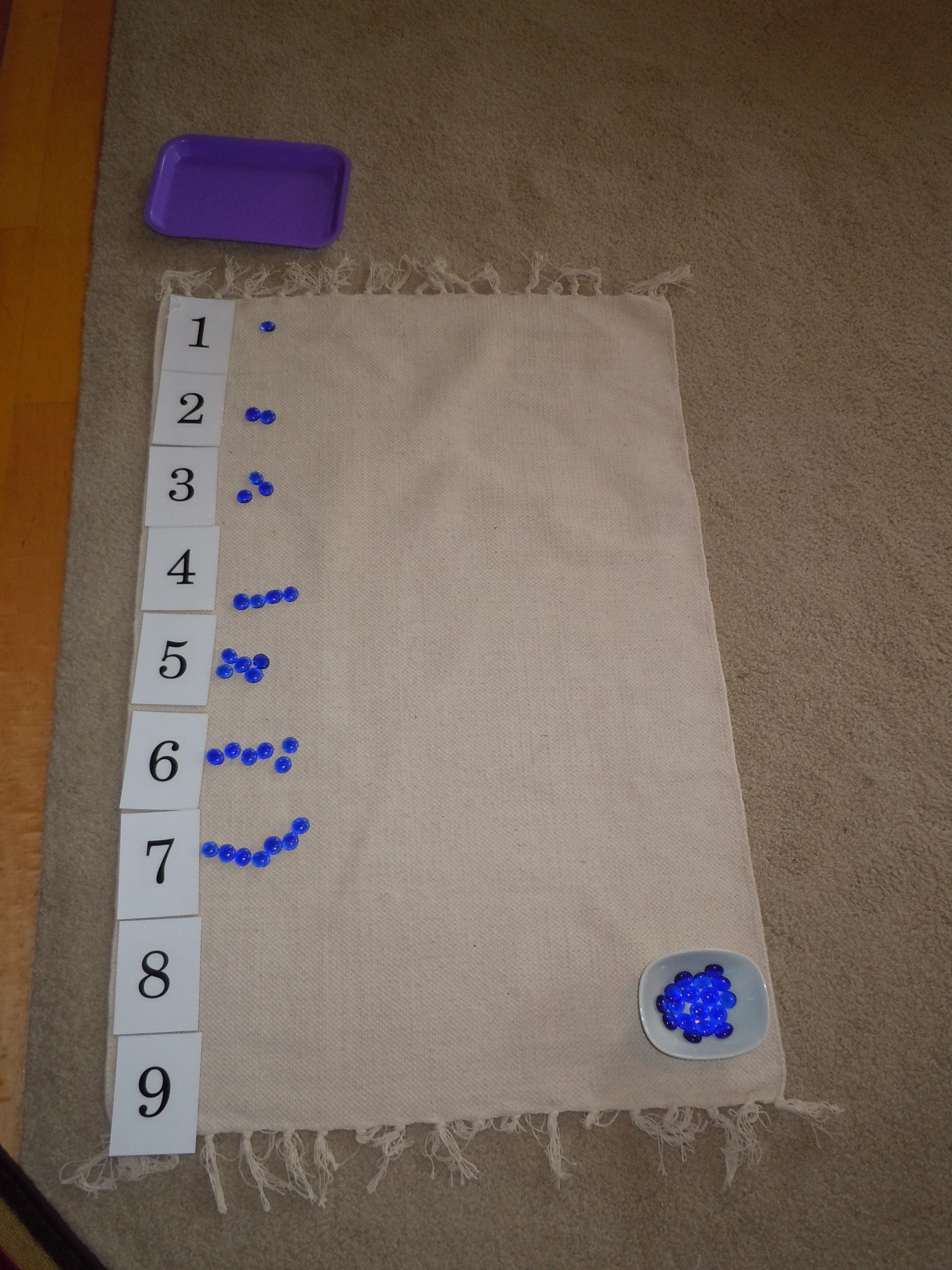
I recently created this Montessori counting activity for our Montessori inspired homeschool. I started with number stickers and card-stock. Laminated the number cards. Found these beautiful blue glass counters in our game closet, stuck them in a beautiful ceramic bowl. Put everything on a tray and voila! We now have a very popular counting work for the math shelf. Just make sure this activity has supervision as the counters are choking hazards for children under three years.

DSCN1869

Why My Child’s Sleep Rules My Life and I Wouldn’t Have it Any Other Way

I hear all sorts of things from other parents and from my colleagues about how a child’s sleep schedule doesn’t have to rule your life. I’ve heard moms proclaim, “I’m not about to let my infant dictate my schedule, she can sleep just as well in the stroller anyway.” Well, I respectfully disagree.

Children need adequate sleep to be able to function and learn well, just like we all do. And stroller sleeping is NOT the same thing as sleeping at home in a cozy and familiar bed. Sure, children CAN do it, but that doesn’t mean they should.

Just yesterday I was listening to the radio and heard that for an adult, missing an hour of sleep per night for a week diminishes our mental capacity to the same degree as it would if we had not slept for 48 hours straight. Whoa. Sleep really does impact us more than we realize.

Maybe you’re one of those parents who resists a consistent schedule or who doesn’t want to schedule the rest of your life around your child’s need for sleep. If so, my intention is not to belittle your choice or even necessarily to convince you to change your ways. I just want to tell you about why I love it that my life is completely ruled by my daughter’s sleep.

#1 Zero meltdown days- When my daughter gets a consistent sleeping schedule, she is happier, more adaptable, and better able to handle surprises or disruptions to the rest of the schedule. If she’s sleep deprived (even an hour less sleep in 24 hrs.) she is MUCH more reactive and more likely to become upset by things that seem incredibly small and insignificant to me. As long as I keep her napping and sleeping schedule consistent, we often have lots of zero meltdown days!

#2 She asks for her nap and to go to bed at night- The first time I asked, “Are you ready for your nap?” and heard a “Yes, Mommy.” I was shocked. I’ve had a LOT of experience with children resisting sleep, and she will sometimes fight it after we’re in her room, but she will ALWAYS willingly go into her bedroom for nap-time. I think this speaks to how clearly I’ve held her sleep as a priority and how consistent I’ve been with the timing and location of her daily naps.

#3 I like a consistent schedule too- Honestly, it’s difficult for me to empathize with a distaste for schedules, I find a consistent routine comforting and easier than changing things up constantly. Sure, we’re home a lot, but I like being at home! For those of you who don’t enjoy a consistent schedule, what is it about this that bothers you? Is it simply boring to do the same thing every day? Or is it something else? I guess I’m just lucky that I enjoy consistency, because it’s been clear to me all along that my daughter thrives when she knows what to expect and feels comfortable in a familiar environment. Sure, we go out on adventures, but we almost always come back home to sleep.

#4 Did I mention zero meltdowns?- OK, so not only is it easier for HER emotional state when she gets consistent and reliable sleep, it’s easier for me too! I guess I could choose to stay out at a fun activity for an extra half an hour, but the resultant fussiness my daughter exhibits has never seemed worth it to me. I make it a point to change or disrupt her sleeping schedule only about once a month. And when I do, it usually takes us several days to get back on schedule, so it has to be something really worthwhile like staying up late around the campfire, going to a special art exhibit or a musical performance I’ve been really looking forward to.

#5 When the schedule changes, she rolls with it- By providing a consistent sleep schedule as a foundation for my daughter, she knows she’ll get the rest she needs, so she doesn’t have to freak out when I keep her out an hour past her bedtime once a month. Instead, she is just her usual happy self, even well past her bedtime. But that’s only because I’ve built up a saving’s account of consistent sleep that she can draw on during unusual circumstances.

So, all in all I think my message is clear. I’ve prioritized my daughter’s sleep schedule so that our lives together will be easier and more fun. Who cares about that extra hour of time out with a friend if the rest of the day with my daughter is frustrating and filled with meltdowns?!

When I choose consistency for my child’s sleep, I’m also choosing more cooperation, ease and sanity for myself. Do you agree or disagree with me? I would love to hear YOUR opinion!

Have a wonderful and restful week, Shelly

Video: The “Find it” Game

Here’s a great game you can play virtually anytime you’re home and busy with a task.  Your kids will love it and feel connected to you, even as you continue to cook dinner.

What other ways could you play this game?  Can you see how it can help kids learn colors, shapes, locations of things in your home, sizes, and so much more?!  I would love to hear how you would modify this game to best fit your child’s interests.  Please leave me a comment!