
8 Breastfeeding Myths That Make Me Want to Scream

Happy Breastfeeding Awareness month everybody! In honor of this important topic, I’d like to share some of the breastfeeding myths that make me want to shake people and yell, “What?! No!!!! That’s just not true!”

1)   Breastfeeding is sexual

Um, excuse me but while our culture has sexualized breasts, their original and primary function is to FEED BABIES.  Yes, breastfeeding feels good, but it’s definitely not sexual, and nursing in public is certainly not displaying our breasts to be ogled or even an overt attempt to make you uncomfortable.

If my baby needs to eat, I will feed her. Period. It’s not about you. It’s about meeting my baby’s needs as best I can so that she can learn to trust that the world is a benevolent place and know on a fundamental level that she is deeply cared for. I’m not trying to make you uncomfortable by nursing in public, but I will do it and hope that others will too until it just becomes normal and no longer makes people cringe, blush, or turn away.

2)   Nursing in public is immodest

OK, so what about this group of people who claim that breastfeeding in public is fine, as long as it’s hidden under a cover or in a bathroom stall. I’m sorry but I don’t like eating with a blanket over my head and neither does my baby. And don’t try pulling that “nipples are obscene” crap either, men’s nipples are shown ALL THE TIME and nobody makes a fuss. Get over it.

3)   Formula supplementation is necessary

The truth is that formula supplementation can lead to a reduction in milk supply which leads to more formula supplementation and before you know it and despite your best intentions, you end up giving up on nursing entirely.

Yes, there are some instances where babies need formula supplementation, like when they are unable to digest protein and need medical intervention. But what bothers me is how often nurses and hospital staff freak parents out with percentages of weight loss and then push formula supplementation on them in the early days of their baby’s life when the nursing relationship is still so new and newly developing.

My milk didn’t come in until day 9 and the doctors were concerned about my baby losing so much weight. So I did supplement, but I did it with donated breast milk using a tube so that my daughter was sucking at the breast while she received the donated milk. That helped stimulate my milk production and gave her the benefits of breast milk, even before mine came in.

I guess I just want new moms to know that there are other options and they don’t HAVE to use formula if they don’t want to. And I think hospital staff tend to downplay the potential long term effects on your milk supply, so please consider the decision carefully before you decide to supplement with formula.

4)   Toddlers and preschoolers are too old to nurse

Oh this one really pisses me off. Anthropologically, it’s believed that humans have nursed until ages 3-5yo for most of human evolution. We nurse until we’re ready to give it up, until our needs for comfort transform into hugs and snuggles, and until most of our caloric needs are met by solid foods. The age at which these milestones happen can be different for different kids. And sure, the mom also has a say in how long she’s willing or able to nurse. But this idea that once they’re talking they’re too old for their “milky” is just ridiculous. That’s a personal decision to be made between mother and child. It’s actually not anyone else’s business, so take those judgments elsewhere please.

5)   You should pump so that others can feed your baby

Excuse me but someone else’s desire to feed my baby is not a good enough reason for me to attach myself to a machine for half an hour to get a couple of ounces of milk out. If you like pumping, more power to you Mama, but for me, it was a hassle, I never got much milk, and I MUCH preferred the experience of snuggling up with my baby to hanging out with that machine.

I worked hard to arrange my life so that I would be able to work from home, nurse my baby for 2 years, and spend time bonding with her. Yes, it required a big commitment to be available to her for about half an hour AT LEAST every 3 hours (and often for shorter nursing sessions much more frequently), for 2 years but it worked well for us. I guess I just want you to know that if you don’t want to pump and store extra milk so that others can feed your baby, you don’t have to. Even though you might get some pressure to do so, you should only do what works for you and your baby. Everyone else will adjust, and before you know it your sweet baby will be weaned and on to new adventures.

6)   Breastfeeding takes too much effort

Unfortunately, our society is not based on what’s best for children and families. Instead, the almighty dollar seems to determine our fate far more than we’d like. But there are some things that are worth pushing ourselves out of our comfort zones and brainstorming new solutions.

Yes, nursing in public can be uncomfortable, especially when you get dirty looks or nasty comments from passers by. Yes, you’re required to be near your baby more frequently and can only have small windows of time away from him. But have you SEEN all the new studies showing what a huge benefit breastmilk is to your baby? Better immunity, better emotional security, and even a higher IQ? I think breasfeeding is well worth the effort.

Oh, and when I see parents shushing their screaming infants while trying to mix powder and water as quickly as humanly possible, I think, “Wow! That looks like a lot of effort. All I have to do is pull down my shirt and I have instant access to the most nutritious food my baby could want!”

7)    Breastfeeding doesn’t hurt

It’s a nice idea and all, and maybe for some women breastfeeding never hurts a bit. But most of the women I talked to said it hurt a LOT for the first couple of weeks and then settled down after that. Unfortunately for me, the pain didn’t cease and since all I heard was, “it shouldn’t hurt” I didn’t realize that I had Raynaud’s phenomenon of the nipple until my daughter was 9 months old.

Although it was once considered rare, new studies estimate that up to 20% of women may suffer from Raynaud’s, many of whom are misdiagnosed with thrush, and given antibiotics unnecessarily. Often, not understanding the cause of their pain, women stop breastfeeding because it’s so incredibly painful to continue. But there are herbal solutions (like red pepper) and there’s a medication that can bring relief of these symptoms and help moms continue to breastfeed, even if they have Raynaud’s.

8)   Advocating for breastfeeding means I think you’re a bad parent if you formula feed

I do want to acknowledge the fact that not everyone is able to breastfeed. If you’ve tried hard to nurse your baby and still weren’t able to breastfeed, please know that I support and appreciate your efforts. And I don’t think your baby’s immune system will be drastically compromised or that formula will make your baby stupid.

Your care and attention have a far greater impact than the milk your baby consumes. There’s no shame in being unable to breastfeed. I just wish our society was set up in such a way that we could help each other out, nurse each other’s babies and tell formula companies to go take a hike.

So what are the breastfeeding myths that most bother you? I would love to learn even more about breastfeeding this week, so don’t be shy, please share your thoughts, ideas, articles and resources with the rest of us by leaving a comment.

And have a wonderful week, Shelly



7 Destructive Parenting Myths

As a parent coach, I hear all sorts of thoughts and ideas that just don’t hold up to the current research on child-development and attachment, but some of these myths have been handed down from generation to generation for so long that we can forget to question them. Here are the 7 parenting myths that bother me the most:

1.    Kids Can’t Be Trusted

In my work as a preschool teacher, I’ve worked with hundreds of children and I’ve never met a child who wasn’t trustworthy. Children will rise to our expectations of them and I’ve noticed that when I expect them to follow through on their commitments and do what they say they will, I get excellent results.

If you’ve been thinking that your child isn’t trustworthy, ask yourself how you can support the innate trustworthiness inside every child. You could try making it easier for your child to keep his commitments by setting up systems that remind and help, instead of blaming or shaming him when he makes a mistake. After all, everybody makes mistakes, it’s a huge part of learning!

2.    Discipline Equals Punishment

I sure wish these two words weren’t as conflated as they are in our culture. Punishing children is both inappropriate and ineffective. Discipline on the other hand is absolutely essential. Self-control, self-discipline, and self-determination are the result of appropriate and compassionate discipline.

Discipline means setting clear boundaries, and being flexible within those boundaries. It does not need to include threatening, coercing or constantly forcing our will upon our kids. And it certainly doesn’t require overt or covert physical or emotional punishments.

Yes, time-out and counting to three can be used as punishment. The tone of your voice and the energy you’re projecting can make a huge impact on how your communication will be received. I’ve seen moms use innocuous phrases to threaten and just the other day I realized that something I said to my daughter could have been a threat if I’d used a different tone.

I think that mutual respect is the key to effective discipline. So this week, check in with yourself about the kind of energy your projecting and do your best to express your highest intentions, rather than getting stuck in the muck of using threats, coercion and punishment to get kids to do what you want.

3.    Breastfeeding is Embarrassing

Breastfeeding is one of the most important and beautiful gifts we can give to our infants, if we’re able. It is not embarrassing or sexual in any way to nurse a baby or toddler. Breastfeeding is without a doubt the best nourishment for babies. It also provides the bonding and comfort that infants need in order to develop healthy relationships and emotion regulation skills. How is any of that offensive? Yes, breasts are involved. In fact, news flash: breastfeeding is the PRIMARY FUNCTION of breasts.

Sure you can try to use a cover, but my daughter would never accept a cover, she found it far too distracting. Yes you can try to nurse at home, but sometimes your baby will be hungry when you’re not at home. Yes, cars are more private, but less comfortable, and there were times when I nursed in a car that I felt like I was hiding. I think it’s time to normalize breastfeeding again. Surely an all natural food source should not be denied to our children because other people are uncomfortable with the sight of a breast.

4.    Co-sleeping Means No More Sex

Without getting too graphic, let me just say that I have co-slept with my daughter for the past three years and my husband and I are having the best sex of our marriage. And no, we DO NOT have sex in the bed when our daughter is there.

Instead, I’ve co-slept with her in HER bed and we’ve reserved our bed for adult time, except for the occasional morning family snuggle. There are lots of ways to arrange co-sleeping. None of them need to involve sex in bed with a child present and all of them allow for lots of fun sexy adult time in places other than where your child is sleeping.

5.    It’s Inappropriate to Show Emotion In Front of Kids

I feel really sad when I think about this one. It’s crucially important for children’s emotional development and wellbeing that the adults around them model emotion regulation and emotional vulnerability. This lets kids know that they’re not alone in their emotional experiences and it helps them learn how to cope with their own big feelings.

Unfortunately when we hide our emotions from our kids, they end up feeling invalidated and learn to suppress their emotions too. Since I had to re-learn how to feel my feelings after decades of repressed emotion, I’m really hoping my daughter doesn’t have to go through the same process.

I do think it’s important to be responsible with our emotions when we’re with our kids. And to me, that means showing and sharing my emotional experience without directing my feelings AT my child or blaming her for my experience. It also means reassuring my daughter that she’s not the cause of my upset and telling her about what’s going on for me in peaceful language that’s developmentally appropriate.

Studies have shown that children can handle exposure to intense emotion without long-term negative effects, as long as they also experience a de-escalation and resolution of the emotional outburst (Nurture Shock by Po Bronson).

6.    Stay at Home Moms (or Dads) Don’t Work

Um, excuse me, but stay at home parentss are some of the hardest working people I know. In fact, often times I’m grateful for the diversion of working for cash because one, it’s painful how little our culture values homemakers’ work and two, being with young people all day every day is enough to make anyone lose their marbles. When I get to work with adults doing coaching I get paid for my time AND I get an adult social interaction out of the deal.

When I’m home alone with my daughter, I giver her attention and do the laundry and the dishes and clean the house and cook and clean up the kitchen after a meal and play with her and put her to sleep for her nap and rush around doing more cooking and cleaning and straightening and sorting until she wakes up and then I do an art project or create an activity or take her to the park or a museum but before we leave I pack a bag with extra clothes and snacks and water and alternate shoes depending on the activity and a sun hat and it. Just. Never. Stops.

And by the end of the day I’m completely exhausted and the house is a mess again and I didn’t earn a dollar. But I did get time with my daughter, some of which was fun and some of which was weirdly frustrating. And now I’m ruminating about the tone of voice I used that wasn’t kind and the thing that stranger said to my kid. Any of that sound familiar?

Let me just say it one more time in case I wasn’t clear, stay at home moms are the hardest working people I know. Your complete dedication to your children astounds me. I am in total awe that you can be with them from 6am to 8pm day in and day out without a break and without completely losing it 80% of the time. I commend you, appreciate you, and I want you to know, I see you. Even in the moments when you’re not with your kids, you’re thinking about them, planning things for them, and preparing to be your best for them. All I can say is WOW. And THANK YOU. Your children benefit immensely from your devotion and I’m so grateful for the work you do.

 7.    Taking Care of Ourselves Is Selfish and Hurts Kids

Quite the opposite actually, we ought to be the adults we hope our children will become. If we want our kids to take good care of themselves, guess what? We have to model the kind of self-care that will help us maintain a healthy and happy life. That means we MUST have friends. We need social interaction in order to be well and enjoy life as social beings. We also need time alone.

It is absolutely crucial that we do the things that make us happy and at ease so that our kids can experience that joy and ease too. Spending time in nature contributes to wellbeing by lowering your blood pressure.

I highly recommend that every woman participate in some type of women’s circle. Ideally you’d have a group of women that you feel comfortable sharing with and who you view as chosen sisters. The women’s circles I’ve participated in have been so incredibly supportive and life affirming. Every single time I participate in a women’s circle I’m glad I went.

Although I’m sure there are plenty more destructive parenting myths, these are the seven that I most want to dispel. On a more positive note, never forget that your connection with your kids is the most important part of parenting. As long as you’re reaching out for it, open to it, and working to repair any damage that’s been done, you’re doing a fantastic job as a parent and as a compassionate, caring, human being.

Have a fantastic week, Shelly

The Number One Most Important Thing You Can Do For Your Kids

When my daughter and I were traveling to Illinois to visit family, we spent time in several airports.

There was a moment when we had just gotten off of one of the planes and we were using the bathroom. A mom and her 6-year-old daughter were in the next stall and the tone of voice that the mother used literally made me want to crawl out of my skin. I wished my daughter had never heard anyone use that tone and my heart went out to the young girl who was on the receiving end of her mother’s wrath.

Essentially the mom was having a tantrum and was directing her anger and frustration at her child. It hurt my heart to listen to the way she spoke to her daughter. Where was the respect and compassion?

Look, I get it, sometimes we all get frustrated and lose it with our kids. I guess I just hope that we can notice ourselves getting upset and have the wherewithal to process those feelings on our own, rather than dumping them on our kids, at least some of the time.

I know not everyone shares my values. Not all adults want to treat young people with complete respect and offer them as much love and compassion as possible. But I’m sure grateful that you do.

Maybe that mom in the airport hadn’t yet processed her own childhood trauma and so she was repeating the pattern with their own kids. Right now I’m feeling very glad that I have chosen to actively process mine and to forge a new parenting path for myself.

So what’s the number one most important thing you can do for your kids?

Heal your past and become more available for connection.

I’m curious, have you unpacked your own childhood? Do you know what happened to you growing up and why things were the way they were?

I recently remembered one of the core concepts of “Parenting from the Inside Out” by Siegel and Hartzell. The research they wrote about showed that the greatest predictor of a healthy attachment between parent and child had nothing at all to do with the child.

His sex, personality, disposition, and even attachment style were essentially irrelevant to his ultimate connection with his parent. Instead, the attachment between parent and child had everything to do with the parent and how well he or she had processed their own childhood. Yep, that’s right,

Our own ability to process our childhood predicts how connected we’ll be with our kids.

Siegel writes about how having a “cohesive narrative,” which means being able to make sense of our past and creating a story for ourselves about what happened, why, and how we’ve emerged as a result of our past experiences is actually the most important predictor of attachment. When moms (and dads) have a cohesive narrative they end up being far more connected with their kids. And that’s better for the parents AND the kids.

To give you a more personal example of what this “cohesive narrative” might look like, I’ll share a story from my own life.

When I was five my parents divorced and a year or so later my dad and I moved from Champaign, IL to Collinsville, IL about a 3 ½ hour drive south west. I stayed with my dad for the school year and my mom drove down for every other weekend visits. I also stayed with my mom in Champaign for the summer. As a child I made up a story that my dad “took me away from my mom.” And even though I loved and appreciated my dad, I was angry with him for taking me away.

I held on to that story for many years, into adulthood and looking back I can see that that particular story was one of the things that kept me emotionally distant from my dad.

As an adult, I decided that perhaps my story about what had happened was incorrect, or at least incomplete, so I sat down with my dad and asked him about it. I was terrified to have the conversation, fearing that he would get angry and defensive, so I learned some Nonviolent Communication skills, practiced with a friend, and processed my own pain so that I could go into the conversation with an open and curious energy, instead of blaming or shaming my dad.

During the conversation I got a whole new perspective on what was happening for my dad at the time when he decided to move. I realized that his intention was to move closer to his family for additional support. I learned about some things that were happening in his emotional and financial life that impacted his decision, and I finally understood that while the result was that we moved away from my mom, that wasn’t the driving factor in his choice to move.

Whew! Now instead of seeing his choice as an attempt to hurt me, I saw it as a desire to provide and care for me. And that utterly transformed my narrative and my relationship with my dad. I’m much closer with my dad now than I was during my teens and twenties. In fact, almost as soon as I changed my narrative and began to see things more from his point of view, our relationship became closer.

And I think my connection with my daughter is a testament to the inner work I’ve done to be able to come up with a story of my life that makes sense and brings me clarity and understanding. Do you have a cohesive narrative of your life? Are there experiences you had in childhood that still feel traumatic to think about?

If so, my invitation is to take a closer look at those experiences this week. Now is the time to heal your past and connect even more deeply with your child as a result. It doesn’t matter if your child is an infant or a teenager. You still have time to deepen your connection. And who knows, you might even get a closer relationship with your parents out of the deal.

I hope you’ll share your story with me too and allow this community to support you and help you heal. If not for yourself, do it for your kids. They deserve the best version of you that’s humanly possible.

Have a healing, freeing, super connected week, Shelly

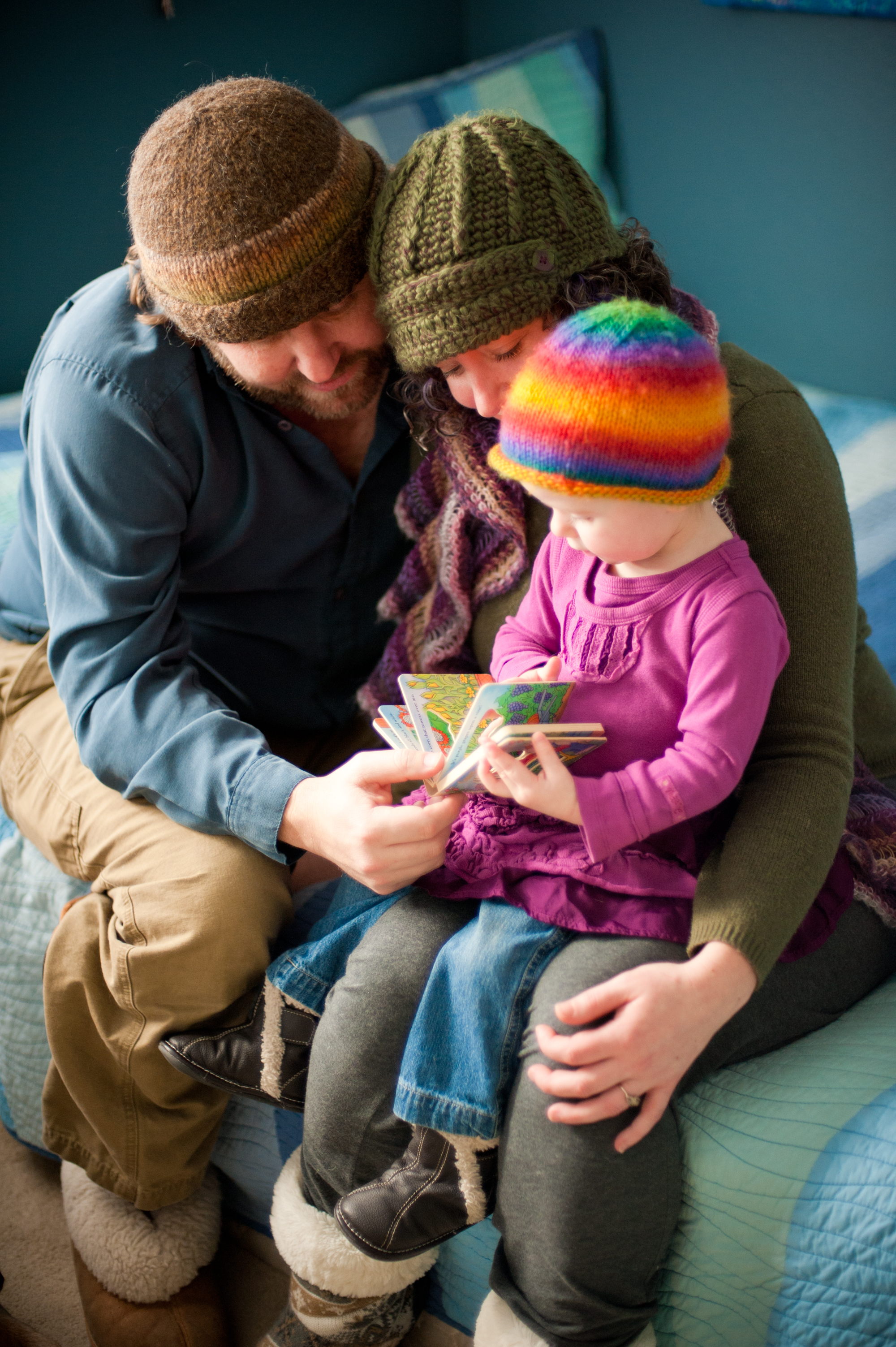
Photo by DIONNA RAEDEKE

The Secret to Improving Your Child’s Attention Span

The way to help children improve their attention span is counter-intuitive. You might think that giving children tasks that require their continued attention would help. Or maybe challenging them to accomplish long and complex sequences will help memory and cognition, improving attention span. But the current research is showing something counter to what we might think.

In fact, research shows that allowing kids to have unstructured playtime can actually improve their ability to focus on a task. In the book “Nurture Shock” by Po Bronson I learned about a kindergarten program which encourages children to choose a character to play in an imaginary play scenario that lasts for several hours. Researchers found that the children who were able to remain in character did better on later academic tests than children who were taught their letters and numbers instead of engaging in imaginary play.

The real take away here is that imaginary play and unstructured playtime are tools that children use to learn real life skills that will benefit them forever. It might seem like “child’s play” to us, but to them, this type of play involves acting out potential scenarios, doing scientific experiments, and using critical thinking skills.

So what’s the secret to improving your child’s attention span?

Offering them big chunks of unstructured time to explore their own interests and engage in imaginary play.

Our daughter Julia wakes up at about 6:30am every day of the week and lately I’ve been helping her get to the bathroom and then climbing back into bed with my husband on the weekends. For several weekends in a row Julia has happily played by herself and allowed us to sleep in.

One morning she found the box of stickers and this is what she did:

The Secret to Improving Your Child's Attention Span

DSCN2130


I was impressed and here’s why. Not only did she use her fine motor skills to get each of the tiny stickers off of the sticker paper and on to her robe independently. She focused on this task for well over an hour without interruption. She put over a hundred stickers on her robe one by one. And she’s not yet three years old. I think we’re on our way to a very well developed attention span!

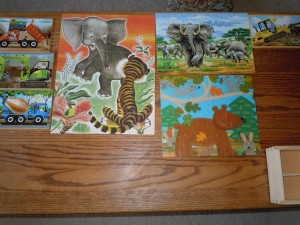
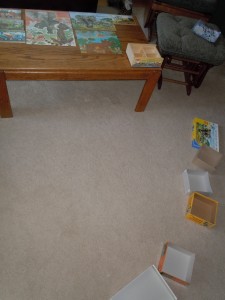
The following weekend she impressed me even more. Here’s what she did while we slept:


DSCN2141

DSCN2140

I love the way that she displayed her finished puzzles and the fact that she also lined the boxes up on the floor was interesting too. And just for the record, this is four 12 piece puzzles, two 24 piece puzzles and a 35 piece puzzle. And she didn’t wake us up for help even once.

So what does your child like to do when given uninterrupted alone time?

When Julia was smaller she would spend up to an hour looking at books in her bedroom. Sure there was a huge pile of books on the floor afterward, but she had entertained herself for an hour…with books! And we did work on putting them away together, so now, she happily puts away most anything she plays with.

Just a quick disclaimer here, safety is very important any time you’re allowing young children to have time alone without direct supervision.

Please make sure that the environment is free of hazards whenever you leave your child alone.

There’s one more secret to helping your child expand his attention span, remembering not to interrupt his work. Again, while it might just seem like meaningless play to us, children are engaged in the work of becoming the adults they hope to be. When we remember to respect their time and attention by refusing to interrupt when they’re engaged or by simply waiting for them to approach us, we’re helping them learn more independence and encouraging their natural urge to go deeply into the subject at hand.

If every time a child becomes engrossed in something he gets interrupted and asked to do something else instead, he’s not as likely to develop a deep and long lasting desire to dive in to his own interests. Instead, he may become overly attuned to the needs and desires of the people around him, believing that it’s more important to do what others require of us than it is to develop our own driving interests.

Oh, one more thing I forgot to mention, screen time does NOT count as independent play. In fact, excessive screen time has been linked to shorter attention spans and an inability to focus on real world tasks. So, if you’re in the habit of using the screen to get some time to yourself, I hope you’ll consider some other options.

So this week your challenge, if you choose to accept it, is to allow your kids to have some extra alone time, unstructured playtime, and wide swaths of time when they’re not interrupted. You might be as surprised by the results as I was when I woke up to that table full of puzzles.

Have a great week, Shelly

12 Easy Ways to Help Kids Unplug

I’ve been reading Dr. Laura Markham’s book, “Peaceful Parent, Happy Kids” and this week as I read about helping children cooperate, one of her suggestions really stood out. Dr. Laura recommended that if you’re not getting enough connection and cooperation, you might want to try unplugging.

This is not just some thought, idea, or wild theory about how to reconnect with your kids and support their healthy development. The American Academy of Pediatrics recommends no screen time for children under 2 and limited screen time for kids over two. Their website claims that the average amount of screen time for today’s children is a whopping 7 HOURS per DAY. Whoa. That’s more than half of a typical child’s waking hours in a day!

There is an increasing body of research that shows that excessive screen time can lead to attention problems, social delays, and an increase in violent behavior. But I’d argue that even much smaller amounts of screen time deprives kids of what they most need, our attention.

Interaction with a live human being is clearly what human babies and young children need more than anything else. In fact, babies deprived of human contact die, even if they’re provided with adequate food, clothing, and shelter. Freedom to explore their world in a physical and sensory way is also crucial to healthy development. So, how can we help kids avoid media when screens are so prevalent and so unbelievably addictive?

If you don’t think that screen time is addictive, just try to go a whole day with your smart phone turned off. I bet you’ll reach for it at least 20 times. We check Facebook, phone messages, texts, emails, watch videos and that’s even before the television, movies, or cable comes on. Today’s society is deluged with screens and young children are not immune to the draw.

Lately, almost every morning, my daughter asks her Dad in a super sweet voice, “I was wondering if we could watch videos on the iPad?” This is an activity that they enjoy together, recording and then watching themselves on video. But it’s clearly becoming her go-to activity with Daddy.

Is your child in a similar media rut? Perhaps they’re asking for movies or television on a daily basis, or maybe they want to play computer games. I’m not saying that these activities are bad for kids altogether, but I do think that they should be kept in the “occasional” category, rather than as staples of our daily life.

So how can we help our kids break the habit? Often it’s as simple as offering an alternative and helping them engage in something different long enough to forget about their desire for screen time. Here are 12 ideas to get you started:

1) Model what you want—

If you want them to stay off of media, then you have to do it too. Show them how to live a life of personal real-life connections, instead of web connections.

2) Schedule play dates—

Building in person social connections is hugely important for kids of all ages. Establish a “no screens during play-dates” rule and help the kids come up with ideas for how else they can spend their time together.

3) Offer books, games, puzzles, and other diversions—

And participate WITH your kids if they’re not engaging in these right away. Once they’re absorbed, you’re welcome to return to your own activity.

4) Do an art project—

You could go on a nature hike and collect interesting items, then bring them home and create a collage. Or just bring out the paint! Ask the kids to agree to help clean up the mess too, the clean up might be half the fun!

5) Rough and tumble play—

Physical play is a great way to reconnect and to get out the day’s frustrations in the form of laughter. Remember to let your child be the more powerful one for the most giggles.

6) Gardening—

Getting out into nature, even if it’s just the back yard can be rejuvenating for kids and adults alike. Spend some time outdoors every day. And better yet, plant a food producing plant and enjoy the moments of discovery when flower turns to fruit. Harvesting and eating food they’ve grown themselves is a great way for kids to learn about food production and the life cycle of a plant.

7) Make up a silly song—

Stimulate your child’s creativity by using a familiar tune and making up new silly, rhyming lyrics.

8) Play a brain teasing game—

Riddles, mental puzzles, alliteration games and mysteries are really good for brain plasticity and developing problem solving skills.

9) Read aloud—

No matter how old your kids are, reading aloud can be a wonderful family activity. If you start a chapter book today, I guarantee that in a week or so, your kids will be begging for the daily chapter.

10) Exercise—

Riding bikes, canoeing, running, playing sports, swimming, and skiing can be excellent family activities that will get the whole family outside and physically active. Instilling the habit to move while kids are young can translate to a healthier lifestyle for decades to come.

11) Puppetry and theater—

Do you have a child who seems to need endless attention from you? Set him up with some puppets or assign him the task of writing a play to perform for you and you’ll be amazed at the creative results. Provide costumes, or the means to make their own to add even more depth to the performance. This is a fantastic play date activity.

12) Science experiments—

Head over to your local library and check out a book on science experiments for kids. Look through it yourself and copy a few items that you’d be willing to supervise or that don’t need much adult intervention. Help your kids collect the materials and watch their minds expand as they learn about mass, volume, weather, chemistry and more!

So, hopefully after reading through these initial ideas, you’re brimming with even more ideas of your own! Isn’t it amazing how creative we can be when we take screen time off the table? Hopefully you’re already doing a bunch of these, and if not, I hope you’ll try some. Then, leave a comment to let me know how it’s going. If you’re not feeling more free from technology and MUCH more connected with your kids after these, I’ll be shocked. But even if these particular ideas don’t work for you and your family, I bet you can come up with a few activities that will work great and will keep you all connected to each other, instead of to your various devices.

Have a fabulous week! Warm hugs, Shelly