Sharing Gratitude: Acknowledging each family members’ contributions

It’s amazing what a little appreciation, acknowledgment and gratitude can do.  You can go from feeling hum-drum or bummed to feeling completely ecstatic in a few short moments if you only take the time to practice gratitude.  Gratitude is like this magic potion that reminds us of all we have to appreciate in life–and there is a LOT to appreciate.

I have some friends who share gratitude with one another every time they sit down to share a meal together.  Others use gratitude as a way to connect at the beginning of their monthly family meeting.  I even know some parents and kids who say what they’re grateful for each night before bed.

I’ve found that when I feel appreciated and acknowledged, I am more willing to contribute, I feel more engaged in my relationships, and I’m just generally happier.  So, do kids feel any different?  I don’t think so.  I think we all respond well to being appreciated and acknowledged.  But it depends on how.  For instance, compliments like, “You have pretty hair.” usually don’t impact me in the same way that true acknowledgment does.

Here’s the difference:  A compliment is really just a positive judgment which might feel good at the time, but then it also leaves room for negative judgments which we can feel afraid of.  An acknowledgment is different. Continue reading “Sharing Gratitude: Acknowledging each family members’ contributions”

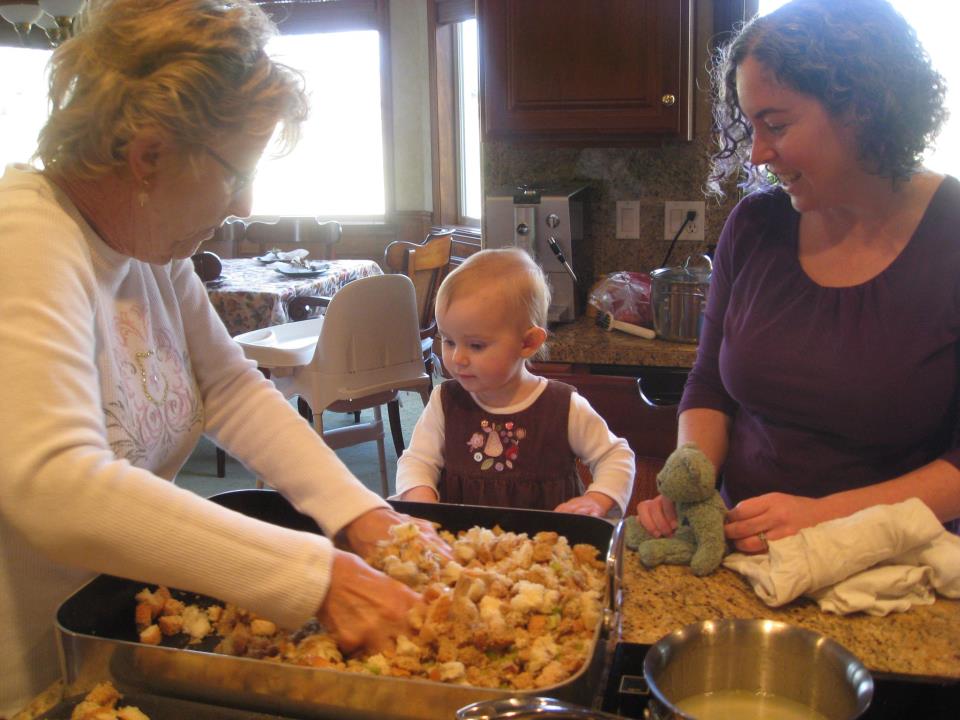
Cooking with kids: How preparing food for ourselves and our families contributes to everyone’s well-being.

I used to despise spending time in the kitchen. I didn’t like doing dishes, I didn’t know how to cook, and I preferred microwave meals to home cooked ones. Wow! Have things changed. Now I buy lots of fresh organic produce, free-range meats and eggs, and I enjoy coming up with new interesting creations and cooking traditional foods. And for some reason I want to put cumin on everything.

Thinking back, I can identify a couple of things that produced the shift for me. First, I read “Peace is Every Step” by Thich Nhat Hanh. There’s a passage where he talks about enjoying the present moment even in the mundane activities of life like washing dishes. I immediately began to ENJOY doing dishes! I luxuriated in the warm soapy water and felt a deeper sense of accomplishment than I ever could have anticipated from the simple act of doing dishes.

And then I moved in with my husband to be (we’re getting married in 6 weeks!). As soon as I moved in with him I noticed a strong desire to learn to cook welling up in me. I wanted to feed us delicious, nutritious foods.

So, I began to learn the art of cooking. It feels a little funny to be writing about cooking since I’m still so new at it, Jill is the real chef of the two of us. But what I do bring to the table is the ability to modify cooking activities into interesting and age-appropriate activities for kids of all ages.

Think of your child as the apprentice chef in your kitchen. Continue reading “Cooking with kids: How preparing food for ourselves and our families contributes to everyone’s well-being.”

Nine ways to exercise with children

Have you been lamenting your lack of exercise? Thinking back on the days when you used to get to go to the gym, or run around your neighborhood or swim laps at the pool? Kid time is sometimes almost all our time—and the kind of “running around” we do with them doesn’t always feed our body’s need for vigorous (or gentle) and sustained exercise.

Here are some of the ways I’ve found to bring exercise back in, with activities that you and your kids both enjoy, and that give you the added benefit of that exercise you’ve been craving to round out your life, keep you physically fit, and elevate your mood. You can adapt these suggestions to your mobility level.

1. Go for a long walk outdoors. People who walk in nature report that they feel happier after a walk in the woods than they did when they started. Find a trail where you can both walk, or where you can walk and push a stroller, or where your child can run, or scoot on a scooter (a great way for them to develop coordination). A brisk walk can revitalize your and your child’s circulatory system, and a controlled dose of sunshine will do you both some good. If it’s cold, bundle up. If it’s raining, throw on ponchos.

2. Play chase. Pretend you can’t catch your child, so they can feel powerful. Then run away from them and let them “catch” you. Before you do, you might be able to run several laps around them. Depending on how long their energy lasts, you might be able to get in a good aerobic workout.

3. Go for an actual dedicated run with your child around a local track.  If you have an infant or very young child, you might be able to run pushing a stroller.  Or, if your older child runs slower, you can run circles around them, and make a game out of it. In this case, your goal will be to keep up your own pace. You can talk with them beforehand about your goals, for example, “I want to run for twenty minutes. You can run with me, let me run around you, follow on your scooter, or stay on the side where I can see you and play with your toys and books.” Did I mention it helps to bring toys and books almost anywhere? Continue reading “Nine ways to exercise with children”

Got a wild child? Give ‘em more responsibility!

I know it sounds counter-intuitive, but working in preschools has taught me that when kids act out, it’s often because they’re bored and want attention from us. I’ve noticed that when I give these kids MORE responsibility, jobs to do, and tasks to complete (without being too ATTACHED to them actually accomplishing the task) they respond by becoming more driven and successful.

This creates a positive cycle in which:
1) You notice some behaviors you don’t like.
2) Rather than focusing on those behaviors, you offer alternatives in the form of tasks, jobs, or responsibilities (careful here though, these must be tasks that would be nice to have done, but which are true requests- not demands). Continue reading “Got a wild child? Give ‘em more responsibility!”

How I averted a power struggle and created a game instead

After I learned to Go for the Giggle, I had an experience with a child in which I could see two distinct choices before me of how to handle a potential power struggle.

It was another afternoon with “Kyle”, six years old, and “Neil”, who was two. I was sitting in the playroom folding the family laundry.

Just as I had almost finished, and was stacking some of the folded laundry into the basket, Kyle ran over and knocked the basket over, spilling the newly folded laundry on to the floor.

I felt a flash of anger and tensely asked him to pick it up. He refused and ran out of the room with a grin. I continued to fold the last of the laundry but left the basked toppled and waited for him to return.

I considered my options… “This could easily escalate and become a huge power struggle,” I thought, envisioning that scenario unfolding (pun intended).

I knew I didn’t want to pick up the laundry myself, but I also couldn’t force him to do it.

Suddenly, Kyle entered the room wearing his dress-up armor, carrying a sword and a shield.

He pointed the sword at me.

I asked again if he would pick up the basket. He said, “I didn’t knock over the basket.”

We all knew he was lying–we’d seen him knock the laundry over.

But I had an idea. I decided to play along with his game and see if I could spin this so that he’d actually WANT to pick up the basket.

“Oh Great Knight!” I exclaimed, “I’m so glad you’ve come! A laundry monster has knocked over my basket of laundry! Please, Great Knight, will you help me?!”

Kyle flashed me a smile and ran over to the basket.

After he picked everything up he pointed the sword at me again.

I glanced over and pointed at a stuffed dragon on the floor nearby “There it is Great Knight! The Laundry Monster! Slay it!” Kyle quickly directed his sword at the stuffed dragon–and away from me.

I felt triumphant. Not only had I averted a potential power struggle, we had actually remained connected, and had fun together in the midst of a potential disaster.

I got my laundry fixed, and he got to play and save face. In fact, as soon as I was able to take his lead and really play with him, he was able to cooperate.

In this instance, not only was I able to remain grounded in my own needs for safety and peace, but also I was able to make a clear request, to which Kyle could agree without feeling overpowered, forced, or coerced.

So, the next time it seems like he’s just out to get you, see what you can do to turn the tables to avoid the power struggle.

I feel so grateful that this time, I chose the path of ease, fun, and connection. I hope by sharing this story, I can offer you more options for avoiding a power struggle and staying connected with your child.

Thanks for being here!
Warmest hugs, Shelly Birger

P.S. What did you think about this topic ? Have you ever had similar experiences? We welcome your comments in the box below.